


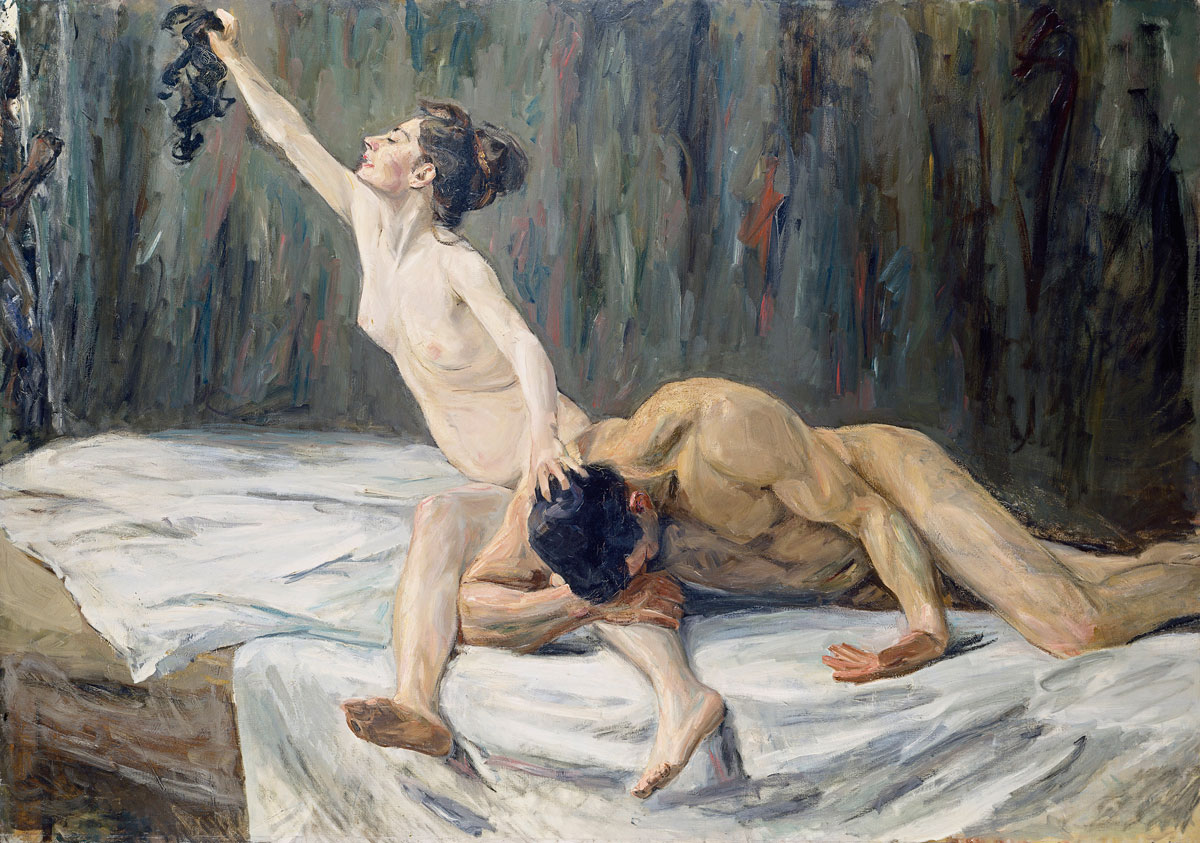

There are two Strong Men Heroes who have come together in history and are reenacting the myths of Heracles, and, Samson and Delilah. Heracles was forced to wear a dress and do women’s work. He has been compared to Samson. Delilah means “she who weakens”. She cuts Samson’s hair and weakens him. Her Philistine kindred rush in and subdue him. They poke his eyes out and chain him to a threshing stone. He is now a weak and helpless chore woman. His humiliation, is complete.
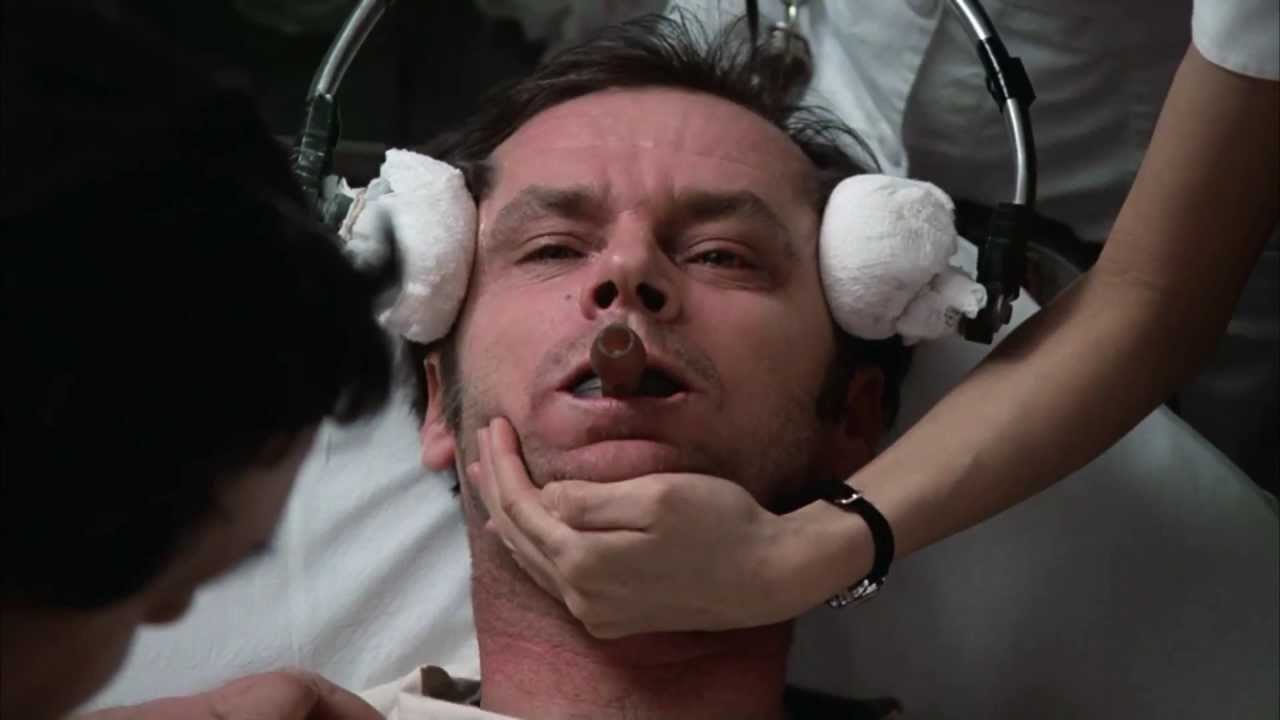
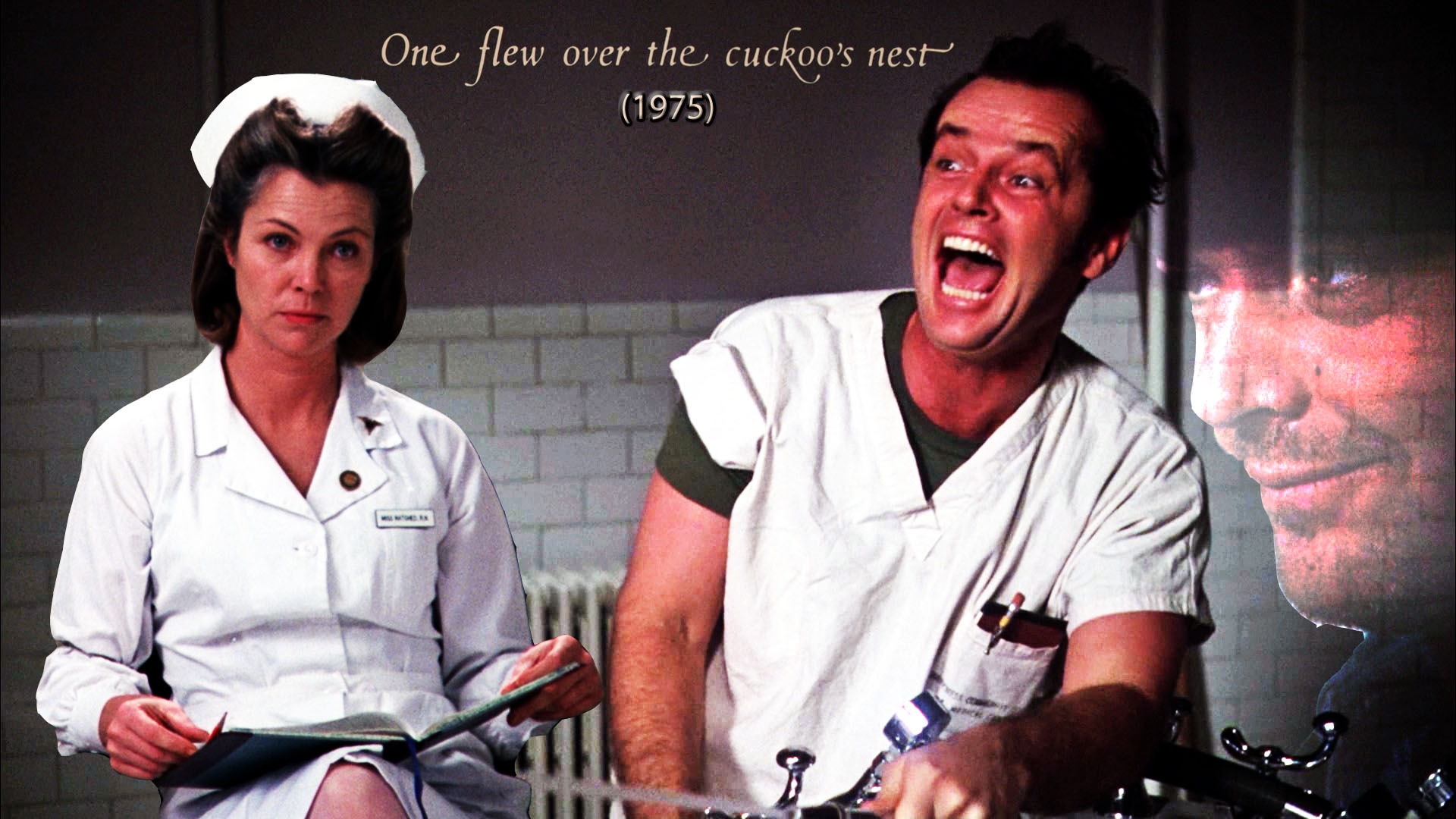
I awoke this morning and realized ‘One Flew Over the Coo-Coo’s Nest’ is a classic Samson and Delilah story. Nurse Ratchet has seen his kind before. He’s a Man’s Man who loves sports and bravado. He is virile and outgoing. He’s a He-man! As Jason, he takes his boys out for a cruise. They bring home the Golden Fleece which spells their doom. Ratchet has to transform McMurphy into a weak weenie, a flaccid vegetable, in order to get back control of her subservient Half-men. Note the beautiful arm that holds the Heroes head steady as the essence his manhood is sucked out of him. This is the statuesque Arm of Delilah. Ratchet is a Weakener of Men. Chief Broom will perform a Herculean Feat in order to escape this motherly arm that unborn men. We are talking about castration.
Bruce Jenner was an Olympic Champion, who is now a woman named Caitlen, which is Kathlene. The Kardashian daughter’s names starts with a K. Bruce became one of them, an Amazon. O.J. Simpson was a great athlete given the nickname ‘The Juice’. These athletes are s shadow of their former selves. They have been severely weakened. Now we have the KKKK Sisterhood vying for power on their reality show where men are mere wallpaper and sex slaves. They serve the KKKK. They see the Man of the House parade around in high heals. What shade is his lipstick?
Kardashian’s divorce from Kristen pained him, especially because she left him for Bruce Jenner, the former Olympic decathlon champion. Jenner and Kristen later married, and at the time of the murders they were starring in a frequently played infomercial for a thigh-exercising device. According to a close associate of Kardashian’s, “It bothered him that she was on TV all the time with the Thighmaster. This case was his way to step over them. This was better than infomercials.”
My homeless friend, Spooky Noodles, is authoring a story ‘Who’s Killing All the White Men?’ With the appearance of Superman Trump, the strongman braggart, who bids his followers to beat-up his distracters, it is clear white men do feel they are being weakened, even killed off. I suggested Spooky avoid making any conclusions and thus be accused of being a bigot of some sort. Just, tell it like you see it. Kafka’s Metamorphois is an excellent template to tell a new version of a very ancient tale, where men are reduced to being bugs. You need not describe the color of their skin. Does Simpson watch the Kardashians in his cell?
Then there is Dionysus the “twice born” which some scholars say gave birth to the Jesus-Cristos myth that the Catholic church stole and sew in the thighs of Fathers and Nuns. Since no man can be like The Son of God, all men who come in contact with those Thighmasters, are killed off in a literary sense, and this rendered Transvestites. The KKKK have reborn the Dionysus Theatre. The Greek Gods are alive and well.
The ‘Kardashians’ is ‘I Claudius’.Women are poisoning men. Bruce is “twice born”, His mother born a male, and, the media born a female. He is both Samson and Delilah. He is an androgynous survivor like the stutterer, Emperor Claudius. Kathlene saw the women were winning and his daughters would eat him alive. They keep Kate from their parties. Their mother opens everyone’s emails. It is safer to be a Weakener, than a Weakened Warrior-Champion……a Hated Hero!
Zeus rescued the unborn Dionysus by sewing him into his thigh. A few months later, Dionysus was born on Mount Pramnos in the island of Ikaria, where Zeus went to release the now-fully-grown baby from his thigh. In this version, Dionysus is born by two “mothers” (Semele and Zeus) before his birth, hence the epithet dimētōr (of two mothers) associated with his being “twice-born”.
The earliest cult images of Dionysus show a mature male, bearded and robed. He holds a fennel staff, tipped with a pine-cone and known as a thyrsus. Later images show him as a beardless, sensuous, naked or half-naked androgynous youth: the literature describes him as womanly or “man-womanish”.[13] In its fully developed form, his central cult imagery shows his triumphant, disorderly arrival or return, as if from some place beyond the borders of the known and civilized. His procession (thiasus) is made up of wild female followers (maenads) and bearded satyrs with erect penises.
Simpson is Bacchus, the god of wine a.k.a. ‘The Juice’. The Maenads are the Dallas Cheerleaders, and the Satyrs, are Moon Day Night Football Fans returning victoriously from the Super Bowl, where they sustain the National Hard-on and Lust-level which was severely damaged when he butchered the young un-armed lover of his estranged wife, then, allowed Kardashian to enter a “Not Guilty” plea. I am sure ‘The Juice’ wanted to confess – be a man!
“He came between my erection and my wife!”
“How the mighty have fallen!”
Long live The Juice and the Thigh Master!
Jon Presco
Did This Bruce and Kris Jenner Infomercial Haunt Robert Kardashian?
Kafka, The Metamorphosis
CHAPTER 1
In one of the most famous first sentences in all of literature, Franz Kafka confronts us with the premise, or “thesis” even, of The Metamorphosis:
When Gregor Samsa woke up one morning from unsettling dreams, he found himself changed in his bed into a monstrous vermin. (3)
From this point onwards, any reader who is not brain-dead will be on the lookout for clues as to the true meaning of this statement. How are we to take this? What does it “mean” that the protagonist has woken up as an insect? Is it a dream? (We’re told no after a few more lines.) A delusion? A wish-fulfilment fantasy? Is it metaphoric? A manifestation of how he feels for some reason or a set of reasons? A dehumanizing regression? In any case, how is this opening statement and its implications a good introduction into 20th-century arts and literature?
The rest of the first paragraph offers material of interest to those taxonomically inclined to determine what type of insect Gregor has become.
The second paragraph begins with the noticeably passive, “What’s happened to me?” — a question we’re apt to take in a larger sense once we’ve learned more about Gregor’s life. Among the potentially relevant details is the fact that Gregor considers his room — his surroundings — “a little on the small side” (3). The “fabric samples” tell us what kind of traveling salesman he is; and, because the description is so vivid, we wonder what the significance is of this item:
the picture which he had recently cut out of a glossy magazine and lodged in a pretty gilt frame. It showed a lady done up in a fur hat and a fur boa, sitting upright and raising up against the viewer a heavy fur muff in which her whole forearm had disappeared. (3)
The image of wealth and high fashion stands in sharp contrast to the Samsa apartment we’ll be introduced to soon. The woman is wrapped in the skin of something she isn’t, but this is considered beauty and wealth. Insects are a sign of poverty. Freudian psychoanalytic critics have their own interpretation of this image.
The weather is “overcast” (3), so dreary at least and perhaps oppressive. Gregor tries to get back to sleep, his hope of “forgetting all this nonsense” (3) suggesting escapism, but his insect form prevents him from attaining a comfortable position. “He must have tried it a hundred times, closing his eyes so as not to have to see his squirming legs” (3); Gregor is reluctant truly to see himself.
Most of his ruminations concern his job: “the torture of traveling, worrying about changing trains, eating miserable food at all hours, constantly seeing new faces, no relationships that last or get more intimate” (4). One could take his cliché job complaints as an avoidance mechanism, perhaps, but we also learn that he tolerates his crappy job only because his parents are in debt to his employer, and paying it off “will probably take another five or six years” of breadwinning (4). “He was a tool of the boss, without brains or backbone” (5). Gregor should have caught the five o’clock train but he seems to have slept though the alarm and is considerably late now. Gregor frets about making the seven o’clock train but he’ll “have to hurry like a madman, and the line of samples wasn’t packed yet” (5) — really an issue at this point? Interesting is the extent to which Gregor operates in denial of his insect state. “In fact, Gregor felt fine, with the exception of his drowsiness” (5). When his mother calls to him about catching the next train,
Gregor was shocked to hear his own voice answering, unmistakably his own voice, true, but in which, as if from below, an insistent distressed chirping intruded, which left the clarity of his words intact only for a moment really, before so badly garbling them as they carried that no one could be sure if he had heard right. (5)
Both his parents call to him in friendly concerned harassment, and responding is difficult for him: he “made an effort, by meticulous pronunciation and by inserting long pauses between individual words, to eliminate everything from his voice that might betray him” (6). Because Kafka had tuberculosis, these descriptions of Gregor’s failing voice are interesting. His sister wants to see him, but fortunately, he thinks, he has taken a “precaution he had adopted from his business trips, of locking all the doors during the night even at home” (6). He tells himself that the insect form is “imaginary,” and “he was eager to see how today’s fantasy would gradually fade away” (6). Gregor tries to get out of bed but finds “he could not control” his many constantly moving legs (7). “‘Just don’t stay in bed being useless,’ Gregor said to himself” (7).
His biggest misgiving came from his concern about the loud crash that was bound to occur and would probably create, if not terror, at least anxiety behind all the doors. (8)
Yet we soon find out the room is carpeted (9)! So what a misery of constant monitoring from his family. After 7:00 the doorbell rings and Gregor knows immediately that the prying manager from the office has come to check up on him.
Why was only Gregor condemned to work for a firm where at the slightest omission they immediately suspected the worst? Were all employees louts without exception, wasn’t there a single loyal, dedicated worker among them who, when he had not fully utilized a few hours of the morning for the firm, was driven half-mad by pangs of conscience and was actually unable to get out of bed? (9)
Gregor manages to fall to the floor. His sister and father inform him that the manager is waiting for him. The manager and his mother also call to him. He hears his father telling the manager there must be something wrong with Gregor since he is always so focused on his work “that he never goes out nights” (10). Gregor of course cannot let anyone into his room, considering what he calls euphemistically his “condition” (11). The manager begins officiously chiding Gregor, hinting that his tardiness could be taken as a questionable matter of “cash payments recently entrusted to [him]” (11). Gregor blurts out at length an anxious plea for patience and tries to prop himself up so as to open the door. “‘Did you understand a word?’ the manager was asking his parents. ‘He isn’t trying to make fools of us, is he? … That was the voice of an animal’” (13). Gregor’s mother starts panicking, calling for his sister to fetch a doctor, and his father calls for a locksmith. “It was true that they no longer understood his words” (13), but Gregor is encouraged by this show of attention:
He felt integrated into human society once again and hoped for marvelous, amazing feats from both the doctor and the locksmith, without really distinguishing sharply between them. (13)
Exuding yicky insect substances, Gregor is able to turn the key in the lock with his jaws. The manager lets out a startled “Oh” (15) and Gregor’s mother seems nonplussed. “With a hostile expression his father clenched his fist, as if to drive Gregor back into his room, then looked uncertainly around the living room” (15). Gregor remains at the doorway.
In the meantime it had grown much lighter; across the street one could see clearly a section of the endless, grayish-black building opposite — it was a hospital — with its regular windows starkly piercing the façade. (15)
It’s an interesting architectural feature that a hospital, an institution representing health care, faces opposite the Samsa apartment. Its visibility — its accessibility — will later fade. We learn that Gregor’s father “would prolong [breakfast] for hours while reading various newspapers” (15), and that a photo of Gregor “from his army days, in a lieutenant’s uniform, … a carefree smile on his lips, demanding respect for his bearing and his rank” (15) hangs on the wall. Gregor tries to address the manager, proving here that he is not shirking his work responsibilities.
A man might find for a moment that he was unable to work, but that’s exactly the right time to remember his past accomplishments and to consider that later on, when the obstacle has been removed, he’s bound to work all the harder and more efficiently. (16)
He tries to rectify the mistaken stereotype of the traveling salesman and elicit some understanding. But the whole time, the manager has been backing towards the foyer. Gregor’s mother is also freaking out; “on the other hand at the sight of the spilling coffee he could not resist snapping his jaws several times in the air” (18). The manager runs off, but Gregor’s father takes the cane the manager has left, and a newspaper, and, stamping his feet, tries to drive Gregor back into his bedroom (18-19). Gregor is still accustoming himself to his uncertain mobility and gets stuck in the doorway. “If only his father did not keep making this intolerable hissing sound! It made Gregor lose his head completely” (19). In trying to get back into his room, “one of his flanks was scraped raw, ugly blotches / marred the white door” (19-20). The chapter ends:
from behind his father gave him a hard shove, which was truly his salvation, and bleeding profusely, he flew far into his room. The door was slammed shut with the cane, then at last everything was quiet. (20)
Further quotations for discussion:
“Certainly they did not want him to starve either, but perhaps they would not have been able to stand knowing any more about his meals than from hearsay, or perhaps his sister wanted to spare them even what was possibly only a minor torment, for really, they were suffering enough as it was” (25).”Of course he actually could have paid off more of his father’s debt to the boss with this extra money, and the day on which he could have gotten rid of his job would have been much closer, but now things were undoubtedly better the way his father had arranged them” (28).
“the hospital opposite, which he used to curse because he saw so much of it, was now completely beyond his range of vision” (29).
Of course his sister tried to ease the embarrassment of the whole situation as much as possible, and as time went on, she naturally managed it better and better” (29).
“often he heard them say how much they appreciated his sister’s work, whereas until now they had frequently been annoyed with her because she had struck them as being a little useless” (31).
“With his last glance he saw the door of his room burst open as his mother rushed out ahead of his screaming sister, in her chemise, for his sister had partly undressed her while she was unconscious in order to let her breathe more freely; saw his mother run up to his father and on the way her unfastened petticoats slide to the floor one by one; and saw as, stumbling over the skirts, she forced herself onto his father, and embracing him, in complete union with him–but now Gregor’s sight went dim” (39).
“Gregor’s serious wound … seemed to have reminded even his father that Gregor was a member of the family, in spite of his present pathetic and repulsive shape, who could not be treated as an enemy; that, on the contrary, it was the commandment of family duty to swallow their disgust and endure him, endure him and nothing more” (40).
“And she broke out crying so bitterly that her tears poured down onto her mother’s face, which she wiped off with mechanical movements of her hand” (51).
“Growing quieter and communicating almost unconsciously through glances, they thought that it would soon be time, too, to find her a good husband. And it was like a confirmation of their new dreams and good intentions when at the end of the ride their daughter got up first and stretched her young body” (58).
“Art for the artist is only suffering through which he releases himself for further suffering” (xx).
“As political estrangement becomes more and more the norm of Western society, and as capitalism, as Kafka said, becomes ‘the condition of the world and the soul,’ Kafka’s late fears will more and more provide the frame in which we read his work” (xxi).
 Rosamond Press
Leave a comment