


Emmy Lou Packard also known as Betty Lou Packard (1914–1998) was a Californian post-war artist known for painting, printmaking and murals. She had a passion for the cause of social justice and peace.
What can I say?
Emmy was a good friend of Ralph Stackpole and had to know about the Lake Temescal Bohemians. As a muralist she is in the Circle of Greats. Rivera depicts his friend before her easel in his mural.
Jon Presco
Emmy Lou Packard was born on April 15, 1914 near El Centro, California, to parents Emma and Walter Packard.[1] Her father founded an agricultural cooperative community in the Imperial Valley and was an internationally known agronomist. In 1927, the Packard family traveled to Mexico for Walter’s consulting job with the Mexican government working on agrarian and land settlement reform issues.[1] Emmy was 13 years old during this trip and a very active artist; her mother introduced her to artists Diego Rivera and Frida Kahlo, and this was the beginning of a long friendship and mentorship.[1]
In 1934, she eloped to Nevada with the architect Burton Cairns, a recent graduate of the University of California, Berkeley. They had a baby together, Donald Cairns.
In 1936 Packard graduated from the University of California, Berkeley with her bachelor’s degree and later studied sculpture, mural and fresco painting at the San Francisco Art Institute.[2]
Career[edit]
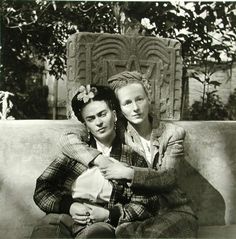
In 1939, her husband Burton Cairns died in a car accident. And after his death she traveled to Mexico to live with Rivera and Kahlo, working as their studio assistant.[3] During the time she stayed with Rivera and Kahlo, she took a number of photographs of the couple.[4]
When Diego Rivera came to San Francisco in 1940 for the Golden Gate International Exposition (GGIE), he asked Emmy to be the chief assistant for painting the Pan American Unity mural.[5]
Between 1944–1945, she briefly worked as an illustrator of a labor newspaper for the San Francisco Bay Area shipyards.[1][5]
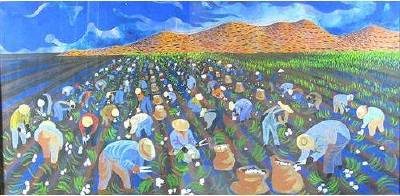
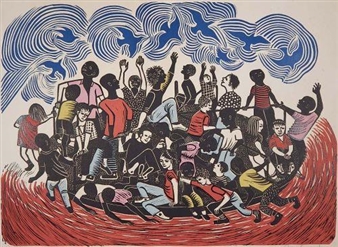
In the following years, Packard worked in many different genres including; murals, mosaics, oil paintings, prints, plexiglass collages and photographs. She worked to achieve a feeling of a universal human spirit in her work that corresponded with overcoming turmoil.[citation needed]
Packard designed and executed the mural on the exterior of the dining commons at the University of California, Berkeley in the Lower Sproul student union center.[6] She also designed the terrace parapet which is embellished with an 85-foot long, 5-foot high, bas-relief, Modernist mural depicting California landscape features, including coastal bluffs, cultivated fields, mountains, and rivers located in the central façade of Chávez Student Center at the University of California, Berkeley in the Lower Sproul.[6]
On May 29, 1959 she married artist Byron T. Randall, they later divorced in 1972.[7]
Packard was an active community member in the Mission District of San Francisco and San Francisco’s community mural movement.[8] In 1974 she served as a mural technical adviser for the Bank of America building mural located at Mission Street and 23rd Street, the local artists that painted this mural are Jesús “Chuy” Campusano, Luis Cortázar and Michael Rios.[9]
Emmy Lou Packard died February 22, 1998 in San Francisco, California of diabetes and related illnesses.[1]
History
The Canessa Building, built in the late 1800s and located at 708 Montgomery, is an official San Francisco landmark.
Canessa once housed printing presses and gas lights, and nearby, on Sansome Street, a bustling produce market district shook the neighborhood into pre-dawn life.
Following the 1906 earthquake, most of the buildings on the 700 block of Montgomery looked like stage-sets from a wild western movie. The second story of Canessa was destroyed but soon rebuilt.
In 1925, sculptor Ralph Stackpole and painter Timothy Wulff began work to turn the buildings at 716-718-720 Montgomery into artists’ studios. For the next 35 years, artists, including Diego Rivera, William Gerstle, Caroline Martin and Ruth Cravath, sculpted and painted in the “Ship Building,” so-named because a ship’s hull — historically thought to be the Georgian — is incorporated in the building.
Though many of the original buildings in this area did not survive the era of high-and-higher architecture, the diminutive gem known as Canessa has. Today, the old brick building still glows with light and life and is home to an art gallery and several creative professionals and small businesses.
Black Cat Cafe
For 30 years, from 1933 to 1963, the Black Cat Cafe, located at 710 Montgomery, was the Canessa Building’s next door neighbor. In the 1930s and 1940s, the Cat attracted a bohemian clientele of both straight and gay writers, artists and musicians from the neighborhood. Many lived and worked across the street in the historic Montgomery Block building where the Transamerica Pyramid now stands. Just north of the Cat, at 716-718-720 Montgomery, were the studios of Diego Rivera, Frida Kahlo, Emmy Lou Packard and Ralph and Peter Stackpole.

Regular visitors to the Cat included artists Hassel Smith, Maynard Dixon and Ed Corbett. John Steinbeck and William Saroyan also dropped in from time to time — as did two veteran police reporters, Neil Hitt of the San Francisco Chronicle and Harry Debolt of the Examiner. According to Jerry Flamm, author of Hometown San Francisco, Hitt and Debolt, “an inseparable pair in the Hall of Justice press room after 5 p.m., would occasionally stroll down one block to the Black Cat for a thirst quencher after advising the police radio dispatcher where they would be in case all hell broke loose somewhere in the city.”
In the 1950s, Black Cat proprietor Sol Stoumen hired José Sarria, a female impersonator, to play host at the Cat every Sunday. Clad in an ornate costume, Sarria performed camp versions of operatic arias. Sarria’s performances started drawing a large gay clientele, and police began raiding the bar. Printer Henry Evans’ reaction to the Cat was typical of the time. “The Black Cat … [once] was by far the best place for a wild drunk that an adventurer could hope for,” he writes in Bohemian San Francisco (1955). “But … the place changed hands and the new owner encouraged the fruit and the place went to hell.”
The Black Cat lasted until 1963 when its liquor license was lifted by State Alcoholic Beverage Control Board agents the morning before the bar’s annual Halloween party,” reports Jerry Flamm in Hometown San Francisco. “The state agency had been threatening for several years to close the saloon, charging that ‘lewd and indecent acts’ took place there. The boisterous ‘witches night’ celebration was held anyway, with only fruit juice and soft drinks sold at the bar, but it was the last Halloween observance at the Black Cat.”
A book consisting almost almost entirely of direct interview quotes, The Empress Is a Man: Stories from the Life of José Sarria by Michael R Gorman, appeared in 1998 (Jesse Monteagudo review). Chapters cover history of The Black Cat (The Nightingale of Montgomery Street) and much of Sarria’s career including becoming the first openly gay candidate for public office (San Francisco Board of Supervisors, 1961) and founder of the Imperial Court System, an association of charitable organizations (Empress José I, The Widow Norton).
 Rosamond Press
Leave a comment