



“Rumors, of course, exist that Pynchon doesn’t exist at all. Or if he does exist, that he didn’t write the books.”
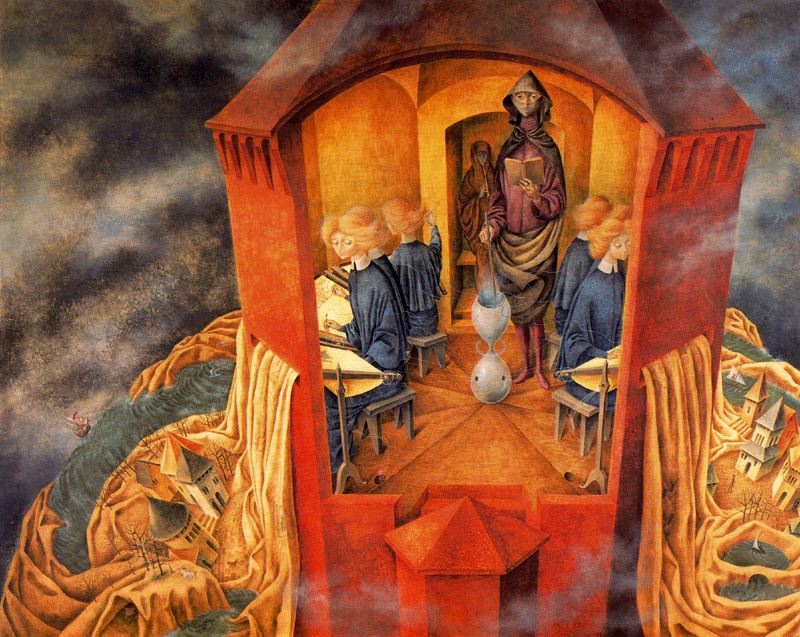
“According to the author of Remedios Varo: Unexpected Journeys, Pynchon saw Bordando el Manto Terrestre (“Embroidering Earth’s Mantle”) when, as part of the first full retrospective of the painter’s work, it was displayed at the Palacio de Bellas Artes in Mexico City in 1964, a year after her death at the age of 55.
She was a regular visitor to the Prado Museum and took particular interest in the paintings of Hieronymus Bosch, most notably The Garden of Earthly Delights. Renaissance art inspired harmony, tonal nuances, unity, and narrative structure in Varo’s paintings. The allegorical nature of much of Varo’s work especially recalls the paintings of Hieronymus Bosch, and some critics, such as Dean Swinford, have described her art as “postmodern allegory,” much in the tradition of Irrealism.”
Did our ex-wife, Mary Ann Tharaldsen, take Thomas Pynchon – kicking and screaming – to the Palacio de Bellas Artes? Did she specifically want her husband to view the work of the famous woman artist Remedios Varo whose work is similar to MA? That MA would marry a man kin to members of the Swan Brethren who commissioned Bosch, and begat a family of weavers who belonged to Weaver’s Guilds, is a profound coincidence: or is it?
In her artwork, Tharaldsen renders some tombs that are guarded by an archangel with a guitar. Is this the Tomb of God?
This Pynchon-Bosh connection now drags Pynchon, and his books, into the
Rosy Art World of Jon Presco a.k.a. Manny di Presso. If Pynchon can be anybody he wants to be in my world, I can now be anyone I want to be in his world.
Several authors have compared Pynchon’s ‘Crying of Lot 49′ to The Da Vinci Code’ that may be a billion dollar industry. Since 1997 I belonged to a dozen yahoogroups that discussed a Grail Bloodline and society originating at Rennes-le-Chatau. I was banned from most of these groups when I discovered the Rosamond-Rosemont-Rougemont name was tied to Knights Templars and neo-Templars. When someone sent me a genealogy of the Chambrun family who married into the Rosemont family of Arginy Chateau, I became a real threat. When I proved the Templars owned the Shroud of Turin via the Rougemont genealogy, I got the silent treatment.
The Browns lurked in these yahoogroups, noted how many people were interested in proving these mysteries to be FACTUAL, and decided they would author a work of FICTION saying this Holy Grail Bloodline is the God’s Truth. Millions wanted it to be TRUE, and wanted to own A BOOK, that would take your to TRUEVILLE for twelve hours or so, then return you to FACTLAND. I never read it. My roseline was altered.
Because Thomas Pynchon is in my family tree, I take the liberty to include him in a Rose Society – with Guild – that will explore the human need to create faux mysteries just so our human treasure hunts will not come to an end – on earth!
I was a Facebook friend of Philip Coppens just before he died. Philip appeared several times on ‘Ancient Aliens’ a HC show that claims folks from outer space built all the interesting stuff on earth – for their own amusement – or just to screw with our minds. That they did not sign their work, and include a artist’s bio, is Pynchonian, because it keeps us wondering and guessing. Elusive little buggers. If we earthlings could see just one photo of an elderly Pynchon, then we could put all these silly rumors to rest.
I was a Facebook friend of Ben Hammet who makes a confession many want to hear Pynchon make. However, the Men in White, do not want him to make such a confession, because they have incorporated the faux Priory de Sion into their scheme of things, as well as their Rosy Bloodline.
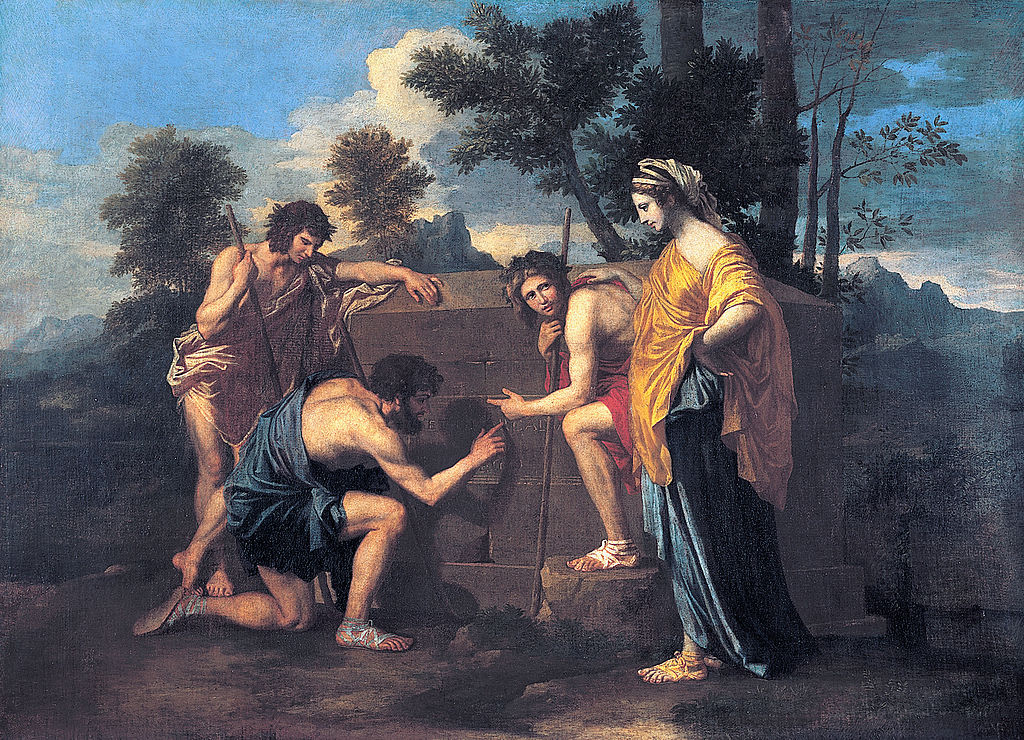
In America we do not worship Masonic cathedral builders, as much as we do our common housepainters, they so quickly getting us down on our hands and knees the moment they pull into our driveways.
“Don’t worry. We always drink a ceremonial morning beer before we start a new job.”
“Please! Please take pity on us!”
Jon Presco
At the end of the first chapter of Thomas Pynchon’s The Crying of Lot 49, Oedipa Maas looks at a painting and cries. The painting is by the exiled Spanish artist Remedios Varo and depicts
a number of frail girls with heart-shaped faces, huge eyes, spun-gold hair, prisoners in the top room of a circular tower, embroidering a kind of tapestry which spilled out the slit windows and into a void, seeking hopelessly to fill the void. (CL 13).
What upsets Oedipa is that she identifies with these girls, not only their sense of captivity, but also their impotence. It is with terror she thinks that
what really keeps her where she is magic, anonymous and malignant, visited on her from outside and for no reason at all… if the tower is everywhere and the proof of deliverance no proof against its magic, what else? (CL 13)
http://nickholdstock.com/category/pynchon/

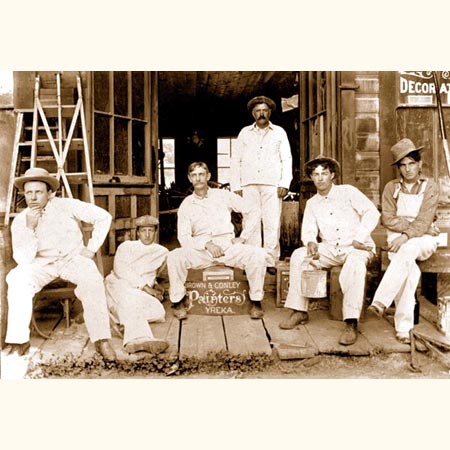
Carbonari House Painters
http://en.wikipedia.org/wiki/Carbonari
Although some of the society’s documents claimed that it had origins in medieval France,[5] and that its progenitors were under the sponsorship of Francis I of France during the sixteenth century, this claim is hard to substantiate. Although a plethora of theories have been advanced as to the origins of the Carbonari, the organization most likely emerged as an offshoot of Freemasonry,[5] in reaction to the spread of liberal ideas from the French Revolution
Francis I (French: François Ier) (12 September 1494 – 31 March 1547) was a monarch of the House of Valois who ruled as King of France from 1515 until his death. He was the son of Charles, Count of Angoulême, and Louise of Savoy. He succeeded his cousin and father-in-law Louis XII, who died without a male heir.
A prodigal patron of the arts, he initiated the French Renaissance by attracting many Italian artists to work on the Château de Chambord, including Leonardo da Vinci, who brought the Mona Lisa with him, which Francis had acquired. Francis’ reign saw important cultural changes with the rise of absolute monarchy in France, the spread of humanism and Protestantism, and the beginning of French exploration of the New World. Jacques Cartier and others claimed lands in the Americas for France and paved the way for the expansion of the first French colonial empire.
http://www.societe-perillos.com/info01.html
http://www.renneslechateau.nl/2008/05/02/bloodline-fiction/
”
The novella tells the story of Oedipa Maas’ journey of discovery. It opens with an exquisite sentence, “One summer afternoon Mrs. Oedipa Maas came home from a Tupperware party whose host had perhaps put too much kirsch in the fondue to find that she, Oedipa, had been named executor, or she supposed executrix, of the estate of one Pierce Inverarity, a California real estate mogul who had once lost two million dollars in his spare time but still had assets numerous and tangled enough to make the job of sorting it all out more than honorary.” So right away we have an answer to the question that might reasonably enough be daringly posed by a reader undaunted by the literary reputation of Pynchon and the novel. The question is what makes this book better than Master Dan Brown’s “The Da Vinci Code”, a book that has thematic resemblance to “The Crying of Lot 49”. Here is its first line: “Renowned curator Jacques Sauniere staggered through the vaulted archway of the museum’s Grand Gallery.” If Jacques had come from the same Tupperware party as Oedipa and was staggering from the cherry brandy in the fondue, then there might be a story. Instead what we get is a deployment of sentences in “The Da Vinci Code” aimed solely at getting the reader to turn the next page, until the final revelation that a sinister albino has gotten his pale hands on Jesus’ DNA code. On the other hand, “The Crying of Lot 49” is composed of more and more sentences like this memorable opening one, which contains embedded in it the entire premise of the novel as well as the satirical key it is written in, each sentence tantalizing the reader with bizarre names and puzzles, with unique, pointed humor, and all the while highlighting the intrinsic interest of English itself. Pynchon is Demosthenes to Dan Brown’s carnie barker.
So this is why readers are still compelled to follow the story Pynchon sets up in the first line of the book, even over fifty years after the book was published. In 2013, “The Crying of Lot 49” still matters and speaks to us. (Let’s see how things stand with Dan Brown’s work in half a century.) Of course not everyone agrees that this is a canonical work deserving of its reputation.”
“Everything I said I discovered is a hoax, planted by me and only me.
Sandy, Bill, Pat, Rene and Bruce, my brother, and everyone else were unwitting pawns in my game, for the lack of a better word. I have no idea why I did it, or carried on what was at first a stupid prank that escalated out of control. My intention was never to deceive, but then of course it was by doing what I did.
Perhaps I did it for the money, though very little was ever forthcoming and realised early on that it probably never would.
Did I do it for fame and attention? Perhaps. I did enjoy it at times but it wasn’t the driving force behind it.
Maybe I just carried on to see what I could get away with. I really don’t know.
One story involved the book jacket photographer for “V” going to Pynchon’s only known address, a hotel room in Mexico City, for a picture of the young author. The man who answered the door said Pynchon would be back in an hour, but when the photographer returned, the room was barren.
Another story involved the typically aggressive Normal Mailer, who after making numerous requests to have a drink with Pynchon, finally tracked him to an address and began pounding on the door. after a while, Mailer gave up, only to learn from neighbors that a strange tall man had jumped from the second story window and skittered off down the sidewalk.
Pynchon siting pop up every now and then. One moment, he is rumored to be involved in the writing of a television show. The next, he is penning a tribute to his favorite rock band.
Rumors, of course, exist that Pynchon doesn’t exist at all. Or if he does exist, that he didn’t write the books. In 1976, an article in the Soho News announced that Pynchon was in fact J.D. Salinger. Soon after the article came out, Pynchon sent a note to the author to the effect that he did exist and did write the books.
Arginy, is located on the territory of the municipality of Charentay (Rhone).The castle, isolated in the plains between the Saone and the Beaujolais, seems to spring from the Middle Ages. Flanked by several towers and two drawbridges, surrounded by heavy water and green, he probably saw successively pass the Templars, the Lords of the Renaissance and all the cream of modern esotericism.
At the time of the Gauls, the site was the center of a forest where it operated a salt mine. During the Roman conquest, a lieutenant of Caesar, named Arginusae, built an oppidum in this place, which subsequently took his name. The first red-brick building would last nine centuries. And on its ruins was built a castle in the Middle Ages. On the road to the castle near the Girardi?re which passes the castle, a Roman road indicates the presence of a very old past.
The castle was built in two periods: in the eleventh century – this time there is almost nothing – and in the sixteenth century. Near the tower known as the eight Beatitudes, near the moat, the research allowed to identify the old one into the ground.
In this passage, the remains of two towers belonging to the former defense system have been discovered, and the remains of a bridge of 5.80 meters long. In the eleventh century, the castle seems to have been built small, comprising only three towers and a dungeon.
The farm is located in front of the castle was built at a later time. As for the towers that rise to the drawbridge, they date from the sixteenth century.Who were the original owners of the castle? The regional archives do not remember. But in 1253, Louis de Beaujeu, the lord of the whole valley, chose to leave the family castle and moved to Arginy. His descendants will also Arginy their main residence, Guichard VI Grand in 1295, Edward 1st in 1331, Antoinnette of Beaujeu in 1343. Then some time later appears Vernet family who had some land in the town of Charentay. They will increase their area by acquiring the firm in 1365 Arginy, then in 1388 the castle and all its dependencies.
Throughout the fifteenth century, as successive owners of the premises, Guichard II Vernet (1422), Thomas de Vernet (1430), Jacqueline de Chalon (1453), Thomas de la Bussiere (1485).
In 1533, Claude King Francis Vignolles bought the first right of justice enjoyed by Beaujeu two centuries earlier. The castle was restored and enlarged, then the farm is built.
In 1576, Antoinette Vignolles continued expansion of the field by acquiring more land. In 1883 the family became owner of Rosemont eight hundred acres of land and the castle of Arginy. Rosemont was one of the best families of the French nobility. Their stronghold, in the fourteenth century, was located in Figeac in the Lot.
Interest in Arginy regarding the Temple treasury is related to Master William de Beaujeu, a member of the family which owned the area from the thirteenth to fourteenth century. Guillaume de Beaujeu, as explained in particular Dupuy in his “History of the Templars” of 1653, was originally buried in Saint-Jean d’Acre. Then returned to France, his remains were deposited in the Temple of Paris. Did she then traveled to Arginy through Guichard of Beaujeu? This is where the mystery begins, and the treasure hunt is launched …
This treasure hunt, dates back to the late fifteenth century: Anne of France (Anne de Beaujeu), daughter of Louis XI, had carried out searches in the dungeon of the castle with the hope of finding the treasure of the Templars.
His research, according to tradition, ended tragically. One of his workers who had descended into a pit, suddenly uttered a dreadful cry that per?urent his comrades remained in the open air. The man came out of the gallery, however, about one quarter of an hour later, he walked like a robot, with his skull crushed fragments from which emerged brains.
Arrived in front of his companions, he spread his arms and finally fell. They felt along his body already cold and, finding the latter “diabolical”, refused to resume work to flee in terror.
In 1883, ownership was Arginy Chambrun of Uxeloup Rosemont. Around 1900, Count Pierre de Rosemont began excavations to turn to find the treasure of the Templars. He cleared a vertical gallery in which one of his workmen down at the end of a cable…. His descent ended in an accident just as tragic as before: the man had his foot crushed by a kind of articulated wheel ..
Several years ago, his step-daughter – wife of Jacques de Cham Uxeloup Rosemont (now deceased) – revealed to Breyer and some of her friends that her stepfather had carried out excavations in the castle 1914. However, it would suddenly received “spiritual” to stop his investigations and clog the underground from which he had begun his research.
In fact, Pierre de Rosemont have discovered a mysterious sarcophagus. Breyer, meanwhile, was confident that would happen Rosemont to a room of small dimensions, situated less than 12 meters deep, which would be based in a Baron de Camus and his wife, a trained master of the esoteric Templar initiated the Renaissance, lead author of alchemical graffiti found inside the rooms and on the crest of entry.
Also at the time of Count Pierre, two tragic incidents have also occurred at Arginy. A stranger presented himself at the castle claiming to discover the treasure of the Templars, was found two days later on the roadside, his skull broken. A farmer who undertook clandestine excavations suffered a similar accident: a wheel of his car crushed her head.
In 1950, Jacques de Rosemont, son of Peter and rushed to turn in search of the treasure of the Templars in working with a bulldozer. In vain … That same year, a British officer, representing a British secret society, offered a large sum for the castle to the Earl of Rosemont, who refused to sell. Many were later also those who sought to acquire the domain …
For some, the treasure of the Templars should generally be considered protected by hidden forces unleashing a curse against those who attempt to penetrate the secret. Now the site is by far Arginy deemed as the most dangerous, most inviolable, the most “overlooked”. So the treasure could be buried. Thus, fans of mystery and irrationality are not afraid to wield the syllogism he can consolidate it.
In 1953, when Jacques de Rosemont was still alive, a team of occultists, mediums and investigators determined undertook with the consent and support of Rosemont, to tackle the mystery and its Arginy Templar treasure. There was Jacques Breyer, writer and esotericism, Armand Barbault, alchemist, and his wife, remarkable medium, Maxime Roquemaure, Mr. and Mrs. Michon, Beaujeu, Claude Cariven, filmmaker, Mr. Champion and many others. All these scientists indulged in occult number of experiments spiritualist invocations night, some of which were particularly spectacular. The “contact” was established, it seems, with eleven entities Templar, guarding the treasure, and not willing to indicate access!
Works occult and excavations continued for some time. Then as numerous and varied incidents came the disturbing gradually.One after the other, the visitors left Arginy. The old feudal building soon found silence.
Not for long. All that France has occultists, Hermetics, mediums, magicians and other alchemists marched to Arginy. As researchers illegal, it is virtually impossible to estimate the number how many they were, for thirty years, to enter the field, handling the pendulum or dynamite, sounding every stone, every inch of land back? .. .
In a work as strange and exciting, published in 1973 by Robert Laffont, Time out of time, Gabrielle Carmi, medium and expert in comparative religion Kabbalah, the mystery of Arginy recovery while providing new details on it it. The treasure is a chest containing a collection of parchment making, state capitals of revelations on a variety of subjects, the work of insiders Temple.
However, Arginy has still not officially at least, delivered his secret. So why the craze delivery of researchers from very different backgrounds, to this place? Then there is the document that relates Schiffmann that Jacques de Molay, exposing the unfairness of the trial concluded that there was no hope, either for himself or for the Order. He brought near him, just days before his execution, the Count of Beaujeu, his nephew, “which had long shown a decided to enter the Order, initiated him into the mysteries” and held her remarks obscure.
This document then states: “As soon as Jacques de Molay was expired, Beaujeu proceeded to carry out its commitments. He secured nine knights unfortunate remains escaped the fury of persecution and torture of terror, he mixed his blood with that of his brothers and vowed to spread the Order on the globe as he would be perfect nine architects.
He went to ask the King Philip’s permission to remove the tomb of the Grand Master Grand Master’s coffin Beaujeu his paternal uncle’s predecessor Molay and having obtained it, he went with his brothers in the tomb of the great masters and drove off the coffin that instead of ashes of his uncle the box contained money, which has been mentioned. ” He also
removed the treasures contained in the two columns and transport, all in a safe place. ”
Esotericists and treasure hunters assume that this “place of safety” could be that Arginy Castle, located on the lands of the former estate of Beaujeu. However, it should be noted qu’Arginy was at the time a dependency of the Temple: the real castle was Beaujeu and it will be destroyed by the revolutionaries.
Moreover, if one sticks to the document Schiffmann, how to design “a few days before his execution,” Jacques de Molay had been as easy to receive visitors, initiate, give specific instructions etc.. sans surveillance et en toute libert? ? unattended and freedom? Molay, besides his captors, would be surrounded by spies … How to explain the good grace with which Philip the Fair acceded to the request of the Count of Beaujeu?
No historian has not addressed the reality of the relationship between Jacques de Molay and the Count of Beaujeu.
To our knowledge, the document Schiffmann, was first published in France by John Carpenter in 1945. It could therefore influence Pierre de Rosemont, nor the different researchers in the 1900s. Fewer still Anne of France, who first, performed searches Arginy. Finally, another contradiction, the document makes no reference to the field of Beaujeu. ” Indeed, following the previous quote, it says: “It is likely that is was in Cyprus where the Archimandrit where resided with the Patriarch of the Grand Chapter clerical Order.”
Thus, if one believes the document Schiffmann (provided it is genuine and that its content is not only symbolic) National Treasure should be in Cyprus, probably in Limassol, thesis which was to joined several other historians.
So there is a real mystery: a strong oral tradition, dating from the time of the affair of the Templars, “she Arginy designated as a cache of order, tradition, including the daughter of Louis XI, who knows what average would have known?
Jon Presco | 16 Jan 18:09 2005
Picon
Sleeping Beauty
This is from an article by Andre Douzet who appears to have once
been an ally of Timothy Carmain. This article says only one special
person may approach the treasure.
“One of the Duke’s descendants claims to have excellent evidence
concluding that Pierre de Rosemont was able to gain access to the
tomb of Camus said to be very close to the secret treasure of the
Knights Templars. Apparently, though, having almost reached his
goal, the Duke was struck by violent blows and cries emanating from
below, balls of mauve fire encircling the room and strange odours
and visions.”
“Since 1959, many people have attempted to fathom this enigmatic
secret. Having lived around the castle of Arginy, I am aware that
many curious, painful and sometimes dangerous things happen every
time someone tries to grasp the terrible secret. Local folklore has
it that only one person is designated and recognised by the deceased
Templars to have access to them without risk to his or her life. The
tradition thus reactivated, it is claimed that the Order shall rise
from its ashes towards a higher and more certain glory.
Perhaps the French author Robert Charroux found the key when he
deciphered this passage from Breyer’s book: “Think hard: the great
art is Knowledge.”
In William Ainsworth’s ‘Auriol’ the Rosicrucian tomb of Cipriani de
Rougemont is opened after hundreds of years by his kin. There exist
legends about the White Lady of Rosemont/Rougemont. I have
correspondence from a relative of Pierre Rosemont who sent me a
genealogy.
“”Finally, we should add that it is not the first time that Timothy
> Carmain has made wild accusations against our organisation. Last
> year, he made a complaint with the local authorities that André
> Douzet was planning to steal the “treasure of Perillos” (nature
> unspecified) and “disturb the dead”. He added that he alone could
> lay claim to that treasure, this because of his title of count de
> Perillos! The mind boggles
”
“Through personal research and interviews with the local villagers
who lived on and around the estate, we learned that strange noises,
followed by horrible cries coming from the Tower of the Eight
Beauties were heard ever more frequently. Luminous events sparked
off by these rituals preceded the fierce escape of the participants.”
Andre Douzet
Grimms give the name Rosamond to the Sleeping Beauty Princess. Denis
de Rougemont is a Grail Scholar and like my Rougemont/Rosamond
family they descend from Huguenots. Denis is quoted in ‘Holy Blood,
Holy Grail in regards to the Albigensian Crusade. Rougemont also
talks about the tower of Beauties.
Three years ago, my daughter Heather was introduced to me for the
first time. She was sixteen. Seventeen years ago three Seers told me
I had concieved her they seeing her as faint petals on a rose. Two
years ago she disapeared. A month ago I discovered she was lured
away by my family who used her in the fight over the artistic and
literary legacy of my late sister, the world famous artist Rosamond.
The executor of Rosamond’s estate kept the probate going two years
longer so that Carrie Fisher, the Princess Laeh of Star Wars, could
promote a movie script she authored about Rosamond’s life. There is
a fight over this legacy worth tens of millions.
I believe my beautiful daughter is the one who can approach the
spirits of the dead Templars and be shown their hidden secret and
treasure for she is liken to a Foundling and all the tales that
entail a treasure, a dragon, and a lost bloodline. She can awaken a
lost kingdom.
Jon Presco
The Treasure Trove of the Knights Templars.
Part 2 of 2.
THE TREASURE HUNT BEGINS.
The first organised search of the treasure trove left by de Beaujeu
was organised by one of his descendants, Anne de Beaujeu. She talked
about “very old documents that testified about the presence of a
major and historical depot”. The men entering the underground
network of tunnels were decimated by traps that had probably been
put in place by Count de Beaujeu. Anne de Beaujeu eventually gave up
and had the entrance to the underground network sealed off.
In 1914, the new owner of the castle, Duke Pierre de Rosemont, felt
the time was ripe for a new enterprise. After breaking down the wall
that Anne de Beaujeu had built, the Duke opened the entrance to the
underground caverns. One of his workmen, however, had his legs
crushed when he was hit by two stone balls that rolled out of a wall
another trap installed so many centuries earlier. De Rosemont
decided to change his tactics and opted for safer methods. After
some scouting of his own, de Rosemont discovered a hole that led
downwards, so he decided to try to reach the treasure on his own.
One of the Duke’s descendants claims to have excellent evidence
concluding that Pierre de Rosemont was able to gain access to the
tomb of Camus said to be very close to the secret treasure of the
Knights Templars. Apparently, though, having almost reached his
goal, the Duke was struck by violent blows and cries emanating from
below, balls of mauve fire encircling the room and strange odours
and visions. When the water began to rise mysteriously, he decided
to retreat as quickly as he could. Upon reaching the surface, he
decided never to return, so he made sure that no one would ever
discover the hole through which he had reached the underground
network.
The oldest part of the castle is a tower, the “Tower of the Eight
Beauties”. Constructed in red bricks, its walls are more than one
metre thick. It appears circular from the outside, but inside, on
the first floor, the tower becomes octagonal. At the top are eight
openings that appear to have no functional use. It is also known as
the “Tower of Alchemy”, for the walls were once covered with
alchemical symbols. Though these symbols are almost invisible today,
but we have photographic records of them in our possession.
It was towards this tower that two of the greatest alchemists of our
age set course: Eugene Canselier and Armand Barbault, the author
of “Gold of a Thousand Mornings”. Their visit to the castle was not
a tourist outing, instead, Barbault and his wife stayed there for
several weeks in the company of the now infamous Jacques Breyer.
In 1950, a mysterious English colonel came to Arginy and asked
whether the owner, Gilbert Marie Jacques de Chambrun d’Uxeloup de
Rosemont, was willing to sell the estate for no less than one
hundred million French francs. De Rosemont flatly refused. Two years
later, he and Jacques Breyer decided to have another go at
discovering the treasure of Arginy.
THE BIRTH OF NEO-TEMPLARISM.
The new team decided to dig underneath the Tower of the Eight
Beauties. In their search they hit upon the underground stream that
was responsible for the sudden flooding that had plagued previous
seekers. Jacques Breyer believed that the Templar treasures at
Arginy consisted of several different forms, each requiring a
certain kind of focus on his part if he was going to find them. He
believed that there was a material treasure, taken from the Treasury
of the Temple in Paris and therefore possibly involving large
quantities of gold; a spiritual treasure, detailing the rituals and
doctrines of the Order; and an esoteric treasure, a treasure of
Wisdom that contained information on magic and Hermetic rituals.
Breyer also believed that the castle might have been specifically
converted into an “alchemical stronghold” so that certain alchemical
experiments could take place there. In any case, it does seem that
alchemical thought was applied in the Tower’s construction.
The birth date of neo-Templarism is currently accepted as 12 June
1952, the birthplace: Arginy. The event is often referred to as
the “the Resurgence of Arginy”. Indeed, Arginy became the focal
point of the Rosicrucians, Freemasons and other strange orders as
well as numerous “Templar Orders”. Important figures made visits to
the castle. Amongst the visitors was Constantin Melnik, head of the
French Secret Service and confidant of the French Minister of the
Interior, Michel Debre, who visited the castle in 1959. Guarded by
members of the Secret Service who cordoned off the entire castle,
Melnik reportedly participated in night-time ceremonies held within
the castle walls.
It was on 12 June 1952 that the first such alchemical ritual was
held. Conducted by Breyer, Barbault and his psychic wife and other
people, some of whom were merely attendants. Breyer, who believed he
was the reincarnation of Jacques de Molay, tried to reach the ghost
of Guillaume de Beaujeu, whose remains had been placed close to the
treasure underneath the treasure. Apparently Breyer was successful
in this attempt, as de Beaujeu had asked for a certain ritual to be
performed so that his spirit could be brought back to life. The
ritual supposedly involved the sexual union between man and wife at
Arginy, whereupon the resulting child would be the reincarnation of
the former Grand Master.
Breyer stayed on at Arginy castle from 1952 until 1959. He stated
that it was “a haunted place, but in the loftiest sense of the word:
it is a place of high initiation.” For seven long years, Breyer did
fill kinds of occult works and magical rituals, hoping to contact
the souls of eleven Templars whose spirits had been charged with
guarding the treasure that lay in Arginy’s subterranean chambers.
Perhaps the entire history of Breyer’s searches seems foolish, but
it is known that during those seven years he did discover an
underground chamber and locate many entrances to the underground
kingdom of Arginy. He reportedly found several small objects that
were lying in numerous small holes. Some of these objects are
allegedly kept in a private collection.
During his time at the castle, Breyer prepared several books, but
these are difficult to access at present. His most famous book
is “Arcanes Solaires”, “dedicated to the Ancient ‘Arch Masters’,
eleven in all, who came to help me during my seven-year stay at the
castle of S.” In referring to Arginy, Breyer always denoted it with
the letter “S”, or, even more commonly, with the symbol “$”. Breyer
indicated that Arcanes Solaires is the resume of the secret
inheritance of the last Grand Master of the Temple, Jacques de
Molay. He claimed to have told this story to the walls of the
castle, and, like certain inhabitants before him, to have placed
alchemical graffiti on the castle walls.
Breyer then rounded a neo-Templar order, the Sovereign Order of the
Solar Temple. Although this Order cannot be confused with the Order
of the Solar Temple, responsible for the collective suicide of 53
people in Canada and Switzerland in 1994 and of 16 people in France
in 1995, it is understood that Jacques Breyer was the great
inspiration behind the foundation of the Order of the Solar Temple
and also knew its leaders.
The Sovereign Order of the Solar Temple, however, was supposed to be
the new Order of the Knights Templars. The eleven entities with whom
Breyer conversed had requested that Breyer raise the spirit of
former Grand Master Guillaume de Beaujeu in order that he could
guard the development of the “resurgence” of his Order. As the story
goes, everything had been put in place so that the ritual could be
conducted, but apparently something was not quite right at the last
moment. Something happened that no one had prepared for and the
experiment turned into a nightmare. Through personal research and
interviews with the local villagers who lived on and around the
estate, we learned that strange noises, followed by horrible cries
coming from the Tower of the Eight Beauties were heard ever more
frequently. Luminous events sparked off by these rituals preceded
the fierce escape of the participants.
Even though the resurrection of Guillaume de Beaujeu was probably
unsuccessful, it seems quite certain that some or several of the
eleven guardians were liberated but chose to remain voluntary
captives of Arginy castle.
The Sovereign Order of the Solar Temple (OSTS) was the exoteric
result of the initiates’ constant participation in events that
transpired at the castle. The Order elected its first Grand Master
in 1966 and announced its existence the following year in the form
of an association. The Order was officially recognised by Prince
Rainier III of Monaco, the location of the Order’s official
headquarters. Book publishing is one of its functions.
The OSTS was the inspiration for most neo-Templar orders that have
subsequently seen the light of day, including the already mentioned
Order of the Solar Temple, but also the Renovated Order of the
Temple, the ORT. Researchers investigating these orders claim to
have found evidence that they are closely connected to extreme right-
wing circles, particularly the Italian Propaganda Due, P2. Even if
this is correct, it should be noted that from its inception the OSTS
seems to have been of a totally different calibre. Indeed, it is
more likely that any such links were merely the result of certain
people’s interest in Breyer’s works and his organisation.
THE SECRETS STAY HIDDEN.
Though numerous places claim to hold the treasure of the Templars
(some as far as away as Canada), Arginy is arguably the only place
where such important events have transpired. Though several people
would wish that the castle and what has transpired there, did not
become public knowledge, if only because of the gruesome events that
eventually led to the collective suicides of 1994 and 1995, it
should be remembered that what took place at Arginy had one goal: to
give mankind an important revelation. In former centuries, such
information was held by the secret circle within the Knights
Templars. This may explain why Breyer and other key people went to
Arginy in the years following 1952 and participated in strange
magical rituals: they believed Arginy held the key to something very
important.
Unfortunately, whatever that revelation was, it has been suppressed.
It does seem most likely, though, that the castle holds within its
walls one of the most important secrets of the Knights Templars.
When this secret will be revealed, or whether it will be revealed at
all, is not known.
Since 1959, many people have attempted to fathom this enigmatic
secret. Having lived around the castle of Arginy, I am aware that
many curious, painful and sometimes dangerous things happen every
time someone tries to grasp the terrible secret. Local folklore has
it that only one person is designated and recognised by the deceased
Templars to have access to them without risk to his or her life. The
tradition thus reactivated, it is claimed that the Order shall rise
from its ashes towards a higher and more certain glory.
Perhaps the French author Robert Charroux found the key when he
deciphered this passage from Breyer’s book: “Think hard: the great
art is Knowledge.”
Source: Nexus Magazine.
— In davincicodefans yahoogroups.com, “Jon Presco”
<montrose44 c…> wrote:
>
> “Finally, we should add that it is not the first time that Timothy
> Carmain has made wild accusations against our organisation. Last
> year, he made a complaint with the local authorities that André
> Douzet was planning to steal the “treasure of Perillos” (nature
> unspecified) and “disturb the dead”. He added that he alone could
> lay claim to that treasure, this because of his title of count de
> Perillos! The mind boggles
”
>
> http://www.perillos.com/info01.html
>
> Did Timonty Perillos attack me lest I make some ancestral claim on
> the Perillos treasure like he has? That he turned against Andre
> Douzet who wrote about the Rosemonts at Arginy, suggests the idea
> that only a relative of the Rosemonts may approach this templar
> treasure and not be attacked by spirits of some kind.
>
> JON: >Did I “create” such myth, or, did it already exist? Yes it
> does! >Indeed, it existed in the published work of the expert you
> called upon >to further impeach my OPEN study – YOU YOURSELF
> enhancing my so called “self-serving myth.”
>
> TIMOTHY: That would be Andre Douzet, who has written not about
> these “du Temple de Rougemont” ancestors who you now seem to have
> dropped from your repertoire,
> but of Pierre de Chambrun d’Uxeloup, the self-styled “Duc de
> Rosemont”, who
> owned the chateau of Arginy at one time. You are the one claiming
> this
> gentleman as a kinsman; nothing in Mr. Douzet’s work makes any such
> assertion.
>
> >To suggest the FBI may come to my door if I should continue with
> this
> > >fabrication that surpasses the lies of Michael Stewart and
> Laurence
> > >Gardner – is CRIMINAL LIBEL – especially when you premise this
> libel >as
> >a restrained attack, you no longer able to hold back your expert
> >opinion – AND FINAL JUDGEMENT – on the matter.
>
> Jon Presco
>
>
>
>
>
> March 29, 2004: 1666, underground bases and Revelation in
Amsterdam
>
> The English branch of Société Perillos was the prime mover behind
> last weekend’s Nexus Conference in Amsterdam. No surprise
therefore
> that a few speakers had topics of interest, specifically Stuart
> Urban and Richard Sauder. Stuart Urban is the writer and director
of
> the movie Revelation, released in 2002, and currently available on
> video/DVD. This 7 million pound budget movie was filmed in several
> locations, including Rennes-le-Château. It features the quest
> throughout the ages to experience the divine nature of Jesus,
> including figures such as Isaac Newton and the “Grand Master” of
the
> Knights Templar. Urban stated that when filming on location in St
> John’s Co-Cathedral in Valleta, Malta, the team was amazed to see
> the many alchemical symbols on the tombstones of the Grandmasters
of
> the Order. Of course, Ramon de Perellos y Roccaful was one of
these
> grandmasters. When the church officials realised what they were
> exactly filming, the crew was asked to stop filming. Urban noted
how
> the movie revealed the first account of this alchemical imagery
> being used on those graves. The movie itself also revolves around
> the “loculus”, an object specifically made for the movie, which
> Urban had brought with him to show to the audience and to explain
> the alchemical imagery that had gone into the design.
>
> Richard Sauder has investigated the US government’s involvement
with
> underground tunnels and bases. Though focused on the US, Sauder
made
> it clear that such structures exist in all countries including
> France. Of course, you can wonder whether some of the modern
enigma
> of Perillos, such as the mysterious power supply, monitoring
> stations, etc. might have to do with this, specifically as a
> military base is nearby. At the speakers’ dinner we asked Sauder
> whether the military had any preference for a specific type of
rock
> formation to build these bases in. He stated limestone and granite
> were their favourite types of rock, but with money being no issue
> (costs of an underground base have been estimated at approx. 3
> billion dollars), they can be located anywhere.
> Finally, though Valery Uvarov did not speak on a related subject,
he
> did mention how Cassini, the man behind the Zero Meridian and the
> French observatory, had observed a mystery celestial object in the
> sky in 1666
a number well-known to Perillos! He observed it
again,
> and other astronomers in the 17th and 18th century did the same,
> before the object, possibly another planet in our solar
> system “hiding” behind the sun, “disappeared”.
> Any further developments on these or other topics will, of course,
> be reported on as they happen
>
>
>
> March 5, 2004: Further developments in the Carmain saga
>
> First: one minor error crept into last week’s report. The letters
> from Tim Carmain were not postmarked “London”, as they were sent
as
> emails.
> Also, because of the extreme nature of the complaint, certain
local
> police stations felt ill-equipped to deal with the complaint,
which
> as a result was only officially submitted on March 2, 2004. The
> complaint was submitted solely against Tim Carmain, and not
against
> other individuals in London (as was understood to be the case, in
> the assumption we were dealing with letters being posted from
> there). The police have now begun their enquiry, which will
> hopefully reveal whether these are the actions of a single person
> (Timothy Carmain), or are part of a concerted effort to discredit
> the activities of the Société Perillos and some of its members,
> particularly André Douzet.
>
> Tim Carmain claims he “obtained” his title from the “Imperial
> government of Vietnam”. Vietnam is currently ruled by a communist
> regime and this “Imperial government” is apparently trying to
seize
> power in that state and restore it to the descendants of its
ousted
> leaders, the Nguyen dynasty (removed from power in 1945). Should
the
> Vietnam war have been successful, the family would have been one
of
> the prime claimants to power.
> One “colleague” of our count de Perillos in this organisation is
one
> Joseph Crisp II, who is the front man for the Royalist Party of
> America! George Bush, beware he is after your job! Others live
in
> Spain, Eastern Europe and Great Britain (London). In 2002, this
> Vietnamese family also resurrected the “Imperial Order of the
Dragon
> of Annam”, which seems to be a new methodology to gather interest
> for their cause.
>
> Contrary to this modern extravaganza, it should be noted that the
> official title of Perillos became extinct in the 16th century. The
> title passed through the lords of Durban, as noted by the research
> done by Dr. Courrent in the 20th century. Courrent was also the
> doctor who attended Saunière late in life. After the lords of
> Durban, another local family passed on the title through their
> generations. No doubt, they will not enjoy the fact that someone
> from America is now trying to lay claim to it!
>
> As in the case of “Perellos y Roccaful”, the title of the
> grandmaster of the Order of Malta, that title was purchased, and
not
> transmitted by any bloodline. In such cases, the hereditary value
of
> the title is void. Timothy Carmain has invented a series of
> illusionary descendants, through an alleged female line, which are
> both unknown to all genuine genealogists, but which by default
would
> prove he has no right to claim the title which is specifically
> reserved for male descendants, as centuries of French history
attest.
> Of course, the “Imperial government of Vietnam” has no authority
to
> distribute this title and might itself be a victim in this
sherade.
> See however
http://www.geocities.com/vietmonarchy/imperialstaff.html
> and other pages on their site for details of their activities.
> Finally, we should add that it is not the first time that Timothy
> Carmain has made wild accusations against our organisation. Last
> year, he made a complaint with the local authorities that André
> Douzet was planning to steal the “treasure of Perillos” (nature
> unspecified) and “disturb the dead”. He added that he alone could
> lay claim to that treasure, this because of his title of count de
> Perillos! The mind boggles
>
>
> February 27, 2004: Project Proposal under review
>
> Recently, Societe Perillos gave a project proposal of the work it
> envisions to perform over the next few years to the local
> authorities. These are currently reviewing the proposal before
> feeding back. Ideas include an exposition, walks, and
> restoration/preservation work in and around the village, including
> the cave Oursu. We will keep you informed of any further
> developments in our efforts to preserve the village and promote
its
> history.
>
>
> February 27, 2004: Wild accusations from California
>
> It is not news, but we think it is interesting information, if
only
> because it seems our previous news item was the direct cause for
> this development. Following the news that the church of Perillos
was
> pillaged, one “Timothy de Carmaing de Perillos” claimed that André
> Douzet and the mayor of Opoul-Perillos were behind the crime.
> Together with an aide in London (United Kingdom), “de Carmaing de
> Perillos” wrote to all mayors of the department, “informing” them
of
> this allegation, which of course did not hold up as most of the
> allegation was actually not conform with the known details of the
> crime it needs no further elucidation that the allegation itself
> is preposterous.
> Perhaps unsurprisingly, the gendarmerie (national police) were
> informed, but by the mayor and Mr. Douzet and a complaint was made
> against “de Carmaing de Perillos” and associates. Because “de
> Carmaing de Perillos” and aide are not French residents, the
> complaint will at the moment have no further effect, until either
> party decides to visit France, when the police will “invite” them
to
> a private audience, or until the nature of their allegations
reaches
> a more serious (in the sense of litigious) nature.
>
> “Timothy de Carmaing de Perillos” is in reality one Timothy B.
> Carmain, until recently a clerk at a Californian University,
working
> as an admission administrator for an MBA programme (now apparently
> working as a set designer in the Los Angeles movie and theatre
> scene). After trying to lay claim to the title of “de Foix” in the
> mid 90s, he was quickly nicknamed “de Faux” by expert
genealogists;
> as a result, he tried to lay claim to other estates before, from
> 2000 onwards, trying to lay claim to the title of “count of
> Perillos”. Carmain is one of several people involved in a growing
> trend of trying to lay claim to various titles, most often in
France
> (fertile ground as all noble titles were done away with during the
> French Revolution), in what is in all cases nothing more than a
> money-making scheme, or as seems to be the case with Carmain,
> attention seeking. One interesting claim of Carmain is that he
> claims to be a genealogist, with his area of expertise French
> medieval genealogy. Amazingly, Carmain has not only never visited
> France, he is not even able to speak or write French, let alone
> medieval French. Of course, he has also never visited Perillos.
More
> recently, he has allied himself with people seeking to lay claim
to
> Vietnamese nobility. If it is attention “de Carmaing de Perillos”
> wants, then we wanted to give him his 3 minutes of glory. Enough
> said
>
> February 15, 2004: Perillos church broken into
>
> During the first week of February, the Perillos church was broken
> into. Minor damage to furniture occurred and a cross from the
altar
> were stolen. The authorities believe they know who is behind the
> crime, but knowing and proving are two different things.
>
> As a result of this crime, access to the church out of season can
> only occur via the Societe Perillos or via the mayor of Opoul-
> Perillos, provided staff are able to accompany the visitors.
> Unaccompanied access is no longer possible.
>
> Calendar dates
>
> This year, May will be another busy period for Perillos. On May 1,
> there is the Chronodrome experiment. On May 31, the Monday of
> Pentecost, the village will see the annual mass being celebrated,
> with the Black Madonna statue present.

 Rosamond Press
Leave a comment