



When the mailman slipped the mail into the brass slot on the door at 217 33rd. St. Manhattan Beach, one of the guards for the Sunshine Surfer Revenge Cluster, called up Big Brother and informed him Pynchon had won a award for his book ‘Gravity’s Rainbow’. This is to say the Brotherhood of Eternal Love had won this award, for they wrote GR in order to defuse the Doomsday Bomb – with Paranoid Clock. Now, real paranoia set in, because Writers Mundi wanted the Supreme Recluse to come out of hiding to except this supreme honor.
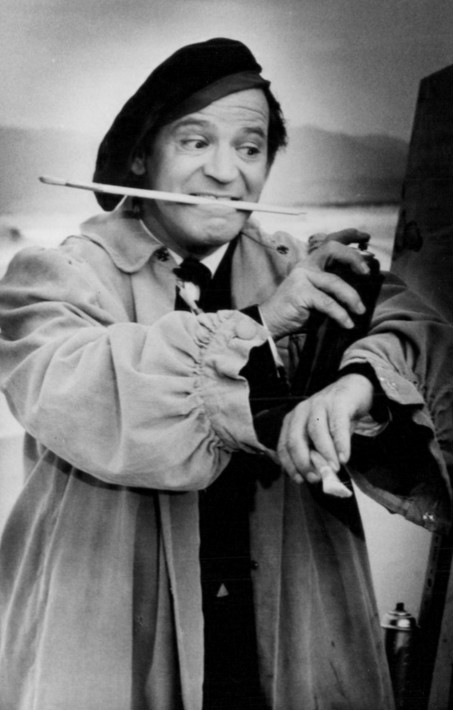
Glancing into the dining room at the mummy, and a scene right out of ‘Great Expectations’, this psychedelic guard had a vision of a comic he just befriended in a club in Venice.
“Why don’t we hire someone to receive this award in Pynchon’s place.”
“Do you know someone.”
“There’s this guy named Professor Irwin Corey. He pretends he knows everything, just like you know who, but he’s faking it.”
“We’re all faking it. But, continue.”
“I just about pissed my pants when I superimposed Thomas on this dude.”
Irwin was a real Jewish Hobo, who won a Golden Glove award, thanks to reading the tedious meandering of William Unmack who destroyed Rugby in America by publishing a scientific theory on how to play the game. He didn’t understand, that not like the British, Americans are into football so they don’t have to THINK. This is why they have talking-heads doing their thinking for them. Sports-Speak gave birth to Orwell’s 1984. The world of readers came to the same conclusion within the same week, that was not missed by the non-readers and the uneducated, who turned to the Sports Page in order to bury their head in the sand.
Most us only pretend we understand, anything. The murderous rock-grinder going on in the Gaza, is THE END of THINKING. Jews were once known as THINKERS, problem solvers. The end of this idea is the canary in the mine.
Ninety-four percent of those who read Pynchon, are pretenders. Do the math, and count how many folks DESERVE to be on the Last Ark, and compare it to the probability they will not even get out the door, which is Pynchon’s pretend problem. That he sillifies all the names of his characters, tells me he is on par with that housepainter who was kicked out of art school because there were no people in habiting his cityscapes. To title Pynchon ‘King of the Beat Writers’ is…nasty!
Corey’s boxing coach ate-up Unmack’s masterpiece that was very applicable to boxing due to his detailed instruction on how to fake-out your opponent with your eyes.
Lenny Bruce said Corey is the greatest comedian of all time, because he applied this eye movement to stand-up comedy.
“It’s all done with the eyes. I don’t have to say anything relevant once I got my audience on the ropes. Wink like a butterfly and bite like a bee.”
Study the eyes of Groucho Marx, and know the world has gone awry, we not able to look our fellow human being in the eye, or keep our eyes on the road, because we our busy texting. The world’s youth are begging to be Sucker-punched!
What does this have to do with Doomsday, you ask? Well, there will be a Doomsday Scrum, a stampede to get on the last boat, the last train car, that will take you to the Last Ark, and knowing how to get around those who get in your way – and try to stop you – is key!
Unmack’s father was a member of the German Turnverein and was a good friend of Max Nardau, the Zionist, who could not be kept out of the Promised Land. There was a look about him. This caused a falling out when they lived in Berlin, after they had their children marry one another in order to create the New Man.
Max is the father of Muscular Judaism that stole the physical fire of the Turner Gymnastic clubs, and created modern Zionism. Like most Jocks, he attacked Bohemian Art and Artists, titling them ‘Degenerates’. The Vonneguts built Turner Halls, and like my Janke kindred, were Forty-Eighters who co-founded the Radical Republican Party and waged war against the Confederacy. Brothers faced each other with bayonets. They had murder in the eye.
How ironic, that very physical surfers, driving Volkswagons and wearing Iron Crosses, would become the vanguard of a mind-altering revolution that promoted Free Thinking.
Above is the house my ex lived in with Thomas. Note the two guys in white, pretending to be house painters. Do you see a paintbrush in their hands? Well, their job is to keep ‘The Nosy’ at bay.
House painters are the biggest fakes of all. But, what can we do. Who can we get to paint our homes, but a housepainter? Most homeowners are perplexed about who actually painted their homes, they biting their nails down to the quick every time they behold these lazy bums, some with surfboards on their van. Just when you rush home to call the cops, and your attorney, after (with binoculars) you caught the whole crew hanging ten in the breakers, there’s their boss with his hand out for a check.
“All done Mr. Doubting Thomas. All done!”
I call them ‘The Roller Mafia’. On their breaks (which can last for days) painters engage in Sports-Speak. Is the painter on left describing the touchdown he saw on T.V. along with twenty million other viewers? It’s now not too difficult to imagine these Men in White are authoring great novels, when, and if, they finally get back to work!
“Oh ye of little faith.”
Irwin Corey is a Centenarian.
Jon Presco
Copyright 2014
P.S. I just discovered this article on Sunday the 3rd. Tom may have tried to enroll at UC the same time Mary Ann did, but was rejected.
http://www.theaesthetic.com/NewFiles/pynchon.html
When the famously publicity-shy Thomas Pynchon won the National Book Award Fiction Citation for Gravity’s Rainbow, he asked Corey to accept it on his behalf.[6] The New York Times described the resulting speech as “…a series of bad jokes and mangled syntax which left some people roaring with laughter and others perplexed.”[6]
The novel’s title declares its ambition and sets into resonance the oscillation between doom and freedom expressed throughout the book. An example of the superfluity of meanings characteristic of Pynchon’s work during his early years, “Gravity’s Rainbow” refers to:
the parabolic trajectory of a V-2 rocket: the “rainbow-shaped” path created by the missile as it moves under the influence of gravity, subsequent to the engine’s deactivation;
the arc of the plot. Critics such as Weisenburger have found this trajectory to be cyclical or circular, like the true shape of a rainbow. This follows in the literary tradition of James Joyce’s Finnegans Wake and Herman Melville’s The Confidence-Man.[6]
The light-bending property of gravity, an experimental observation confirming the general theory of relativity, in the context of the bending of light that produces rainbow effects.
“There are lots of ways the experienced
rugby player has of deceiving his oppo-
nents, and one of the most used by
thoroughly experienced players is to
mislead the opposition by means of the
eyes. This method of clever deception
is very often responsible for the success
of many brilliant careers on the rugby
field, and numbers of the leading players
of the world today to a very great extent
owe their superiority to this particular
“trick of the trade” as it were. While
there are numbers of players who know
of this trick, yet tliere are thousands who
do not know of it, or even stop to con-
sider it. ‘WK^ again there are those
players wlw^owe much of their success
to this mode of deception, and yet are
not aware of the fact till they are spoken
to about it. Every player after study
and practice can run with his head point-
ing straight in front and at the same
time take in the weak and strong positions
of his opponents, and also see where
his own sides strongest point is without
turning his head and thereb}^ allowing
his opponents to detect his intentions.”
Corey was born in 1914 in Brooklyn, New York.[2] Poverty-stricken, his parents were forced to place him in the Hebrew Orphan Asylum of New York, where Corey remained until his early teens, when he rode the rails out to California, and enrolled himself at Belmont High School in Los Angeles.[2] During the Great Depression he worked for the Civilian Conservation Corps and, while working his way back East, became a featherweight Golden Gloves boxing champion.
http://en.wikipedia.org/wiki/Muscular_Judaism
http://www.ohio.edu/chastain/rz/turnvere.htm
http://www.athenaeumfoundation.org/tour/projects/about-the-athenaeum/
The building is the design of the Indianapolis architectural firm of Vonnegut and Bohn. Both Bernard Vonnegut and Arthur Bohn were American-born of German immigrant parents and received architectural training in Germany. Vonnegut’s father, Clemens Sr., was one of the founders of the Socialer Turnverein in 1851, and Bernard’s brother, Clemens Vonnegut, Jr., was an officer of the stock association. The building was equipped with a gymnasium, locker rooms, meeting rooms, restaurant, auditorium, bowling alleys, a ball and concert hall, and a wall-enclosed Biergarten with a concert pavilion.
http://www.thisisamericanrugby.com/2013/01/a-look-back-american-rugby-in-print.html
Nordau’s major work Entartung (Degeneration), is a moralistic attack on so-called degenerate art, as well as a polemic against the effects of a range of the rising social phenomena of the period, such as rapid urbanization and its perceived effects on the human body.
This work is cited by William James in his lecture on Neurology and Religion at the beginning of The Varieties of Religious Experience (footnote 4). James mocks the author on the grounds that he exemplifies the then current school of medical materialism, stating that Nordau “has striven to impugn the value of works of genius in a wholesale way (such works of contemporary art, namely, as he himself is unable to enjoy, and they are many) by using medical arguments.”[5]
The Game as it Should be
Played to be Scientific
By Wm. Unmack
y^-‘lHE MAN who enjoys his game of
\^ football must be one who has
^^R taken care of his training, and
^^» prepared himself in the most up-
to-date and scientific manner possible.
When a player has reached a certain
stage of physical fitness, the hardest
and most severe game of football becomes
a pleasure and does not leave any serious
or even uncomfortable after-effects, such
as stiffness or light bruises. To reach
this stage of physical condition should
be every man’s earnest desire. It means
hard and unflinching work, but once
having attained his ambition he will
glory in and enjoy his football. It is
also a player’s only chance of reaching
the top rung of the football ladder,
which should be every mans aspiration.
It should also be properly understood
that not merely the limbs, but the whole
body and mind need studying and culit-
vating.
There are players and even coaches,
who think that as long as they run a few
miles, do a little kicking and handling of
the ball, with a little “scrum work”
and a few “line outs,” that they have
done all that is necessary to complete
a modern footballer. This is a grave
error, and the sooner it is recognized the
better for the player, coach, and team.
I do not for one moment deny that the
above work is not necessary, still it is
of little use without the solid study and
keen attention to the scientific develop-
ment of one’s sei. — such as working out
diagrams of both defensive and attack-
ing positions of ones own. This will
train the mind to grasp the oppor”
tunity of attacking the oppositions weak”
est point the moment the said opportun”
ity presents itself. Then with the prac-
tical experience, and one’s own judg-
ment there can be but one conclusion,
and that must lead to a better and
much needed understanding among
players, and therefore be of great bene-
fit to the game and to the players them-
selves.
Again a player must know that con-
dition to play football differs entirely
from any other form of athletic condi-
condition, inasmuch as a footballer must
prepare himself to counteract bumps,
hard knocks, and heavy falls, all of which
the ordinary athlete knows nothing.
I am not a faddist, nor do I think that
a man should bind himself to any par-
ticular form of training. Moderation
in all things is the best plan to work on.
To a certain point a man should con-
sider what he is to eat, but by that I
do not mean that he should diet himself.
Everything can be eaten with perhaps
the possible exception of pastry and
other sluggish food of that nature. Three
good hearty meals should be eaten daily.
When a man is in training he has to build
up his body to suit the requirements of
the sport he is going to enter. The old
fashioned ideas of an athlete living on
dry toast and rare roast beef have long
ago been relegated to the ash heap, and
it is now an admitted fact amongst
athletes all over the world, that the
more one eats without actually overdoing
WM. UNMACK
13
it, the better off the man in question
will be.
One thing more than another that
bothers a footballer is a parched and
dry mouth. This can be remedied if
the player will discontinue drinking and
sipping liquids with meals. Players
should learn and practice to keep the
mouth moist by natural circulation, and
not by frequent sipping or other arti-
ficial means.
To attain proper physical condition
it is necessary for the players to go
through a light course of exercises every
morning before breakfast, and also before
retiring at night. It might seem strange
to ask a big husky footballer to use a
light dumbell, or Indian club, but the
benefits to be derived from these exer-
cises if carried out consistently every
day will surprise anyone undertaking
them. In conjunction with this exer-
cise, deep breathing for chest develop-
ment can also be practiced to great ad-
vantage. These exercises alone will not
properly fit a footballer, but they will
greatly add to the physical fitness of the
man when gone into properly as a neces-
sary adjunct to his usual training.
There are lots of ways the experienced
rugby player has of deceiving his oppo-
nents, and one of the most used by
thoroughly experienced players is to
mislead the opposition by means of the
eyes. This method of clever deception
is very often responsible for the success
of many brilliant careers on the rugby
field, and numbers of the leading players
of the world today to a very great extent
owe their superiority to this particular
“trick of the trade” as it were. While
there are numbers of players who know
of this trick, yet tliere are thousands who
do not know of it, or even stop to con-
sider it. ‘WK^ again there are those
players wlw^owe much of their success
to this mode of deception, and yet are
not aware of the fact till they are spoken
to about it. Every player after study
and practice can run with his head point-
ing straight in front and at the same
time take in the weak and strong positions
of his opponents, and also see where
his own sides strongest point is without
turning his head and thereb}^ allowing
his opponents to detect his intentions.
It is often said that some particular
first class team or “three Quarter line”
thereof, has got the game down to such
a fine art that they simply throw the
ball without looking and someone is
always in a position to take the “pass.”
The fact is that, although those players
face right ahead, they can at the same
time see their own men working into
position, hence the idea that they throw
the ball about as they please. Many
games are won by one man disguising
his movements and misleading and beat-
ing his opponents with his eyes, and so
opening up the game in an unexpected
direction.
Again in training itjis^^essential that
every player should learn to guard and
protect himself against the knocks, and
bumps, and falls so common to the
game, and to do this a man must learn
to fall, dive, and throw himself heavily
to the ground in such a manner that he
will not hurt, but toughen and harden
himself, so that a severe fall in a match
will not sicken him and interfere with
his game.
There are many other little things that
need the attention of the man in training,
but they are rather too numerous to be
dealt with in this article. So much for
training for a game, and now to get
closer to the game itself.
In regard to accidents I am firmly of
the opinion that the majority of them
are due to gross carelessness or want of
discretion on the part of the player in-
jured. Of these two causes, the latter
is probably accountable for more than the
former. In stopping heavy forward
rushes, if a man drops on the ball he
stands every chance in the world of
being injured, while he could have
stopped the rush just as successfully
(without the same chance of being in-
jured) by falling in front of the ball so
that the shins of the onrushing forwards
may lightly strike, and the men then
fall on top of the ball. Again a player
may fall behind the ball, and it will
be kicked up against his side whence it
will rebound; or should it stay beside
him the opposition may kick it, but the
fallen player is safe from reasonable
danger. By following out these methods
it will be found that a rush can be checked
14
OUT WEST
‘:m^ m
^9m,p^^m’
“Tackled High” — A bad way to tackle a player
with a minimum amount of risk. For
the players own safety they should
remember never to actually fall directly
on top of a ball during a rush.
Numerous accidents also happen
through a player waiting to receive a
high kick that is being charged down by
his opponents. There are, perhaps, a
few occasions that such accidents can-
not be avoided, though in the majority
of cases it can be. Often a plaj’^er is seen
running at full speed to the spot where
he thinks the high kicked ball is going
to fall, then of a sudden he stops mnning
when he gets to the spot where he has
judged the ball will come and stands
still, waiting for it with his opponents
rushing madly on him. He receives
the ball but is immediately bumped
into before he can get going again and
the contact is in most cases very serious
for the man taking the ball. In this
style of play, men should use their judg-
ment so as to reach the ball at the spot
where it will fall with a fair amount of
speed on and the instant the ball is re-
ceived should put on a burst of speed.
Never (unless making a mark) attempt
to take the ball while stationery, and
above all things a player should never
allow the ball to bounce if he can possibly
reach it on the fly. It is surprising how
far a player can run and catch the ball
on the fly if there has been no hesitation
at the start. Too many players in Calif-
ornia are apt to let the. ball bounce be-
fore taking it. This is an exceptionally
bad mistake, as in most cases the ball
will beat the player on the rebound.
“Tackling” is also somew^hat of a
dangerous department of the Rugby
game. To be able to bring an oppo-
nent down is somewhat of an art in it-
self, and causes the best of players con-
siderable worry and hard knocks before
they eventually get on to the right method
of “grounding” their opponents. It i&
easy enough to tell a player how to tackle
how not to tackle. In the latter case
it is absolutely wrong to go at your man
“high” and unless it is as a last resource
a “high” tackle should never be resorted
to. Personal experience, serious study,,
determination, and lots of practice are
necessary before a player can bring an
opponent down correctly, as it is neces-
sary to adopt different styles to suit the
various peculiarities of the players to
be tackled.
In scrum work a light forward pack
is often see to push a big heavy opposing
pack all over the place and gain posses-
sion of the ball. A rugby scrum is the
place where weight should be an asset
to a team, but on many ocassions, as
the one just instanced, the larger men
are not adept in packing the scrum to
the advantage where they can get the
benefit of every pound that is in the
combination. The reason why a weighty
pack is sometimes out manouvered by
lighter opponents, is that the front or
middle row men stand too high, and do
not get down low enough to get the bene-
fit of th^ weight behind them. Another
reason is that they probably get into the
scrum with their backs slightly arched
instead of having a straight line as it
W M. U N M A C K
15
were from the shoulders to the extreme
ends of the hips. When this is the case
and the weight from behind is being
exerted the front row men with their
arched backs double up into a complete
curve and cannot use their proper muscles
or legs to offset the oncoming weight of
the opponents, and they are therefore
placed “hors de combat” when it comes
to fighting for possession of the ball
or holding the other scrum. When this
is the case the men who should be doing
the hooking get so squeezed and strained
that the scrum loses its compactness
and so the pushing power is quite use-
less. Most players in (“‘alifornia com-
plain of the “hard going” in the scrums,
but the above reasons are exactly why
the “going” is so hard. If all the for-
wards would pack low and keep a straight
back, there would not be the difficulty
and hard exertion that at present exists
in the scmms in this country.
“Side stepping” and swerving are
accomplishments that are well worth
practicing. They need considerable
practice and when perfected can be put
into execution when a man is travelling
at full speed. Side stepping, somewhat
resembles the ]\Iilitary “change step”
the only difference is the former is done
while the runner is going at full speed
while the military step is done on the
march. Immediately the “change step”
is done in Rugby football, the player
must jump quickly to one side — rather
a complicated feat — ‘and it needs con-
siderable practice before it can be properly
mastered. It must be carried into effect
just as the runner approaches within
striking distance of the opponent wait-
ing to tackle him.
Swerving is not nearly so complicated
as side stepping yet it requires consider-
able practice, and a good deal of fore-
sight and judgement when putting it
into execution. When running at top
speed and nearing the intending tackier,
the player must swerve or swing away
from the tackle, or in other words he
must deviate from his original course
in such a way as to mislead and pass
outside of striking distance of the would
be tackier, at the same time quickening
his pace. It is also essential to be able
to control and negotiate ones pace by
quickening and slackening, so as to
mislead and deceive an opponent who
anticipates cutting a runner down at a
certain spot.
” Kicking” is somewhat of a “lost art”
in rugby. It is hard to understand
why this valuable department of the
game is so little carried out, as there is
always room for several good kickers
on a team though for that matter every
man on a iiigby team should be able to
kick accurately. A good kicker has on
more than one occasion been known to
turn almost positive defeat into a glorious
victory. Wherever a rugby team is
seen practicing the players do lots of
kicking, but it is aimless and devoid of
any definite objective. The players
simply kick as high or as far as they
can, and so when it comes to a match,
at a critical moment when a well directed
kick may mean much, the kicker has no
16
OUT WEST
idea where the goal posts are or where
the touch Hnes are, but simply kicks at
random toward his opponents goal line.
Every player whether back or forward,
should learn to handle and kick the ball
with judgement and direction, even
without wanting to attain distance at
first, as this will come with proper prac-
tice.
When practicing place, drop kicking
or punting, every player should do so
with an objective in view. The man
practicing kicking should place himself
This allowing for the wind is an art
that requires considerable working out,
and when the wind is blowing hard when
a team is in practice the kickers of the
team should take every advantage of
the wind to practice kicking at different
points around the goals and in this way
they will become adept kickers under
the most unfavorable conditions.
When the ball is once set and allow-
ance made for the wind the kicker steps
back a few paces. He now starts for-
ward on the run, keeping his eyes firmly
Well formed line out — two lines of forwards ready to receive the ball
in position and draw an imaginary line
for some particular object or some par-
ticular point on the touch lines. When
this is found the kicker should drop back
(if for a place kick) and then run up
quickly with his eyes fixed on the ball,
and kick steadily. As the player has
placed the ball in a certain direction it
will necessarily travel in that direction
so that when running up to kick the ball
from the placement it is only necessary
to watch the ball so that he kicks it
squarely in the proper place.
In place kicking for the goal posts
set the ball in a straight line with the
posts, and if any wind is blowing allow
sufficiently for the speed of the iwnd.
riveted on the ball. No heed should be
taken as to where the ball is going be-
cause it has been set and only needs
kicking in the right place and it is bound
to travel directly for the place it is set.
The actual kick in a place kick should
be a sharp kick with all the weight of
the kicker behind it.
Long kicks are useless without accur-
acy and every player should practice
this part of the game as much as possible.
It is always best to practice short kicks
for accuracy, rather than kicks for dis-
tance. If a man can kick a short dis-
tance accurately the longer kicks will
come natural to him. Once an objective
point is found for the kick, or when the
WM. UNMACK
17
ball has been placed or set in the proper
position for a place kick, it is absolutely
essential that the player keep his eye
on the ball and not on the particular
place he is expecting the ball to land.
By trying to watch the spot where the
ball is to land the kicker loses sight of
the ball, and the direction of his foot
is liable to send the ball in an altogether
different direction unless he lands his
kick fairly on the ball.
After a game a man should always
make a close study of particular plays
in the match in question. He should
puzzle out just why he did this or that
incorrectly, or why he was beaten at
this point or that, why it was that his
opponents were able to beat his men at a
certain feature of the game. How was
it that his team was able to secure the
ball so easily in the scrums, why was his
team superior in the line outs, and why
the opposition so good in the loose play?
All these things should be thought over
and by doing this a man teaches himself
more of the game than he imagines, and
besides that, this fortifies him to be pre-
pared for an exact counterpart of the
occurrence in the next game to be played.
By thinking these things out for himself,
a player discovers his mistakes and also
finds out the remedy for them.
The illustrations all depict phases
of the game that I have written on.
For instance in the first photo, an example
of a bad “high tackle” is shown. The
second picture shows a scrum just break-
ing up and one of the players attempting
to put his foot to the ball but he is being
held by an opponent. This is an “il-
legar tackle” as no player can hold an
opponent unless he actually has the ball
in his possession. The referee was evi-
dently on the blind side of the scrum
when this happened.
The last picture shows a well formed
“line out.” The forwards of each side
line up in the field of play to receive the
ball as it is thrown in from the touch line.
In this picture the ball was just about to
be thrown in and the men can be seen
watching the half back, (who is throw-
ing the ball in but is not in the picture. )

 Rosamond Press
Leave a comment