




Yesterday I noticed there is a subliminal message in the TARGET store brand…..”Get art at Target!”. I rearranged the letters. No sooner do I post on Target, this company is in the news.
Artists have been playing God for thousands of years. They love to play with coincidence and connectivity. At the Hobby Lobby you can buy art and support God-Jesus ‘Big Whitey’ who is wrapped in the American flag, a gift from the Koch brothers who want to get rid of the Federal Government who dare get in THEIR WAY.
The Koch brothers – are God! They have conducted a successful ad campaign that resulted in Obama being voted the worst President in American History. Our President has been depicted as America’s Bin Laden who attacked Madison Avenue Ad Men on 911. Many disillusioned artists become commercial artists who also like to play God. Can we identify the artist who came up with the Bulls-eye?
“Wealthy and powerful people need more power so they can fulfill the dreams of certain little people. You know who you are, and so do we. You will be rewarded on earth as it is in heaven! You have been targeted by the Supreme Being, and will receive Cash & Prizes. Thanks for choosing Door No.1.”
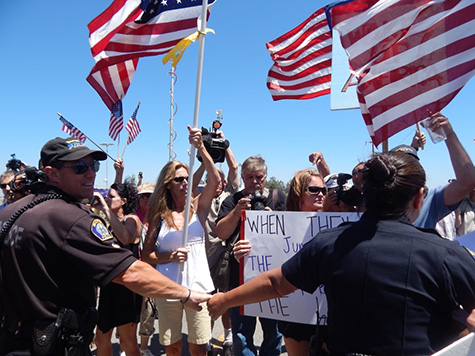
Yesterday, Target announced you can not carry guns in their store. Consider the Black Panther carrying guns. Angry white folks blocked buses carrying young refugees from South America. They waved American flags. Here are the two symbols that Jaspar John’s used to sum up the American Gothic Experience. Now add the Louisiana Purchase, some Indians, Benton’s Manifest Destiny, and the Monroe Doctrine. Many well to do folks up north threatened to secede from the union because this purchase weakened their political power. They rightly claimed the U.S. Constitution did not permit the purchase of more territory, and thus, expansion. “Go back!” the protestors screamed – like bald eagles!
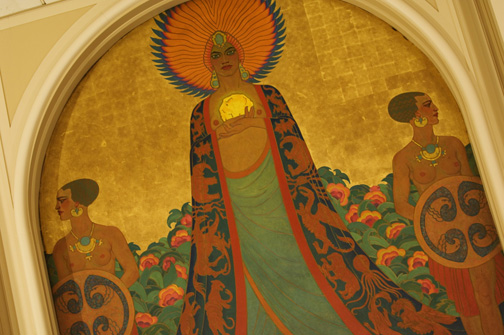
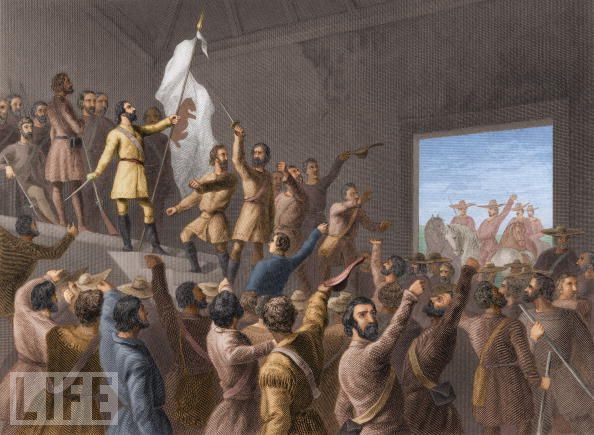
Lawrence McDonald began his show last night on illegal immigration by asking how California got its name. Calafia is a fictional black goddess, an amazon who lives on an island in the Pacific with Griffins she launched against Christian Knights in a war that Islam launches against Spanish forces who once ruled California before the Bear Flag Rebellion that was backed by John Fremont and Senator Thomas Hart Benton. Here is the a prophetic book that predicts the coming of President Barack Obama who lying evangelical propagandist claim has ambitions to be the Caliphate of the World. Calafia comes from khalifa, meaning “successor”. Consider the fact ISIS is the name of a very popular Egyptian Goddess. Has the Battle of Armageddon began in California?
Thomas Hart Benton worked hard to keep British, French, and Habsburg royalty out of North America that was inhabited by Native Americans, and then the Vikings. I believe Mary Ann Tharaldsen, a descendant of Eric the Red, has opened Pandora’s Box when she exposed to the world her lost apocalyptic Art. We are not talking about Restoration, but, Revelations. Note the Angel with Rock Guitar. Is this John Lennon, the leader of the British Rock and Roll Invasion?
Jon Presco
Copyright 2014
Texas officials appealed to the Obama administration on Thursday to secure the U.S.-Mexico border once and for all as waves of illegal immigrant children overwhelm the system, with one lawmaker saying U.S. military bases effectively have been transformed into camps to handle the influx.
“Our military bases are turning into refugee camps. I never thought I’d see this in the United States of America,” House Homeland Security Committee Chairman Michael McCaul, R-Texas, said.

Last night the Isis militant group declared its occupied territories as a new state, removing “Iraq and the Levant” from its name and announcing the “restoration of the caliphate”.
The significance of that final point may have been lost on many in the West since, apart from within the Ahmadiyya sect of Islam, there has not been a caliphate since the days of the Ottoman Empire.
Declaring a “caliphate” is a move that has huge ideological and theological significance. Defined as meaning “the government under a caliph”, it means Isis, now simply The Islamic State (IS), has declared its leader Abu Bakr al-Baghdadi as the spiritual leader of all Islam.
The word “caliph” comes from the Arabic khalifa, meaning “successor”. Its use means the IS claims Baghdadi as the only legitimate successor to the Prophet Mohammed.
Isis (Ancient Greek: Ἶσις, original Egyptian pronunciation more likely “Aset” or “Iset”) is a goddess in Ancient Egyptian religious beliefs, whose worship spread throughout the Greco-Roman world. She was worshipped as the ideal mother and wife as well as the patroness of nature and magic. She was the friend of slaves, sinners, artisans and the downtrodden, but she also listened to the prayers of the wealthy, maidens, aristocrats and rulers.[1]
Calafia is a fictional warrior queen who ruled over a kingdom of Black women living on the mythical Island of California. The character of Queen Calafia was created by Spanish writer Garci Rodríguez de Montalvo who first introduced her in his popular novel entitled Las sergas de Esplandián (The Adventures of Esplandián), written around 1500.[1]
In the novel, Calafia is a pagan who is convinced to raise an army of women warriors and sail away from California with a large flock of trained griffins so that she can join a Muslim battle against Christians who are defending Constantinople. In the siege, the griffins harm enemy and friendly forces, so they are withdrawn. Calafia and her ally Radiaro fight in single combat against the Christian leaders, a king and his son the knight Esplandián. Calafia is bested and taken prisoner, and she converts to Christianity. She marries a cousin of Esplandián and returns with her army to California for further adventures.[2]
The name of Calafia was likely formed from the Arabic word khalifa (religious state leader) which is known as caliph in English and califa in Spanish. Similarly, the name of Calafia’s monarchy, California, likely originated from the same root, fabricated by the author to remind the 16th-century Spanish reader of the reconquista, a centuries-long fight between Christians and Moslems which had recently concluded in Spain. The character of Calafia is used by Rodríguez de Montalvo to portray the superiority of chivalry in which the attractive virgin queen is conquered, converted to Christian beliefs and married off.
http://en.wikipedia.org/wiki/Calafia
Napoleon’s asking price worked out to be about four cents an acre.
The deal was struck in April 1803, but it brought a good deal of controversy. While American development in the 19th century depended on western expansion, it also raised controversial issues that might lead to the disunion of the United States. Some New England Federalists, for example, began to talk of seceding from the U.S. since their political power was dramatically reduced by the purchase.
Further, Jefferson had clearly not followed his own strict interpretation of the Constitution. Federalist critics howled that the Constitution nowhere permitted the federal government to purchase new land. Jefferson was troubled by the inconsistency, but in the end decided that the Constitution’s treaty-making provisions allowed him room to act.
Most of the Senate agreed and the Louisiana Purchase easily passed 26 to 6. The dramatic expansion also contradicted Jefferson’s commitment to reduce the national debt as swiftly as possible. Although 15 million dollars was a relatively small sum for such a large amount of land, it was still an enormous price tag for the modest federal budget of the day.
Manifest Destiny had serious consequences for Native Americans, since continental expansion implicitly meant the occupation and annexation of Native American land, sometimes to expand slavery. The United States continued the European practice of recognizing only limited land rights of indigenous Peoples. In a policy formulated largely by Henry Knox, Secretary of War in the Washington Administration, the U.S. government sought to expand into the west through the nominally legal (by United States law) purchase of Native American land in treaties. Indians were encouraged to sell their vast tribal lands and become “civilized”, which meant (among other things) for Native American men to abandon hunting and become farmers, and for their society to reorganize around the family unit rather than the clan or tribe. The United States therefor acquired lands by treaty from Indian nations, usually under circumstances which suggest a lack of voluntary and knowing consent by the native signers, and in many cases a lack of authority by the signers to make any such transaction.
Manifest Destiny was always a general notion rather than a specific policy. The term combined a belief in expansionism with other popular ideas of the era, including American exceptionalism and Romantic nationalism. While many writers focus primarily upon American expansionism when discussing Manifest Destiny, others see in the term a broader expression of a belief in America’s “mission” in the world, which has meant different things to different people over the years. This variety of possible meanings was summed up by Ernest Lee Tuveson, who wrote:
A vast complex of ideas, policies, and actions is comprehended under the phrase ‘Manifest Destiny’. They are not, as we should expect, all compatible, nor do they come from any one source.[7]
John L. O’Sullivan, sketched in 1874, was an influential columnist as a young man, but is now generally remembered only for his use of the phrase “Manifest Destiny” to advocate the annexation of Texas and Oregon.
Journalist John L. O’Sullivan, an influential advocate for Jacksonian democracy, wrote an article in 1839[8] which, while not using the term “Manifest Destiny”, did predict a “divine destiny” for the United States based upon values such as equality, rights of conscience, and personal enfranchisement– “to establish on earth the moral dignity and salvation of man”. This destiny was not explicitly territorial, but O’Sullivan predicted that the United States would be one of a “Union of many Republics” sharing those values.[9]
Six years later O’Sullivan wrote another essay which first used the phrase Manifest Destiny. In 1845, he published a piece entitled Annexation in the Democratic Review,[10] in which he urged the U.S. to annex the Republic of Texas, not only because Texas desired this, but because it was “our manifest destiny to overspread the continent allotted by Providence for the free development of our yearly multiplying millions”.
The United States had long been interested in acquiring Cuba from the declining Spanish Empire. As with Texas, Oregon, and California, American policy makers were concerned that Cuba would fall into British hands, which, according to the thinking of the Monroe Doctrine, would constitute a threat to the interests of the United States. Prompted by John L. O’Sullivan, in 1848 President Polk offered to buy Cuba from Spain for $100 million. Polk feared that filibustering would hurt his effort to buy the island, and so he informed the Spanish of an attempt by the Cuban filibuster Narciso López to seize Cuba by force and annex it to the U.S., and the plot was foiled. Nevertheless, Spain declined to sell the island, which ended Polk’s efforts to acquire Cuba. O’Sullivan, on the other hand, continued to steal money for filibustering expeditions, eventually landing him in legal trouble
Manifest Destiny had serious consequences for Native Americans, since continental expansion implicitly meant the occupation and annexation of Native American land, sometimes to expand slavery. The United States continued the European practice of recognizing only limited land rights of indigenous peoples. In a policy formulated largely by Henry Knox, Secretary of War in the Washington Administration, the U.S. government sought to expand into the west through the nominally legal (by United States law) purchase of Native American land in treaties. Indians were encouraged to sell their vast tribal lands and become “civilized”, which meant (among other things) for Native American men to abandon hunting and become farmers, and for their society to reorganize around the family unit rather than the clan or tribe. The United States therefore acquired lands by treaty from Indian nations, usually under circumstances which suggest a lack of voluntary and knowing consent by the native signers, and in many cases a lack of authority by the signers to make any such transaction.
In June 1813, Jackson served as a second for Billy Carroll in a duel with Jesse Benton, Jr., Thomas’s brother. Both men were severely wounded and the Benton-Jackson friendship came to an abrupt end. In September, in Nashville, Jesse and Thomas Benton met Jackson and one of his friends, Colonel John Coffee. Fist-fighting erupted, knives were used, shots were fired, and Jackson was badly wounded in the arm while Thomas Benton received several minor knife wounds. Before the fight ended several other people got into it and it finally ended when the last men standing fell down a flight of stairs. The Bentons claimed victory, but recognized that Thomas’s political future in Tennessee was damaged beyond repair. Later that month, Jackson led the militia against a band of Creek Indians led by Chief Red Eagle and scored what was counted to be an important victory against British inspired hostile Indian attack. Benton, no longer in the militia, was involved in organizing and training the 39th Infantry Regiment. In 1814 Benton’s unit was ordered to join General Jackson in an all-out attack on hostile Indians, but, to his dismay, Benton was directed to return to Nashville on recruitment duties. In June Jackson assumed command of the entire Southwest Military District. Benton tried repeatedly to get into action with either Indians or the British, but Jackson consistently refused to permit it. In frustration Benton again went to Washington seeking a combat position in the north. After a very long wait he was finally ordered to Canada just as word came of Jackson’s victory in New Orleans and the signing of the treaty that ended the war.
In 1823 Benton began focusing on Oregon, arguing that steps should be taken to assure that the territory would eventually become part of the United States. An agreement with Great Britain calling for joint occupation was to expire in 1828. In 1824 Benton began agitating for a constitutional amendment that would do away with the electoral college and permit direct election of the president. He also offered a plan to change the government’s land policy making it easier for common citizens to purchase government lands. In support of his various proposals he began printing leaflets for public distribution in an attempt to gain public support for his policies. In the fall of 1823 Jackson was elected to the Senate from Tennessee. He and Benton reconciled their differences, sat next to each other in the senate, and worked well together on the Military Affairs Committee. On May 31, 1824 Elizabeth gave birth to their second child – Jessie Ann Benton. In the run up to the 1824 presidential election Benton supported his cousin-in-law Henry Clay over Andrew Jackson, John Quincy Adams, and William H. Crawford. In that election eighteen of the twenty-four states selected their candidate of choice by popular vote rather than by the respective state legislatures. Jackson received the greatest number of popular votes but only 99 electoral votes. Adams was next with 84 electoral votes, then Crwaford with 41 and finally Clay with 37. None had received enough electoral votes to win the presidency and the elction was thrown into the House of Representatives.
Once it was clear that Clay could not be elected, Benton switched his support to Jackson, but Adams emerged as President and Clay was made Secretary of State. Jackson’s supporters claimed that Adams had made a “corrupt bargain” with Clay that would ensure that Clay would succeed him to the presidency in 1828. Benton rejected this charge, but no longer supported Clay. Eventually the two men ceased to be personal friends. In April 1825 Benton was part of the official welcome party for the Marquis de Lafayette’s visit to St. Louis. That same year a new newspaper was established in the city and absorbed the Enquirer
In December 1835 Jackson announced that for the first time in the history of the United States the public debt had been completely paid off. In 1836 Benton was nominated for Vice-President by the Mississippi Democratic Party Convention.
Benton’s daughter, Jessie, fell in love with Lieutenant John Charles Fremont, but her parents felt that they were too young for marriage. Fremont was sent off on a surveying trip. In October, on his return, they married secretly. In 1843 the senate again debated the future of the Oregon Territory with Benton arguing that it was rightfully United States territory. In February 1844 Benton was injured in the explosion of the “Peacemaker” canon aboard the Princeton and Secretary of State Abel P. Upshur was killed. President Tyler appointed John C. Calhoun to replace Upshur. In April 1844, Calhoun negotiated a treaty that would annex Texas to the Union and in his argument for the treaty emphasized the importance of protecting Texans’ right to own slaves. Benton supported annexation, but worried that it might provoke war with Mexico unless it was handled carefully and not rushed. Van Buren also questioned “immediate” annexation, while James K. Polk declared his support. Benton introduced a bill that would authorize the president to negotiate with both Texas and Mexico. In the subsequent debate Benton warned that the issue of slavery in Texas might ultimately lead some to advocate disunion. Van Buren’s position on Texas lost him the Democratic nomination for president. It went to Polk instead.
In November 1844 Polk was elected president and Benton was reelected to the senate. Texas was annexed. In June 1845 Jackson died. During 1845 and 1846 Benton continued to advocate the absorption of Oregon into the Union. The northern border of the Oregon Territory became an issue. Benton argued for a demarcation along the 49 degree line. Polk agreed and the final treaty was negotiated on that basis. Also in 1845 relations between the United States and Mexico deteriorated and eventually led to war in April 1846. At first reluctant to declare war on Mexico, Benton eventually cooperated with Polk in prosecuting the war. Benton was chairman of the Senate Military Affairs Committee and claimed to be the one who first suggested the plan for the southern campaign against Mexico City. In fact Benton wanted to lead it himself. John C. Fremont became involved in the conquest of California, during which he and Major General Stephan Kearny got into a serious disagreement and Fremont was court-martialed. Benton defended him during the court-martial proceedings, but he was found guilty on all charges and dismissed from the service. President Polk agreed that Fremont was guilty of insubordination, but offered to reinstate him in the army. Fremont refused and Benton was furious with the army and with the president. In January 1848 gold was discovered in California. During 1848 the senate debated the issue of governance in Oregon and California. Slavery quickly became an issue blocking agreement and Benton recommended that the citizens organize their own governments.
In November 1848 the Whig candidate, Zachary Taylor, was elected president. In January 1849 Benton proposed legislation that would create a national road from the Mississippi River to San Francisco Bay. At the same time a group of southern politicians led by John C. Calhoun prepared and signed the so-called Southern Address declaring that the Federal Government had no right to restrict slavery. Benton refused to sign. Within Missouri Benton was faced with severe opposition by pro-slavery advocates. In October 1849 Benton spoke at the St. Louis Railroad Convention in support of his National Road proposal. In the 1850 senatorial debates concerning the legal status of the new lands taken from Mexico, Benton supported President Taylor and opposed the Clay compromise. In the process he parted company with many Democrats and began to isolate himself politically. In January 1851 Benton was defeated and the Whig pro-slavery candidate, Henry S. Geyer, was elected to the Senate in his place. After his defeat, Benton started writing a book but also remained active in the Missouri political scene. On August 2, 1852, he was elected to the House of Representatives and took his seat in Washington in December 1853. In the spring of 1854 the first volume of Benton’s book, Thirty Years View, was published. It was criticized by many political leaders but well received by the public. It sold well and Benton made money on it.
In 1862, French forces under Napoleon III invaded and conquered Mexico, giving the country to Austrian-born Emperor Maximilian. Americans proclaimed this as a violation of “The Doctrine,” but were unable to intervene because of the American Civil War. This marked the first time the Monroe Doctrine was widely referred to as a “doctrine.” After the civil war came to an end, the U.S. brought troops down to the Rio Grande in hopes of pressuring the French government to end its occupation. Mexican nationalists eventually captured the Emperor and executed him, reasserting Mexico’s independence.
 Rosamond Press
Leave a comment