


Some of the original Diggers are copyrighting much of their history which goes against their idealogy. The OCCUPY and Whiteaker Anarchists have stolen the Digger’s playbook. I am going to reveal the amazing discovery I made two months ago concerning Joaquin Miller and Pre-Raphaelitism that will put the founding of American Bohemianism in the Oakland Hills. Hobbitism was born next door in Berkeley. Alterative British Culture came to America long before the Beatles.
Hobbitism has thrived in Eugene Oregon, but, the children of the Hobbits are vicious and selfish anarchists who believe they have invented radicalism.
Jon Presco
Hobbitism
Hobbitism is a broad term for the body of hobbits and hobbit like people, their theologies and doctrines, ethical, spiritual, and behavioral characteristics, as well as their numerous and specific meals and in general their ravenous eating habits. It can also refer to human beings or other creatures sharing obvious or numerous traits of the hobbits.
http://www.nytimes.com/1954/10/31/arts/103154RING.html?_r=0
http://en.wikipedia.org/wiki/Pre-Raphaelite_Brotherhood
The Digger Archives is an ongoing Web project to preserve and present the history of the anarchist guerrilla street theater group that challenged the emerging Counterculture of the Sixties and whose actions and ideals inspired (and continue to inspire) a generation (of all ages) to create models of Free Association.
The Diggers were one of the legendary groups in San Francisco’s Haight-Ashbury, one of the world-wide epicenters of the Sixties Counterculture which fundamentally changed American and world culture. Shrouded in a mystique of anonymity, the Diggers took their name from the original English Diggers (1649-50) who had promulgated a vision of society free from private property, and all forms of buying and selling. The San Francisco Diggers evolved out of two Radical traditions that thrived in the SF Bay Area in the mid-1960s: the bohemian/underground art/theater scene, and the New Left/civil rights/peace movement.
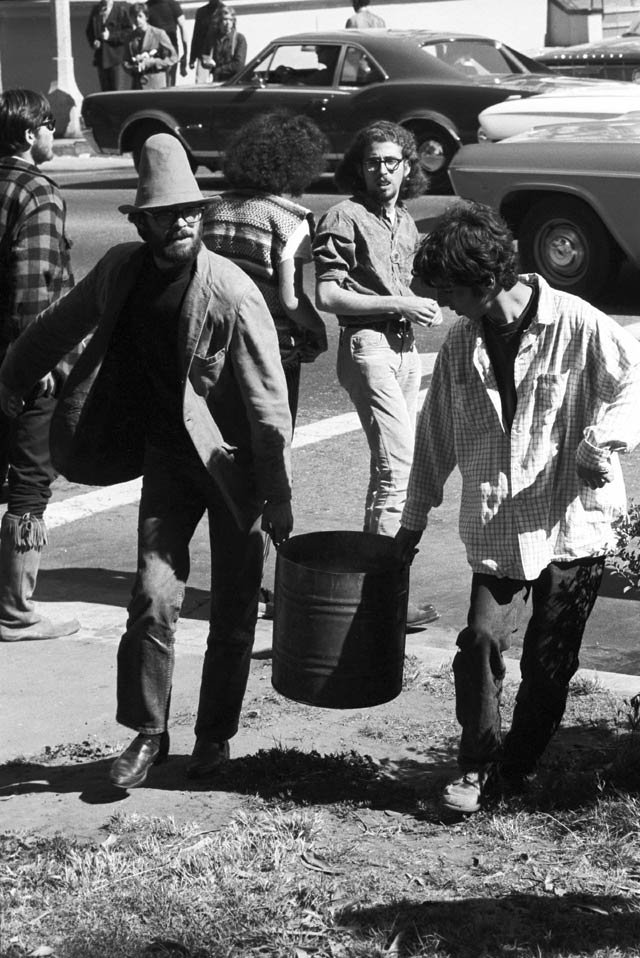
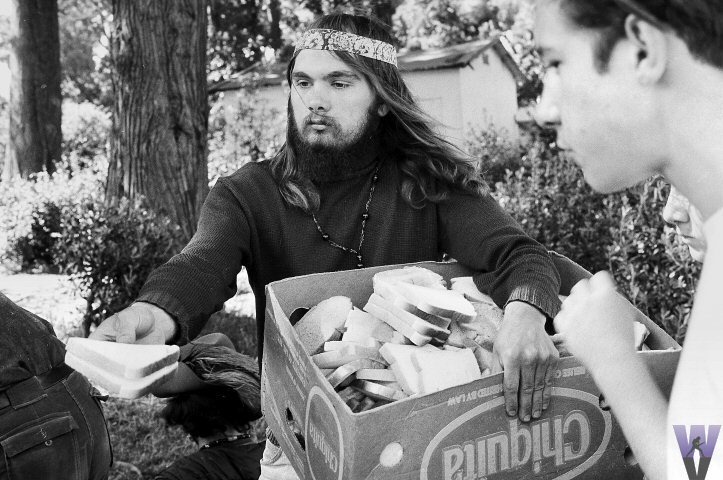
The Diggers combined street theater, anarcho-direct action, and art happenings in their social agenda of creating a Free City. Their most famous activities revolved around distributing Free Food every day in the Park, and distributing “surplus energy” at a series of Free Stores (where everything was free for the taking.) The Diggers coined various slogans that worked their way into the counterculture and even into the larger society — “Do your own thing” and “Today is the first day of the rest of your life” being the most recognizable. The Diggers, at the nexus of the emerging underground, were the progenitors of many new (or newly discovered) ideas such as baking whole wheat bread (made famous through the popular Free Digger Bread that was baked in one- and two-pound coffee cans at the Free Bakery); the first Free Medical Clinic, which inspired the founding of the Haight-Ashbury Free Medical Clinic; tye-dyed clothing; and, communal celebrations of natural planetary events, such as the Solstices and Equinoxes.
First and foremost, the Diggers were actors (in Trip Without A Ticket, the term “life actors” was used.) Their stage was the streets and parks of the Haight-Ashbury, and later the whole city of San Francisco. The Diggers had evolved out of the radicalizing maelstrom that was the San Francisco Mime Troupe which R.G. Davis, the actor, writer, director and founder of the Troupe had created over the previous decade. The Diggers represented a natural evolution in the course of the Troupe’s history, as they had first moved from an indoor milieu into the parks of the City, giving Free performances on stages thrown up the day of the show. The Digger energy took the action off the constructed platform and jumped right into the most happening stage yet — the streets of the Haight where a new youth culture was recreating itself, at least temporarily, out of the glaring eye of news reporters. The Diggers, as actors, created a series of street events that marked the evolution of the hippie phenomenon from a homegrown face-to-face community to the mass-media circus that splashed its face across the world’s front pages and TV screens: the Death of Money Parade, Intersection Game, Invisible Circus, Death of Hippie/Birth of Free.
The Diggers broadcast these events, as well as their editorial comments of the day, pronouncements to the larger Hip Community, manifestos and miscellaneous communications, through broadsides and leaflets distributed by hand on Haight Street. These Web pages are my attempt to present the story of the digger movement as it developed in the mid-to-late sixties and early seventies (and evolved in various directions even to the present). I have been collecting this Archive for forty years, and see the Web as a way to display the materials and make them available both for researchers and for all diggers past and present who want to preserve and participate in this history.
The Diggers were a radical community-action group of activists and Improvisational actors operating from 1967 to 1968, based in the Haight-Ashbury neighborhood of San Francisco. Their politics have been categorized as “left-wing”; more accurately, they were “community anarchists” who blended a desire for freedom with a consciousness of the community in which they lived.[citation needed] They were closely associated and shared a number of members with the guerrilla theater group San Francisco Mime Troupe.
Actor Peter Coyote was a founding member of the Diggers.
Contents
[hide]
1 Origins
2 Activities
3 See also
4 References
5 Books
6 External links
Origins[edit]
The Diggers took their name from the original English Diggers (1649–50) who had promulgated a vision of society free from buying, selling, and private property.[1] During the mid- and late 1960s, the San Francisco Diggers organized free music concerts and works of political art, provided free food, medical care, transport, and temporary housing and opened stores that gave away stock. Some of their happenings included the Death of Money Parade, Intersection Game, Invisible Circus, and Death of Hippie/Birth of Free.[2]
The group was founded by Emmett Grogan, Peter Coyote, Peter Berg (later director of Planet Drum),[3] and other members of the San Francisco Mime Troupe including Billy Murcott, Roberto La Morticella, and Brooks Bucher.[2]
Activities[edit]
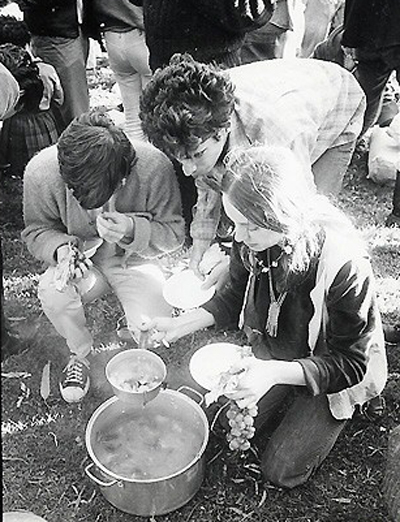
The group sought to create a mini-society free of money and capitalism.[4] The Diggers provided a free food service in the Panhandle of Golden Gate Park in Haight-Ashbury every day at four o’clock, generally feeding over 200 people with a stew from donated meat and vegetables that was served from behind a giant yellow picture frame, called the Free Frame of Reference. On one occasion, at a free concert in the park, people who came for the food were given a two-inch-by-two-inch frame to hang about their necks, called the portable Free Frame of Reference. The Diggers also popularized whole wheat bread with their Digger Bread, baked in coffee cans at the Free Bakery in the basement of Episcopal All Saints Church on 1350 Waller Street.[1] In cooperation with All Saints Church and later via the Haight Ashbury Switchboard at 1830 Fell Street, they arranged free “crashpads” for homeless youth drawn to the Haight-Ashbury area.
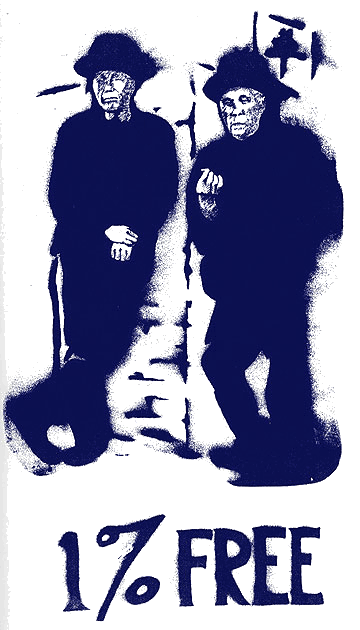
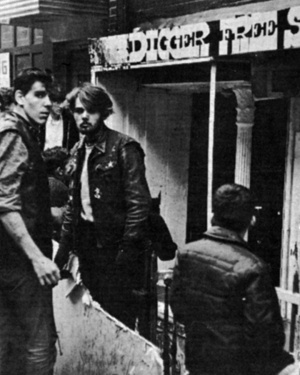
They opened numerous Free Stores in Haight-Ashbury, in which all items were free for the taking or giving. The stores offered discarded items that were still in usable condition. The first Free Store, in a six-car garage on Page Street that they found filled with empty frames that they tacked up on the side of the building, was called the Free Frame of Reference and was later superseded by the Trip Without a Ticket on Frederick Street. It was unclear how the stores were funded. The 1% Free poster, showing two Chinese Tong assassins under the Chinese character for revolution, was thought to be demanding a 1% tithe from merchants, but that was not the case. The poster was a challenge, implicitly suggesting that ‘free’ people were the minority, and inciting others to step up. They also opened a Free Medical Clinic, initially by inviting volunteers from the University of California, San Francisco medical school up the hill from the neighborhood.
They threw free parties with music provided by the Grateful Dead, Janis Joplin, Jefferson Airplane and other bands. They also staged street theater events such as driving a truck of semi-naked belly dancers through the Financial District, inviting brokers to climb on board and forget their work. On December 17, 1966, the Diggers held a happening called “The Death of Money” in which they dressed in animal masks and carried a large coffin full of fake money down Haight Street, singing “Get out my life, why don’t you babe?” to the tune of Chopin’s “Death March.”[5] This was a precursor to the happening “The Death of Hippie,” staged in October 1967. In “The Death of Hippie,” also staged in the Haight Ashby neighborhood, masked participants carried a coffin with the words “Hippie–Son of Media” on the side. This event was meant to mark the end of the era of Haight-Ashbury. The event was staged in such a way that any media outlet that simply described the happening would unknowingly transmit the Diggers’ message that Hippies were a media invention. This was called “creating the condition you describe”.[6] The Diggers skillfully used this technique for media relations. Their own publications, notably the Digger Papers, are the origin of such phrases as “Do your own thing” and “Today is the first day of the rest of your life.” The Diggers fostered and inspired later groups like the Yippies.
Contrary to popular opinion, the Diggers did not fall apart but evolved into the larger and more complex Free Family.[citation needed] While the Free Food and Medical Clinics were responses to necessary conditions caused by the enormous influx of young people during the heyday of the hippie scene, conditions that the San Francisco government was ignoring, the Diggers’ central tenet was to be “authentic”. Running soup kitchens and medical clinics was not the authentic, long-term concern of the Diggers’ founders. After passing those institutions on to a local Church and Dr. David Smith to continue, the Diggers moved out of the City, creating various land bases in Forest Knolls, Olema, Covelo, Salmon River, Trinidad, and Black Bear California. In those places they integrated with other groups: The Free Bakery, the Up Against the Wall Motherfuckers, and the Gypsy Truckers, creating The Free Family. That larger group still exists informally, and many of the Diggers’ children and grandchildren remain close and in contact with one another, and many (children included) are still involved with progressive causes.
Various alternative communities like those the Diggers founded were covered in a documentary film made by Will Vinton, who later went on to fame for his ClayMation clay-animation studio in Portland, Oregon, His 1970-ish documentary feature-length film was titled “Gone for A Better Deal,” which, so far, has never been released to any video format.
Haight-Ashbury Golden-Gate park poet Ashleigh Brilliant, later known for his series of epigrams on cards and in books called “pot-Shots,” has recently released a CD of his songs, parodies of old movie and show tunes about “life in the Haight.” The album includes two songs about the Diggers.
—Laughlin recruited many of the early psychedelic musical talent including the Grateful Dead, Jefferson Airplane, Iron Butterfly, The Charlatans, and others. Laughlin and George Hunter of The Charlatans band, were true “proto-hippies” wearing long hair, boots, and outrageous clothing. Together they opened the Red Dog Saloon in the old mining town of Virginia City, Nevada. The Red Dog Saloon became a focal point of drugs and psychedelic music festivals. During this time, LSD manufacturer Owsley Stanley, who also lived in Berkeley, provided much of the LSD to the burgeoning hippie scene. Stanley, an ex-army radar operator, converted his amphetamines lab to an LSD lab and became one of the first millionaire drug dealers in the United States. His LSD product became a part of the “Red Dog Experience”, the early evolution of psychedelic rock and the budding hippie culture. image:http://ifitshipitshere.blogspot.com/2010/05/dennis-hopper-behind-camera-and-canvas.html Read More:http://ifitshipitshere.blogspot.com/2010/05/dennis-hopper-behind-camera-and-canvas.html
http://madamepickwickartblog.com/2011/08/d-i-y-pranksters-staying-on-the-bus/
Digger Poster from 1968
Image: Digger Archive
The San Francisco Diggers became one of the legendary groups in the Haight-Ashbury during the years 1966 to 1968. Shrouded in a mystique of anonymity, they took their name from the original English Diggers of the 1640s. The San Francisco Diggers combined street theater, anarcho direct action, and art happenings in their social agenda. Their most famous activities revolved around Free Food (every day in the Panhandle), and the Free Store (where everything was free for the taking). They produced a series of events that mark the evolution of the hippie phenomenon from a homegrown face-to-face community to the mass-media circus that splashed its face across the world’s front pages and TV screens.
In front of their truck, named “The Albigensian Ambulance Service” is Judy Goldhaft (left) holding Ocean Berg, Destiny Gould holding Solange, and Peter Berg (right), c. 1966.
In front of their truck, named “The Albigensian Ambulance Service” is Judy Goldhaft (left) holding Ocean Berg, Destiny Gould holding Solange, and Peter Berg (right), c. 1966.
http://foundsf.org/index.php?title=San_Francisco_Diggers
http://foundsf.org/index.php?title=San_Francisco_Diggers
Judy Goldhaft
November 16, 1967, Vol. XIII, No. 5
Not Everyone Loves You For Giving Things Away
by Ross Wetzsteon
To those of us who live on East 10th Street between First Avenue and Avenue A, the Diggers’ Free Store doesn’t have anything to do with the residue of capitalism or the exorcism of money. It’s just the reason we see a lot more police lately, or the explanation for the huge pile of garbage in the middle of the block (officially, the store is “a commercial enterprise”), or the subject of ominous rumors (is it true they have guns? did the police tacitly agree to let the neighborhood gamblers drive them out?).
But to some on our block, the Diggers — flamboyant, energetic, highly visible — are nothing but turf trouble, and last Thursday night, in a series of volleys at half-hour intervals, bricks sailed off the roof of the building across the street through the plate-glass windows of the store.
A couple of days later, I walked across the street to ask Richie and Suzi about the trouble. At first, they seemed to suspect I was a narcotics detective and were reluctant to talk. But suddenly they opened up — in a disoriented flow of bitterness, exuberance, anger, and hope, wild swings in which the medium was not so much language as energy, all punctuated with frequent requests to “print that!”
“We’re going to split, man,” Suzi said. “I’m afraid someone’s going to get killed in all this.”
“It’s just like the gangster days,” Richie was saying at the same time. “The only way these Puerto Ricans will respect you is if you kick their asses.”
As he worked on his dismantled motorcycle, he talked about his several encounters with the Puerto Ricans on the block. “These seven guys feel they own the street.” Apparently the trouble started when “I beat the living bejesus out of their leader. They’ve got to get rid of us to save face.” About the only thing that’s kept the lid on this long is that one of the seven is wanted on a rape charge and is hiding out.
The night before the volleys of bricks, “this cat with a knife came up here saying he was going to kill us.” His hand was bleeding, so they took him in, gave him a beer, bandaged his hand, and told him to “cool his head.” Soon he left, but in 10 minutes he was back, claiming he’d left his leather jacket. Who swung first? Anyway, Richie speargun guided the fight out onto the street, police arrived, and to Richie’s amazement, again “this cat threatened to kill us — right in front of the cops.”
“If we get out of here, those cats are going to be joyous,” Suzi said. And though she’d said, just 20 minutes earlier, “we’re going to split,” now she seemed determined to stay.
But that reminded them of their problem — money — and they spoke with a great deal more bitterness. If they’re disillusioned, it isn’t at racial violence but at the dogged persistence of money. “Nobody cares about the store,” they complained. “It’s not our store, it’s everybody’s store” — but “everybody” has diminished, in just a few weeks, to a small core of fewer than a dozen people.
Abbie Hoffman? — “he ain’t shit.”
The communes? — “they tell us how we ought to do things but they won’t help us with the work.”
Benefits? — “500 people came to one and you know how much we got? $85.”
“One cat left us make a documentary for ABC for $3000 — do you think we’re going to see any of that money?” But they were just as bitter about the day they made oatmeal instead of stew and “this spade over in the park took one bite, spit it out, and said ‘this shit’s oatmeal!’”
The most specific threat is the lease on the store — the landlord wants a “responsible” person to sign. “Paul Krassner is the only motherfucker who cares,” Richie said. “He offered to sign the lease for us. He even offered to pay our rent for a year. But we can’t put that burden on him. We don’t want to be in a position to have to say ‘hey, Paul, we need this,’ or ‘hey, Paul, we need that’.”
But the conversation kept returning to “that cat who came up here with a knife.” “Death was close that night,” Suzi said.
On the block, everyone speculates about how long the Diggers can stick it out. Richie and Suzi seem to take both the longest and the shortest view, swinging in only minutes from exuberant optimism to exhausted pessimism.
“Since this store’s opened I’ve seen such good and such shit,” Suzi said. “I mean I’ve had experiences…”
After a pause she added, almost absently, “but you can’t live on nothing.” This might have been an interesting irony, coming from a Digger, but I had the feeling she meant more than money.
http://blogs.villagevoice.com/runninscared/2010/03/hippies_free_st.php
http://www.diggers.org/hodgdon_aquarius.htm
Manhood in the Age of Aquarius
Masculinity in Two Countercultural Communities, 1965–83
by Tim Hodgdon
Tim showed up on the Digger Forum suddenly one day and announced he was writing a book in part about the Digger/Free Families, looking at the changing role of masculinity that the counterculture wrought. I thought, good luck, given the heavy egos of the original Digger men. Fortunately for Tim and for the rest of us, several of the women opened their hearts and poured forth their wisdom. When Tim’s book was published in 2008, he decried the copyright entanglements that prevented his posting the Digger chapters here. Well, at long last (and long delay due in no small part to your inveterate archivist’s itinerant habits) these writings are now available. Respecting Tim’s wishes, I am linking to the Gutenberg-e.org Open Access Terms and Conditions under which we have permission to republish these chapters.
Thank you, Tim. And congratulations on a fine contribution to Digger History.
All the following (excepting one) are Adobe PDF documents which require Adobe Reader.
Chapters/Sections
Preface
Abbreviations
Introduction. With Flowers in Their Hair?: Remembering Countercultural Masculinity
Chapter 1. Origins: The Diggers, the Haight-Ashbury, and Hip Identity
Chapter 2. The Diggers and the Postwar “Crisis of Masculinity”
Chapter 3. Brothers and Rivals, Stud Peacocks and Earth Mothers: Gender Relations among the Digger Heavies
Bibliography
Index
About Tim Hodgdon
There are three additional chapters in this masterful analysis. They pertain to the group of San Francisco hippies who followed Stephen Gaskin to Tennessee in 1971 to form The Farm. For anyone interested in reading this part of the story, please follow this link to Tim’s book on the Gutenberg-e site.
http://www.thestripproject.com/category/hippies/
http://beta.shapingsf-wiki.org/index.php?title=San_Francisco_Diggers

 Rosamond Press
Leave a comment