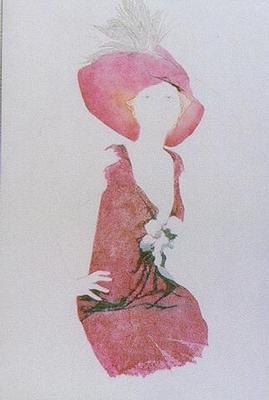


Above is the serigraph ‘Cleo’ that the world-famous artist, Christine Rosamond Benton, gave to me in 1987. Rosamond signed it with these words;
“To my beloved brother.”
Several days later I erased these words and gave Cleo to my childhood friend, Nancy Hamren. Nancy was the first girl I kissed, we had just turned thirteen. Her grandmother’s recipe for yogurt made the Kesey family very wealthy.
Cleo was rendered from the photograph of Christine stretching her neck out. Our mother made a comment that her eldest daughter to not get the long neck of the Rosamond women, but rather Melba’s neck, our father’s mother, who disowned all four of her grandchildren just before she died.
When was living in the foothills near Yosemite, I ran out of food. I called Christine and asked her if I could borrow $50 dollar. She said this;
“You’ll never see a dime from my art.”
A couple of years later, Rosamond said this to me on the phone;
“I demand you tell me where you live because I’m going to have you killed!”
Both my sister’s conspired to get me away from our father who had inherited his mother’s estate, he her only beneficiary because not one of his four children showed up at her death-bed.
“Vicky didn’t tell you Melba was dying. I am positive I told her to tell you all she was dying.”
Vic invested $100,000 thousand dollars in the partnership he formed with his daughters. My sisters put me in touch with my first girlfriend who had been trying to get in touch with me for two years. She had written Christine a letter asking her of my whereabouts. They knew they could always find me through Michael Dundon. Only when it looked like Vic would have a change of heart, he cutting me out of Melba’s legacy by appearing as her loyal son, did Christine have Vicki put me on the phone.
“Guess who’s trying to get hold of you?”
When I met Belle Burch in Ken Kesey Square, I wondered if she was borderline homeless. She had a pack on her back. When she told me her name, I was already making plans to make this beautiful young woman my heir. I offered to make her my co-author, and when she came over to model, I was going to offer to teach her Rosamond’s style. I had just made an amazing discovery concerning Juanita Miller and the Pre-Raphaelite Artists that is guaranteed to put my family in the Art History books.
Three days ago I found another of my grandfather’s books that will become famous in the annals of Country Western Music. The Rosamond literary legacy is proving superior to the art legacy that I wanted Belle to take over so I could concentrate on these revelations that entitle me to author the next Lord of the Rings books because William Morris was one of my heroes. Morris had a profound influence on J.R. Tolkien.
I am the only member of my family who has never realized a dime from Rosamond’s success. This is deliberate. My ex-friend, Casey Farewell, kept encouraging me to make this blog a app. In the last two months I had 14,175 visitors to this blog. If I had charged them a $1 dollar, I would have made $14,175 dollars.
This question begs to be asked…….Was Belle Burch considering an app, or, anyone she knows?
Here’s another nagging question……Did Belle contact Alley Valkyrie when I started blogging about my suspicions, or, was Alley already reading my blog? If she was reading this blog, when did she start reading it?
I sent Belle several e-mails after I posted my concerns. I left a message on her phone, and, she picked up once. She would not talk to me. Why? If she was concerned about her reputation, why did she not TRY to convince me to remove my posts? One answer is, she/they wanted to see how much I had figured out. How close was I to the truth. Was I very angry, and thus would not remove my suspicions. But, more than that I make it clear that I am trying to prevent any publisher from handling this blog thinking Belle Burch is my agent. I highly suspect there was a book contract in the works that could have existed before Belle made an appointment with me at the Wandering Goat.
Why did Belle take such a huge risk by bringing Alley into this matter? The answer is…….MONEY!
Belle had to trust me so she could own money. But, could the other person trust me? There has to be another person, a co-conspirator who sees she/he is going to be out of ‘The Running For The Roses’ and, has a hold over Belle. This person has to be Alley Valkyrie, because she was taking a huge risk. If she failed to back me off from my suspicions, then her reputation would be shot. This is why she tried to get the Whiteaker Community Council to demonize me. She tried to get Art History on her side. Alley did not count on the 14,175 readers of this blog in the last two months. They only found out, yesterday.
Here is the list of Rosamond’s images that the executor made after Christine’s mysterious death. The family partnership prints are;
Melinda
Beach
Lena and Sisters
Maggie

There were 8,000 prints total. They were not supposed to be sold for under $450 dollars. Many of these prints are un-singed, thus rendering them valueless. Pierrot got the executor to issue and Estate Seal.
In the claim I filed in order to stop the sale of the Family Creative Legacy, I speak of my becoming a New Pre-Raphaelite in 1969. Two weeks after Christine’s death, my sister, Vicki Presco, showed me the handwritten copy of our sisters autobiography, that begins…
“Everyone believed my brother would become a world-famous artist one day, but, it was not meant to be.”
Did Rosamond also steal the Sword of Green (Money) Destiny from her teacher?
This 276 page work, was disappeared. I believe this is because it devotes many pages to demonizing me and making me a “parasite” on her fame, he art, that she did not do when a child. I am depicted as a child molester who catches my sister in the close when she is four, drawing. My family knew this was bullshit, and nixed this book, because they were angry at Christine because she owed my kindred money. Rosamond filed bankruptcy just before she died. Hmmmm!
“One of Swinburne’s earliest works about love is Rosamond, a drama in the Elizabethan style, but one that employs a medieval setting and real historical figures as characters. Published in 1860, this play is extra-ordinarily significant for the poet’s future themes and artistic development.”
Below is a conversation Kipling had over Bret Harte’s poem ‘The Heathen Chinee’ where Swinburne’s poem id discussed. Swineburne was a Pre-Raphaelite Poet and good friends with the Rossetti family. I have been giving new life to these literary conversations and Belle Burch knows it because she studied literature at Lane College. Her heinous crime against Art and Literature, will go down in history. This is not my doing. I offered Belle the World. I put a glass slipper on her foot! But, the other saw her chances…….fading away!
Christine Rosamond Benton never foresaw me becoming a great writer and historian. And, I must chuckle…..in a French manner! Belle speaks perfect French. Why do these Rosamond Women have such a need to destroy me in such a heinous manner? It can’t be just about money. Perhaps it has something to do with unrequited love? Did these women ever find anyone like me?
My first girlfriend let me video tape her defense of me, but, when she heard the terrible threats, she became afraid. When she was fifteen she confronted Rosemary’s hold over me, and my mother beat her up. Alley’s words are Rosemary’s wrath born again from the grave.
Rosemary and Rosamond loved me in a uncommon way, because I was Their Mirror they gazed into after the Beast was gone. I was their light, their muse, their teacher, their lover of the truth. I am the Phantom of this Soap Opera. I write about the Muse of the Night who put Christine in a swan boat.
When Belle saw me from afar, like a moth to a flame she came to behold herself in my mirror that captures beauty. If I was twenty-five, she would be here by my side, feeding me strawberries as I type. Then she would whisper French in my ear.
hei·nous
ˈhānəs/
adjective
adjective: heinous
1. (of a person or wrongful act, especially a crime) utterly odious or wicked.
“a battery of heinous crimes”
synonyms:
odious, wicked, evil, atrocious, monstrous, abominable, detestable, contemptible, reprehensible, despicable, egregious, horrific, terrible, awful, abhorrent, loathsome, hideous, unspeakable, execrable; More
http://www.artmagick.com/poetry/poem.aspx?id=11430&name=cleopatra
Jon Presco
Copyright 2014
Et l’amour
C’est ma flamme,
Mon grand jour,
Ma chandelle
Blanche et belle,
Ma chapelle
De séjour.
. . . .
Toi, mon âime
Et ma foi,
Sois ma dame
Et ma loi;
Sois ma mie,
Sois Marie,
Sois ma vie,
Toute à moi! (Tragedies, II,14)
[“Love is my passion, it is my light, my great day, my beautiful white candle, my shrine. You, my soul and my faith, be my lady and my law; be my love, be Marie, be my life, everything to me.”]
http://en.wikipedia.org/wiki/Unrequited_love
In Something of Myself, Kipling writes: “Swinburne did not strike my very young mind as ‘anything in particular’ till I read Atalanta in Calydon, and one verse of verses which exactly set the time for my side-stroke when I bathed in the big rollers off the Ridge. As thus:-
Who shall seek – who shall bring
Who restore us the day
When the dove dipped her wing
And the oars won their way
Where the labouring Symplegades whiten the Straits of Propontis
with spray ?
If you can time the last line of it to end with a long roller crashing on your head, the cadence is complete.”
Kipling here ignores his own advice that “You should always verify you quotations” and he doesn’t get this “verse of verses” quite right. The verse is actually personal, addressed to the dying Meleager. The speaker is reminding him of his glory days as one of Jason’s Argonauts. They have come to the Clashing Rocks, great black continually-moving pinnacles which smash together and rebound. They send out a dove, and she flies between the rocks, only losing the tips of her tail-feathers as the rocks come together again. Encouraged by the omen, they row till the oars bend like bows, and they get through, though the Rocks shear off the mascot from Argo’s stern. So the verse really reads:
Who shall seek thee and bring
And restore thee thy day
When the dove dipped her wing
And the oars won their way
Where the narrowing Symplegades whitened the Straits of Propontis
with spray?
Kipling goes on: “I even forgave Bret Harte, to whom I owed many things, for taking that metre in vain in his ‘ Heathen Chinee.’ But I never forgave C- [Crofts, the prototype of King in Stalky & Co.] for bringing the fact to my notice.”
“The Heathen Chinee” is Bret Harte’s best-known poem, though in these politically-correct days we should probably give it its proper title – “Plain Language from Truthful James.”
Which I wish to remark
And my language is plain,
That for ways that are dark
And for tricks that are vain,
The heathen Chinee is peculiar,
Which the same I would
rise to explain.
Atalanta came out in 1865, and The Heathen Chinee in 1870, which gives Swinburne priority. But Bret Harte had used the metre in “Dows Flat” in 1858.
You see this ‘yer Dow
Hed the worst kind of luck:
He slipped up somehow
On each thing that he struck.
Why, ef he’d a-straddled that fence-rail,
The derned thing ‘ed get up and buck.
It would be nice to think that Swinburne somehow got to know the work of an obscure compositor from San Francisco, but it’s pretty unlikely.
So did Bret Harte and Swinburne each develop that metre independently?
Or had another poet, whom they had both read, used it before 1858?
One of Swinburne’s earliest works about love is Rosamond, a drama in the Elizabethan style, but one that employs a medieval setting and real historical figures as characters. Published in 1860, this play is extra-ordinarily significant for the poet’s future themes and artistic development. Rosamond possesses many of the virtues of Swinburne’s later tragedy Chastelard, which has attracted somewhat more critical attention, but the earlier work is usually dismissed as a mere Pre-Raphaelite exercise. Both plays, however, prove inspired throughout by Swinburne’s youthful enchantment with courtly love topoi. In these dramas we can discern the depth of his fascination with the topoi of medieval romance and tourbadour poetry, as well as their effect [37/38] on his treatment of the carnal and the ideal aspects of his constant theme, love.
Analysis of these two works with emphasis on their courtly elements reveals the extent of his early assimilation of values fundamental to medieval love literature, which he adapted to his “modern,” that is, Romantic world view and to his unique artistic needs. In Swinburne’s version of Rosamond, the passionate entanglement between Henry II and his mistress culminates with Rosamond’s murder by his wife, Eleanor of Aquitaine, perhaps the most famous heroine of courtly love lore.2 Similarly, an ethos derived from courtly convention underlies Chastelard’s love for Mary Stuart.
The first of Rosamond’s five scenes is the most forceful in demonstrating Swinburne’s debt to troubadour conventions as well as to Pre-Raphaelite stylistic influences. Courtly love preoccupations and the medieval setting overshadow elements of Jacobean revenge tragedy throughout the play. Swinburne’s Rosamond, rather than the historical queen of the Courts of Love, espouses the religion of love and, as a result of her lived creed, is poisoned by Eleanor out of jealousy. The play’s predominantly lyrical psychodramatic vignettes stress highlights of the relationships among the four main characters during the last months of Rosamond’s life. The action begins in spring and ends in late summer, but the only explicit time lapse occurs between the fourth and fifth scenes, when Henry is abroad, subduing the French provinces. In addition to the historical characters, Swinburne creates the courtier Bouchard, the serviceable object of the jealous Queen’s ambivalent affections. But Rosamond is significant primarily for the characterization of its tragic heroine, whose passion for Henry suggests the power of the courtly love influence on young Swinburne. In the “Prelude” to Tristram of Lyonesse (written nine years later), Swinburne catalogues “the sweet shining signs of women’s names / That [38/39] mark the months out and the weeks anew,” which Love “moves in changeless change of seasons through / To fill the days up of his dateless year” (Poems, IV, 208. Alongside Guenevere, Hero, Cleopatra, and the rest is “The rose-white sphere of flower-named Rosamond.” This Swinburnean heroine conceives of herself not as an individual but rather as a type, the beautiful woman who inspires insatiable and potentially destructive passions: “Yea, I am found the woman in all tales, / The face caught always in the story’s face.” She is Helen, Cressida, Hero, and Cleopatra. In her particular “tale,” as in Swinburne’s versions of stories about Cleopatra, Guenevere, and Yseult, the heroine herself is destroyed. Yet we are conditioned from the play’s first scene, as the “flower-white” Rosamond wrestles with the fact of her own mutability, to accept the drama of her death as merely one episode in Love’s timeless, cyclic tragedy.
Swinburne’s choice of the “rose of the world” as one of his first subjects for verse suggests that he associated his conception of Rosamond with courtly love allegory, specifically the Roman de la Rose, in which the rose is the eternal symbol of the beloved and of the perfect beauty that is fearfully transient but simultaneously immortal.3 As in Swinburne’s later lyrics “Before the Mirror” and “The Year of the Rose,” Rosamond’s central symbol is the rose, and, like them, this play recapitulates the major preoccupations of courtly love poetry: the apotheosis of beauty; love as the necessary consequence of beauty fear of mutability; and a final insistence on the immortality of both love and beauty, which can be attained, paradoxically, only through death.
[39/40] The first scene of Rosamond characterizes its heroine as simultaneously enchanted with her own beauty, exalted by her love affair with Henry, and insecure about the permanence of her beauty and her love. Surrounded by the ephemeral rose blossoms with which she identifies in the maze at Woodstock, she is alone with her maid, Constance. Here Rosamond reveals her concern with the world’s slanderous gossip about her, and as the scene progresses she attempts gradually to rebuild her self-confidence-in her beauty, in Henry’s continuing devotion, and in the unassailable value of beauty and of love. At first, she is defensive:
See,
If six leaves make a rose, I stay red yet
And the wind nothing ruins me; who says
I am at waste? (Tragedies, I, 231)
She repeatedly challenges Constance to “say I am not fair,” in order to elicit the praise she pretends to despise. She equivocates between self-doubt and unabashed vanity: “Leave off my praise . . . quaint news to hear, That I am fair, have hair strung through with gold” (Tragedies, I, 232). Then she renews herself by remembering Henry’s courtly verses of adulation, and concludes by defining her own and the world’s goodness purely in terms of beauty, the ultimate value that Swinburne everywhere associates with love:
But I that am
Part of the perfect witness for the world,
How good it is; I chosen in God’s eyes
To fill the lean account of under men, The lank and hunger-bitten ugliness
Of half his people . . . I that am, ah yet,
And shall be till the worm has share in me,
Fairer than love or the clean truth of God,
. . . . . . . . . . . . . . . . . . . . . .
I . . . have roses in my name, and make
All flowers glad to set their colour by. (Tragedies, I, 236- 37)
Earlier, Eleanor has revealed that the source of her jealousy is her homeliness. Angrily and plaintively, she compares herself with Rosamond:
Sweet stature hath she and fair eyes, men say;
I am but black, with hair that keeps the braid,[40/41]
And my face hurt and bitten of the sun
Past medicine of all waters. (Tragedies, I, 245)
Nonetheless, feelings of jealousy are mutual. Throughout the play Rosamond schizophrenically alternates between vanity and insecurity. Since she values herself exclusively for her beauty, she needs a man continually to reinforce her self-esteem, as does every courtly lady. She nourishes her vanity by goading the king to denigrate his queen:
As you are king, sir, tell me without shame
Doth not your queen share praise with you, show best
In all crowned ways even as you do? I have heard
Men praise the state in her and the great shape. (Tragedies, I, 260)
That Henry can describe Eleanor coldly as “A Frenchwoman, black-haired and with grey lips / And fingers like a hawk’s cut claw” (Tragedies, I, 261) explains Eleanor’s rabid antagonism toward Rosamond. In the play’s aesthetic theology, ugliness is equivalent to damnation, and Henry’s adulterous relations with so beautiful a mistress as Rosamond entirely undermine the queen’s pride and reputation.
Rosamond and Eleanor both need courtly praise and devotion, because the love that beauty inspires is their supreme value. Beauty not only assures love, it assures immortality: “Love’s signet-brand stamps through the gold o’ the years” (Tragedies, I, 238). In Scene I, Rosamond articulates the courtly apotheosis of love upon which the whole action of the play depends. Here, as always, a life of love assures salvation. It is the one crucial sacrament:
God has no plague so perilous as love,
And no such honey for the lips of Christ
To purge them clean of gall and sweet for heaven.
It was to fit the naked limbs of love
He wrought and clothed the world with ordinance.
Yea let no wiser woman hear me say
I think that whoso shall unclothe his soul
Of all soft raiment coloured custom weaves,
And choose before the cushion-work of looms
Stones rough at edge to stab the tender side,
Put honour off and patience and respect
And veils and relics of remote esteem
To turn quite bare into large arms of love,[41/42]
God loves him better than those bitter fools
Whom ignorance makes clean, and bloodless use
Keeps colder than their dreams. (Tragedies, I, 238)
Rosamond’s emphasis here on the transcendent value of passion that defies convention and her earlier emphasis on the power of beauty that defies mortality are reminiscent of two arguments implicitly proferred in Morris’ “The Defence of Guenevere,” composed at about the same time as Swinburne began the first draft of Rosamond (see Jeunesse, I, 235-36). But Guenevere’s values are more strained and tentative than Rosamond’s. Of even greater importance in differentiating Morris’ attempt at a sternly realistic adaptation of medievalist amatory and religious values and Swinburne’s iconoclastic recasting of them, however, is that Guenevere pathetically capitulates in “King Arthur’s Tomb,” her monologue’s companion piece, to conventional religious orthodoxies, as Swinburne’s medievalist heroines and heroes often refuse to do.
In the passage from Rosamond quoted earlier, we discover the first lengthy formulation of Swinburne’s consistently fatalistic “religion” of love and beauty, which “makes the daily flesh an altar-cup / To carry tears and rarest blood within / And touch pained lips with feast of sacramant” (Tragedies, I, 239). Indeed, in this play as elsewhere in Swinburne’s poetry, the experience of passion temporarily becomes a kind of religious ecstasy. The oblivion it engenders, however, simulates death. In a sad and loving mood, after singing a Swinburnean imitation of a sorrowful troubadour lyric, Rosamond ends Scene III with this plea to Henry:
Yea, kiss me one strong kiss out of your heart,
Do not kiss more; I love you with my lips,
My eyes and heart, your love is in my blood,
I shall die merely if you hold to me. (Tragedies, I, 265)
The hyperbole of this last line is typical of courtly rhetoric. Further, Rosamond’s postponement of carnal satisfaction, and her demand for a single kiss, reflects an “orthodox” courtly love convention in which the degree of restraint a lover feels compelled to employ is merely a measure of promised bliss and present woe, the mixed pain and pleasure of passion. [42/43]
With Rosamond it is not so much the intensity of insatiable love as the fear of forfeiting her beauty and, consequently, her lover’s praise that makes her desire death. Although she is terrified and cowardly when actually confronted by Eleanor, Rosamond opens the play’s last scene with a weary and sorrowful soliloquy in which she ponders the ugliness age is sure to bring, and because of that inevitability, she prays, “God . . . / get me broken quickly.” Finally she meets death as a succedaneum and is consoled to die with her beauty and Henry’s love undiminished: “To die grown old were sad, but I die worth / Being kissed of you” (Tragedies, I, 287). It is appropriate that the heroine should end this play receiving the traditional kiss or consolamentum of courtly love, for Swinburne has produced in Rosamond an only slightly modified- that is, sensualized-recapitulation of what he perceived to be the essential values and basic conventions of medieval love literature.
Chastelard reflects the same adherence to the courtly love ethos as does Rosamond. However, Swinburne’s religion of love by 1865 contained Sadean elements with which the poet was unacquainted five years before. In Chastelard we find the ideals of Rosamond sensationalized with a graphic carnal awareness. Moreover, the desire for death as love’s supreme consummation had become more than a convention. By 1865, Swinburne’s own mythology of passion had subsumed the ideology of medieval love literature that had earlier inspired his work. The reciprocal influences of London life and Swinburne’s own artistic experiments of the early 1860s are reflected in a play that crystallizes Pre-Raphaelite, Sadean, and courtly love influences. But in it, historically empty conventions of courtly love are presented dramatically as earnest and moving solutions to the problem of human passion.
Chastelard constitutes an even more convincing transposition of courtly love values than does Rosamond, partly because of Swinburne’s improved dramatic technique and partly because of his ability to write more vigorous verse, but primarily because of an ostensibly deeper personal involvement in the emotional issues that the play dramatizes. Although Chastelard was not published until 1865, it was — as Georges Lafourcade plausibly asserts — the focus of Swinburne’s [43/44] attention immediately after, if not simultaneously with, “The Triumph of Time,” his own elegy on the loss through marriage of Mary Gordon. We know, however, by Swinburne’s own assertion, that Chastelard was first conceived and begun in 1859 or 1860 and that it went through numerous revisions (Letters, II, 235). Following Rosamond so closely, early drafts of Chastelard perhaps laid more stress on Swinburne’s unsophisticated acceptance of courtly love ideals than the final version does. The play’s hero, who describes Ronsard as “The sweet chief poet, my dear friend long since” and as “my old lord” (Tragedies, II, 139), not only espouses courtly love values but acts them out in his life. Whether additions to the original version of Chastelard resulted from Swinburne’s disappointment with Mary Gordon, as “The Triumph of Time” is assumed to have done, or simply from a more epic conception of his evolving mythology of insatiable passion, Chastelard in its final form is a palpable and artistically successful reflection of Swinburne’s ethos of love. Dramatic tension in the play is generated almost exclusively by the dynamic and suicidal passion of the hero for the dark and capricious heroine.
Chastelard is depicted from the start as a warrior-poet who is also Mary Stuart’s courtier and lover. Lafourcade has pointed out the play’s biographical significance: Swinburne’s identification with the ideals that Chastelard embodies is transparent. The poet’s most important early critic remarks that Swinburne
crée, comme Dieu, à son image. . . . Chastelard est poète comme Swinburne; et ce dernier ne manque pas de lui donner l’auréole qu’il avait, adolescent, ambitionnée: celle des armes et de la gloire militaire; il mêle ses rêves de Mary à des visions de bataille.
[Swinburne] created, like God, after his own image ….Chastelard is a poet, like Swinburne; and he did not neglect to give Chastelard the aura which he himself had, as an ambitious adolescent; the aura of arms and military glory; he mixes his dreams of Mary with his vision of battle. [Jeunesse, 280]
Lafourcade does not perceive, however, that all the attributes with which Swinburne invests Chastelard belong also traditionally to the [44/45] troubadours and their successors. Chastelard is represented in the play as a sixteenth-century trouvère whose devotion to the ideal of his love is fanatically orthodox. When the object of his passion proves inaccessible and viciously changeable, his commitment to the ideal supersedes his passion for the beloved. It becomes a passion for death.
Curtis Dahl has already verified the significance of Swinburne’s use of Ronsard in the play. Chastelard’s “old lord” is the author of the book that Mary in the last act brings to Chastelard’s prison cell and that Chastelard reads as he approaches the block. Indeed, Dahl claims that Swinburne’s conception of Mary Stuart was inspired by a misreading of Ronsard, who was writing about Mary Stuart “in a highly artificial convention of courtly compliment developed in the Middle Ages and raised to a paean to physical love in the early Renaissance.” Dahl accurately observes:
By consciously or unconsciously ignoring the conventional quality of Ronsard’s diction and attitudes toward his beloved mistress, Swinburne transforms what is really graceful and beautiful but not unusual flattery by a court poet to a lovely and unfortunate Queen into characterization of a fabulously seductive, partly historical but largely mythological goddess of aesthetic beauty and cruel passion. Whereas in Ronsard the emphasis on Mary’s many physical charms is conventional cataloguing compliment, Swinburne (whether unknowingly or with conscious literary intention) reads into it an almost morbid eroticism.
Swinburne was aware of the convention Ronsard was working in and deliberately undertook to literalize the courtier-poet’s typical love song-to employ courtly rhetoric and hyperbole in earnest. Mary Stuart is thus transformed by Swinburne into a truly threatening femme fatale, and Chastelard becomes a powerfully realized extension of the representative courtly poet-lover, a literary ideologist with troubadour conditioning.
As a result, the play is punctuated with Swinburnean imitations of sorrowful love lyrics. Mary Beaton appropriately sings one as the play begins, for her futile love of Chastelard represents the sad, steadfast, and ethereal counterpart of Chastelard’s carnal and aesthetic passion for Mary Stuart. Mary Beaton and Mary Stuart both sing his songs in [45/46] the second act, and in the last play of the trilogy that Chastelard begins, Mary Stuart’s fate rests on her being able to recognize the author of a lyric composed years before by Chastelard. As with all Swinburne’s pastiches, the verses attributed to Chastelard in the play are authentic reproductions of conventional courtly love lyrics. But they have special significance here, foreshadowing the play’s action and echoing the imagery used to depict it. For instanre, the last two stanzas of Mary Beaton’s opening song characterize the religious quality as well as the consuming intensity of Chastelard’s love for Mary Stuart, which he sustains to his death and which, in fact, transforms his violent end into the final, sacramental act of his passion:
Et l’amour
C’est ma flamme,
Mon grand jour,
Ma chandelle
Blanche et belle,
Ma chapelle
De séjour.
. . . .
Toi, mon âime
Et ma foi,
Sois ma dame
Et ma loi;
Sois ma mie,
Sois Marie,
Sois ma vie,
Toute à moi! (Tragedies, II,14)
[“Love is my passion, it is my light, my great day, my beautiful white candle, my shrine. You, my soul and my faith, be my lady and my law; be my love, be Marie, be my life, everything to me.”]
The paradox of Chastelard’s passion is that it is at once what he lives for and what kills him. Life without his love is not only futile but equivalent to damnation, and after Mary jealously and spitefully chooses Darnley as her husband, fulfillment is impossible. Yet Chastelard’s devotion is complete and inevitable, wrongheaded as he knows it is. His conditioning apparently does not allow for the caprice of traditional courtly lovers, expected as well as displayed by Mary Stuart.[46/47]
As in Swinburne’s lived mythology, Chastelard is both made and broken by an irretrievable commitment to one love. However, Mary, in spite of her desire to be loved with devotion like Chastelard’s, can honestly yet remorsefully describe her own fickle nature this way:
I would to God You loved me less; I give you all I can
For all this love of yours, and yet I am sure
I shall live out the sorrow of your death
And be glad afterwards. You know I am sorry.
. . . . . . . . . . . . . . . .
God made me hard, I think. Alas, you see
I had been fain other than I am. (Tragedies, II, 75)
Thus, with severe irony, Mary can remark upon expected infidelities after singing one of Chastelard’s mutablity lyrics, which, in Swinburne’s usual manner, associates love with roses:
As-tu vu jamais au monde Vénus chasser et courir? Fille de l’onde, avec l’onde Doit-elle mourir? Aux jours de neige et de givre L’amour steffeuille et s’endort; Avec mai doit-il revivre, Ou bien est-il mort? Qui sait où s’en vont les roses? Qui sait où s’en va le vent? En songeant à telles choses, J’ai pleuré souvent. [Tragedies, II, 56]
[Have you ever seen Venus chasing and running? Daughter of the sea, should she die with the sea? “In days of frost and snow love sheds its petals and goes to sleep, with May should it awaken or is it really dead? “Who knows where the roses have gone? Who knows where the wind goes? One dreams of such things. I have often cried.]
The Venus of the first stanza has already been identified in Act I as Mary herself. “A Venus crowned, that eats the hearts of men” (Tragedies, II, 25) is represented on a breastclasp given her by an admiring artist. As a later incarnation of the archetypal femme fatale with whom Rosamond has identified, this beautiful Queen, fearful of death but [47/48] doomed to be beheaded, is, in fact, immortal. “Doit-elle mourir?” in connection with Mary Stuart is a doubly ironic rhetorical question.
The power of Mary Stuart’s beauty makes her, like Rosamond, the eternal object of men’s desires. For Chastelard, as for Swinburne’s earlier courtly lovers, beauty is the supreme and literally captivating attribute of woman. Because of it, he becomes Mary’s suicidal “sweet fool.” To love in irrevocable earnest is Chastelard’s fatal “flaw.” Yet it is a fault that is most easily understood in terms of the erotic aestheticism of Chastelard’s courtly heritage. Even Mary at first cannot fathom the obstinate depths of his devotion to her beauty. Gradually, however, she begins to perceive the passionate spirit of his unique supplication, along with the power it confers upon her:
Though he be mad indeed It is the goodliest madness ever smote Upon man’s heart. A kingly knight-in faith, Meseems my face can yet make faith in men And break their brains with beauty: for a word, An eyelid’s twitch, an eye’s turn, tie them fast And make their souls cleave to me. (Tragedies, II, 115)
Like any religious fanatic, Chastelard appears mad. For him, as for Rosamond, beauty is the chief measure of goodness in the world. In his last moments with Mary, he explains,
You have all the beauty; let mean women’s lips
Be pitiful, and speak truth: they will not be
Such perfect things as yours. Be not ashamed
That hands not made like these that snare men’s souls
Should do men good, give alms, relieve men’s pain;
You have the better, being more fair than they,
They are half foul, being rather good than fair;
You are quite fair: to be quite fair is best. (Tragedies, II,138)
Chastelard is finally vindicated in his worship of a pitiless and capricious beauty not only by the traditional courtly apotheosis of “fairness” but also by the representation of Mary’s beauty as a characteristic ethereally detached from her other attributes. All the play’s major figures at some point remark upon Mary’s superb beauty and intuit its tragic counterpart, cruelty. Mary knows that her beauty is the exclusive cause of men’s attraction to her and of Chastelard’s passion. [48/49] Chastelard confirms the fact when Mary Beaton tries to understand why he loves Mary Stuart so fervently. In response, he catalogs her physical splendors:
She hath fair eyes: may be
I love her for sweet eyes or brows or hair,
For the smooth temples, where God touching her
Made blue with sweeter veins the flower-sweet white;
Or for the tender turning of her wrist,
Or marriage of the eyelid with the cheek;
I cannot tell; or . . . her mouth,
A flower’s lip with a snake’s lip, stinging sweet,
And sweet to sting with: face that one would see
And then fall blind and die with sight of it
Held fast between the eyelids. (Tragedies, II,20)
Chastelard in fact dies because of his inalterable devotion to an ideal of beauty, of which Mary Stuart is a typical incarnation. In the mythology of this play, as in Rosamond, coalescence with the ideal can be striven for in this world but achieved only in death. His early intuition of some “kindling beyond death / Of some new joys” inspires Chastelard’s last hour. In fact, by the time he dies, he has articulated several visions of possible consummations to his passion that death may supply. When in Act III he hides himself in Mary’s chamber and confronts her with the fact that his love is undiminished though obstructed by her marriage to Darnley, he articulates his yearning for a union with Mary of the type craved by Sappho in “Anactoria.” Between frenzied kisses, he threateningly chides,
Now I am thinking, if you know it not,
How I might kill you, kiss your breath clean out,
And take your soul to bring mine through to God
That our two souls might close and be one twain
Or a twain one, and God himself want skill
To set us either severally apart. (Tragedies, II, 72)
Chastelard’s ideal is total integration with Mary, his ideal of beauty. Although he can conceive of attaining such a consummation to his passion only in death, in life he assiduously pursues whatever can best approach or simulate it. Thus, he insists on accompanying Mary to Scotland and, later, on exulting in his love of her even after she is married. [49/50]
Our impression of Chastelard’s masochism results from his aggressive pursuit and apparent enjoyment of passions he knows are inherently insatiable. At the play’s beginning Chastelard admits to having suffered the unquelled passion of “two years’ patience.” In Act I, awaiting the Queen in Mary Beaton’s chamber, Chastelard joyously anticipates an end to his fever of expectation. When the figure he assumes to be the Queen appears, he at once associates her embrace (and the promise of a final gratification of his desires) with man’s final consolation, death. “O sweet,” he sighs,
If you will slay me be not over quick,
Kill me with some slow heavy kiss that plucks
The heart out at the lips. (Tragedies, II, 35)
His accumulated passion for the Queen is so intense that, discovering Mary Beaton’s deception, he impulsively threatens to kill her. When Chastelard does finally gain access to the Queen in her chamber with a promise of impassioned confrontation, he for the first time realizes the inevitably fatal nature of his love. He affirms that “to die thereof, / . . . is sweeter than all sorts of life” (Tragedies, II, 63). As in Swinburne’s other works of passion, death in this play’s mythology becomes the desired end of love, the ultimate consummation:
let me eat sweet fruit and die
With my lips sweet from it. For one shall have
This fare for common day’s-bread, which to me
Should be a touch kept always on my sense
To make hell soft, yea, the keen pain of hell
Soft as the loosening of wound arms in sleep.
Ah, love is good, and the worst part of it More than all things but death. (Tragedies, II, 64-65)
Death is, in fact, superior to love because it guarantees release from the necessary constrictions and the mutability of life, both of which prevent the perfect fulfillment of love. In obviating the further possibility of unrequited or disappointed passion, death paradoxically assures love’s permanence, “Held fast between the eyelids.” Chastelard’s death, then, represents a means to immortal fulfillment. Courtly rhetoric is taken with a fatal seriousness that prevents the play from being melodrama, and Chastelard’s example vividly underscores his proposition that death is “sweeter than all sorts of life.” [50/51]
In spite of all the sanguinary images that surround and prepare for Chastelard’s death, the event itself comes to represent the ultimate act of love for both the queen and her courtier-poet. Murder and suicide do converge at Chastelard’s beheading, but the love talk in the play has prepared us to accept his execution as a specific metaphor for a form of mutual sexual satisfaction. Throughout the play, Chastelard has explicitly identified acts of violence with acts of love. He has explained that in battle “when the time came, there caught hold of me / Such pleasure in the head and hands and blood / As may be kindled under loving lips” (Tragedies, II, 52-53). Shortly afterward, he has revealed a further connection between his sensations in battle and his impassioned conception of Mary. He has rapturously explained how “when I rode in war / Your face went floated in among men’s helms, / Your voice went through the shriek of slipping swords” (Tragedies, II, 71). Mary, for her part, has dwelt at length on her yearnings for participation in the violent physical excitement of battle. Watching “the fight at Corrichie,” she claims, “twice my heart swelled out with thirst / To be into the battle.”
Death at Mary’s violent hands (albeit at one remove) comes to simulate a sexual encounter in the same way that battle does for both Mary and Chastelard. In idle discourse with her devoted courtier in Act II, she says: “I would you might die, when you come to die, / Like a knight slain” (Tragedies, II, 55). Chastelard views his execution as precisely such an honorable end. It will prevent his dying “meanlier sometime.” In addition, this kind of death preserves passion intact. This way Chastelard is “sure of her face” (as neither Rosamond nor Eleanor is of hers), thus avoiding the profound bitterness of love’s decay. In Act II, believing Chastelard had rejected her and conceived a new passion for Mary Beaton, the Queen has dolefully declaimed: “There’s nothing broken sleep could hit upon / So bitter as the breaking down of love” (Tragedies, II, 46). Later she suggests death as a solution to the problem of love’s transience. She asks Chastelard if he agrees that “it were convenient one of us should die,” for “there could come no change then; one of us / Would never need to fear our love might turn / To the sad thing that it may grow to be” (Tragedies, II, 47). With Chastelard’s execution they succeed in raising their love to a condition of permanence through tacit cooperation in an ostensibly brutal, but actually loving series of intuitively grasped moves and [51/52] countermoves. Mary Stuart and Chastelard act out their own immortal myths of the kind that, Swinburne repeatedly insisted, art strives always to imitate, and that Swinburne himself successfully imitated in his lived, lost-love myth as well as in his art. But it is a myth that was initially legitimized in courtly love lore and formally propagated in troubadour poetry. There, death, as sought after in military service on behalf of the beloved or simply as a release from an ultimately insatiable passion, is represented as the metaphorical solution to problems of transience and consuming love. It served, as it does in Chastelard, as self-fulfilling proof of constancy and as a guarantee of love’s permanence.
From this point of view, Chastelard and Mary Stuart appear something more than suicidal and merciless. By means of Chastelard’s death they are able to gratify their individual inclinations and to consummate an otherwise doomed love in an event that has acquired the significance of a supreme act of passion. It simultaneously fulfills and immortalizes their relationship. Therefore, Chastelard is a “tragedy” only from a perspective unsympathetic to the courtly dynamics of the protagonists’ love relationship. Mary Beaton represents such a perspective within the play, and it prevents her, as it has prevented a century of commentators, from understanding exactly how a belle dame sans merci and ostensibly helpless victim can both be full and sympathetic figures. Perhaps better than any of Swinburne’s other major works, Chastelard, along with its earlier, thematic companion piece Rosamond, demonstrates how his unique and complex modern additions to the tradition of courtly love literature depend in part upon an ability to depict hauntingly beautiful women who fit into the archetypal category of femme fatale but preserve their integrity as convincing, sympathetic characters.
The sinister reputation that Swinburne’s heroines have acquired originated with the work of Georges Lafourcade and Mario Praz. Both critics emphasize the femmes fatales who appear in Swinburne’s poems of the 1860s, the period of his career in which he was strongly influenced by Sade. They focus on Swinburne’s female figures who dominate Poems and Ballads, First Series. Close analysis of the major medievalist poems in that volume demonstrates, however, that nearly all the beloved women appear as mute objects of their lovers’ affections. They are seen entirely through anguished eyes, and these frequently [52/53] belong to medieval knights, courtiers, or clerks. Swinburne uses such lovers, who are located in a precise historical situation, not primarily to exalt or excoriate beautiful seductive women, but rather to make unconventional statements about the unchanging relations among passion, orthodox religion, and art over the course of human history.
Only by the very end of the 1860s, I believe, did Swinburne’s mythology of female “types” fully crystallize. At its base is his concept of Hertha, a transcendent and ubiquitous generative principle eternally active in the world, one that compels the “illimitable” passions that define human relationships as well as interactions among objects and phenomena in nature. (For an extended discussion of this topic, see my article, “The Swinburnean Woman,” Philological Quarterly, LVIII (1979), 90-102.)
 Rosamond Press
Leave a comment