




Belle Erin means “beautiful Ireland”. There is an Irish Legend amongst the Ulster-scots that Belle may be part of. Catherine Van Tuin may descend from members of the Orange Lodge, as do my Rosamond kindred. When Belle Burch held an invisible rose in her beautiful hand, and when she showed a message on her hands, I had to wonder.
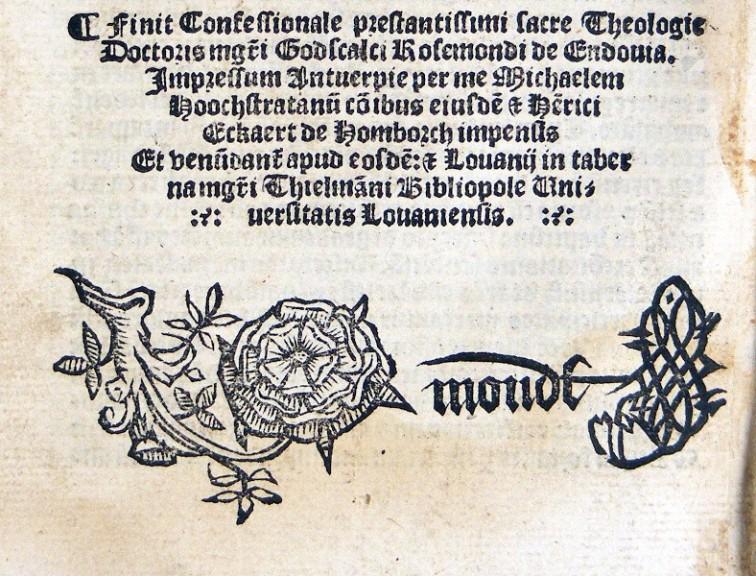
I believe many of my subscribers are Orangeman, they keenly interested in following the clue of the Scarlet Thread that I associate with Fair Rosamond. The rose of the Swan Brethren is is worn by the Dutch Royalty. It is a closed rose branch, while my ancestor employs a open rose branch in signing his name. He was the Master of the Falcon Art College and Leuvain. I believe he was a Master of the Swan Brethren that admitted William the Silent of Orange.
I knew Belle was ‘The One’ the moment I lay eyes on her. She had the neck of swan, and an Irish Smile that can warm the coldest heart. She has the mouth of a cherub. I hear a harp when I am in her presence. That I should be so viciously attacked after choosing her to be Heir to the Orange Rosamond Destiny, is all the proof anyone needs, that here is Ériu. Catherine Vandertuin (Van Der Tuin) was a educated mother who thought things out, and, loved to find, and put, hidden meanings in almost everything. For, she knew, only the worthy will find, for only the worthy, seek.
“What is in a name?”
Tuin means “garden” Van Der means “of the”. Since Catherine was not married to Jeffrey Burch, Belles should go by ‘Beautiful Irish Goddess of the Garden. Belle is a born gardener.
I am a genealogist of some renown. I look at many things when I look at someone’s tree. It is best to be upfront with me and not hide anything. In my theological novel ‘Where Art Thou?’ I reveal why God can no longer see Adam and Eve…….in His Garden. “Where art thou?” is the first question God put to humankind.
‘Beautiful Wanderer in the Irish Garden’ also works.
A wanderer may complain they have nowhere to lay their head. On Belle’s hands are these words;
“How do you sleep when you ban others from doing the same?”
God told His Children they will be wanderers all their days. Belle is the Sleeping Beauty Princess that was given the name Rosamond ‘Rose of the World’.
Jon Presco
Copyright 2013
TAMAR TEPHI was apparently the second of King Zedekiah’s “daughters.” Tamar means Palm. When Tamar is combined with Tephi (Heb. “beautiful”) it means palm beautiful—that is, “Beautiful Palm.” In Irish history, Tamar Tephi was also known by the name Tea Tephi. When “Tea” (Heb. wanderer) is combined with “Tephi” (Heb. “beautiful”), we get Tea Tephi (Beautiful Wanderer). We shall soon see why this beautiful princess was called a “Beautiful Wanderer.”

If Belle Van Der Tuin places her palms to together she has made the Pillow of the Beautiful Wanderer. Tea Tephi brought Jacob’s Pillow to Ireland after the fall of House of God and His Kingdom.
“It is claimed that with the Princess Tea Tephi, were brought to Ireland many priceless relics showing the Hebrew identity, and royal descent of her people; among them the “Jodham Morain” or priest breast plate; the harp of King David, “Sweet Singer of Israel”, and the famous Coronation Stone of the Kings of Ireland, Scotland, and England.
This Stone, tradition states, is the identical pillow upon which the head of Jacob rested at Bethel; that it was carried to Egypt by his sons, and became sacred in the eyes of his descendants.
It is called the Stone of “Fate” or “Fortune”, and is spoken of in the old records as “the ancientest respected monument in the world.”

http://www.ensignmessage.com/womaninwilderness.html
http://reluctant-messenger.com/judahs_sceptre_307.htm
“Furthermore, these knights of the Red Branch, of whom Gallam, the conquering Milesian, was one, called themselves Craunnogs, or ‘the crowned.’ The true meaning of their name is ‘Tree tops,’ for it comes from words common to all dialects: craun ‘a tree,’ and og ‘a tuft’ or ‘termination.’ We use the same word for a ‘crown,’ as they did, and the very use of it in common language would be enough to verify this identity of race were there not other reasons in their history and legends to establish it conclusively.”
http://en.wikipedia.org/wiki/Erin
In Irish mythology, Ériu (Irish pronunciation: [ˈeːrʲu]; modern Irish Éire), also called Eri,[1] daughter of Ernmas of the Tuatha Dé Danann, was the eponymous matron goddess of Ireland.
The English name for Ireland comes from the name Ériu and the Germanic (Old Norse or Old English) word land.
Since Ériu is represented as goddess of Ireland, she is often interpreted as a modern day personification of Ireland, although since the name “Ériu” is the older Irish form of the word Ireland, her modern name is often modified to “Éire” or “Erin” to suit a modern form.


“In 1825, in the village of Fenagh in county Leitrim in Ireland, a gang of Catholic youths attacked the Rosamond home. The Rosamonds were staunch Protestants. James, aged 20 (born 1805) and his brother Edward, aged 15, attempted to protect their mother. A shot was fired by Edward and a youth was dead. The boys fled to Canada. James went
to Merrickville where he worked for James Merrick as a weaver. Edward, still fearing arrest, worked his way eventually to Memphis, Tennessee.”
http://en.wikipedia.org/wiki/William_III_of_England
William III & II (Dutch: Willem III; 4 November 1650 – 8 March 1702)[1] was a sovereign Prince of Orange of the House of Orange-Nassau by birth. From 1672 he governed as Stadtholder William III of Orange (Dutch: Willem III van Oranje) over Holland, Zeeland, Utrecht, Gelderland, and Overijssel of the Dutch Republic. From 1689 he reigned as William III over England and Ireland; it is a coincidence that his regnal number (III) was the same for both Orange and England. As King of Scotland, he is known as William II.[2] He is informally known by sections of the population in Northern Ireland and Scotland as “King Billy”.[3] In what became known as the “Glorious Revolution”, on 5 November 1688 William invaded England in an action that ultimately deposed King James II & VII and won him the crowns of England, Scotland and Ireland. In the British Isles, William ruled jointly with his wife, Mary II, until her death on 28 December 1694. The period of their joint reign is often referred to as “William and Mary”.
http://en.wikipedia.org/wiki/Orange_walk
http://en.wikipedia.org/wiki/Orange_Order
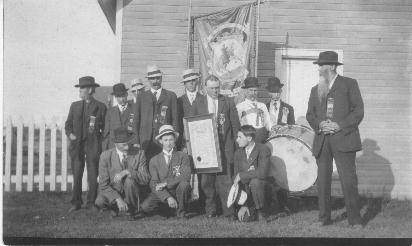
Above is a photograph of Bennett Rosamond the Grand Master of the Orange Order in Canada. Bennett is with members of Lodge 389 in Lanark, or, Almonte. The image on the banner is that of William of Orange who is carried in Orange Parades. That is Bennett on the far right, looking like Gandalf, or, a Levite Prophet.
According to the History of the Rosemond Family by Leland Rosemond, the Rosamond family were members of the Orange Order in Leitrim Ireland, and fled to Canada after a Rosamond son killed a Catholic lad who was invading the Rosamond home with a gang bent on doing my kindred harm.
Bennett may have been a Freemason as well – and an Oddfellow. There is a long history of the Rosamonds belonging to Guilds. They were members of the Swan Brethren.
My grandparents, Royal and Mary Magdalene Rosamond, begat my mother, Rosemary Rosamond, and her sisters, Lilian, Bonnie, and June Rice.
Jon Presco
British Israel students among my readers will know that the Red Hand
is the symbol of the Zarah line from Judah, reunited in the purpose
of God with the Pharez line of the Davidic monarchy through the
marriage of Milesius the Heremon, of the Zarah line, with David’s
descendant Tea Tephi, of the Pharez line, in Ireland. This Heremon
was a king of the Scarlet-thread branch of Judah and his genealogy
can easily be proved through study. The symbol of this branch of
Judah is the Red Hand, symbolising the scarlet thread placed round
the wrist of Zarah by the midwife (see Genesis 38).
Genesis 38:27-30 tells the story of Judah and Tamar’s birth of twins that would split the Judah tribe into two different Judah historical time lines.
In the story of Judah, Tamar bore twins for Judah. The first born, Zarah revealed his right hand, a scarlet thread or cord was tied around the wrist, but his brother Pharez would steal his brother’s birthright by coming out of the womb first. Pharez becomes the messianic bloodline, the golden lion nation of Judah and Zarah becomes the Gaelic Christian bloodline or scarlet (red) lion nations of Judah. This breach that took place within Judah wouldn’t be healed for 2500 years when these two blood lines of Judah would come together again in North Ireland in a planned marriage that would reunite the crown over one Judah and prepare for all the commonwealth nations to come.
http://www.mylordmysavior.com/King%20Lineage%20(Blood%20Lines).htm
Ancient Irish histories indicate there were two prominent eastern ladies—both of whom appear to have been daughters of Zedekiah—who were later connected with the people of Ireland: SCOTA and TAMAR TEPHI.
1) SCOTA was apparently the older of the two celebrated women, and some biblical scholars believe Scota was one of Zedekiah’s daughters. Scotch-Irish records explain that this eastern lady, Scota, had previously married Niul—one of Pharaoh Hophra’s mercenary soldiers—while she was living as a royal refugee (a “daughter”) under the adoptive protection of the Pharaoh Hophra, who had a royal “house” or palace at Tahpanhes, Egypt (see Jer. 33:9; 44:30). It was this Scota whose name the people of Ireland later adopted—as Ireland was subsequently called “Scotia” until the 10th century AD (Moore’s History of Ireland, vol. 1). Later that name, Scota, was applied to North Britain (i.e. Scotland) and still later Scota was applied to a province in Southeastern Canada called NOVA SCOTIA.
Notice the following account of what happened to “JACOB’S PILLOW STONE” in connection with King Zedekiah’s daughters: TEA TEPHI and SCOTA— “It [this “Pillow Stone” or “Stone of Destiny”] was saved from destruction with the Temple, was cherished as a palladium by the Jews; and, after the death of Zedekiah, was carried by a migrating colony, with ‘SCOTA the King’s daughter’ under the leadership of the Prophet Jeremiah…. It was taken to ‘The Isles of the Sea,’ and preserved as a Stone of Destiny, by the ‘People of Scota’…. Finally, it was ‘stolen’ by Edward, King of England, and placed in the Coronation Chair at Westminster Abbey where it still is” (THE STONE OF DESTINY, by F. Wallace Connon, p. 15).
The Voyage of Zarah is a historical research paper that re-examines the lost history and roots of western civilization. Zarah is a person and he is the father to the Gaelic tribes of Western Europe. Zarah’s voyage starts when he was born as a twin in 1883BC to the tribe of Judah. Genesis 38:27-30
Zarah was the first born son of Judah but his brother Pharez would breach his birthright and come out of the mother’s womb first. Pharez becomes the bloodlines of the Jews and kings over Judah and the other tribes of Israel. Zarah on the other hand was the first born but has a whole other history timeline, but remember Zarah is connected right back to this main bloodline with Judah and right back through to Jacob-Isaac – and Abraham.
Zarah are the tribes that make-up all the Gaelic – Celtic – Saxon – Norsemen tribe’s that cultivated Europe’s first civilized people and nations.
And the sons of Ju’dah; Er, and O’nan, and She’lah, and Pha’rez, and Za’rah: . Er and O’nan died in the land of Ca’naan. Genesis 46:12.
The tribe of Judah will come back into the story with the Zarah tribes starting in 583BC and different times with the connection with the Irish, Scot, Welsh and English Saxon. Also, the other tribes of Israel come into the confused story in the British Islands from about 400 BC onward in different times to our present day.
The story of the Voyage of Zarah is about the Zarah Hebrew tribes of Judah, and not about the Jews and the tribes of Israel before and after the great exodus out of Egypt. That is the history and journey of Zarah’s twin brother Pharez of Judah and the times of Moses, and onward down to David and Jesus and other 11 tribes of Israel.
TAMAR TEPHI was apparently the second of King Zedekiah’s “daughters.”
Tamar means Palm. When Tamar is combined with Tephi (Heb. “beautiful”) it means palm beautiful—that is, “Beautiful Palm.” In Irish history, Tamar Tephi was also known by the name Tea Tephi. When “Tea” (Heb. wanderer) is combined with “Tephi” (Heb. “beautiful”), we get Tea Tephi (Beautiful Wanderer). We shall soon see why this beautiful princess was called a “Beautiful Wanderer.”
Along with the Sinclairs, the Stewarts have been titled a Rex Deus family meaning they are kin to Jesus and a divine ruling lineage. In the Ulster Red Branch Knight legends, there is a lineage that descends from a Davidian King and a Egyptian princess. This legend existed hundreds of years before Dan Brown and others came along. With the revelation that the Preston family in America descends from the Stewart line that was involved in the plantations of Ulster, comes a true prophecy that brings together under one banner my fourteen year genealogical investigation that begins with these words.
First Generation next
Tea Tephi Queen of Ireland, daughter of Zedekiah Last King of Judah, was born in Spain and died in Odhbha, Meath, Leinster, Ireland.
The Chronicles say:
Tephi born of the House of the High One, Princess of Zion, loved of The Lord, Home of the House of her God, daughter of David, Shepherd in Judah, Tribe of the Lion, Queen over Bethel, and Dan where they be scattered abroad.
Is not the word made sure, we are spread forth in alien places. Fire that was kindled burnst to the utter-most hell. Princes led captive to Baal. I even I am left to pry from the outtermost region, far off isles of the west, home of the remnant of Dan. Sewn as a thistle on earth, is Jacob. The name of us is legion. Tongue of the Hebrew fails. Tea-Tephi describing the dispersal of the Lost Tribes of Israel
Buried in the poetry and folk-lore of Ireland is the tale of a Prophet, an Egyptian Princess and Simon Brug (Baruch) a Scribe. They Landed in Ireland about the same time that the destruction of Jerusalem took place, bearing with them a great chest and a stone wrapped on a banner. The Princess married the Zarahite King, Eochaidh II. Ard-dath, Ard-righ, or Heremon, horse man of all Ireland.
It is claimed that with the Princess Tea Tephi, were brought to Ireland many priceless relics showing the Hebrew identity, and royal descent of her people; among them the “Jodham Morain” or priest breast plate; the harp of King David, “Sweet Singer of Israel”, and the famous Coronation Stone of the Kings of Ireland, Scotland, and England.
This Stone, tradition states, is the identical pillow upon which the head of Jacob rested at Bethel; that it was carried to Egypt by his sons, and became sacred in the eyes of his descendants.
It is called the Stone of “Fate” or “Fortune”, and is spoken of in the old records as “the ancientest respected monument in the world.”

Old Irish verse:
The praises of Tea Tephi are sung as:
“The Beautiful One with a Royal Prosperous Smile.”
“Tephi (Hebrew beautiful) the most beautiful that traversed the Plain.”
“Temor of Bregia, whence so called.”
Relate to me O learned Sages,
When was the place called Temor?
Was it in the time of Parthalon of battles?
Or at the first arrival of Caesaire?
Tell me in which of these invasions
Did the place have the name of Tea-mor?
O Tuan, O generous Finchadh,
O Dubhan, Ye venerable Five
Whence was acquired the name of Te-mor?
Until the coming of the agreeable Teah
The wife of Heremon of noble aspect.
A Rampart was raised around her house
For Teah the daughter of Lughaidh (God’s House)
She was buried outside in her mound
And from her it was named Tea-muir.
Cathair, Crofin not inapplicable.
Was its name among the Tuatha-de-Danaan
Until the coming of Tea – the Just
Wife of Heremon of the noble aspect?
A wall was raised around her house
For Tea the daughter of Lughaidh,
(And) she was interred in her wall outside,
So that from her is Tea-mor.
A habitation which was a Dun (Hebrew court) and a fortress
Which was the glory of murs without demolition,
On which the monument of Tea after her death,
So that it was an addition to her dowry.
The humble Heremon had
A woman in beautiful confinement
Who received from him everything she wished for.
He gave her whatever he promised,
Bregatea a meritorious abode
(Where lies) The grave, which is the great Mergech (Hebrew burial place)
The burial place which was not violated.
The daughter of Pharaoh of many champions
Tephi, the most beautiful that traversed the Plain.
She gave a name to her fair cahir,
The woman with the prosperous royal smile,
Mur-Tephi where the assembly met.
It is not a mystery to be said
A Mur (was raised) over Tephi I have heard.
Strength this, without contempt,
Which great proud Queen have formed
The length, breadth of the house of Tephi,
Sixty feet without weakness
As Prophets and Druids have seen.
From “Forward” – Watchman What of the Dawn
Tea married Héremón King of Munster, 2nd Monarch of Ireland, son of Milesius of Spain King of Braganza, Father of the Irish Race and Scota Tephi Princess of Egypt. Héremón was born in Braganza, Iberia or Spain and died in 1683 B.C. in Rath-Beothaight, Argat-Ross, Ireland.
Children:
i. Iarél Fáith 10th Monarch of Ireland (died in 1670 B.C. in Magh Muaagh, Galway, Connaught, Ireland)
http://freepages.genealogy.rootsweb.ancestry.com/~cnoelldunc/Ancient/Tea/A1.htm
Almonte’s Oldest Citizen Goes To His Reward
From the Almonte Gazette
A week or two ago we announced the illness of James Rosamond, Sr., little expecting we would so soon be called upon to chronicle the news of his death which took place on Wednesday morning. The old gentleman attended the Orange gathering here on the 12th July and owing to the dampness of the day contracted a cold which was followed by an attack of bronchitis and other troubles and after the wear of so many years his constitution had not the vitality to withstand the attack of the disease and shortly after midnight the end came calmly and peacefully.
Mr. Rosamond was born near Ballinamore, County Leitrim, Ireland on the 14th Feb., 1805. His parents were Bennett and Fanny Rosamond and his father followed the three fold occupation of reed maker and linen weaver and farmer. The subject of this sketch came to Canada in 1827 with his brother. The latter died at Prescott seven or eight years ago. For about two years after coming to Canada, Mr. Rosamond lived at Ogdensburg, New York where he learned the distillery business. In 1830 he removed from New York to Carleton Place. In 1831 he was married to Margaret Wilson of Ramsay, a lady who although of naturally an amiable and retiring disposition, has proved a faithful wife and helpmate for one who has led such an active life as her husband. Some years ago Mrs. Rosamond met with an accident from which she suffered considerably for some time and which prevented her from going out much among her friends but she is still hale and hearty although beyond the allotted three score and ten years. Their marriage has been blessed with seven children, four of whom survive namely Bennett, Mary Ann (Mrs. A. Bell), William (of Cobourg), James and Rosaline (Mrs. De Hurd).
After coming to Carleton Place, Mr. Rosamond was engaged in the distilling business for about three years and then went into the sawmill and gristmill business in partnership with John McEwen. Their mill was the only one in this section of the country at that time. This partnership lasted for four years when it was dissolved and a new one formed with Messrs. R. Bell and Company. The new firm determined to extend their business and had a carding and cloth – dressmaking establishment also the only one in this part of the province. The firm rented the mills in Carleton Place from Mr. Bolton for 16 or 17 years and continued for that time in business in that village, which was then known as “Morphy’s Falls”. In the course of time Mr. Rosamond went into the spinning, weaving and manufacturing of such goods as satinettes, etoffes, etc. These enterprising early manufacturers kept constantly adding to their machinery and increasing their business and towards the close of their lease wanted to buy or rent the water power but the owner Mr. McLaren of Beckwith would do neither. Just then an employee of Mr. Rosamond came to Almonte—at that time called “Waterford”—and succeeded in forming a company known as the Ramsay Woolen Manufacturing Company. Among those who held stock in this company were John Scott and the late John Patterson who about the year 1853 or 1854 one year after the company was formed, went to California but before going, disposed of their shares in the company to Mr. Rosamond. The mill was burned shortly afterwards.
In 1856 Mr. Rosamond moved to Almonte and bought his present residence from Edward Mitcheson. After the mill was burned, a sale was called and the site—the one on which the #2 mill is built—was knocked down to the late Albert Tesky for about 90 pounds. Mr. Tesky afterwards repented of his bargain and sold the water power to Mr. Rosamond who built the #2 mill on it moving his machinery from Carleton Place to Almonte in 1857. The #2 mill was built in 1856 and additions were made to it afterwards by Messrs. Bennett and William Rosamond who put in more machinery and gradually increased its capacity. In 1861, too close applications to business beginning to tell on Mr. Rosamond’s health, he leased the business to his sons Bennett and William and afterwards sold to them. In 1860, Mr. Rosamond and his sons formed a joint stock company with capital of $100,000 to build a large mill which resulted in the erection of #3 mill. When Mr. Rosamond retired from active business he retained an interest in the #1 mill and at the time of his death was still a share holder in it. He was also fro some time in the tanning business his tannery being situated on the site of the present dye room of #1 mill. Although always widely and actively engaged in business, Mr. Rosamond did not forget his obligations as a citizen and was always ready to assume his share of public duties. He was a member of the Carleton Place School Board from 1833 until he removed to Almonte. He has been an active and useful member of the Almonte School Board for about 35 years and occupied a seat there ever since he came to town, with the exception of a year and a half (about the year 1869) when he moved to Vineland, New Jersey for the benefit of his health. He has filled the position of Justice of the Peace for the County of Lanark continuously for over a half century. He was also a life long member of the board of the Ottawa Protestant Hospital. Shortly after Mr. Rosamond took up residence in Almonte, he took an active interest in the union Sunday school which was attended by churches of all denominations. Later on he founded St. Paul’s Sunday school of which he was superintendent for over twenty years. He has always been a devoted member of the Anglican Church and was for many years church warden or lay representative to the Synod for St. Paul’s Church. He was an enthusiastic Orangeman, a strong Conservative in politics and a great admirer of the late Sir John MacDonald. Though Mr. Rosamond attained to a ripe old age he retained to a wonderful degree the use of his mental as well as physical faculties, his mind to the last being clear.
http://roughian.tripod.com/BennettRosamond.html
Bennett Rosamond
Bennett Rosamond was born on May 10, 1833 at Carleton Place, Ontario. At the age of 26 he joined the family business, the Victoria Woolen Mills at Almonte and in 1862 he took over the business from his father. He served on the township council, served as Reeve and was elected mayor of Almonte. He was elected as the federal Conservative member of parliament for the riding of North Lanark in 1892 and sat in the House of Commons until 1904.
Rosamond was a major employer at Almonte and voting days saw his employees turn out en masse to vote for him. As a major benefactor of the town he donated the money to build a hospital in Almonte which was named after him. He died on May 18, 1910 in England while preparing to return to Canada. Rosamond was a member of L.O.L. No. 389, located at Almonte and had served as master of the lodge. He also served as County Master of Lanark for a number of years.
Rosamond Memorial Hospital, Almonte, Ontario c. 1910
The Perth Courier – October 18, 1962
Lanark Orangemen Heard Sir John A. Talk Confederation In District Lodges
Local Lodge One Of Oldest In Ontario East
Sir John A. Macdonald, Canada’s first Prime Minister and “Father of Confederation” first campaigned for Confederation in the Orange lodges of Lanark and Leeds Counties. Confederation was the union of British colonies in North America as a buffer to U.S. expansionism or “manifest destiny”, which saw all North America as one great American country.
Sir John, a resident of Kingston, was an ardent Orangeman who saw the possibility of having one Federal Parliament and separate Provincial Legislatures modelled on the Orange Association, which eight years prior to Confederation had decided on such a constitution for itself.
What the Orangemen had been able to do inspired him to attempt, Sir John gladly admitted, “for the sake of the future of Canada.” Thus, Confederation was born when the Orange Order boasted 1,400 lodges and tens of thousands of members. The year was 1867.
Perth One of Oldest
Perth was there with one of the oldest Orange Lodges in Canada, L.O.L. No. 7, at Drummond Centre. Old records show how politicians stumped up-and-down the rural routes selling ideas in lodgeroom, on the street, over the fence, in parlor and country store. Only five [six] older lodges exist, LOL No. 1 at Brockville, LOL No. 2 at Pine Hill, North Leeds County, LOL No.3 at Foxboro in South Hastings, [LOL No. 4 at Toronto] LOL No. 5 in Peel County and LOL No. 6 at Kingston [the lodge Sir John joined in 1841].
Minutes of these lodges show that Canada’s first Prime Minister or his representative spoke in them all. The first Orange Grand Lodge in North America was founded in Brockville, just 40 miles from Perth, by an immigrant Irishman Ogle R. Gowan, who rose to become Member of Parliament and Colonel of Militia. He was also Grand Master of British America in 1830 – 1846, 1854 – 1855 and 1856.
Although Orange lodges existed in Canada from Wolfe’s conquest of Quebec in 1759, the first Grand Lodge warrant was only granted on April 23, 1832, signed by Field Marshal, Ernest Duke of Cumberland, Grand Master of the Empire. The warrant was brought home to Brockville and given great display about the countryside. The first Grand Secretary of the first Grand Lodge of British America was Alexander Matheson of Protestant Hill, Perth.
Thus almost 140 years after the founding of the Orange Confederacy in 1688, the Orange influence reached into the Perth area. This influence was strongest in the United Empire Loyalist, Army and Navy settlements throughout Canada, the Order having been founded on military lines to protect Protestant interests in troubled Ireland. Perth was a military settlement.
Ruling body for Lanark County Orangemen is the Imperial Grand Council of the World, with Captain Sir George A. Clark, Bart., DL, of Ireland, the Grand Master. Next comes the Grand Lodge of British America with eleven provincial bodies, of which the Grand Lodge of Ontario East is one with 25 county jurisdictions.
The Orange Association of the County of Lanark is part of Ontario East and boasts three districts with 13 primary lodges. The primary lodge is the basic unit of the Orange Order. The lodge in Perth is LOL 115 which meets at the Orange Hall on Gore Street East. Lodge Master is Herbert Campbell and secretary James Kirkham, both of Perth.
cont…..
The Grand Lodge of Ontario East has met nine times in Lanark County since 1830, in Peth 1865, 1933, 1943, in Smiths Falls 1890, 1902, 1911, 1922, 1945, in Carleton Place in 1929. His Honor Judge J.A. Scott of Perth was Grand Master of British America in 1911 – 1914. Reverend Canon J. W. R. Meakin of Almonte, currently is Honorary Grand Chaplain of Ontario East, while Lieutenant Colonel Hon. T. Ashmore Kidd of Kingston, has been Imperial Grand Master of the World, and Grand Master of British America in 1930 – 1933 and 1940 – 1947.
County Master Roy Haveron, of Perth notes a trend to larger lodges in Lanark County which prove more efficient and active. Biggest problem today is lack of publicity and dedicated organizers with the time to devote to the demands of ritual and degree work.
LOL No. 90 of Lombardy won the Duncan Alexander MacLeod trophy for the largest increase in membership – 47 per cent this year. LOL No. 1 Brockville remains the largest lodge in Eastern Ontario with over 150 members. The Orange Order has exerted an influence in Lanark far in excess of its numbers, although its numbers have never been large. It’s a grass roots movement with “few aristocrats” or people with “aristocratic notions” included in its membership. The rural influence has a leveling effect, so it seems.
What do Orangemen do? First, they support the reformed faith. Next comes strong support of British democratic ideals and parliamentary government. The Bill of Rights of 1689 is the Order’s Bible. “Equal rights for all and special privileges for none,” has been the battlecry of the Order for ages. Prime Minister John Diefenbaker used an abbreviated form of this slogan in his 1957 general election campaign.
Orangemen support benevolent causes, including two Orange homes for children. There is an active insurance program and many bands. Perth, Smiths Falls and Carleton Place boast OYB [Orange Young Briton] bands.
District Masters and Officials
District Masters: Kenneth Leacock, Smiths Falls; Wm. Evans, Pakenham; W. H. Shaw, RR 2, Perth; Secretaries, Lyle Jordan, Smiths Falls; W. A. Fulton, Pakenham; Roy Haveron, Perth.
Primary Lodges: [master and secretary], LOL 7 Drummond Centre, Edward Wright, D. A. Devlin; LOL 88 Smiths Falls, Harvey Leacock, Ken Leacock, LOL 92 Innisville, George Gardiner, Gordon James. LOL 115 Perth, Herbert Campbell, James Kirkham. LOL 190 Montague Corners, John Kidd, Elmer Fox. LOL 202 Fallbrook, Cecil Ennis, Russell Fair. LOL 378 Almonte, Glen Ireton, M. Giles. LOL 381 Franktown, Glen Irvine, Milton McCaul. LOL 512 Montague, Russel Burchill, W. Rice. LOL 529 Rusenham, Forbes Evans, E. A. Connery. LOL 749 Wemyss, Carl Larmon, L. J. Patterson. LOL 788 2nd Line of Drummond, O. P. Dowdall, J. B. Hands.
Lanark is bordered by North Leeds with three districts and eleven lodges, Carleton with eight districts and 33 lodges, Lennox and Addington with two districts and 13 lodges, Renfrew with four districts and 21 lodges.
William Henry Boulton
William Henry Boulton was born on April 19, 1812 in York [Toronto], Upper Canada, the son of D’Arcy and Sarah Ann Boulton [nee Robinson, daughter of Sir John Beverley Robinson]. Boulton was born into one of the most prominent families of Upper Canada; his grandather, D’Arcy Boulton Sr. Was chief justice of Upper Canada and his uncles included John Beverley Robinson. Boulton studied to be a lawyer and was called to the bar of Upper Canada at the age of twenty-three.
Boulton was to become one of the social leaders of early Toronto, his estate “The Grange” being the setting for many of the young city’s most prominent social gatherings. As a member of parliament for Toronto from 1844 to 1853, Boulton supported conservatives William Henry Draper and Henry Sherwood. As a member of one of the old established families he was a strong defender of the privileged position of the Anglican Church with regards to the clergy reserves and education.
Aside from provincial politics Boulton was heavily involved with Toronto affairs. He served as an alderman for St Patrick’s Ward from 1838 until 1842 and after a two year absence from municipal politics he again served as alderman for the same ward from 1844 to 1847. During this time he was elected mayor of Toronto for three successive terms, from 1845 – 1847. After his terms as Mayor Boulton continued to sit on council as an alderman in 1852 and 1858, again being elected Mayor of the city in 1858.
During his term as mayor an agreement had been made between the province and the city over the distribution of judicial powers. The Mayor and aldermen had now ceased to act as magistrates and cases were heard by police magistrates. Boulton got into a fierce argument with the chief constable of Toronto, Samuel Sherwood, and resigned as mayor. He then ran again for Mayor in 1859 in the first election that was held by popular vote, but lost to Adam Wilson.
He then retired from politics and lived at the grange. After his death on February 15, 1874, his wife continued to live there and she later married author Goldwin Smith in 1875. Today “The Grange” is owned by the Art Gallery of Ontario. Boulton had served as the Master of Enniskillen L.O.L. 387 in 1858 and was the Deputy Grand Master of Canada in 1854.
LANARK’S ORANGE LODGE.
It was in the fifties too that the first secret fraternity unfurled its Orange banner in this village. An elevated site was chosen for the Lodge room of the Loyal Orange Lodge, the exact spot being near where Mr. William Spalding’s storehouse now stands. The lodge succeeded in gathering beneath its colors a large and flourishing membership and it looked for a time at least that this was one of Lanark’s permanent institutions. But something happened one night that stopped a lodge career. From Buffam’s tavern to the lodge room the brethren cleaved the air with their discontent. An eye-witness says it was certainly a rough night and obviously he was not referring to the weather. When you hear a brother shout “Paice, bhoys, paice and brotherly love,” while he belabors you with a drum stick it is high time to call a halt and that is exactly what the Orangemen of Lanark did. They held no more meetings, the building fell into disuse and later was removed to its present stand where it serves the public faithfully day after day and is known as Darou’s bakery. The Buffam’s Tavern referred to stood where the residence of Mr. R.F. Robertson is now. At one time this building was occupied by the McLaren family as a store, the scene of many boyhood experiences of the Hon. Peter McLaren, of Perth, whose father was the merchant.
The Hart name is associated with the Red Hand of Ulster and the O’Neill Kings of Ireland. In authoring the history of the Rosemond family, Leland Rosemond consulted O’Hart’s Irish Pedigrees compiled by John O’Hart. The Hart family is there in the name Thomas Hart Benton.
“To complete his genealogies he used the writings of Cú Choigcríche Ó Cléirigh, Duald Mac Firbis and O’Farrell, along with the Annals of the Four Masters, for the medieval pedigrees. He used the works of Bernard Burke, John Collins and others to extend his genealogies past the 17th century.”
Above we see a flag with a Red Hand within a Star of David. John O’Hart was the Dan Brown of his day.
“In his Irish Pedigrees, O’Hart presents the legendary origins of the Irish people, from the Biblical Adam and Eve through the kings of ancient Ireland. Irish tradition holds that every Irish person is descended from the king Milesius who emigrated from Spain in 500 BC, so O’Hart started each of his genealogies with Adam recording Milesius as his 36th descendant.”
I am authoring a great genealogical story that will sweep over my enemies like a tsunami, and leave their history wallowing in pools of mud!
Jon Presco
Copyright 2011
O’Harte is a native English name, numerous in that country but in Ireland the Harts (usually spelt Harte in Connacht) are nearly all of the Sept O’Hart [4]. Some families have always retained, others have recently retained preserved the prefix O. In Irish the name is O’hArt, i.e. descendant of Art who was son of King Conn of the Hundred Battles. The O’Harts were the Southern Ui Neill and were one of the Four Tribes of Tara (Co. Meath) in early times. Tbut after the Anglo-Norman invasion they were pushed westward and settled in the territory now known as the barony of Carbury, Co Sligo. O’Hart is included in the Composition Book of Connacht.
Leland E. Rosemond
March, 1938
Scarsdale, N. Y.
THE NAME ROSEMOND
John O’Hart
From Wikipedia, the free encyclopedia
Jump to: navigation, search
This article relies largely or entirely upon a single source. Please help improve this article by introducing citations to additional sources. Discussion about the problems with the sole source used may be found on the talk page. (March 2011)
John O’Hart (1824 – 1902) was an Irish genealogist. He was born in Crossmolina, Co. Mayo, Ireland. A committed Roman Catholic, O’Hart originally planned to become Catholic priest but instead spent 2 years as a police officer. He was an Associate in Arts at the Queen’s University of Belfast. He worked at the Commissioners of National Education during the years of the Great Irish Famine. He worked as a genealogist and took an interest in Irish history. He was an Irish nationalist. He died in 1902 in Clontarf near Dublin, at the age of 78.
O’Hart’s 800-page The Irish and Anglo-Irish landed gentry (Dublin 1884) was reprinted in 1969, with an introduction by Edward MacLysaght, the first Chief Herald of Ireland. Another work, Irish pedigrees; or, The origin and stem of the Irish nation, first published in 1876, has come out in several subsequent editions.
To complete his genealogies he used the writings of Cú Choigcríche Ó Cléirigh, Duald Mac Firbis and O’Farrell, along with the Annals of the Four Masters, for the medieval pedigrees. He used the works of Bernard Burke, John Collins and others to extend his genealogies past the 17th century.
[edit] Stem of the Irish nation
In his Irish Pedigrees, O’Hart presents the legendary origins of the Irish people, from the Biblical Adam and Eve through the kings of ancient Ireland. Irish tradition holds that every Irish person is descended from the king Milesius who emigrated from Spain in 500 BC, so O’Hart started each of his genealogies with Adam recording Milesius as his 36th descendant.
From (1) Adam, his son (2) Seth, his son (3) Enos, his son (4) Cainan, his son (5) Mahalaleel, his son (6) Jared, his son (7) Enoch, his son (8) Methuselah, his son (9) Lamech, his son (10) Noah, his son (11) Japhet, his son (12) Magog, his son (13) Baoth “to whom Scythia came has his lot,” his son (14) Phoeniusa Farsaidh (Fenius Farsa) King of Scythia, his son (15) Gaodhal (Gathelus), his son (16) Asruth, his son (17) Sruth (who fled Egypt to Creta), his son (18) Heber Scut (returned to Scythia), his son (19) Beouman, King of Scythia, his son (20) Ogaman King of Scythia, his son (21) Tait King of Scythia, his son (22) Agnon (who fled Scythia by sea with the majority of his people), his son (23) Lamhfionn (who led his people to Gothia or Getulia, where Carthage was afterwards built), his son (24) Heber Glunfionn King of Gothia, his son (25) Agnan Fionn King of Gothia, his son (26) Febric Glas King of Gothia, his son (27) Nenuall King of Gothia, his son (28) Nuadhad King of Gothia, his son (29) Alladh King of Gothia, his son (30) Arcadh King of Gothia, his son (31) Deag King of Gothia, his son (32) Brath King of Gothia (who left Gothia with a large band of his people and settled in Galicia, Spain), his son (33) Breoghan King of Galicia, Andalusia, Murcia, Castile, and Portugal, his son (34) Bile King of Galicia, Andalusia, Murcia, Castile, and Portugal, and his son (35) Galamh (also known as Milesius of Spain) King of Galicia, Andalusia, Murcia, Castile, and Portugal.
According to O’Hart’s account, Milesius had four sons, Heber, Ir, Heremon, and Amergin, who were involved, along with their uncle Ithe, in the invasion of ancient Ireland; Milesius, himself, had died during the planning. Because Amergin died during the invasion, he died without issue. It is from the four other invaders–Heber, Ir, Heremon, and Ithe–that the Irish are alleged to descend. These. according to O’Hart, are the four lines from which all true Irish descend.
Niall Noígíallach (Irish pronunciation: [ˈniːəl noɪˈɣiːələx], Old Irish “having nine hostages”),[1] or in English, Niall of the Nine Hostages, son of Eochaid Mugmedón, was an Irish king, the eponymous ancestor of the Uí Néill kindred who dominated Ireland from the 6th century to the 10th century. The rise of the Uí Néill dynasties and their conquests in Ulster and Leinster are not reliably recorded but have been the subject of considerable study and attempts to reconstruct them.
Although generally supposed to be a historical personage, very little can confidently be said of Niall’s life. The sources for the details of Niall’s life are genealogies of historical kings, the “Roll of Kings” section of the Lebor Gabála Érenn, Irish annals such as the Annals of the Four Masters, chronicles such as Geoffrey Keating’s Foras Feasa ar Éirinn, and legendary tales like “The Adventure of the Sons of Eochaid Mugmedon” and “The Death of Niall of the Nine Hostages”. These sources date from long after Niall’s time and their value as history is limited at best.
Niall is placed in the traditional list of High Kings of Ireland. His reign dated to the late 4th and early 5th centuries. The Annals of the Four Masters dates his accession to 378 and death to 405.[2] The chronology of Keating’s Foras Feasa ar Éirinn broadly agrees, dating his reign from 368-395, and associating his raiding activities in Britain with the kidnapping of Saint Patrick (ca. 390-461).[3] However, the traditional roll of kings and its chronology is now recognised as artificial. The High Kingship did not become a reality until the 9th century, and Niall’s legendary status has been inflated in line with the political importance of the dynasty he founded. Based on Uí Néill genealogies and the dates given for his supposed sons and grandsons, modern historians believe he is likely to have lived some 50 years later than the traditional dates, dying circa 450.[4]
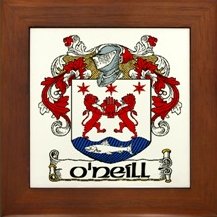
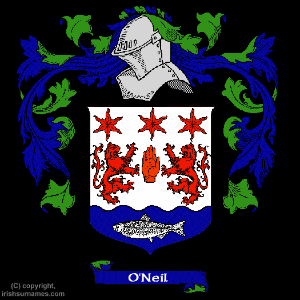
The coat of arms of the Uí Néill (plural of Ó Néill) of Ulster were white with a red left hand cut off below the wrist, and it is because of this prominence that the red hand (though a right hand is often found used mistakenly, rather than the left used originally) has also become a symbol of Ireland, Ulster, Tyrone and other places associated with the ruling family of Uí Néills. The red hand by itself has become a symbol of the O’Neill name, such that when other O’Neill family branches were granted or assumed a heraldic achievement, this red hand was often incorporated into the new coat of arms to the point of being a cliché.[5]In his Irish Pedigrees, O’Hart presents the legendary origins of the Irish people, from the Biblical Adam and Eve through the kings of ancient Ireland.heir chiefs were lords of Tiffia (Co Meath) Irish tradition holds that every Irish person is descended from the king Milesius who emigrated from Spain in 500 BC, so O’Hart started each of his genealogies with Adam recording Milesius as his 36th descendant.
According to O’Hart’s account, Milesius had four sons, Heber, Ir, Heremon, and Amergin, who were involved, along with their uncle Ithe, in the invasion of ancient Ireland; Milesius, himself, had died during the planning. Because Amergin died during the invasion, he died without issue. It is from the four other invaders–Heber, Ir, Heremon, and Ithe–that the Irish are alleged to descend. These. according to O’Hart, are the four lines from which all true Irish descend.

 Rosamond Press
Leave a comment