Brutal men defending Putin’s Police State attacked lovers of poetry and liberty – with whips – the symbol of slavery! When hooded thugs approached the peaceful event, the people dispersed. Is this the work of the Night Wolves, the haters of freedom, poetry, and art?
This is cultural warfare on a vast scale.
Jon Presco
Today as the citizens of Ukraine rise up in the name of democracy, freedom and their right to self-determination, the words of, their most outstanding poet and national bard, remain close to their hearts. Shevchenko’s reputation as the “people’s poet” is reflected not only in his humble origins but also by the fact that his poetry expresses his nation’s innermost aspirations.
http://www.utoronto.ca/elul/Ukr_Lit/Vol01/01-04.html
“KIEV, Ukraine — Rival rallies turned violent in Crimea on Sunday, as Ukraine celebrated the 200th anniversary of the birth of its greatest poet and the White House announced that President Obama would host the Ukrainian prime minister just days before a controversial referendum on Crimean secession next week.”
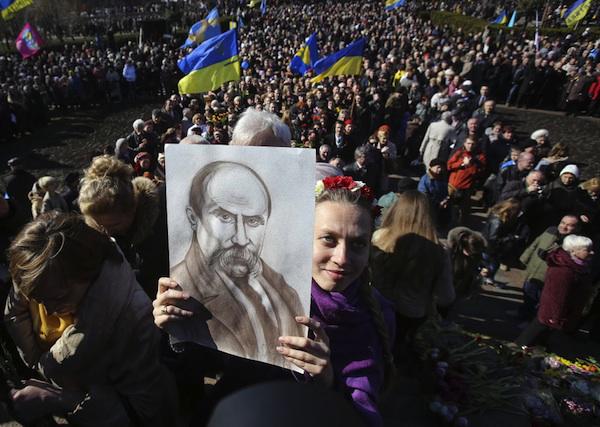
In Kiev, the capital, tens of thousands rallied in Independence Square to celebrate the birth of Taras Shevchenko, a poet who is a symbol of Ukrainian nationhood. The gathering was both a riposte to Russia and a memorial service for the more than 80 people who died there.
“Our fathers and grandfathers have spilled their blood for this land,” said the interim prime minister, Arseniy P. Yatsenyuk, who will visit the White House on Wednesday. “We won’t budge a single centimeter from Ukrainian land. Let Russia and its president know this.”
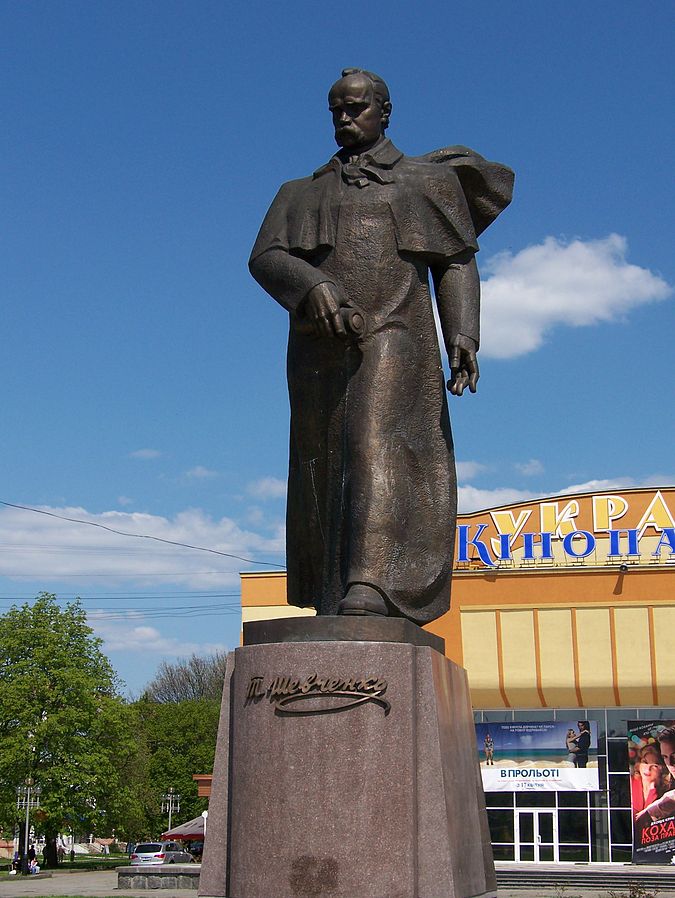
Yet in Sevastopol, Crimea, a pro-Ukraine rally attended by several hundred people was attacked by pro-Russia supporters — some brandishing whips — who had their own large rally there. In the Crimean capital, Simferopol, about 400 people, a mixture of pro-Ukrainian Russians and Tartars, gathered around a statue of Shevchenko while listening to readings of his works and speeches calling for Russian troops to withdraw. The police there stopped a group of hooded men from approaching the rally.
Photo
People attended a pro-Russian rally in Feodosia in Crimea on Sunday. Credit Sergey Ponomarev for The New York Times
In Donetsk in eastern Ukraine, thousands of pro-Russian activists took over the city’s main thoroughfare to call for greater autonomy from Kiev and a referendum on secession. Vitali Klitschko, the former boxing champion and opposition politician who is now a presidential candidate, visited Donetsk to appeal for calm after days of violence between pro-Russian and pro-Ukrainian protesters.
“The current conflict and aggression must be resolved,” Mr. Klitschko told reporters at a news conference, urging residents to support national unity and stating that he was worried that the events in Crimea may repeat themselves here, in the country’s east. “It must not be solved through bloodshed.”
He laid a wreath at a statue of Shevchenko, but canceled a scheduled appearance at a rally at the request of the police.
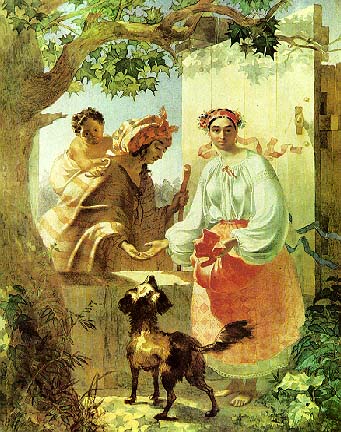
Taras Hryhorovych Shevchenko (Ukrainian: Тара́с Григо́рович Шевче́нко, Taras Hryhorovych Shevchenko; March 9 [O.S. February 25] 1814 – March 10 [O.S. February 26] 1861) was a Ukrainian poet, writer, artist, public and political figure, as well as folklorist and ethnographer. He is also known under the book name Kobzar. That was his most famous literary work, a collection of poems entitled Kobzar. His literary heritage is regarded to be the foundation of modern Ukrainian literature and, to a large extent, the modern Ukrainian language. Shevchenko is also known for many masterpieces as a painter and an illustrator.
He was a member of the Sts Cyril and Methodius Brotherhood and an academician of the Imperial Academy of Arts.
http://en.wikipedia.org/wiki/Taras_Shevchenko
Taras Shevchenko spent the last years of his life working on new poetry, paintings, and engravings, as well as editing his older works. But after his difficult years in exile his final illness proved too much. Shevchenko died in Saint Petersburg on March 10, 1861, the day after his 47th birthday.
His influence on Ukrainian culture has been so immense, that even during Soviet times, the official position was to downplay strong Ukrainian nationalism expressed in his poetry, suppressing any mention of it, and to put an emphasis on the social and anti-Tsarist aspects of his legacy, the Class struggle within the Russian Empire. Shevchenko, who himself was born a serf and suffered tremendously for his political views in opposition to the established order of the Empire, was presented in the Soviet times as an internationalist who stood up in general for the plight of the poor classes exploited by the reactionary political regime rather than the vocal proponent of the Ukrainian national idea.
This view is significantly revised in modern independent Ukraine, where he is now viewed as almost an iconic figure with unmatched significance for the Ukrainian nation, a view that has been mostly shared all along by the Ukrainian diaspora that has always revered Shevchenko.
In nearby Luhansk, the regional capital of a coal-mining region bordering Russia, several thousand protesters occupied a regional administration building, where the region’s governor, a Kiev appointee, is based, and raised the Russian flag.
As Ukrainians rallied on Sunday, leaders of several nations continued to pursue diplomacy. Prime Minister David Cameron of Britain and Chancellor Angela Merkel of Germany both spoke with President Vladimir V. Putin of Russia. Mr. Cameron’s office relayed that Mr. Putin “said that Russia did want to find a diplomatic solution to the crisis” and “agreed that it is in all our interests to have a stable Ukraine.”
By the British account, Mr. Putin said he would discuss proposals for a contact group, which the West envisages involving direct talks between Moscow and Kiev.
The German government said Ms. Merkel made it clear that any Crimean referendum was illegal and that it would not be recognized internationally. On Thursday, the chancellor said that if a contact group was not formed soon and no progress was made in negotiations with Russia, the European Union could impose sanctions on Russia, including travel restrictions and the freezing of assets.
According to the Kremlin’s account of the call, however, Mr. Putin “underlined in particular that the steps taken by Crimea’s legitimate authorities are based on international law and aimed at guaranteeing the legitimate interests of the peninsula’s population” and that Kiev was not acting “to limit the rampant behavior of ultranationalists and radical forces in the capital and in many regions.”
Continue reading the main story
ELSEWHERE ON NYTIMES.COM
The case of the accidental superstar
The Scene | Paris Fashion Week
Sign of the Times | To have and to hold
nytimes.comT Magazine
Continue reading the main story
The Kremlin statement continued: “Despite the differences in the assessments of what is happening,” the three leaders “expressed a common interest in de-escalation of the tensions and normalization of the situation as soon as possible.”
The new Ukrainian government and its supporters, the United States and the European Union, reject the legitimacy of the Crimea referendum, scheduled for March 16, and deny that any ethnic Russians or Russian speakers have been threatened or harmed in Ukraine.
Photo
Pro-Russian protesters scuffled over the Ukrainian flag after removing it from a regional administration building in the eastern Ukrainian city of Donetsk on Sunday. Credit Uriel Sinai for The New York Times
Vladimir Konstantinov, the speaker of the Crimean parliament, had said on Friday that Ukrainian troops remaining there should “quietly and peacefully” leave the territory unless they were willing to renounce their loyalty to Kiev and serve the region’s new administration.
Late Sunday, Mr. Konstantinov told reporters that the Ukrainian military installations “in large part have come under control — they are blocked, and their weapons are under joint control.” That was only partially true, since Russian forces were still demanding that Ukrainian forces disarm and surrender.
He said the Ukrainian forces’ final status will be determined after the referendum. “If they want to serve the people of Crimea, they need to inform us of that,” he said. “Those who do not want to, we will secure their safe exit from the territory of Crimea, and they can leave the peninsula.”
Pavel Dorokhin, deputy chair of the State Duma’s committee on industry, said while on a visit to Simferopol that Russia has set aside 40 billion rubles, or about $1.1 billion, to rebuild Crimea’s industrial infrastructure. He said that after the referendum, Crimea may take on one of three statuses within Russia — that of a region, a territory or an autonomous republic.
In the United States, President Obama’s deputy national security adviser, Antony J. Blinken, rejected the notion that Crimea was now effectively Russian. “It’s not a done deal,” he said on the CNN program “State of the Union.” “I think the door is clearly open to resolving this diplomatically.”
He noted that Mr. Obama and European leaders continued to engage with Mr. Putin.
“Russia’s paying a price for this,” he said. “The question now is whether they will take the off ramp that the president and our partners around Europe have proposed. There is a way out of this that can take into account Russia’s interests and concerns, but restores Ukraine’s sovereignty. That’s what we’re working on.”
Robert M. Gates, a former defense secretary, was less optimistic, telling “Fox News Sunday”: “I do not believe that Crimea will slip out of Russia’s hands.” He said of Mr. Putin: “I don’t think that he will stop in Ukraine until there is a government in Ukraine, in Kiev, that is essentially pro-Russian.”
Although President Obama has made it clear that the United States does not want to escalate the Crimean crisis, the Pentagon has increased training operations in Poland and sent fighter jets to patrol the skies over Lithuania, Latvia and Estonia, three former Soviet republics with sizable populations of ethnic Russians.
In Kiev, the rally on Sunday was also addressed by an emotional Mikhail Khodorkovsky, the Russian oil oligarch who spent years in prison after he challenged Mr. Putin. Mr. Khodorkovsky was released in December.
“I want you to know that there is another Russia,” he said. “There are people who despite the arrests, despite the long years they have spent in prison, go to antiwar demonstrations in Moscow” and support “friendship between the Russian and Ukrainian people.” He said he saw no more “fascists or neo-Nazis” in Kiev than “on the streets of Moscow and St. Petersburg.”
Mr. Khodorkovsky added, “I believe that Russia and Ukraine have a united, common European future.”
 Rosamond Press
Leave a comment