 Bridget Kelly knew there was a good chance people could get hurt after lanes on the bridge were shut down. The calls for help from the Mayor were diverted and never reached Chris Christie who could have prevented a real disaster where many people lost their life. If Kelly wanted to hurt a political opponent, and does not care how many innocent people she hurts, then she should be arrested as a suspected Anarchist Terrorist. What if a school bus caught fire?
Jon Presco
“There are multiple ways of defining terrorism, and all are subjective. Most define terrorism as “the use or threat of serious violence” to advance some kind of “cause”. Some state clearly the kinds of group (“sub-national”, “non-state”) or cause (political, ideological, religious) to which they refer. Others merely rely on the instinct of most people when confronted with innocent civilians being killed or maimed by men armed with explosives, firearms or other weapons. None is satisfactory, and grave problems with the use of the term persist. Terrorism is after all, a tactic. The term “war on terrorism” is thus effectively nonsensical. As there is no space here to explore this involved and difficult debate, my preference is, on the whole, for the less loaded term “Militancy”. This is not an attempt to condone such actions, merely to analyse them in a clearer way.[24]
The political and emotional connotation of the term “terrorism” make difficult its use in legal discourse. In this sense, Saul notes that:
“Despite the shifting and contested meaning of “terrorism” over time, the peculiar semantic power of the term, beyond its literal signification, is its capacity to stigmatize, delegitimize, denigrate, and dehumanize those at whom it is directed, including political opponents. The term is ideologically and politically loaded; pejorative; implies moral, social, and value judgment; and is “slippery and much-abused.” In the absence of a definition of terrorism, the struggle over the representation of a violent act is a struggle over its legitimacy. The more confused a concept, the more it lends itself to opportunistic appropriation.”[25]
What should you do if you discover an anarchist living next door? Dust off your old Sex Pistols albums and hang out a black and red flag to make them feel at home? Invite them round to debate the merits of Peter Kropotkin’s anarchist communism versus the individualist anarchism of Emile Armand? No – the answer, according to an official counter-terrorism notice circulated in London last week, is that you must report them to police immediately.
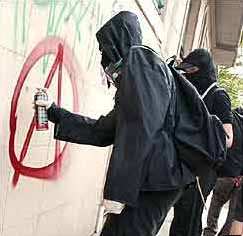
This was the surprising injunction from the Metropolitan Police issued to businesses and members of the public in Westminster last week. There was no warning about other political groups, but next to an image of the anarchist emblem, the City of Westminster police’s “counter terrorist focus desk” called for anti-anarchist whistleblowers stating: “Anarchism is a political philosophy which considers the state undesirable, unnecessary, and harmful, and instead promotes a stateless society, or anarchy. Any information relating to anarchists should be reported to your local police.”
The move angered some anarchists who complained that being an anarchist should not imply criminal behaviour. They said they feel unfairly criminalised for holding a set of political beliefs.
The feeling of disproportion was compounded by the briefing note author making a similar request about Islamist terrorists a few lines further down. Under an image of flag with a gold dot beneath some Arabic script it added: “Often seen used by al-Qaida in Iraq. Any sightings of these images should be reported to your local police.”
“It unfairly implies that anyone involved in anarchism should be known to the police and is involved in an dangerous activity,” said Jason Sands, an anarchist from South London. “There is nothing inherently criminal about political philosophy whatever it is. The police work under the convention on human rights which disallows discrimination against people because of their political beliefs and even the request for information would seem to be in breach of that. It also seems to be a bit useless as a way of gathering intelligence. It isn’t focused on anything specific and they are just asking for general information. Imagine calling up and saying ‘there’s an anarchist in my building. What should I do?’ It doesn’t make sense.”
The note was issued from Belgravia Police Station as part of Project Griffin which aims to “advise and familiarise managers, security officers and employees of large public and private sector organisations across the capital on security, counter-terrorism and crime prevention issues”.
Sean Smith, external relations officer for Solfed, the British section of the anarcho-syndicalist International Workers’ Association, said of the call for whistleblowers: “It’s pretty absurd, but not surprising, when the state seeks to criminalise ideas it deems to be dangerous to its own survival”.
“We are a revolutionary union initiative,” he explained. “Members of our organisation believe in bringing about radical social change through workplace and community organising, not acts of terrorism. We have made extensive information about our ideas and strategy freely available online.”
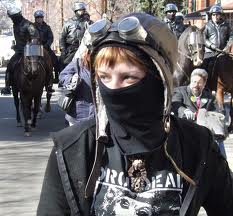
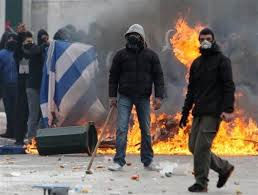
Small groups of anarchists masked and dressed in black did cause some damage to shop windows in central London during anti-cuts demonstrations in the Spring, but there has been little activity of late. The next big anarchist event in London appears hardly likely to concern the police. It is a book fair in October with “all-day cabaret starring assorted ranters, poets, singers and comics; all-day film showings and two kids’ spaces”.
Anarchist historian Max Nettlau provided a more complex concept of propaganda when he said that,
Every person is likely to be open to a different kind of argument, so propaganda cannot be diversified enough if we want to touch all. We want it to pervade and penetrate all the utterances of life, social and political, domestic and artistic, educational and recreational. There should be propaganda by word and action, the platform and the press, the street corner, the workshop, and the domestic circle, acts of revolt, and the example of our own lives as free men. Those who agree with each other may co-operate; otherwise they should prefer to work each on his own lines to trying to persuade one the other of the superiority of his own method.[8]
 Rosamond Press
Leave a comment