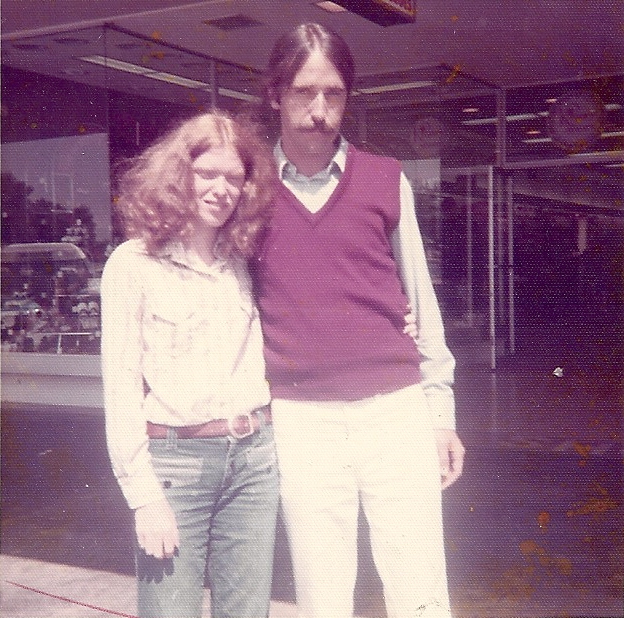
 Above is a photo of Dottie Witherspoon and I. Dottie descend from John Knox, the Calvinist prophet, thus, she may be preordained to be Saved by God, and His sacrificial Son. Dottie and I are kindred via the Benton family. There was talk about us getting married. We are an All American Love Story. Then, she ran away to join a Christian cult that laid the groundwork of the government shut-down. There are evangelicals that are driven by the computer that feeds them more powerful doses of religious addiction. I am one of the few that opposes them employing my knowledge of the Bible. Starting tomorrow, I will be giving Biblical lesson in order to defuse the ticking bomb this Calvinist is, starting with the question I put forth asking why the Jews wanted to kill Jesus after he read from Isaiah.
Ted Cruz will be speaking to evangelicals in South Carolina where the Witherspoons hail. John Witherspoon was a Signer of the Constitution. Cruz ad his kind may subscribe to the “Unconditional election” which establishes a altered Divine Rule of Kings in the Protestant church, that competed with the royalty that the Catholic Pope blessed. This is why we see these people who hate and mock our President, because they perceive THEIR invisible throne is in the White House.
Jon Presco
“Unconditional election” asserts that God has chosen from eternity those whom he will bring to himself not based on foreseen virtue, merit, or faith in those people; rather, his choice is unconditionally grounded in his mercy alone. God has chosen from eternity to extend mercy to those he has chosen and to withhold mercy from those not chosen. Those chosen receive salvation through Christ alone. Those not chosen receive the just wrath that is warranted for their sins against God”
https://rosamondpress.wordpress.com/2013/04/15/kin-to-the-stewarts-and-windsors/
https://rosamondpress.wordpress.com/2013/04/11/hollis-williams-all-american-family/
https://rosamondpress.wordpress.com/2012/02/27/witherspoon-and-the-great-awakening/
Although much of Calvin’s work was in Geneva, his publications spread his ideas of a “correctly” reformed church to many parts of Europe. Calvinism became the theological system of the majority in Scotland (see John Knox), the Netherlands, with men such as William Ames, T. J. Frelinghuysen and Wilhelmus à Brakel and parts of Germany (especially those adjacent to the Netherlands) with the likes of Olevianus and his colleague Zacharias Ursinus.
Most settlers in the American Mid-Atlantic and New England were Calvinists, including the English Puritans, the French Huguenot and Dutch settlers of New Amsterdam (New York), and the Scotch-Irish Presbyterians of the Appalachian back country. Dutch Calvinist settlers were also the first successful European colonizers of South Africa, beginning in the 17th century, who became known as Boers or Afrikaners.
Sierra Leone was largely colonized by Calvinist settlers from Nova Scotia, who were largely Black Loyalists, blacks who had fought for the British during the American War of Independence. John Marrant had organized a congregation there under the auspices of the Huntingdon Connection. Some of the largest Calvinist communions were started by 19th and 20th century missionaries. Especially large are those in Indonesia, Korea and Nigeria. In South Korea there are 20,000 Presbyterian congregations in about 9-10 million church members, scattered in more than 100 Presbyterian denominations. In Korea Presbyterianism is far the biggest Christian denomination.[16]
Unconditional election” asserts that God has chosen from eternity those whom he will bring to himself not based on foreseen virtue, merit, or faith in those people; rather, his choice is unconditionally grounded in his mercy alone. God has chosen from eternity to extend mercy to those he has chosen and to withhold mercy from those not chosen. Those chosen receive salvation through Christ alone. Those not chosen receive the just wrath that is warranted for their sins against God.[36]
Fourth-century Church Father Augustine of Hippo taught that saving grace is sovereignly bestowed by God without any consideration of individual merit. God chose some men for salvation in an eternal, hidden decree. Few later theologians prior to the Reformation would take up this idea.[5]
In Calvinist theology, election is considered to be one aspect of predestination in which God selects certain individuals to be saved. Those elected receive mercy, while those not elected, the reprobates, receive justice without condition. This unconditional election is essentially related to the rest of the TULIP hinged upon the supreme basic belief in the sovereignty of God. Unconditional election is God’s choice to save people regardless of their sin or any condition. This basically means, God’s act of saving is not based on what man can do or choose to will, but man is loved by God without any conditions or man’s action or deeds but solely by God’s grace, thus unconditional election.
In Calvinist and some other churches (Waldensians, Katharoi, Anabaptists, Particular Baptists, etc.) this election has been called “unconditional” because his choice to save someone does not hinge on anything inherent in the person or on any act that the person performs or belief that the person exercises. Indeed, according to the doctrine of total depravity (the first of the five points of Calvinism), the influence of sin has so inhibited the individual’s volition that no one is willing or able to come to or follow God apart from God first regenerating the person’s soul to give them the ability to love him. Hence, God’s choice in election is and can only be based solely on God’s own independent and sovereign will and [not] upon the foreseen actions of man. Scholastic Calvinists have sometimes debated precisely when, relative to the decree for the Fall of man, God did his electing – see supralapsarianism and infralapsarianism – though such distinctions are not often emphasized in modern Calvinism.
The Reformed position is frequently contrasted with the Arminian doctrine of conditional election in which God’s eternal choice to save a person is conditioned on God’s certain foreknowledge of future events, namely, that certain individuals would exercise faith and trust in response to God’s [offer] of salvation.
http://en.wikipedia.org/wiki/Unconditional_election
The ransom and Christus Victor theories present Jesus as dying to overcome (supernatural) powers of sin and evil. In this model, the devil has ownership over humanity (because they have sinned) so Jesus dies in their place to free them. The doctrine is that Jesus gave himself as a ransom sacrifice in behalf of the people. (Matthew 20:28) This is known as the oldest of the theories of the atonement,[7][8] and is, in some form, still, along with the doctrine of theosis, the Eastern Orthodox Church’s main theory of the atonement.
Satisfaction and penal substitution[edit]
Main article: Satisfaction theory of atonement
Main article: Penal substitution
The widest held substitutionary theory in the West is the penal substitution model. Both the penal theory and Anselm’s satisfaction theory hold that only human beings can rightfully repay the debt (to God’s honour [Anselm], or to God’s justice [penal substitution]) which was incurred through their wilful disobedience to God. Since only God can make the satisfaction necessary to repay it, therefore God sent the God-man, Jesus Christ, to fulfil both these conditions.[9] Christ is a sacrifice by God on behalf of humanity, taking humanity’s debt for sin upon himself, and propitiating God’s wrath.[10]
http://en.wikipedia.org/wiki/Substitutionary_atonement
Key Bible texts[edit]
Christian doctrine holds that Christ’s coming and sacrifice was portended by, among others, the Prophet Isaiah approximately 700 years before Jesus was born. These prophesies can be found in Isaiah 52:7-53:12. Luke 4:16-22 reports Jesus saying that the prophesies in Isaiah were about him. The New Testament explicitly quotes from Isaiah 53 in Matthew 8:16-18 to indicate that Jesus is the fulfillment of these prophesies. Although various Christians read them in different ways (some in non-substitutionary ways),[1][2] the following Biblical passages are sometimes put forwards as key texts by proponents of substitutionary atonement theories:
He was despised and rejected by men; a man of sorrows, and acquainted with grief; and as one from whom men hide their faces he was despised, and we esteemed him not. Surely he has borne our griefs and carried our sorrows; yet we esteemed him stricken, smitten by God, and afflicted. But he was wounded for our transgressions; he was crushed for our iniquities; upon him was the chastisement that brought us peace, and with his stripes we are healed. All we like sheep have gone astray; we have turned—every one—to his own way; and the LORD has laid on him the iniquity of us all. He was oppressed, and he was afflicted, yet he opened not his mouth; like a lamb that is led to the slaughter, and like a sheep that before its shearers is silent, so he opened not his mouth. By oppression and judgment he was taken away; and as for his generation, who considered that he was cut off out of the land of the living, stricken for the transgression of my people? And they made his grave with the wicked and with a rich man in his death, although he had done no violence, and there was no deceit in his mouth. Yet it was the will of the LORD to crush him; he has put him to grief; when his soul makes an offering for guilt, he shall see his offspring; he shall prolong his days; the will of the LORD shall prosper in his hand. Out of the anguish of his soul he shall see and be satisfied;by his knowledge shall the righteous one, my servant, make many to be accounted righteous, and he shall bear their iniquities. Therefore I will divide him a portion with the many, and he shall divide the spoil with the strong, because he poured out his soul to death and was numbered with the transgressors; yet he bore the sin of many, and makes intercession for the transgressors.[Isaiah 53:1-12]
For our sake he made him to be sin who knew no sin, so that in him we might become the righteousness of God.[2 Cor. 5:21]
All who rely on works of the law are under a curse; for it is written, ‘Cursed be every one who does not abide by all things written in the book of the law, and do them.’ […] Christ redeemed us from the curse of the law, having become a curse for us—for it is written, ‘Cursed be every one who hangs on a tree.'[Galatians 3:10,13]
Isaiah 52:7-53:12
New International Version (NIV)
7 How beautiful on the mountains
are the feet of those who bring good news,
who proclaim peace,
who bring good tidings,
who proclaim salvation,
who say to Zion,
“Your God reigns!”
8 Listen! Your watchmen lift up their voices;
together they shout for joy.
When the Lord returns to Zion,
they will see it with their own eyes.
9 Burst into songs of joy together,
you ruins of Jerusalem,
for the Lord has comforted his people,
he has redeemed Jerusalem.
10 The Lord will lay bare his holy arm
in the sight of all the nations,
and all the ends of the earth will see
the salvation of our God.
11 Depart, depart, go out from there!
Touch no unclean thing!
Come out from it and be pure,
you who carry the articles of the Lord’s house.
12 But you will not leave in haste
or go in flight;
for the Lord will go before you,
the God of Israel will be your rear guard.
The Suffering and Glory of the Servant
13 See, my servant will act wisely[a];
he will be raised and lifted up and highly exalted.
14 Just as there were many who were appalled at him[b]—
his appearance was so disfigured beyond that of any human being
and his form marred beyond human likeness—
15 so he will sprinkle many nations,[c]
and kings will shut their mouths because of him.
For what they were not told, they will see,
and what they have not heard, they will understand.
53 Who has believed our message
and to whom has the arm of the Lord been revealed?
2 He grew up before him like a tender shoot,
and like a root out of dry ground.
He had no beauty or majesty to attract us to him,
nothing in his appearance that we should desire him.
3 He was despised and rejected by mankind,
a man of suffering, and familiar with pain.
Like one from whom people hide their faces
he was despised, and we held him in low esteem.
4 Surely he took up our pain
and bore our suffering,
yet we considered him punished by God,
stricken by him, and afflicted.
5 But he was pierced for our transgressions,
he was crushed for our iniquities;
the punishment that brought us peace was on him,
and by his wounds we are healed.
6 We all, like sheep, have gone astray,
each of us has turned to our own way;
and the Lord has laid on him
the iniquity of us all.
7 He was oppressed and afflicted,
yet he did not open his mouth;
he was led like a lamb to the slaughter,
and as a sheep before its shearers is silent,
so he did not open his mouth.
8 By oppression[d] and judgment he was taken away.
Yet who of his generation protested?
For he was cut off from the land of the living;
for the transgression of my people he was punished.[e]
9 He was assigned a grave with the wicked,
and with the rich in his death,
though he had done no violence,
nor was any deceit in his mouth.
10 Yet it was the Lord’s will to crush him and cause him to suffer,
and though the Lord makes[f] his life an offering for sin,
he will see his offspring and prolong his days,
and the will of the Lord will prosper in his hand.
11 After he has suffered,
he will see the light of life[g] and be satisfied[h];
by his knowledge[i] my righteous servant will justify many,
and he will bear their iniquities.
12 Therefore I will give him a portion among the great,[j]
and he will divide the spoils with the strong,[k]
because he poured out his life unto death,
and was numbered with the transgressors.
For he bore the sin of many,
and made intercession for the transgressors

 Rosamond Press
Leave a comment