 “With its new law Russia is protecting genuine and universally recognized human rights against artificial and fabricated “values” aggressively imposed in many modern societies.”
These messengers of Christian-X have created a Protestant Dogma that they want the Leader of the Soviet Union to sign off on…… apply his MARK.
The founding fathers of the Protestant Religion were against the Catholic Dogmas surrounding Mary and her family, where even her mother, Anna, is subjected to a kind of holy cleansing that is vital in producing ONE SON, who is not a normal son, but, the Son of God. When they spoke against these “fabricated values” they were rounded up, tortured, and murdered by the aggressive Inquisition.
“Russia is protecting genuine and universally recognized human rights against artificial and fabricated “values” aggressively imposed in many modern societies”
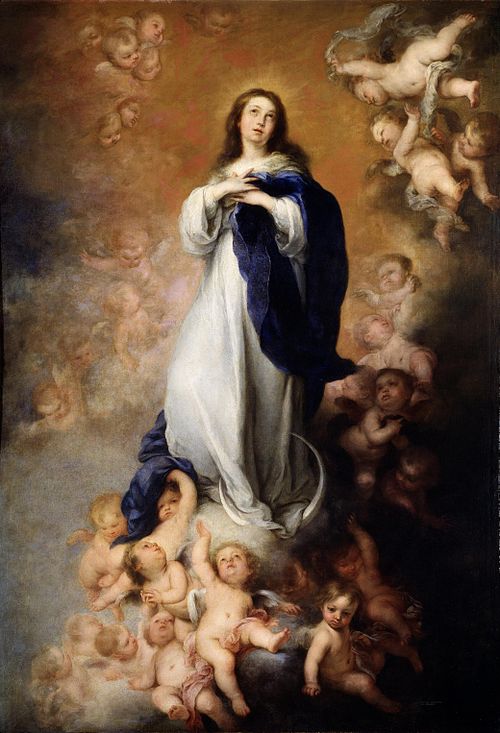
In your normal births one does not see little naked cherubs surrounding ones wife. This is a common theme. In the painting above the genitalia of the boy cherubs is covered up with a cloth like the one that covered Jesus on the cross. However, there are hundreds of works of holy art that show little penises galore, because, you don’t want any tiny (unclean) vaginas competing with the Holy Mothers – when they grow up to be real women!
These virginal lessons are still taught by virginal nuns and priests, some who cut off their penis. This is why the newly founded Protestant church allows its ministers to get married, because the veneration of the Virgin Mary – was out of this world!
Catholic priests have systematically preyed upon little boys and girls. Here is proof as to who has been imposing their “artificial values” on our families!
“Any harmful initiative for the natural family is destructive for the society as a whole. We also affirm that the children need special protection due to their innocence and immaturity.”
But, it’s just fine for Christian-x in our Congress to vote food out of the mouths of babes!
In the act of Mary getting pregnant, there is an angel who performs some kind of holy impregnation. Mary’s husband and his erect genitalia does not take part in this pregnancy – that is abnormal. After this holy spirit is done, then the father in proxy is moved to the back burner. Joseph’s son will not be like his father. Mary is not like any Jewish mother, accept for her cousin, who gave birth to John in a immaculate fashion – too! How then can the Christian-x claim these holy people have set an example for all Christians to follow – and the whole secular world!
This is madness! If these Christian-X groups believed this was the way their God wanted things to be, then why didn’t the send their edict for Putin to sign – before he passed a law making homosexuality a crime! If this pact become a World Wide Holy Law, then gay folks can take credit!
When Hitler watched his Nazis march into Paris he turned to Goebbels and said;
“If the Jews didn’t exist, we would have had to invent them!”
Christian-X has anointed Putin the Father of the Russian Annunciation. Mark my words, from this pact the Anti-Christ has already been concieved!
Jon Presco
One Nazarite guarding the door
We affirm that the natural family created through the marriage of a man and a woman is the foundation of any human society and is entitled to protection by society and the State as stated in the international Human Rights norms, including Universal Declaration of Human Rights (Art. 16 (3)). Any harmful initiative for the natural family is destructive for the society as a whole. We also affirm that the children need special protection due to their innocence and immaturity.
We acknowledge that the Russian law protects the innocence of children and the basic rights of their parents recognized in the international legislation and treaties. With its new law Russia is protecting genuine and universally recognized human rights against artificial and fabricated “values” aggressively imposed in many modern societies. We also note that the concepts of “sexual orientation” and “gender identity” are not outlined in the existing binding international treaties and agreements.
We thus call for respect of the sovereignty of the Russian people and we invite all organizations and people who feel responsible for the protection of the innocence of children and their rights, the natural family and parental rights to stand up for Russia, as well as for Ukraine and Moldova suffering the same pressure due to similar laws.
Source: Profesionalesetica.org and ChristianNewswire.com
Annunciation to the Blessed Virgin Mary or Annunciation of the Lord, is the Christian celebration of the announcement by the angel Gabriel to the Virgin Mary that she would conceive and become the mother of Jesus, the Son of God, marking his Incarnation. Gabriel told Mary to name her son Jesus, meaning “Saviour”.
The Immaculate Conception is a dogma of the Catholic Church maintaining that from the moment when she was conceived in the womb, the Blessed Virgin Mary was kept free of original sin, [1][2] so that she was from the start filled with the sanctifying grace normally conferred in baptism. It is one of the four dogmas in Roman Catholic Mariology. Mary is often called the Immaculata (the Immaculate One), particularly in artistic and cultural contexts.[3]
The Immaculate Conception should not be confused with the perpetual virginity of Mary or the virgin birth of Jesus; it refers to the conception of Mary by her mother, Saint Anne. Although the belief was widely held since at least Late Antiquity, the doctrine was not dogmatically defined until December 8, 1854, by Pope Pius IX in his papal bull Ineffabilis Deus. It is not formal doctrine except in the Roman Catholic Church.[4] The Feast of the Immaculate Conception is observed on December 8 in many Catholic countries as a holy day of obligation or patronal feast, and in some as a national public holiday.
Original sin and actual (personal) sin[edit source]
The defined dogma of the Immaculate Conception regards original sin only, saying that Mary was preserved from any stain (in Latin, macula or labes, the second of these two synonymous words being the one used in the formal definition).[1] The proclaimed Roman Catholic dogma states “that the most Blessed Virgin Mary, in the first instance of her conception, by a singular grace and privilege granted by Almighty God, in view of the merits of Jesus Christ, the Saviour of the human race, was preserved free from all stain of original sin.”[1] Therefore, being always free from original sin, the doctrine teaches that from her conception Mary received the sanctifying grace that would normally come with baptism after birth.
The definition makes no declaration about the Church’s belief that the Blessed Virgin was sinless, in the sense of actual or personal sin.[5] However, the Church also holds that Mary was also sinless personally, that she was “free from all sin, original or personal”.[6] The Council of Trent decreed: “If anyone shall say that a man once justified can sin no more, nor lose grace, and that therefore he who falls and sins was never truly justified; or, on the contrary, that throughout his whole life he can avoid all sins even venial sins, except by a special privilege of God, as the Church holds in regard to the Blessed Virgin: let him be anathema.”[7]
Virginal conception[edit source]
The doctrine of the immaculate conception (Mary being conceived free from original sin) is not to be confused with her virginal conception of her son Jesus. This misunderstanding of the term immaculate conception is frequently met in the mass media. Catholics believe that Mary was not the product of a virginal conception herself but was the daughter of a human father and mother,[8] traditionally known by the names of Saint Joachim and Saint Anne. In 1677, the Holy See condemned the belief that Mary was virginally conceived, which had been a belief surfacing occasionally since the 4th century.[9] The Church celebrates the Feast of the Immaculate Conception (when Mary was conceived free from original sin) on 8 December, exactly nine months before celebrating the Nativity of Mary. The feast of the Annunciation (which commemorates the virginal conception and the Incarnation of Jesus) is celebrated on 25 March, nine months before Christmas Day.[10][11]
Redemption[edit source]
Another misunderstanding is that, by her immaculate conception, Mary did not need a saviour. When defining the dogma in Ineffabilis Deus, Pope Pius IX explicitly affirmed that Mary was redeemed in a manner more sublime. He stated that Mary, rather than being cleansed after sin, was completely prevented from contracting Original Sin in view of the foreseen merits of Jesus Christ, the Savior of the human race. In Luke 1:47, Mary proclaims: “My spirit has rejoiced in God my Saviour.” This is referred to as Mary’s pre-redemption by Christ. Since the Council of Orange II against semi-pelagianism, the Catholic Church has taught that even had man never sinned in the Garden of Eden and was sinless, he would still require God’s grace to remain sinless.[12][13]
History[edit source]
A feast of the Conception of the Most Holy and All Pure Mother of God was celebrated in Syria on 8 December perhaps as early as the 5th century. Note that the title of achrantos (spotless, immaculate, all-pure) refers to the holiness of Mary, not specifically to the holiness of her conception.[14]
An 11th-century Eastern Orthodox icon of the Theotokos Panachranta, i.e. the “all immaculate” Mary[15]
By the 7th century the feast of her conception was widely celebrated in the East, under the name of the Conception (active) of Saint Anne. In the West it was known as the feast of the Conception (passive) of Mary, and was associated particularly with the Normans, whether these introduced it directly from the East[16] or took it from English usage.[17] The spread of the feast, by now with the adjective “Immaculate” attached to its title, met opposition on the part of some, on the grounds that sanctification was possible only after conception.[18] Critics included Saints Bernard of Clairvaux, Albertus Magnus and Thomas Aquinas.[19] Other theologians defended the expression “Immaculate Conception”, pointing out that sanctification could be conferred at the first moment of conception in view of the foreseen merits of Christ, a view held especially by Franciscans.[19]
Writers such as Mark Miravalle and Sarah Jane Boss interpret the existence of the feast as a strong indication of the Church’s traditional belief in the Immaculate Conception.[20][21]
On 28 February 1476, Pope Sixtus IV, a Franciscan after whom the Sistine Chapel is named, authorized those dioceses that wished to introduce the feast to do so, and introduced it to his own diocese of Rome in 1477,[17] with a specially composed Mass and Office of the feast.[22] With his bull Cum praeexcelsa of 28 February 1477, in which he referred to the feast as that of the Conception of Mary, without using the word “Immaculate”, he granted indulgences to those who would participate in the specially composed Mass or Office on the feast itself or during its octave, and he used the word “immaculate” of Mary, but applied instead the adjective “miraculous” to her conception.[23][24] On 4 September 1483, referring to the feast as that of “the Conception of Immaculate Mary ever Virgin”, he condemned both those who called it mortally sinful and heretical to hold that the “glorious and immaculate mother of God was conceived without the stain of original sin” and those who called it mortally sinful and heretical to hold that “the glorious Virgin Mary was conceived with original sin”, since, he said, “up to this time there has been no decision made by the Roman Church and the Apostolic See.”[25] This decree was reaffirmed by the Council of Trent.[26]
One of the chief proponents of the doctrine was the Hungarian Franciscan Pelbartus Ladislaus of Temesvár. [27]
Pope Pius V, the Dominican Pope who in 1570 established the Tridentine Mass, included the feast (but without the adjective “Immaculate”) in the Tridentine Calendar, but suppressed the existing special Mass for the feast, directing that the Mass for the Nativity of Mary (with the word “Nativity” replaced by “Conception”) be used instead.[28] Part of that earlier Mass was revived in the Mass that Pope Pius IX ordered to be used on the feast and that is still in use.[29]
On 6 December 1708, Pope Clement XI made the feast of the Conception of Mary, at that time still with the Nativity of Mary formula for the Mass, a Holy Day of Obligation.[18] Until Pope Pius X reduced in 1911 the number of Holy Days of Obligation to 8, there were in the course of the year 36 such days, apart from Sundays.[30]
Definition of the dogma[edit source]
Altar of the Immaculata by Joseph Lusenberg, 1876. Saint Antony’s Church, Urtijëi, Italy.
During the reign of Pope Gregory XVI the bishops in various countries began to press for a definition as dogma of the teaching of Mary’s immaculate conception.[31]
In 1839 Mariano Spada (1796 – 1872), professor of theology at the Roman College of Saint Thomas, published Esame Critico sulla dottrina dell’ Angelico Dottore S. Tommaso di Aquino circa il Peccato originale, relativamente alla Beatissima Vergine Maria,[32] in which Aquinas is interpreted not as treating the question of the Immaculate Conception later formulated in the papal bull Ineffabilis Deus but rather the sanctification of the fetus within Mary’s womb. Spada furnished an interpretation whereby Pius IX was relieved of the problem of seeming to foster a doctrine not in agreement with the Aquinas’ teaching.[33] Pope Pius IX would later appoint Spada Master of the Sacred Palace in 1867.
Pius IX, at the beginning of his pontificate, and again after 1851, appointed commissions to investigate the whole subject, and he was advised that the doctrine was one which could be defined and that the time for a definition was opportune.
It was not until 1854 that Pope Pius IX, with the support of the overwhelming majority of Roman Catholic bishops, whom he had consulted between 1851–1853, promulgated the papal bull Ineffabilis Deus (Latin for “Ineffable God”), which defined ex cathedra the dogma of the Immaculate Conception:[34]
We declare, pronounce and define that the doctrine which holds that the Blessed Virgin Mary, at the first instant of her conception, by a singular privilege and grace of the Omnipotent God, in virtue of the merits of Jesus Christ, the Saviour of mankind, was preserved immaculate from all stain of original sin, has been revealed by God, and therefore should firmly and constantly be believed by all the faithful.
—Pope Pius IX, Ineffabilis Deus, December 8, 1854[35]
The dogma was defined in accordance with the conditions of papal infallibility, which would be defined in 1870 by the First Vatican Council.
The papal definition of the dogma declares with absolute certainty and authority that Mary possessed sanctifying grace from the first instant of her existence and was free from the lack of grace caused by the original sin at the beginning of human history. Mary’s salvation was won by her son Jesus Christ through his passion, death, and resurrection and was not due to her own merits.[36][37]
Later developments[edit source]
For the Roman Catholic Church the dogma of the Immaculate Conception gained additional significance from the reputed apparitions of Our Lady of Lourdes in 1858. At Lourdes a 14-year-old girl, Bernadette Soubirous, claimed that a beautiful woman appeared to her and said, “I am the Immaculate Conception”. Many believe the woman to have been the Blessed Virgin Mary and pray to her as such.[38][39]
Pope Pius IX defined the dogma of the Immaculate Conception “not so much because of proofs in Scripture or ancient tradition, but due to a profound sensus fidelium and the Magisterium”.[40]
Speaking of the witness of the Church Fathers in claiming for Mary titles such as “Free from all contagion of sin”, Pope Pius XII wrote:
If the popular praises of the Blessed Virgin Mary be given the careful consideration they deserve, who will dare to doubt that she, who was purer than the angels and at all times pure, was at any moment, even for the briefest instant, not free from every stain of sin?[41]
The Roman Catholic tradition has a well-established philosophy for the study of the Immaculate Conception and the veneration of the Blessed Virgin Mary in the field of Mariology, with Pontifical schools such as the Marianum specifically devoted to this.[42][43][44]
Medieval dispute about the doctrine[edit source]
Emblem of the Papacy SE.svg
A series of articles on
Roman Catholic
Mariology
Virgin Mary – Diego Velazquez.jpg
General articles
Mariology·
Encyclicals
History·
Popes
Saints·
Societies
Veneration of the Blessed Virgin
Devotions
Acts of Reparation
Consecration to Mary
First Saturdays
Hearts of Jesus and Mary
Immaculate Heart·
Rosary
Scapular·
Seven Joys
Seven Sorrows
Dogmas and doctrines
Assumption·
Co-Redemptrix
Immaculate Conception
Mediatrix·
Mother of God
Mother of the Church
Perpetual virginity
Queen of Heaven
Expressions of devotion
Art·
Churches
Hymns·
Music
Key Marian apparitions
(approved or worthy of belief)
Banneux·
Beauraing·
Fátima
Guadalupe·
La Salette·
Laus
Lourdes·
Miraculous Medal
Pontmain
v·
t·
e
It seems to have been St Bernard of Clairvaux who, in the 12th century, explicitly raised the question of the Immaculate Conception. A feast of the Conception of the Blessed Virgin had already begun to be celebrated in some churches of the West. St Bernard blames the canons of the metropolitan church of Lyon for instituting such a festival without the permission of the Holy See. In doing so, he takes occasion to repudiate altogether the view that the conception of Mary was sinless. It is doubtful, however, whether he was using the term “conception” in the same sense in which it is used in the definition of Pope Pius IX. Bernard would seem to have been speaking of conception in the active sense of the mother’s cooperation, for in his argument he says: “How can there be absence of sin where there is concupiscence (libido)?” and stronger expressions follow, showing that he is speaking of the mother and not of the child.[5]
Saint Thomas Aquinas, the greatest of the medieval scholastics, refused to admit the Immaculate Conception, on the ground that, unless the Blessed Virgin had at one time or other been one of the sinful, she could not justly be said to have been redeemed by Christ.[45]
Saint Bonaventure (d . 1274), second only to Saint Thomas in his influence on the Christian schools of his age, hesitated to accept it for a similar reason.[5] He believed that Mary was completely free from sin, but that she was not given this grace at the instant of her conception.[46]
The celebrated John Duns Scotus (d . 1308), a Friar Minor like Saint Bonaventure, argued, on the contrary, that from a rational point of view it was certainly as little derogatory to the merits of Christ to assert that Mary was by him preserved from all taint of sin, as to say that she first contracted it and then was delivered.[5] Proposing a solution to the theological problem of reconciling the doctrine with that of universal redemption in Christ, he argued that Mary’s immaculate conception did not remove her from redemption by Christ; rather it was the result of a more perfect redemption granted her because of her special role in salvation history.[47]
The arguments of Scotus, combined with a better acquaintance with the language of the early Fathers, gradually prevailed in the schools of the Western Church. In 1387 the university of Paris strongly condemned the opposite view.[5]
Scotus’s arguments remained controversial, however, particularly among the Dominicans, who were willing enough to celebrate Mary’s sanctificatio (being made free from sin) but, following the Dominican Thomas Aquinas’ arguments, continued to insist that her sanctification could not have occurred until after her conception.[18]
Popular opinion remained firmly behind the celebration of Mary’s conception. In 1439, the Council of Basel, which is not reckoned an ecumenical council, stated that belief in the immaculate conception of Mary is in accord with the Catholic faith.[48] By the end of the 15th century was widely professed and taught in many theological faculties, but such was the influence of the Dominicans, and the weight of the arguments of Thomas Aquinas (who had been canonised in 1323 and declared “Doctor Angelicus” of the Church in 1567) that the Council of Trent (1545–63)—which might have been expected to affirm the doctrine—instead declined to take a position.[18][36]
Church Fathers[edit source]
It is admitted that the doctrine as defined by Pius IX. was not explicitly mooted before the 12th century. It is also agreed that “no direct or categorical and stringent proof of the dogma can be brought forward from Scripture”.[18] But it is claimed that the doctrine is implicitly contained in the teaching of the Fathers. Their expressions on the subject of the sinlessness of Mary are, it is pointed out, so ample and so absolute that they must be taken to include original sin as well as actual . Thus we have in the first five centuries such epithets applied to her as “in every respect holy”, “in all things unstained”, “super-innocent” and “singularly holy”; she is compared to Eve before the fall, as ancestress of a redeemed people; she is “the earth before it was accursed.” The well-known words of St Augustine (d . 430) may be cited: ” As regards the mother of God,” he says, ” I will not allow any question whatever of sin.” It is true that he is here speaking directly of actual or personal sin. But his argument is that all men are sinners; that they are so through original depravity; that this original depravity may be overcome by the grace of God, and he adds that he does not know but that Mary may have had sufficient grace to overcome sin “of every sort” (omni ex parte).[5]
The bull of definition of the dogma, Ineffabilis Deus, mentioned in particular the patrististic interpretation of Genesis 3:15 as referring to a woman, Mary, who would be eternally at enmity with the evil serpent and completely triumphing over him. It said the Fathers saw foreshadowings of Mary’s “wondrous abundance of divine gifts and original innocence” “in that ark of Noah, which was built by divine command and escaped entirely safe and sound from the common shipwreck of the whole world;[49] in the ladder which Jacob saw reaching from the earth to heaven, by whose rungs the angels of God ascended and descended, and on whose top the Lord himself leaned;[50] in that bush which Moses saw in the holy place burning on all sides, which was not consumed or injured in any way but grew green and blossomed beautifully;[51] in that impregnable tower before the enemy, from which hung a thousand bucklers and all the armor of the strong;[52] in that garden enclosed on all sides, which cannot be violated or corrupted by any deceitful plots;[53] in that resplendent city of God, which has its foundations on the holy mountains;[54] in that most august temple of God, which, radiant with divine splendours, is full of the glory of God;[55] and in very many other biblical types of this kind.”
The bull recounts that the Fathers interpreted the angel’s address to Mary, “highly favoured one” or “full of grace”,[56] as indicating that “she was never subject to the curse and was, together with her Son, the only partaker of perpetual benediction”; and they “frequently compare her to Eve while yet a virgin, while yet innocence, while yet incorrupt, while not yet deceived by the deadly snares of the most treacherous serpent”.

 Rosamond Press
Leave a reply to Royal Rosamond Press Cancel reply