 “During his time in South Africa, Haggard developed an intense hatred for the Boers, but also came to admire the Zulus.”
We are ready to meet her, the Nazarite Queen whose bones lie at rest in the Louvre. Come, my Muse, after we go back to Nebraska – it’s off to Paris to bow down before her and the Holy Spirit who bid her sons to go to war with Rome, the slave masters.
Or, shall we never meet, nor, speak, we forever being in our young bodies, and forever being in love, and forever living in the words I lay at your beautiful feet.
I will forever prepare your way. Your…..Jon.
Either way, one more great adventure – for you – my beautiful, beautiful young woman, who launched a thousand ships!
Jean de Rougemont of the Rose Lineage a.k.a. ‘The California Kid’
http://en.wikipedia.org/wiki/Tombs_of_the_Kings_(Jerusalem)
The grandeur of the site led to the mistaken belief that the tombs had once been the burial place of the kings of Judah, hence the name Tombs of the Kings; but the tombs are now associated with Queen Helena of Adiabene.[1] According to this theory, Queen Helena chose the site to bury her son Isates and others of her dynasty.
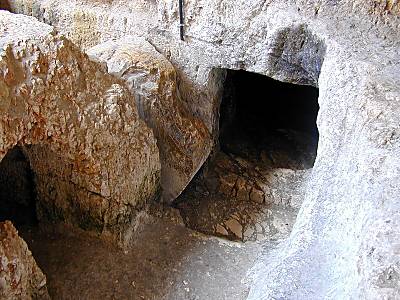
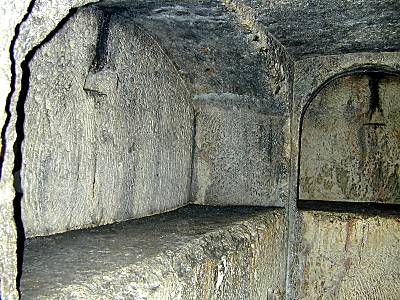
“The tombs are arranged on two levels around a central chamber, with four rooms upstairs and three rooms downstairs. The central chamber itself is entered from the courtyard via an antechamber that goes down into a dimly lit maze of chambers. The access from the antechamber to the exterior courtyard could be sealed closed by rolling a round stone across it, and the stone still remains in-situ. In the first century A.D., a “secret mechanism” operated by water pressure moved the stone. Probably a small amount of water pressure activated a system of weights to open the tomb. Two of the eight burial chambers have arcosolia, resting places made of a bench with an arch over it. Some of the arcosolia have triangular niches where oil lamps were placed to give light during the burial process.
The two most common types of tombs in the first century CE are found in this tomb complex. Shaft tombs were long narrow shafts in which the deceased were placed and closed with a stone slab which probably had the name of the occupant inscribed on it. Channels in the center of the shafts were probably carved to drain the water that seeped through the rock.
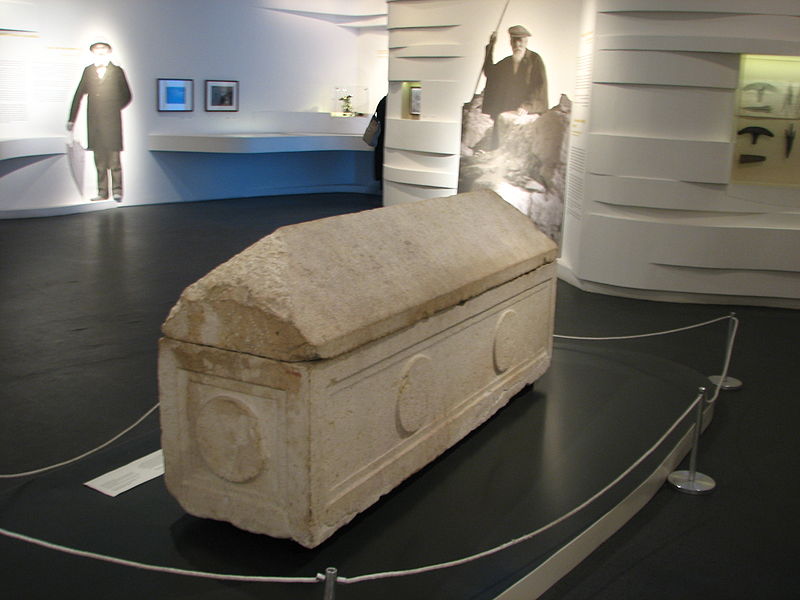
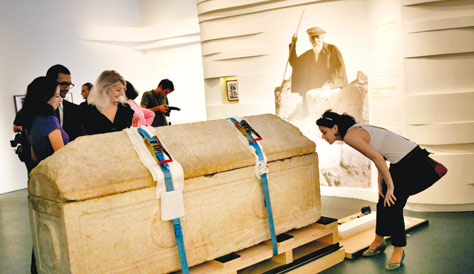
Sarcophagus of Helena of Adiabene, Israel Museum
The tombs are now empty, but previously housed a number of sarcophagi; they were excavated by a French archaeological mission headed by Louis Felicien de Saulcy, who took them back to France. They are exhibited at the Louvre.
Although no kings were buried here, one of the sarcophagi bears an inscription in Hebrew and Syriac identifying the corpse within as that of Queen Sara (Tzara Malchata); this is thought to refer to Helena, the Queen of Adiabene, Ecclesiastical History 2:12 The decorative architecture of the tomb complex is Seleucid, which would fit with this identification.
https://rosamondpress.wordpress.com/2012/05/11/queen-of-the-nazarite-zulu/
In 1875, Haggard was sent to Cape Town, South Africa, as secretary to Sir Henry Bulwer, the lieutenant-governor of Natal. In his memoirs Haggard wrote of his aspirations to become a colonial governor himself, and of his youthful excitement at the prospects.[3] The major event during his time in Africa was Britain’s annexation in 1877 of the Transvaal. Haggard was part of the expedition that established British control over the Boer republic, and on 24 May 1877 helped raise the Union flag over the capital, Pretoria. Writing of the moment, Haggard declared:
“ It will be some years before people at home realise how great an act it has been, an act without parallel. I am very proud of having been connected with it. Twenty years hence it will be a great thing to have hoisted the Union Jack over the Transvaal for the first time.[4] ”
Haggard had advocated the British annexation of the Boer republic in a journal article, “The Transvaal”, published in the May 1877 issue of Macmillan’s Magazine. Haggard maintained that it was Britain’s “mission to conquer and hold in subjection” lesser races, “not from thirst of conquest but for the sake of law, justice, and order”.[5] However, Boer resistance to British rule and the resulting Anglo-Zulu war caused the imperial government in London to withdraw from pursuing British sovereignty over the South African interior.[6] Haggard considered this to be a “great betrayal” by Prime Minister Gladstone and the Liberal Party, which “no lapse of time ever can solace or even alleviate”.[7] He became increasingly disillusioned with the realities of colonial Africa. As the Victorian scholar Patrick Brantlinger notes in his introduction to She: “Little that Haggard witnessed matched the romantic depictions of ‘the dark continent’ in boys’ adventure novels, in the press, and even in such bestselling explorers’ journals as David Livingstone’s Missionary Travels and Researches in South Africa (1857).”[8]
During his time in South Africa, Haggard developed an intense hatred for the Boers, but also came to admire the Zulus.[9] However, his admiration of the Zulus did not extend to other African peoples; rather, he shared many of the racist assumptions that underlay contemporary Victorian politics and philosophy,[10] such as those expressed by James Hunt, the President of the Anthropological Society of London: “the Negro is inferior intellectually to the European…[and] can only be humanised and civilised by Europeans. The analogies are far more numerous between the Negro and apes, than between the European and apes.”[11] The Victorian belief in the inherent inferiority of the ‘darker races’, made them the object of a civilising impulse in the European Scramble for Africa. Although disenchanted with the colonial effort, Haggard remained committed to this ideology. He believed that the British “alone of all the nations in the world appear to be able to control coloured races without the exercise of cruelty”.[12]
https://rosamondpress.wordpress.com/2011/12/24/nazarite-zulu-of-drakensberg-mountain/
https://rosamondpress.wordpress.com/2012/08/07/my-nazarite-church/

 Rosamond Press
Leave a comment