
 Artwork Saves Life of Mother of Five
Now, so many incredible things have happened to me in my life, that I don’t need to make anything up, even though this is done at times to enhance my absurd literary style. I will do all I can to give you the facts, as I recall them.
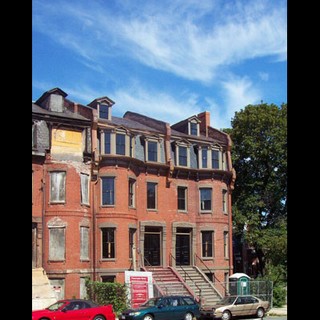
How James and I found each other after I arrived in Boston at four in the morning, is an incredible story. This happened a year after we ground to a halt in Winnemucca. We ended up living in a brownstone in Roxbury on the top floor. In the two floors below lived a black couple with five children. There were five of us in a two bedroom apartment. We were hippies.
Every Saturday morning the neighbor children would knock on the door and ask to come in and watch cartoons. This was quite a sight to see, a bunch of long hair hippies watching T.V. With little black children while eating their cereal, or, soybeans, or tofu.
The mother of these children was a very big woman around three hundred pounds. Her husband was around five foot six, and weighed about hundred a forty pounds.
One afternoon while working on my painting of Rena, I hear this loud banging below and the blood-curdling scream of the mother.
“Help me! Help me! He’s going to kill me!”
I now hear these screams coming up the stairs like rolling thunder.
“Oh Lord! I’m a dead woman. You’s got to save me!” And, she burst into our apartment. He, was right behind with a big butcher knife. I grabbed Rena’s portrait to get it out of the way, because there is going to be a big bloody fight. I didn’t want my painting to get damaged, or, get any blood on it.
Before I could set it aside, get it out of harms way, this large woman rushes behind me, grabs me by the shoulders, and turns me towards her attacker. Her angry husband is only wearing boxer shorts! In is hand is a large butcher knife. He is taking stabs at his wife, who moves me and my artwork towards her assailant. I am being used as a human shield, and so is my rendering of my beloved muse. Together we are protecting this mother who is screeching in my ear, I powerless get out of her grip.
“Ohhhhh! God. Do something! He’s murdering me!”
I now held Rena from my body to make sure I didn’t get stabbed in the belly when the knife pierced the canvas. When the husband stabbed to his left, she moved me to her right. It was like that scene where this guy shoots at his lawyer hiding behind a tree. My plan was to grab him if he stabs Rena, I twisting the blade in the canvas, then taking it from him. I’m now using the canvas like a shield. Violent stabbing motions are stopping short of puncturing my beloved’s heart.
Then, I saw him, our Savior. Here come two hundred and fifty pound James Harkins from off the sofa. He is gritting his teeth. His chubby arms wrap themselves around the husband, and James lifts him off the floor.
“Grab the knife!”
I made a move towards the knife dragging the mother with me, but, suddenly she let me go, ran and got the knife from her husband, and hit him atop his head with the flat of the blade while James still had a good hold.
“I aughta stick you like a pig mother-fucker. Now get your ass downstairs. How dare you disturb these good folks!”
Going down the stairs, she smacked him on the ass a couple of times with the flat of the knife! You could tell he was done, now that his wife had these crazy hippies and artists on her side. He now knew we weren’t a bunch of Tiny Tims handing out tulips. These were our Landlords. We gave them our rent money.
“Thanks James. You did good. You saved our lives!”
“Oh, I wasn’t saving you!” and he chuckles. “I was saving your painting of Rena. I hate people who harm works of art.”
It was there and then that I wondered if James was secretly in love with Rena, for everyone who knows James, knows he never sticks his neck out, because he believes you get what’s coming to you because of your bad karma. You can say my karma was good in James’ eyes because I chose a good subject to paint.
Epilogue
Now, if I did get stabbed to death, and I lie there under my painting of Rena, we joined in death by a big butcher knife and blood stain, what would the cops say;
“This poor sap was just a victim of circumstances.”
Would James pipe in and say;
“How about…..He died for his art!”
The detective rubbing his chin, now has the last word;
“It was beauty….who killed the beast!”
“That works!”
“You got my vote!”
Above is a photo I found of our old abode on the internet.
Jon Presco
Copyright 2013
http://www.wellesnet.com/?p=187
The most basic of all ideas was that of a search for the true significance of the man’s apparently meaningless dying words. Kane was raised without a family. He was snatched from his mother’s arms in early childhood. His parents were a bank. From the point of view of the psychologist, my character had never made what is known as “transference” from his mother. Hence his failure with his wives. In making this clear during the course of the picture, it was my attempt to lead the thoughts of my audience closer and closer to the solution of the enigma of his dying words. These were “Rosebud.” The device of the picture calls for a newspaperman (who didn’t know Kane) to interview people who knew him very well. None had ever heard of “Rosebud.” Actually, as it turns out, “Rosebud” is the trade name of a cheap little sled on which Kane was playing on the day he was taken away from his home and his mother. In his subconscious it represented the simplicity, the comfort, above all the lack of responsibility in his home, and also it stood for his mother’s love which Kane never lost.
In his waking hours, Kane had certainly forgotten the sled and the name which was painted on it. Casebooks of psychiatrists are full of these stories. It was important for me in the picture to tell the audience as effectively as possible what this really meant. Clearly it would be undramatic and disappointing if an arbitrary character in the story popped up with the information. The best solution was the sled itself. Now, how could this sled still exist since it was built in 1880? It was necessary that my character be a collector—the kind of man who never throws anything away. I wished to use as a symbol—at the conclusion of the picture—a great expanse of objects—thousands and thousands of things—one of which is “Rosebud.” This field of inanimate theatrical properties I wished to represent the very dust heap of a man’s life. I wished the camera to show beautiful things, ugly things and useless things, too—indeed everything, which could stand for a public career and a private life. I wished objects of art, objects of sentiment, and just plain objects. There was no way for me to do this except to make my character, as I have said, a collector, and to give him a great house in which to keep his collections. The house itself occurred to me as a literal translation in terms of drama of the expression “ivory tower.” The protagonist of my “failure story” must retreat from a democracy which his money fails to buy and his power fails to control. —There are two retreats possible: death and the womb. The house was the womb. Here too was all the grandeur, all the despotism, which my man had found lacking in the outside world. Such was his estate—such was the obvious repository for a collection large enough to include, without straining the credulity of the audience—a little toy from the dead past of a great man.
 Rosamond Press
Leave a comment