
 “Many great writers, composers and playwrights have regularly indulged, patronised, and befriended prostitutes, including Franz Kafka, Guy de Mauppausant, Georges Rouault, Toulouse Lautrec, Dennis Potter, Picasso, Paul Verlaine.”
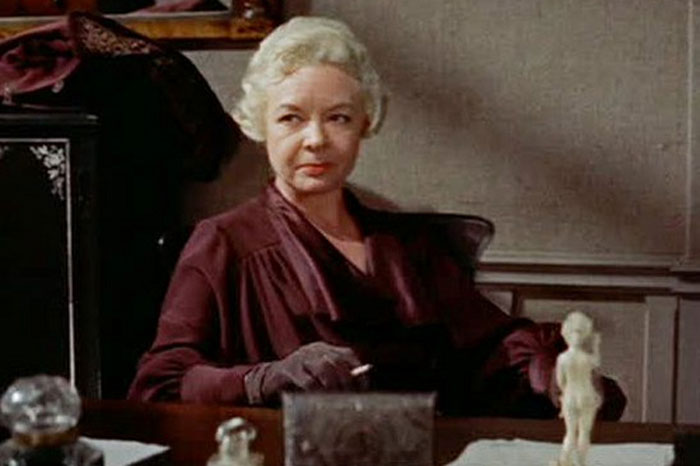
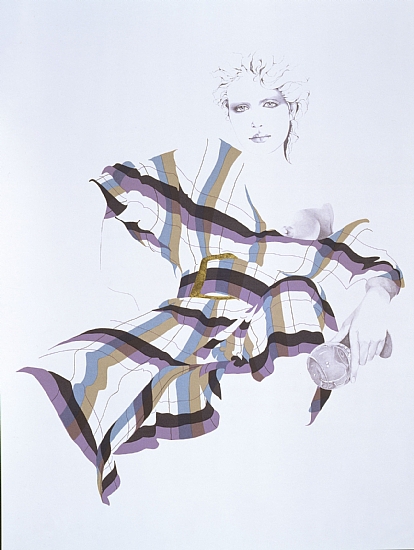
Above is Rosamond’s painting she did of her mother, Rosemary. Our mother looks like a tramp. She has emptied a wine glass and has one breast hanging out – with nipple. The title of this work is ‘Rosemary Circa 1950′. This is not exactly June Cleaver. What is the look on my mother’s face saying to you? How about…
“You got a problem? Do you think I care!”
My mother was desexed in both of the failed biographies of my famous sister. Why? I am castrated due to some evil alliance I have with Rosemary. Let’s do the math.
Christine – dead
Vic – out of the picture
Greg – demonized as No.2 enemy of art
Rosemary – demonized as No.1 enemy of art
Who’s left out the six people who made up our natal family?
Vicki Presco
Mark Presco
Vicki and Mark – the ungifted ones – conspired to get everyone away from Rosamond’s Creative legacy, but themselves. Pierrot was the front – the façade! She is allowed to pimp out Christine, say anything she likes, as long as money goes into Vicki and Mark’s pockets.
Mark, the misogynist, pimped out all the Rosamond Women and images allegedly because Christine owed him $3,000 dollars. But, when you read his blog, he depicts most women as prostitutes. This is how The Good Son’ dealt the news his mother was a prostitute and dirty movie star.
Consider ‘East of Eden’ by John Steinbeck. My novel is a California Cultural Tale on par with John’s study of the poor Oakies, that goes with Royal Rosamond’s novels of Ozark folk, and Thomas Hart Benton’s paintings of them. How many prostitutes are lurking about in these paintings and novels?
Every time the movie ‘East of Eden’ was on T.V. Rosemary gathered her four children around her for the Sacrificial Crucifixion of Rosemary – who looks a lot like Cal and Aarons mother. Artists notice things like this.
I don’t know why the authors of these essays have trouble identifying why Artists bond with Prostitutes. It’s because the Christian Good Boys call them Parasites on Society. Wanting to create something, or express your sexual urges, is not normal. It is degenerate.
Mark would call me a parasite because I aspired to be an artist, while he was going to be an electrical engineer. In 1963, we had a discussion. He came at me, threw my food to the floor, and screamed;
“You’re a parasite! No one makes money off their art!”
I got up and tried to kick his ass – once again! We fought over this issue several times before. He hated the idea that mommy would choose my offering over his.
Cal is Cain. Aaron is Able. Get it? Mark had to get rid of me. He smirked as his hench woman did a job on me – and my mother.
Jon Presco
Copyright 2013
Many great writers, composers and playwrights have regularly indulged, patronised, and befriended prostitutes, including Franz Kafka, Guy de Mauppausant, Georges Rouault, Toulouse Lautrec, Dennis Potter, Picasso, Paul Verlaine. The artistic fascination with prostitutes, rather like their religious fascination, is hard to fathom precisely, but tends to exaggerate their power, beauty, social function and intelligence. Like medieval jesters, and circus clowns, and as social deviants, prostitutes are held in awe and have a fearsome power and fascination contingent upon their ability to engage in ‘immoral acts’ and mix intimately and heedlessly with strangers – types of behaviour that are completely taboo for ‘decent people’. Artists especially identify with prostitutes because the inspired, creative mind is so often used and abused by society and its rich patrons in a similarly merciless, exploitative and disposable fashion. Many users of prostitutes are simply lonely or addicted to sex, while others are deranged socially or psychologically, and have concocted a dangerous or unhappy mixture of various mistaken apprehensions about their psycho-social identity connecting sex, violence, sado-masochism, desire to control or be controlled and deviance.
At the Hay festival in Cartagena last week a young broadcaster took to task a group of Colombian ladies for tolerating the way Gabriel García Márquez romanticises the grim realities of prostitution. He was staggered when one of the bejewelled throng informed him that hot-blooded Latin women were not as women elsewhere. Why, some were capable of desiring a different man every day. For Latinas, this lady seemed to be saying, prostitution could be fun. Cartagena, by the way, is infamous the world over for child prostitution and sex tourism.
The typical Colombian prostitute is a child who has survived abuse, has been ejected from the very family that abused her, and now has no way of surviving except by selling sexual favours. Workers among the child whores of Bogotá are baffled by the extreme sexiness of the girls’ body language, which is almost impossible to interpret as anything but evidence of adult desire. To make matters even more piquant, the girls are mostly under-sized, so that they seem younger than they really are. A casual observer might allow himself to be convinced, momentarily at least, that these knowing, lecherous, hot little girls were born for a life of exuberant whoredom.
Men are not brutes; prostitution would hardly be possible if men did not delude themselves that women enjoyed it. As it is, prostitution is the fastest growing industry in the world. The delusion grows with it, as every porn star emits the “little animal cries” associated by male delusion with female pleasure.
The happy hooker is omnipresent in art, from the flute girls and hetairae of the ancients, to the literary likes of Zola’s Nana and Wedekind’s Lulu. Prostitution and painting go hand in hand. Among the first painters to use female models were Titian and Giorgione. Venetian paintings of luscious nudes as reclining Venuses and Danaes or half-clad Floras served as advertisements for the most successful courtesans of Europe, whose houses were the places where young men on the Grand Tour could expect to hear the finest music played and sung by the best performers and see the finest objets d’art. The courtesan pictures are all poignant in their different ways, none more so than the images of the newest arrivals from the country, with voluptuous milk-white bodies and the fresh faces of children. They clutch handfuls of field flowers to their full breasts, gaze wide-eyed into mirrors, and lie freshly bathed and powdered for the person who looks down on their helpless nakedness from above.
Titian is too great a painter not to build darkness into even his most seductive courtesan images. History does not tell of a single courtesan, however fêted in her heyday, who died rich. Pregnancy was a constant risk, as was disease. If a courtesan bore a female child, and the child was pretty, she would be introduced to the life as soon as her mother grew too old to attract the best-heeled clientele, and her mother would act as her doorkeeper. Behind the glimmering images of the great courtesans lay the reality of the hundreds of thousands of women who would sell sexual favours if they could, wenches who would do the deed for a dish of coals or a mutton chop. In rural Africa and rural South America and God knows where else besides, today you will find women who sit outside their huts, hoping that a passing lorry-driver might stop and go inside with them, leaving in exchange enough money to buy their children something decent to eat.
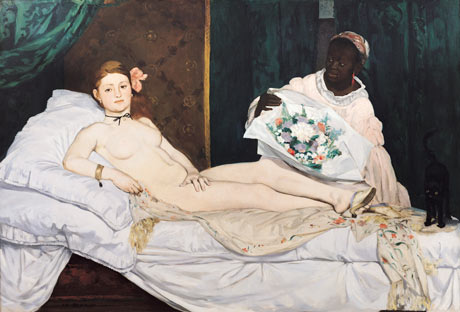
When Manet painted his Olympia, he took on the whole tradition of romanticising prostitution. His model is a young woman of the people. Her legs are short; her knee is knobbly; her skin is sallow; the sole of her slipper is worn. The skin of her face is coarser than that of her body, a disjunction marked by the black ribbon that circles her neck. When Waldemar Januszczak, “Britain’s most distinguished art critic”, talks of Manet’s Olympia he identifies the viewer of the picture as a prospective client. Not all men would see the picture that way, and very few women. (Gauguin, Cézanne and Picasso all made versions of the subject which included the client within the composition.) The face Manet’s model turns to the viewer is utterly blank, her eyes unfocused. Her lips are set, even slightly pursed. She is entirely uninterested in the flowers her servant is trying to show her.
Olympia is a wonderful picture, but its subject is not sensuality, still less passion. It is an enduring emblem of apathy, of disjointure. Most of the female figures on the post-impressionist canvas were part-time prostitutes; their bodies often show the insignia of privation, the pallid skin, the wasted limbs, as they crouch to wash or sweat over a hot iron, or line up for medical inspection, or simply lie in the dishevelled bed and wait. It is the truest irony that a 21st-century connoisseur sees Manet’s Olympia as simply erotic, when what so annoyed the flaneurs of Paris was that it assailed their manly certainty that the women they exploited truly desired them. In the same way we misunderstand the child ballerinas of Degas. In every alley of the theatre loom the silhouettes of the portly gentlemen in top hats who have come to take their pleasure with these skinny half-naked adolescents. They too will have learned to mime desire.

 Rosamond Press
Leave a reply to Royal Rosamond Press Cancel reply