
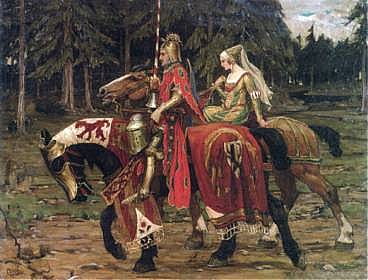
 In the Arthurian Tale of Yder there come a Knight name Talac de Rougemont of the Castle Rougemont, to the Round Table. Talac means “table” the Table de Rougemont? The Rougemont name is forever a part of Arthurian legend, and the quest for the Sangraal.
“All’s well, that ends well!”
Jon Presco
Copyright 2011
As we noted, Arthur, at the beginning, has been rescued by a young, unknown knight, who happens to be Yder8. Learning whom he has saved, Yder hopes to join Arthur’s court, but inexplicably, Arthur largely ignores the young man, forgetting to reward him or even to thank him. Yder’s anger and disappointment at this affront are exacerbated when Arthur soon makes what appears to be an irresponsible decision. A young woman arrives to say that her lady needs Arthur’s assistance, because her castle is besieged by the Black Knight (v. 67ff.). Arthur, who had given the castle to the lady and had sworn to protect her, readily agrees to offer assistance but insists that the task will have to wait. First he must besiege the castle of Rougemont, because its lord, Talac, refuses to accept Arthur as liege lord, and Arthur must remedy that. The messenger berates him, pointing out that his prior duty was to her lady, because Arthur had given his promise to her first. The king, though, insists that he must first besiege Rougemont, arguing stubbornly that « Dist l’ai, si ne m’en veil dedire » (v. 109)9. Yder soon leaves court, distressed to see that Arthur is not doing his duty (v. 129). The narrator does not indicate that either of Arthur’s tasks is unworthy or improper, but clearly the king’s priorities are disordered.
The text later offers a sequence that reflects and almost duplicates the one in which Arthur had to choose between defending a lady’s castle and fighting Talac. Yder’s ladylove, Guenloie, decides to besiege Talac’s castle ; since the latter is now Arthur’s vassal, the king will surely – so Guenloie thinks – come to his assistance, and just as surely he will bring Yder with him, enabling her thus to see the man she loves (v. 3399-551). But Arthur refuses to help Talac, or more precisely, he postpones the deed because, he says, he must first go and avenge the shame he has suffered at the hands of the Black Knight, now besieging the castle of the « orgoillose pucele » (v. 3485).
The Romance of Yder survives in a unique manuscript in Cambridge University Library, and has only once been edited; no translation survives. Yet it is a highly interesting work, reflecting a tradition which reaches back to the beginnings of Arthurian romance in the early 12th century; it is linked to the famous Arthurian sculpture on the cathedral at Modena, and contains an episode which foreshadows the temptation scene in Sir Gawain and the Green Knight, while elsewhere Celtic material is much in evidence as the basis of the tale. It is also close in style and sometimes in content to the work of Chretien de Troyes. Dr Adams’ text provides a clear version of an often corrupt original, and the facing translation serves to illuminate the text further, enabling this neglected work to take its rightful place in the ranks of Arthurian literature.
When Arthur is first mentioned in the early thirteenth-century French romance Yder, the young knight Yder has saved the king’s life, but without knowing the identity of the person he has rescued. When, the following day, he asks someone who that stranger was, the reply is an entirely traditional and expected….
“The Huguenot tradition in the family, confirmed by such sources as
O’Hart’s Irish Pedigrees and Agnew’s French Protestant Exiles,
suggests a French origin also and this has been found in the
name “Rougemont”, still perpetuated by the name of a village in
southeastern France, near Switzerland, and another village in
southwestern Germany. Why this source seems preferable for our origin
will be mentioned again.
Book shows end of PAGE 3 here
“Such a name, transported to other countries and dealt with in other
languages, was certain to be changed and even distorted. Our own
people have at times adopted the form “Roseman”, or “Rosman”,
or “Rossman”, or “Rosmond”, or “Rosmon”. The first three forms are
common in Germany although wholly unconnected with our family. Elders
in the family have held the view that the presence of the “d” is
significant and, since it is the equivalent of the “t”
in “Rougemont,” that seems reasonable. As many as thirty variations
are found, and yet the name in any form is not a common one in this
country if the German forms above are to be disregarded.
Leland E. Rosemond
March, 1938
Scarsdale, N. Y.
THE NAME ROSEMOND
Dietrich und Wenezlan has only survived in a single, incomplete and fragmentary version of about 499 rhyming couplets. Dietrich is at the court of Etzel, when Wolfhart, who, along with Hildebrand, has been captured by Wenezlan von Bôlân (Poland; possibly inspired by Wenceslaus I or II of Bohemia) arrives to tell him that Wenezlan wants to engage Dietrich in single combat – if Dietrich wins, then Wenezlan will release Wolfhart and Hildebrand. Initially, Dietrich seems reluctant, but when Wolfhart grows angry and accuses Dietrich of cowardice, saying that if Dietrich refuses Wenezlan will attack Etzel with an army, Dietrich says he had been joking and of course would fight to free his vassals. There is then a lacuna. The combat between Dietrich and Wenezlan begins in between their two armies and in the company of courtly ladies. When they have dehorsed each other, they fight on foot all day. The fragment ends before a conclusion is reached.
The poem only loosely fits into the category of “historical Dietrich poems,” with the single combat being more reminiscent of the fantastical poems. Dietrich’s initial refusal to fight and the accusation of cowardice (zagheit) also has more in common with the fantastical poems, where this is a frequent occurrence. His admission that he was merely playing a joke may be a game played by the author.
 Rosamond Press
Leave a comment