

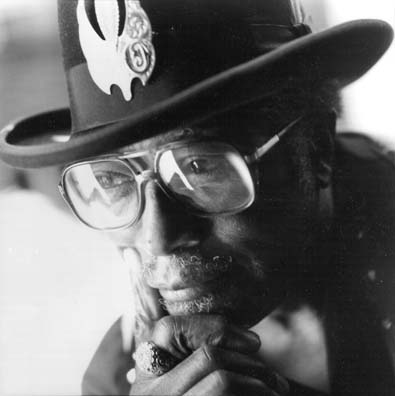

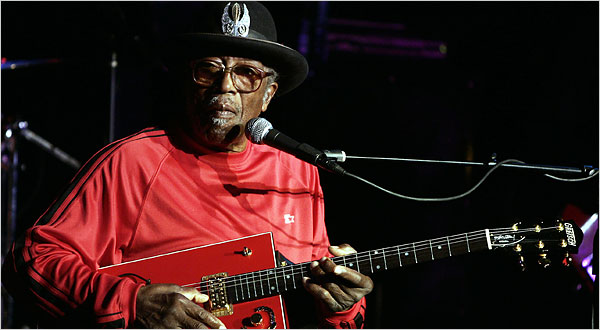
 In 1959, when I was thirteen, I stole an LP containing the Hambone sounds of Bo Diddley. Like most white kids of my generation, I loved the music of Elvis Presley because he had SOUL. Once you heard soul, then you owned the Touchstone to all music. When I first heard, and saw Bo on T.V. I heard more then a man with soul, I heard a Charismic, a Prophet, with a rhythm that was our driving national anthem. Hambo Bo, the Black Bohemian Hobo, had hopped the Great American Mojo locomotive, and done drove it off the track! And now it was coming your way, a thunder of million hearts beating fast….The All Inclusive Flight From Egypt!
Get on board lil children – and shake your hips! Here was Moses with his homemade axe. Behind him are his Nazarites whom he invited to cross the line after the Lord showed him his back side while he was in the cleft of a ROCK! Here come his Nazarite women – out of the wilderness! Let’s hear that funky hand jive!
Here is the sexiest music (muse) video ever made.
These three beautiful Muses move to the front of the stage is the “toughest” move ever made. In Oakland “tough” mean good looking and sexy. If you push up against these muses, they are going to push back. In Oakland a lot of blacks from the south were having their first close encounter with the white culture. At high schoold dances, the blacks danced off in one section, and the whites in another. I would watch the blacks style, then incorporate into my dance routine. I stole African drum albums and danced in front of a mirror before and after school. When I did The Pony, about thirty white students gathered round as I moved ten-fifteen feet from my partner who was in shock, she wondering what this crazy boy was doing.
No way am I going to allow a bunch of crackers to tear down and destroy the core culture of my generation, because they are chicken-shit when it comes to meeting their maker face to face, and thus wish it upon others – not like them! My Rosamond ancestors were doing the Hambone down in Mississippi before Bohemian Bo was born. They learned it from the black slaves they owned, or once owned. This Hambone connection is music history that needs to be told and preserved, and not wiped out so crazy Christians can feel the spirit.
I understand what these white evangelicals are doing with they raise one hand. They are saying the spirit of the Lord has entered – ME!
“He is here!”
What gets me, white-evangelicals look down their nose at other folks being sexy, and have invented their own brand of Christian Sexiness, which is attached to Cowboys and Cowgirls, who in faded blue cotton are letting it all hang out in the barn surrounded by barnyard animals like Noah was.
Or, they are at the rodeo, or Nascar event where a lot of beer guzzling is going on, and being Animalish….in a Clean Country Way. At Island Park you could see Good Ol White Relics digging on the cowgirls in cloroxed jeans.
“Be fruitful and multiply!”
Above is a photo of me when I was sixteen. I pegged my pants, and did the Balero Dance for my first love, my high school sweetheart. I worked on the choreography for a week. It was Marilyn’s birthday, and I was too poor to buy her a present. In some societies, this meant we were married.
Jon Presco
Bo Diddley done had a farm
(Hey, Bo Diddley)
On that farm he had some women
(Hey, Bo Diddley)
Women here and women there
(Hey, Bo Diddley)
Women, women, women everywhere
(Hey, Bo Diddley)
But one little girl lived on a hill
(Hey, Bo Diddley)
She rustled and tussled like Buffalo Bill
(Hey, Bo Diddley)
One day she decided she’d go for a ride
(Hey, Bo Diddley)
With a pistol and a sword by her side
(Hey, Bo Diddley)
She rolled right up to my front door
(Hey, Bo Diddley)
Knocked an’ knocked ’til her fist got sore
(Hey, Bo Diddley)
When she turned and walked away
(Hey, Bo Diddley)
All I could hear my baby say
(Hey, Bo Diddley)
Hey, Bo Diddley
(Hey, Bo Diddley)
Oh, Bo Diddley
(Oh, Bo Diddley)
Hey, Bo Diddley
(Oh, Bo Diddley)
Oh, Bo Diddley
(Oh, Bo Diddley)
Saw my baby run across the field
(Hey, Bo Diddley)
Slippin’ and slidin’ like an automobile
(Hey, Bo Diddley)
Hollerin’, my baby got towed away
(Hey, Bo Diddley)
Slipped on from me like a Cadillac-8
(Hey, Bo Diddley)
Hey, Bo Diddley
(Hey, Bo Diddley)
Oh, Bo Diddley
(Oh, Bo Diddley)
Hey, Bo Diddley
(Hey, Bo Diddley)
My friend, Joy, told me I was crazy when I tried to tell her the original Jesus was not YOUR personal savior and healer, who nowhere for you in your old age, when your hambone aches, and death appears to be real. No one lives forever!
Christians do not want to know the real Moses who took 70 elders up to the mount to behold, and have dinner with THE LORD. Moses was an ABOLTIONIST CHARISMATIC who founded the Nazarite Judges in order to help him judge the multitude in the wilderness. Moses drew a line in the sand, and they came across, the children of the Lord, doing the Hambone!
Will (Rosamond) was an excellent basket weaver and as a young boy he spent many hours at an Indian Reservation near Ackerman, Choctaw County, MS., squatting and watching them weave baskets. Ila Mae, his daughter, remembers him stating that he was a “hobo for a few years and that he rode the train through Meridian [MS].” He was a good singer with a fine bass voice. He could even make music by slapping his knees and chest. He could also play a cross cut saw, and make it sing! He was an excellent story teller and a lover of riddles. His daughter, Maxine, stated that in the 1920′s after his mother, Nancy Bowie Rosamond sold the old home place, Will and wife Virgie moved from t he hills around Weir.”
The dog’s name? Bo… as in Bo Diddley, which is why he qualifies for PopWatch status. (Diddley is also, it’s been reported, a nickname for Michelle Obama’s father.) But being named after one of the great founders of rock & roll is noteworthy, and consider the alternative: Given the young Obama daughters’ musical tastes, that dog could have been named after one of the Jonas Brothers.
The older rocker, who died last year, even had a hit song the family can use when calling the pup: 1957′s “Hey Bo Diddley.”
Ellas Otha Bates (December 30, 1928 – June 2, 2008), known by his stage name Bo Diddley, was an American R&B vocalist, guitarist, songwriter (usually as Ellas McDaniel), and rock and roll pioneer. He was also known as The Originator because of his key role in the transition from the blues to rock, influencing a host of acts, including Buddy Holly, Jimi Hendrix, The Rolling Stones, Pink Floyd, The Velvet Underground, The Who, The Yardbirds, Eric Clapton,[1] Elvis Presley,[2] and The Beatles,[3] among others.[4] He introduced more insistent, driving rhythms and a hard-edged electric guitar sound on a wide-ranging catalog of songs, along with African rhythms and a signature beat (a simple five-accent clave rhythm) that remains a cornerstone of rock and pop.[3][4][5] Accordingly, he was inducted into the Rock and Roll Hall of Fame and received Lifetime Achievement Awards from the Rhythm and Blues Foundation[4][6] and a Grammy Award from the National Academy of Recording Arts and Sciences. He was known in particular for his technical innovations, including his trademark rectangular guitar.
Bo Diddley is well known for the Bo Diddley beat, which is essentially the clave rhythm, and one of the most common bell patterns found in sub-Saharan African music traditions.[45] Tamlyn found this rhythm in 13 Rhythm and Blues recordings made in the years 1944-55, including two by Johnny Otis from 1948.[46]
Bo Diddley has given different accounts regarding how he began to use this rhythm. Sublette asserts: “In the context of the time, and especially those maracas [heard on the record], ‘Bo Diddley’ has to be understood as a Latin-tinged record. A rejected cut recorded at the same session was titled only ‘Rhumba’ on the track sheets.”[47] The Bo Diddley beat is similar to “hambone”, a style used by street performers who play out the beat by slapping and patting their arms, legs, chest, and cheeks while chanting rhymes.[48] Somewhat resembling “shave and a haircut, two bits” rhythm, Diddley came across it while trying to play Gene Autry’s “(I’ve Got Spurs That) Jingle, Jangle, Jingle”.[49] Three years before Bo’s “Bo Diddley”, a song similar syncopation “Hambone”, was cut by Red Saunders’ Orchestra with The Hambone Kids. In 1944, “Rum and Coca Cola”, containing the Bo Diddley beat, was recorded by The Andrews Sisters and later Buddy Holly’s “Not Fade Away” (1957) and Them’s “Mystic Eyes” (1965) used the beat.[50] In its simplest form, the Bo Diddley beat can be counted out as either an on-bar, or a two-bar phrase.
char·is·mat·ic (krz-mtk)
adj.
1. Of, relating to, or characterized by charisma: “the warmth of a naturally charismatic leader” (Joyce Carol Oates).
2. Of, relating to, or being a type of Christianity that emphasizes personal religious experience and divinely inspired powers, as of healing, prophecy, and the gift of tongues.
n.
A member of a Christian charismatic group or movement.
The term charisma (/kəˈrɪzmə/; pl. charismata, adj. charismatic) has two senses: (1) compelling attractiveness or charm that can inspire devotion in others, (2) a divinely conferred power or talent.[1] For some theological usages the term is rendered charism, with a meaning the same as sense 2.[2] Since the 1950s, the term has become widely used, with varying meanings, in religion, the social sciences, the media, and throughout Western societies
Other songs employing the Bo Diddley beat include “(Marie’s the Name) His Latest Flame” (1961) by Elvis Presley, “I Want Candy” by The Strangeloves, “1969” (1969) by The Stooges, “Panic in Detroit” (1973) by David Bowie, “Mr. Brownstone” (1987) by Guns N’ Roses, “Hari Krsna” (lyrics are even sung to the tune of ‘Hey Bo Diddley’) by Hüsker Dü from their album Zen Arcade, “Faith (1987) by George Michael, “Desire” (1988) by U2, “Boa-Diddley” (1990) by Phillip Boa and the Voodooclub, “Movin’ on Up” (1991) by Primal Scream, “Woodcutter’s Son” (1995) by Paul Weller, and “Screwdriver” (1999) by The White Stripes.[51] Other examples include “Magic Bus” by The Who, “Rudie Can’t Fail” by The Clash, “Get Me to the World on Time” by The Electric Prunes, and “Party at the Leper Colony” by “Weird Al” Yankovic.[52] Some of the more subtle uses of the Biddley beat include “Hateful” (1979) by The Clash and “How Soon Is Now?” (1985) by The Smiths.[51]
“Bo Diddley beat”[50]/Son clave About this sound Play (help·info).
Here is the count as a one-bar phrase: One e and ah, two e and ah, three e and ah, four e and ah. The bolded counts are the clave rhythm.
Many songs (for example, “Hey Bo Diddley” and “Who Do You Love?”) often have no chord changes; that is, the musicians play the same chord throughout the piece, so that the rhythms create the excitement, rather than having the excitement generated by harmonic tension and release. In his other recordings, Bo Diddley used a variety of rhythms, from straight back beat to pop ballad style to doo-wop, frequently with maracas by Jerome Green.
Also an influential guitar player, he developed many special effects and other innovations in tone and attack. Bo Diddley’s trademark instrument was the rectangular-bodied Gretsch nicknamed “The Twang Machine” (referred to as “cigar-box shaped” by music promoter Dick Clark). Although he had other odd-shaped guitars custom-made for him by other manufacturers throughout the years, most notably the “Cadillac” design made by Tom Holmes (who also made guitars for ZZ Top’s Billy Gibbons, among others), Diddley fashioned the square guitar himself around 1958 and wielded it in thousands of concerts over the years. In a 2005 interview on JJJ radio in Australia, Bo implied that the design sprang from an embarrassing moment. During an early gig, while jumping around on stage with a Gibson L5 guitar, he landed awkwardly hurting his groin.[53][54] He then went about designing a smaller, less restrictive guitar that allowed him to keep jumping around on stage while still playing his guitar. He also played the violin, which is featured on his mournful instrumental “The Clock Strikes Twelve”, a twelve-bar blues.[55]
He often created lyrics as witty and humorous adaptations of folk music themes. The song “Bo Diddley” was based on the African American clapping rhyme “Hambone” (which in turn was based on the lullaby “Hush Little Baby”). Likewise, “Hey Bo Diddley” is based on the song “Old MacDonald”. The rap-style boasting of “Who Do You Love”, a wordplay on hoodoo, used many striking lyrics from the African-American tradition of toasts and boasts. His “Say Man” and “Say Man, Back Again,” both of which were later cited as progenerators of hip-hop music, share a strong connection to the insult game known as “the dozens”. For example: “You got the nerve to call somebody ugly, why you so ugly the stork that brought you into the world ought to be arrested”.[56]
http://www.afropunk.com/profiles/blogs/lady-bo-the-queen-mother-of
Peggy Jones, aka Lady Bo grew up in New York City, attending Manhattan’s famed High School for the Performing Arts (of Fame fame) as a singer and dancer. She studied tap and ballet and trained in opera. She had been playing guitar for only 2 years when a chance encounter with Bo Diddley before a show at the legendary Apollo Theatre led to a life-changing gig as Bo Diddley’s lead guitarist. Diddley was awestruck by the sight of a beautiful young woman with a guitar and struck up a conversation. When Jerome Greene (the single luckiest maraca player in the history of music) ran out to tell Bo that dinner was being served in the dressing room, Bo invited Jones in. Jones recounts in an interview with Lea Gilmore:
After a while he opened his guitar, asked me to grab mine and play something. When I opened my case he laughed louder than anyone I’d heard before. I wanted to know what¹s funny? Hysterically he said what is that? He had never seen a Supro guitar. I said, “Now that’s a dumb question! First you probably never saw a girl carrying a guitar down the street before and want to know if I played it, did you think that was funny?” He said, “NO!” I continued, “then you insult my ax and I listen to Wes Montgomery, Kenny Burrell and Charlie Parker and I THINK I’ve heard of you! Do you think that’s funny?” He said, “No, but I like your attitude, let’s play something.” I said OK and the rest is history.
Lady Bo was quickly enlisted in the band as the replacement for Jody Williams who was drafted in1957. Diddley taught Lady Bo his distinctive open tuning and unusual techniques. Diddley would later remark that “she knows every move I make… she is the only one that knows the original ways…” Her unique style which is simultaneously soulful and playful, making prominent use of guitar effects, is highlighted in her composition Aztec on which she plays all guitar parts
Exodus 33:11
And the LORD spake unto Moses face to face, as a man speaketh unto his friend.
Deuteronomy 34:10
And there arose not a prophet since in Israel like unto Moses, whom the Lord knew face to face.
Parshat Mishpatim says of the 70 elders who went up on Har Sinai with Moshe and Aharon:
וַיִּרְאוּ, אֵת אֱלֹהֵי יִשְׂרָאֵל; וְתַחַת רַגְלָיו, כְּמַעֲשֵׂה לִבְנַת הַסַּפִּיר, וּכְעֶצֶם הַשָּׁמַיִם, לָטֹהַר.
and they saw the God of Israel; and there was under His feet the like of a paved work of sapphire stone, and the like of the very heaven for clearness.
Later, Ki Tisa says, when Moshe asks to see God’s glory:
וַיֹּאמֶר, לֹא תוּכַל לִרְאֹת אֶת-פָּנָי: כִּי לֹא-יִרְאַנִי הָאָדָם, וָחָי.
And He said: ‘Thou canst not see My face, for man shall not see Me and live.’
How do we reconcile these two passages? The verb ראה is the same in both places. If the 70 elders can “see” God, how is it that God is not able to let Moshe “see” him later?
Exodus 24:9-11. Then Moses went up, also Aaron, Nadab, and Abihu, and seventy of the elders of Israel, 10. and they saw the God of Israel. And there was under His feet as it were a paved work of sapphire stone, and it was like the very heavens in its clarity. 11. But on the nobles of the children of Israel He did not lay His hand. So they saw God, and they ate and drank.

 Rosamond Press
Leave a comment