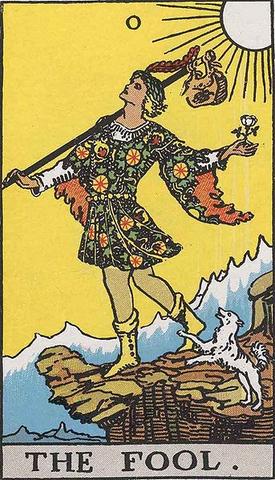
The Fool Freed the Internet
Posted By: •braskewitz
Fri Nov 28, 2008 8:04 am |
The Fool Freed the Internet
“We Owe It All to the Hippies,”
There is a constant battle to keep the Internet Free.
“In a 1995 special issue of Time magazine entitled “Welcome to
Cyberspace,” Stewart Brand wrote an article arguing that that the
personal computer revolution and the Internet had grown directly out
of the counterculture. “We Owe It All to the Hippies,” claimed the
headline. “Forget antiwar protests, Woodstock, even long hair. The
real legacy of the sixties generation is the computer revolution.”
According to Brand, and to popular legend then and since, Bay area
computer programmers had imbibed the countercultural ideals of
decentralization and personalization, along with a keen sense of
information’s transformative potential, and had built those into a
new kind of machine.”
“In the Tarot, the Fool card symbolizes the Creative Force or Power
that initiates and guides the Universe. “The Fool card is actually
the God card in the Tarot.” [1] It is Spirit seeking to know itself
by choosing to manifest on the earthly plane — experience yet
another reincarnation [as in Reincarnation Is Making a Comeback] —
in order to seek (and reach) perfection. With the powers of
creation, it is no wonder that the Fool’s potential is so vast!”
http://www.halexandria.org/dward012.htm
“The journey begins with the Fool, the zero card of the Tarot deck,
representing innocence and inexperience. It is the inexperienced
child, fearless, filled with curiosity, and ready for most anything.
It is also Forest Gump, as depicted in the movie of the same name
starring Tom Hanks. The Fool is seemingly oblivious to much of life,
is often naive, invariably wide eyed and innocent at much of life’s
travails, and is someone clearly in dire need of divine protection.
And in this respect, the Fool receives it… on a continual basis!”
When we first sat before a computer we beheld our face reflected in
the dark screen. “Let there be light!”
After we turned on our computer, we sat like dummies, staring blankly
into a world we knew nothng about, that denied us access because we
were completely innocent about its mysterious workings.
Peter Townsend was a follower of Avatar Meher Baba who did not speak
for the last forty years of his life. After taling a vow of silence,
he used a alphabet board to communicate. This is the God-Man on a
computer keyboard explainging the Infinite which is the Zero.
In the movie `Tommy’ the Fool who can not speak looks into the
Infinite Zero and see another self who leads him to find a Magical
Machine in a heap of scrap metal. With two fingers he uses his divine
intuition to become a Wizened Wizard, a Sage who opens a School of
Wizardry. But no one can follow his path, and he returns to being The
Fool on the Mount.
Jon Presco
http://www.tekmom.com/buzzwords/binaryalphabet.html
The Fool Fixes the Tower of Babel
The Fool is an ancient archetype. He is depicted in the Tarot deck
and is given the No Number, Zero 0. Note the zeros in the images
above from the movie ‘Tommy’.
“Now he is deaf. Now he is dumb . Now he is blind. The guilty are
safe, But always accused by his empty eyes. Nothing to say, Nothing
to hear, And nothing to see.”
http://www.tekmom.com/buzzwords/binaryalphabet.html
“Gravity’s Rainbow is an epic postmodern novel written by Thomas
Pynchon and first published on February 28, 1973. The narrative is
set primarily in Europe at the end of World War II and centers on the
design, production and dispatch of V-2 rockets by the German
military, and, in particular, the quest undertaken by several
characters to uncover the secret of a mysterious device named
the “Schwarzgerät”, which will be installed in a rocket with the
serial number “00000”.
The Fool existed before the Law of KARma, and will forever DODGE this
dualistic LAW that traps us all. THE LAW demands we answer their
questions, while the Fool’s elusiveness bids us to ASK THE
QUESTIONS.and thus is THE GUIDE who leads us to look behind the
mirror, look deep into our computer screens, to SEEK, and to KNOW.
http://www.press.uchicago.edu/Misc/Chicago/817415_chap4.html
http://rougeknights.blogspot.com/search?q=zero+fool
A Crunchy-Granola Path From Macramé and LSD to Wikipedia and Google
• SIGN IN TO E-MAIL THIS
• PRINT
• REPRINTS
• SAVE
By EDWARD ROTHSTEIN
Published: September 25, 2006
The pages are yellowed, the addresses and phone numbers all but
useless, the products antique, the utopian expectations quaint. But
the “Whole Earth Catalog” — and particularly “The Last Whole Earth
Catalog,” published in 1971, which ended up selling a million copies
and winning the National Book Award — has the eerie luminosity of a
Sears catalog from the turn of the last century. It is a portrait of
an age and its dreams.
Ted Streshinsky/Corbis
Forward thinking: Stewart Brand in 1966, with a disc on his forehead.
A counterculture classic.
Deerskin jackets and potter’s wheels, geodesic domes and star charts,
instructions on raising bees and on repairing Volkswagens, advice on
building furniture and cultivating marijuana: all this can be found
here, along with celebrations of communal life and swipes at big
government, big business and a technocratic society.
Can this encyclopedia of countercultural romance have anything to do
with today’s technological world, a world of broadband connections,
TCP/IP protocol and the Internet? The Internet, after all, began
during the cold war as an attempt to create a network of computers
that would be resilient in case of nuclear attack. Its instigator,
the United States Department of Defense, was at the very center of
the culture being countered by the “Whole Earth Catalog.” How could
the romantic, utopian culture of the 1960’s, with its deep suspicions
about modernity and its machinery, be closely linked to one of the
most important technological revolutions of the last hundred years?
Yet as Fred Turner points out in his revealing new book, “From
Counterculture to Cyberculture: Stewart Brand, the Whole Earth
Network, and the Rise of Digital Utopianism” (University of Chicago
Press), there is no way to separate cyberculture from counterculture;
indeed, cyberculture grew from its predecessor’s compost. Mr. Turner
suggests that Stewart Brand, who created the “Whole Earth Catalog,”
was the major node in a network of countercultural speculators,
promoters, inventors and entrepreneurs who helped change the world in
ways quite different from those they originally envisioned.
Mr. Turner, who teaches in the communication department at Stanford
University, is rigorous in his argument, thorough to the point of
exhaustion, and impressive in his range. The basic premise, though,
is not unfamiliar. A decade ago the cultural critic Mark Dery
suggested in his book “Escape Velocity” that the PC revolution could
well be called “Counterculture 2.0.” Other writers have also pointed
out uncanny overlaps.
And some of the anecdotal evidence is familiar. Steve Jobs created
and promoted Apple as a countercultural computer company, most
famously in the 1984 television ad that associated it with the
demolishment of a totalitarian Big Brother. Even I.B.M., in promoting
its first PC, tried to undermine the computer’s association with
corporate power, marketing its machine using images of Charlie
Chaplin’s tramp, who had twitted the gears of industry in “Modern
Times.”
Connections were even made by the participants. Theodore Roszak,
whose 1969 book, “The Making of a Counter Culture,” popularized that
era’s doctrines, later asserted that computer hackers — “whose
origins can be discerned in the old Whole Earth Catalog” — invented
the personal computer as a means of “fostering dissent and
questioning authority.” Timothy Leary, the psychedelic maestro of
that period, declared that “the PC is the LSD of the 1990’s.”
Soon after publishing “The Last Whole Earth Catalog,” Mr. Brand
started to write about the computer scene, helped create the “Whole
Earth Software Catalog” and, in 1985, became a founder of the WELL —
the Whole Earth ‘Lectronic Link — a pioneering online community. “As
it turned out,” Mr. Brand once explained, “psychedelic drugs,
communes, and Buckminster Fuller domes were a dead end, but computers
were an avenue to realms beyond our dreams.” By the 90’s, those
realms were celebrated by the magazine Wired.
It might be argued that so prevalent was the counterculture, and so
experimental and energetic were its most vocal proponents, that it
would have been surprising had many of them not found their way to
the computer revolution. But Mr. Turner demonstrates something more
essential in the continuity.
First, he suggests, we are mistaken in thinking that the postwar
technological world was dominated by hierarchies and rigid
categories. Under the influence of the mathematician Norbert Wiener,
it became increasingly common to think of humans and machines as
interacting elements of “cybernetic systems” — organisms through
which information flowed. This also led to a different way of
thinking about living organisms and their networks of interaction.
Marshall McLuhan wrote in 1964: “Today we have extended our central
nervous system itself in a global embrace, abolishing both space and
time as far as our planet is concerned.” Buckminster Fuller proposed
the idea of a Comprehensive Designer, a creator who would embody “an
emerging synthesis of artist, inventor, mechanic, objective economist
and evolutionary strategist.”
These writers were the patron saints of the “Whole Earth Catalog,”
their books appearing alongside macramé and carpentry manuals, their
ideas presumably brought to life in the commune, where the natural
and human world would be bound together, creating a single organism
from which new possibilities would unfold.
By the 1980’s, Mr. Turner argues, similar fantasies were inspired by
the computer. It had freed itself from corporate control and
ownership; it was also capable of connecting with other computers in
communities like the WELL (which John Perry Barlow, a former lyricist
for the Grateful Dead, called “the latest thing in frontier
villages”). The Internet, designed to be inherently nonhierarchical,
suggested even more grand possibilities, even a revolution in
politics and human consciousness.
In the 90’s, Mr. Turner says, the writers and editors of Wired
believed “they would tear down hierarchies, undermine the sorts of
corporations and governments that had spawned them” and replace them
with a “peer-to-peer, collaborative society, interlinked by invisible
currents of energy and information.” Cyberculture was to be the
fulfillment of counterculture.
Ultimately, of course, such fulfillment was not to be had. But the
consequences of the association were profound. One reason for the
heady pace of innovation during the 90’s is that the motivation was
never purely abstract, but was often accompanied by utopian passions.
Software development occurred not just in the private realm, but also
among collaborative communities that objected to corporate ownership.
Even today’s Wikipedia — the online encyclopedia continuously being
written by its users — can be traced to these ideas.
But there were also limitations of vision and imagination. For a long
time, cyberspace advocates were reluctant to take the problem of
mischievous hacking seriously and could look askance at the very
notion of copyright in the cyberworld. There was even a strain of
countercultural romance in the ways in which the corporate monopolist
Microsoft became widely portrayed as an Evil Empire threatening the
libertarian Internet. (This is also one reason that Google, which has
turned out to be Microsoft’s most potent competitor, made its
motto “Don’t be evil.”)
Moreover, so messianic were expectations, that many failed to see
that cyberspace was not really a different realm from the hard-wired
world of ordinary experience, but would become an extension of it: a
place where banking, shopping, conversation and business transactions
could take place, where the bourgeois world and an imagined frontier
would again have to work out their uneasy relations, and would again
face an uncertain future.
Connections, a critic’s perspective on arts and ideas, appears every
other Monday
 Rosamond Press
Leave a comment