
I came upon the account of John Fremont who mentions John McLoughlin a.k.a. ‘White Eagle’. He is called the Father of Oregon.
With the news we all have been captured in THE PRISM SPY FRACTAL it is time to establish a new frontier of the mind so we can make a new break for freedom. My novel ‘The Gideon Computer’ has come true.
Hit your REFRESH button – man!”
Jon Presco
https://rosamondpress.wordpress.com/2013/06/08/zoom-in-bot-out/
http://www.archive.org/stream/expeditionsofjoh01fr/expeditionsofjoh01fr_djvu.txt
“The dignified trader and physician, John McLough Hn (1784-1857),
known to the Indians as White Eagle, had been in charge of the Columbia
district since 1824. He could be merciless in competition, and served his
company well, but^ — as JCF notes — he also could be kind, and he kept many
an American settler from perishing by extending credit for provisions and
supplies. Although he always encouraged settlement south of the Columbia,
he hoped that the country north of the river would remain in British hands.
For a biography, see Montgomery. For his letters to the governor and Com-
mittee at this time, see rich. The Government of the United States being readily taken ; but every hospitable attention was extended to me, and I accepted an invita-
tion to take a room in the fort, “and to ma\e myself at home while
I staid.”
I found many American emigrants at the fort; others had already
crossed the river into their land of promise— the Walahmette [Wil-
lamette] valley. Others were daily arriving; and all of them had been
furnished with shelter, so far as it could be afforded by the buildings
connected with the establishment. Necessary clothing and provisions
(the latter to be afterwards returned in kind from the produce of
their labor) were also furnished. This friendly assistance was of very
great value to the emigrants, whose families were otherwise exposed
to much suffering in the winter rains, which had now commenced,
at the same time that they were in want of all the common neces-
saries of life. Those who had taken a water conveyance at the Nez
Perce fort continued to arrive safely, with no other accident than has
been already mentioned. The party which had passed over the Cas-
cade mountains were reported to have lost a number of their ani-
mals ; and those who had driven their stock down the Columbia had
brought them safely in, and found for them a ready and very profit-
able market, and were already proposing to return to the States in
the spring for another supply.
John McLoughlin
Dr. John McLoughlin, baptized Jean-Baptiste McLoughlin, (October 19, 1784 – September 3, 1857) was the Chief Factor of the Columbia Fur District of the Hudson’s Bay Company at Fort Vancouver. He was later known as the “Father of Oregon” for his role in assisting the American cause in the Oregon Country in the Pacific Northwest. In the late 1840s his general store in Oregon City was famous as the last stop on the Oregon Trail.
McLoughlin was born in Rivière-du-Loup, Quebec, of Irish (his grandfather came from Sharagower in the Inishowen peninsular of County Donegal), Scottish, and French Canadian descent. He lived with his great uncle, Colonel William Fraser, for a while as a child.[citation needed] Though baptized Roman Catholic, he was raised Anglican and in his later life he returned to the Roman Catholic faith. In 1798, he began to study medicine with Sir James Fisher of Quebec. After studying for 4½ years he was granted a license to practice medicine on April 30, 1803. He was hired as a physician at Fort William, Ontario (now Thunder Bay), a fur-gathering post of the North West Company on Lake Superior; there he became a trader and mastered several Indian languages.[citation needed]
In 1814 he became a partner in the company. In 1816 McLoughlin was arrested for the murder of Robert Semple, the governor of the Red River Colony, after the Battle of Seven Oaks, though it is often claimed he stood in proxy for some Indians who were blamed. He was tried on October 30, 1818, and the charges were dismissed. McLoughlin was instrumental in the negotiations leading to the North West Company’s 1821 merger with the Hudson’s Bay Company. He was promoted to the Lac la Pluie district temporarily shortly after the merger.
The Columbia District [edit]
John McLoughlin
John McLoughlin, National Statuary Hall Collection, statue
In 1824 the Hudson’s Bay Company appointed McLoughlin as Chief Factor of the Columbia District (roughly parallel to what Americans know as the Oregon Country), with Peter Skene Ogden appointed to assist him. At the time, the region was under joint occupation of both the United States and Britain pursuant to the Treaty of 1818. Upon his arrival, he determined that the headquarters of the company at Fort Astoria (now Astoria, Oregon) at the mouth of the Columbia River was unfit. The York Factory Express trade route evolved from an earlier express brigade used by the North West Company between Fort George (originally Fort Astoria founded in 1811 by John Jacob Astor’s American Fur Company), at the mouth of the Columbia River, to Fort William on Lake Superior.[1]
In 1821 the North West Company was forcibly merged (at the behest of the British government) into the Hudson’s Bay Company after armed conflict in the Red River Colony between the two companies.[2]George Simpson, director of Hudson’s Bay Company, visited the Columbia District in 1824-25, journeying from York Factory. He investigated a quicker route than previously used, following the Saskatchewan River and crossing the mountains at Athabasca Pass. This route was thereafter followed by the York Factory Express brigades.[3]
McLoughlin built Fort Vancouver (now Vancouver, Washington) as a replacement on the opposite side of the Columbia across from the mouth of the Willamette River, at a site chosen by Sir George Simpson. The post was opened for business on March 19, 1825. From his Columbia Department headquarters in Fort Vancouver he supervised trade and kept peace with the Indians, inaugurated salmon and timber trade with Mexican controlled California and Hawaii, and supplied Russian America with produce.
By 1825 there were usually two brigades, each setting out from opposite ends of the route, Fort Vancouver in the Columbia District on the lower Columbia River and the other from York Factory on Hudson Bay, in spring and passing each other in the middle of the continent. Each brigade consisted of about forty to seventy five men and two to five specially made boats and travelled at breakneck speed (for the time). Indians along the way were often paid in trade goods to help them portage around falls and unnavigable rapids. A 1839 report cites the travel time as three months and ten days—almost 26 miles (40 km) per day on average.[1] These men carried supplies in and furs out by boat, horseback and as back packs for the forts and trading posts along the route. They also carried status reports for supplies needed, furs traded etc. from Dr. John McLoughlin head of the Oregon Country HBC operations, and the other fort managers along the route.
Fort Vancouver became the center of activity in the Pacific Northwest. Every year ships would come from London to drop off supplies and trade goods in exchange for the furs. It was the nexus for the fur trade on the Pacific Coast; its influence reached from the Rocky Mountains to the Hawaiian Islands, and from Russian Alaska into Mexican-controlled California. From Fort Vancouver, at its pinnacle, McLoughlin watched over 34 outposts, 24 ports, six ships, and 600 employees. Under McLoughlin’s management, the Columbia Department remained highly profitable, in part due to the ongoing high demand for beaver hats in Europe.
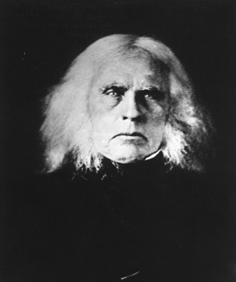
McLoughlin’s appearance, 6 foot 4 inches (193 cm) tall with long, prematurely white hair, brought him respect; but he was also generally known for his fair treatment of the people with whom he dealt, whether they were British subjects, U.S. citizens, or of indigenous origin. At the time, the wives of many Hudson’s Bay field employees were indigenous, including McLoughlin’s wife Marguerite; who was metis, the daughter of an aboriginal woman and one of the original partners of the North West Company, Jean-Etienne Wadin. She was the widow of Alexander McKay, a trader killed in the Tonquin incident. See Jonathan Thorn. Her son Thomas McKay became McLoughlin’s stepson.[4]
When three Japanese fishermen, among them Otokichi, were shipwrecked on the Olympic Peninsula in 1834, McLoughlin, envisioning an opportunity to use them to open trade with Japan, sent the trio to London on the Eagle to try to convince the Crown of his plan. They reached London in 1835, probably the first Japanese to do so since the 16th century Christopher and Cosmas. The British Government finally did not show interest, and the castaways were sent to Macau so that they could be returned to Japan.
Relations with American settlers [edit]
In 1821 the British Parliament imposed the laws of Upper Canada on British subjects in Columbia District, and gave the authority to enforce those laws to the Hudson’s Bay Company. John McLoughlin, as chief factor of Fort Vancouver, applied the law to British subjects, kept peace with the natives and sought to maintain law and order over American settlers as well.
In 1841, with the arrival of the first wagon train via the Oregon Trail, McLoughlin disobeyed company orders and extended substantial aid to the American settlers. Relations between Britain and the United States had become very strained, and many expected war to break out any time. McLoughlin’s aid probably prevented an armed attack on his outpost by the numerous American settlers. The settlers understood that his motives were not purely altruistic, and some resented the assistance, working against him for the rest of his life.
The Hudson Bay Company officially discouraged settlement because it interfered with the lucrative fur trade. The company belatedly realized that the increasing numbers of American settlers in the area would result in Columbia District becoming part of U.S. territory. In 1841, Hudson Bay Company Governor George Simpson ordered Alexander Ross to organize a party of Red River settlers to emigrate and occupy the land for Britain. When the James Sinclair expedition of almost 200 men women and children reached Fort Vancouver later that year, McLoughlin took his time settling them on Hudson’s Bay farms and encouraged them to settle south of the Columbia River.
As tensions mounted in the Oregon boundary dispute; Simpson, realizing that border might ultimately be as far north as the 49th parallel, ordered McLoughlin to relocate their regional headquarters to Vancouver Island. McLoughlin, in turn, directed James Douglas to construct Fort Camosun (now Victoria, British Columbia, Canada). But McLoughlin, whose life was increasingly connected to the Willamette River Valley, refused to move there.
McLoughlin was involved with the debate over the future of the Oregon Country.[5] He advocated an independent nation that would be free of the United States during debates at the Oregon Lyceum in 1842 through his lawyer.[5] This view won support at first and a resolution adopted, but was later moved away from in favor of a resolution by George Abernethy of the Methodist Mission to wait on forming an independent country.[5]
In 1843 American settlers established their own government, called the Provisional Government of Oregon. A legislative committee drafted a code of laws known as the Organic Law. It included the creation of an executive committee of three, a judiciary, militia, land laws, and four counties. There was vagueness and confusion over the nature of the 1843 Organic Law, in particular whether it was a constitutional or statutory. In 1844 a new legislative committee decided to consider it statutory. The 1845 Organic Law made additional changes, including allowing the participation of British subjects in the government. Although the Oregon Treaty of 1846 settled the boundaries of US jurisdiction upon all lands south of the 49th parallel, the Provisional Government continued to function until 1849, when the first governor of Oregon Territory arrived.
Later life in the Oregon Territory [edit]
After resigning from the Hudson’s Bay Company in 1846, McLoughlin moved his family back south to Oregon City in the Willamette Valley. The Oregon Treaty had been ratified by that time, and the region, now known as the Oregon Territory, was part of the United States. The valley was the destination of choice for settlers streaming in over the Oregon Trail. At his Oregon City store he sold food and farming tools to settlers. In 1847, McLoughlin was given the Knighthood of St. Gregory, bestowed on him by Pope Gregory XVI. He became a U.S. citizen in 1849. McLoughlin’s opponents succeeded in inserting a clause forfeiting his land claim in the Donation Land Claim Act of 1850 by Samuel R. Thurston. Although it was never enforced, it embittered the elderly McLoughlin. He served as mayor of Oregon City in 1851, winning 44 of 66 votes. He died of natural causes in 1857. His grave is now located beside his home overlooking downtown Oregon City.[6]
Legacy [edit]
In 1953, the state of Oregon donated to the National Statuary Hall Collection a bronze statue of McLoughlin, which is currently displayed at the Capitol Visitor Center. The title “Father of Oregon” was officially bestowed on him by the Oregon Legislative Assembly in 1957, on the centennial of his death. Many public works in Oregon are named after him, including:
•Name: John A. (McCullough) McCully
•Sex: M
•Birth: 1767 in Asheville, Buncombe, NC or Washington Co., VA
•Death: 16 NOV 1840 in Clifton Hill, Randolph Co., MO (bur. McCully Cem.) 1
•Note:
The following is an excerpt from the book, “Historical Sketches of the Campbell, Pilcher and Kindred Families” by Margaret C. Pilcher, Marshall & Bruce Co., Nashville, 1911, page 96-100:
For “The Virginian”
Old Washington
“Some account of the first settlers of old Washington County, Virginia, would, no doubt, be interesting to many of the readers of the Virginian, and I could tell them something on that subject, if I had the resolution to write it down, but on that point I have some misgivings. I will, however, try.
Hunters visited the county as early as 1745, but no families came and settled permanently until about 1767 or 1768. In two years from that time many emigrated, so that in 1770 the county was dotted all over with improvements. The first great migration was from Augusta County, but the spirit was immediately caught, and large numbers of families, and, indeed, whole connections, came from Frederick County and the Valley – from the Augusta line to the Potomac – from the upper counties of Maryland and from Pennsylvania. Botetourt and the country on each side of it sent members….The rich valley about the salt works was settled early by the Crabtrees, McNews, Falbuths, and Cawoods, and lower down, by the MCCULLOUGHS, Watsons, Dunns, Logans, McReynolds, and many others. ”
——————————–
McCULLOCH / McCULLOUCH / McCULLEY / McCULLY INTRODUCTION by Debbie Kilgore, 29 Oct 2000, kilgore@istmacon.net:
“According to tradition, in Scotland where the family originated in the 12th or 13th century, the name was spelled McCULLOCH, derived from a combination of the root word “cull,” meaning a dealer, with the suffix “loch” in Scotch and “lough” in Irish, meaning a lake, which signifies that the original families were dealers in some kind of business on or adjacent to a lake. The prefix “mack” or “mick” later contracted to “Me” means “son of” giving the meaning of the name “son of Cull on the Lake” and thus it is McCULLOCH in Scotch and McCULLOUCH in Irish. The suffixes in the names McCULLEY, McCULLY, and McCullac are only abbreviations or softened forms of the original “loch” or “lough.”
The family was deeply religious, being Presbyterian, Covenanters. During the wars between church and state the family moved or was driven to Ireland, Probably during the “killing time” ca. 1685-90. Thus, the McCullys are Scotch-Irish and probably from the Lowlands – that portion of Scotland jutting out toward Ireland and comprising the counties of Ayr and exclusively from the southwest region, Galloway.
The ancestors of the McCULLY family fought under William of Orange in his heroic siege of Londonderry (county of Northwest Northern Ireland) and in the battle of Boyne, fought on the banks of the Boyne River, about three miles above Drogheda, Ireland, July 1, 1690, in which William III defeated James II,
In 1717, the progenitors of our McCully family left Scotland and Ireland because of religious persecutions and sailed for America. They supposedly landed at Wilmington, North Carolina, and then settled near Asheville, North Carolina, where John McCULLY, founder of the Missouri family of that name, was born ca. 1777.
In July or Aug. 1718, our ancestors arrived on the east coast, landing in Boston or N.C. Here in the 1760’s was born John A. McCulloch.
In the 1780’s John married Jane Ferris and they made their first home in Powell Valley, Virginia. This is along the Powell River in the southwestern corner of Virginia. Later, they moved just over the state line in the Powell Valley area of Tennessee. It was here in Claiborne Co. that John bought 150 acres of land on Dec. 5, 1809 for $300. John’s land was the “lower lot” of Powell Valley. William, John and Samuel and 6 daughters whose names we believe were Susan, Mary, Sarah, Jane, Margaret and Elizabeth.
In 1815 John and Jane used their 2 wheel ox cart to move to Madison Co., Ill. and settled near Edwardsville. We do not know just what family members went with them, but their son John Jr. must have gone also, as in 1820 he married Sally White of Edwardsville.
The McCulloch men made several journeys into the interior of Missouri in 1822. When Missouri became a state, John and Jane again loaded their belongings in the ox-cart and moved to Howard Co., Missouri. They settled near Huntsville. In 1829 this part of Howard Co. became Randolph Co.
 Rosamond Press
Leave a comment