

 “A shieldmaiden was a woman who had chosen to fight as a warrior in Scandinavian folklore and mythology. They are often mentioned in sagas such as Hervarar saga and in Gesta Danorum. Shieldmaidens also appear in stories of other Germanic nations: Goths, Cimbri, and Marcomanni.[1] The mythical Valkyries may have been based on the shieldmaidens.”
Rosamund \r(o)-samu-nd, ros(a)-mund\ as a girl’s name is a variant of Rosamond (Old German), and the meaning of Rosamund is “horse protector”.
Mund means “protection” as a shield protects. Rohan is also Rochann.
The name Rangar is Ranger, a Sea-Rover. I believe Ragnar is Rangar.
Jon
ROSAMUND
Derived from the Germanic elements hros “horse” and mund “protection”. The Normans introduced this name to England. It was subsequently influenced by the Latin phrase rosa munda “pure rose”. This was the name of the mistress of Henry II, the king of England in the 12th century. She was possibly murdered by his wife, Eleanor of Aquitaine.
The namesake and subject of “Ragnar’s Saga”, and one of the most popular Viking heroes among the Norse themselves, Ragnar was a great Viking commander and the scourge of France and England. A perennial seeker after the Danish throne, he was briefly “king” of both Denmark and a large part of Sweden. A colorful figure, he claimed to be descended from Odin, was linked to two famous shieldmaidens, Lathgertha in the Gesta Danorum, and Queen Aslaug according to the Völsungasaga.
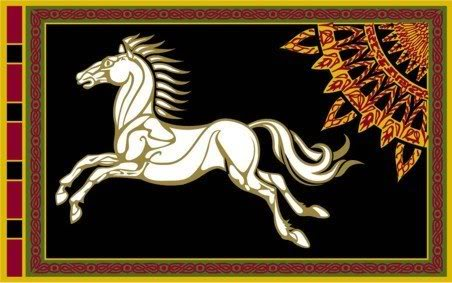
Rohan, originally Rochand or Rochann, was a kingdom of Men, located in the land once called Calenardhon, situated in the great vale between the Misty Mountains and the White Mountains (Ered Nimrais). The land of Rohan extended from the fords of the river Isen in the west, up to the shores of Anduin the great in the east. The forest of Fangorn lay within the borders of Rohan, and Lorien lay to the north of the river Limlight. The land was known as Rohan to the Men of Gondor, and its people the Rohirrim, meaning ‘the Horse-lords’, but the people of Rohan called themselves the Eorlingas, sons of Eorl the Young
The Roche surname is French (Norman) in origin and means “rock”. It is both a geographical and habitation surname; it could be acquired by a family who lived near a rocky outcrop or crag, or by living close to a town with this name. Many towns in France, Ireland and the UK are based on the name.
The Roche surname in Ireland and the UK originated in Wales in approximately 1100 AD. The district of Rhos in south west Wales was heavily influenced by the Normans at this time and also became a major Flemish settlement. The parish of Roch was established in Rhos near a rocky outcrop. A map of the districts (cantref) in medieval Wales is shown below. Rhos later became known as Pembrokeshire.
A prominent family in Rhos
Godebert “the Fleming” of Rhos was born in Roch parish in 1096. He was a Flemish Knight and had 2 sons; Richard FitzGodebert de Roch and Rodebert FitzGodebert de Roch. They acquired the Roch name from the local parish area. Both became Knights and Richard FitzGodebert de Roch was the first Knight to land in Ireland in 1167, prior to the main Norman forces. The families became known as de Roche, or de Rupe (in latin) and they acquired substantial property in Wales and Ireland, including Roch Castle and Pill Priory. Descendants of these Roche families are found predominantly in Ireland and to a lesser extent throughout the UK.
http://en.wikipedia.org/wiki/Duc_de_La_Rochefoucauld
There are few historical attestations that Viking Age women took part in warfare,[2] but the Byzantine historian Johannes Skylitzes records that women fought in battle when Sviatoslav I of Kiev attacked the Byzantines in Bulgaria in 971.[2] When the Varangians had suffered a devastating defeat, the victors were stunned at discovering armed women among the fallen warriors.[2]
When Leif Ericson’s pregnant half-sister Freydís Eiríksdóttir was in America, she is reported to have taken up a sword, and, bare-breasted, scared away the attacking Native Americans.[2] The fight is recounted in the Greenland saga, though Freydís is not explicitly referred to as a shieldmaiden in the text.[3]
[edit] Legendary accounts
Examples of shieldmaidens mentioned by name in the Norse sagas include Brynhild in the Volsunga saga, Hervor in Hervarar saga, the Brynhild of the Bósa saga ok Herrauds, the Swedish princess Thornbjörg in Hrólfs saga Gautrekssonar and Hed, Visna and Veborg in Gesta Danorum.
According to Saxo Grammaticus, 300 shieldmaidens fought on the Danish side at the Battle of Bråvalla, in the year 750. Saxo also records an account of Lathgertha who fought in battle for Ragnar Lodbrok and saved him from defeat through personally leading a flanking attack.
Brynhildr of the Volsunga saga, along with her rival in love, Gudrun, provides an example of how a shieldmaiden compares to more conventional aristocratic womanhood in the sagas. Brynhildr is chiefly concerned with honor, much like a male warrior. When she ends up married to Gudrun’s brother Gunnar instead of Sigurd, the man she intended to marry, Brynhildr speaks a verse comparing the courage of the two men:
“Sigurd fought the dragon And that afterward will be Forgotten by no one While men still live. Yet your brother Neither dared To ride into the fire Nor to leap across it.”[4]
Brynhildr is married to Gunnar and not Sigurd because of deceit and trickery, including a potion of forgetfulness given to Sigurd so he forgets his previous relationship with her.[4] Brynhildr is upset not only for the loss of Sigurd but also for the dishonesty involved. Similarly to her male counterparts, the shieldmaiden prefers to do things straightforwardly, without the deception considered stereotypically feminine in much of medieval literature. She enacts her vengeance directly, resulting in the deaths of herself, Sigurd, and Sigurd’s son by Gudrun. By killing the child, she demonstrates an understanding of feud and filial responsibility; if he lived, the boy would grow up to take vengeance on Brynhildr’s family.
Gudrun has a similar concern with family ties, but at first does not usually act directly. She is more inclined to incite her male relatives to action than take up arms herself. Gudrun is no shieldmaiden, and Brynhildr mocks her for this, saying, “Only ask what is best for you to know. That is suitable for noble women. And it is easy to be satisfied while everything happens according to your desires.” [4] In her later marriages, however, she is willing to kill her children, burn down a hall, and send her other sons to avenge the murder of her daughter, Svanhild. In the world of the sagas, women can be both honorable and remorseless, much like the male heroes. While a shieldmaiden does not fill a woman’s typical role, her strength of character is found in even the more domestic women in these stories.
In J.R.R. Tolkien’s The Lord of the Rings, Éowyn of Rohan fights as a shieldmaiden in the Battle of the Pelennor Fields. She successfully destroys the Witch-king though she is severely wounded in the process.
Éowyn is a fictional character in J. R. R. Tolkien’s legendarium, who appears in his most famous work, The Lord of the Rings. She is a noblewoman of Rohan who is described as a shieldmaiden.
In The Two Towers, Éowyn, a daughter of the House of Eorl and the niece of King Théoden, is introduced in Meduseld, the king’s hall at Edoras.[1] She was the daughter of Théodwyn (sister to Théoden) and Éomund, and the sister of Éomer. When she was only seven years old, her father was killed fighting Orcs and her mother died of grief. Éowyn and Éomer were raised in her uncle’s household as if they were his own children.
Tolkien writes that she longed to win renown in battle—more so because she was royal—but being female, her duties were reckoned to be at Edoras.[2] When Théoden’s mind was poisoned by his adviser Gríma Wormtongue, Éowyn was obliged to care for her uncle, and his deterioration pained her deeply. To make matters worse, she was constantly harassed by Gríma, who lusted after her. However, when Gandalf arrived, he freed Théoden from Wormtongue’s influence.
Éowyn fell in love with Aragorn, but it soon became clear that he could not return her love (though he did not mention his betrothal to Arwen, except by indirect allusion), and would not allow her to join him in going to war.[3] As Aragorn pointed out,[3] her duty was with her people; she had to shoulder the responsibility of ruling Rohan in Théoden’s stead when the war-host of Rohan went to war.[1] Aragorn also said her duties were no less valiant.[3] Likening her situation to a “cage”, Éowyn said she feared
“…[t]o stay behind bars, until use and old age accept them, and all chance of great deeds is gone beyond recall or desire.”[3]
In Return of the King, she disguised herself as a man and under the alias of Dernhelm, travelled with the Riders of Rohan to the Battle of the Pelennor Fields outside the White City of Minas Tirith in Gondor, carrying with her Merry Brandybuck, who had also been ordered to remain behind, on her horse Windfola.
During the battle of the Pelennor Fields, she confronted the Witch-king of Angmar, Lord of the Nazgûl, after Théoden was injured. The Witch-king threatened to “bear [her] away to the houses of lamentation, beyond all darkness, where [her] flesh shall be devoured, and [her] shriveled mind be left naked to the Lidless Eye.”[4] The Witch-king further boasted that “[n]o living man may hinder me,”[4] referring to the 1,000-year-old prophecy by the Elf-lord Glorfindel, foretelling that the Witch-king would not fall “by the hand of man”.[5] Éowyn then removed her helmet and declared:
“But no living man am I! You look upon a woman. Éowyn I am, Éomund’s daughter. You stand between me and my lord and kin. Begone, if you be not deathless! For living or dark undead, I will smite you, if you touch him.”[4]
The Witch-king attacked Éowyn with his steed, but she slew it with her sword. He then shattered her shield and broke her shield-arm with his mace, but was distracted by Merry, who stabbed him behind the knee with a sword enchanted with spells against him. Éowyn seized the opportunity to strike the Witch-king with a killing thrust “between crown and mantle”.[4] Then as her sword shattered, his withering form collapsed and he vanished with a final cry of anguish.
Éowyn soon passed out from the pain in her arm, and was believed dead until Prince Imrahil of Dol Amroth realized she still lived. Éowyn was brought to the Houses of Healing, hovering near death from the effects of having struck the Witch-king.[2] There Éowyn met Faramir, with whom she soon fell in love. Her outlook on life also changed:
“Then the heart of Éowyn changed, or else at last she understood it… …’I will be a shieldmaiden no longer, nor vie with the great Riders, nor take joy only in the songs of slaying. I will be a healer, and love all things that grow and are not barren.’”[6]
After the demise of Sauron, Éowyn and Faramir married and settled in Ithilien, of which Faramir was made the ruling Prince by King Elessar (the name with which Aragorn ascended the throne of the Reunited Kingdom). Faramir and Éowyn had at least one son (Elboron), and their grandson was Barahir, who wrote The Tale of Aragorn and Arwen in the Fourth Age.
[edit] Characteristics
Éowyn is described to be very beautiful; she was tall, slim, pale, and graceful, with long golden hair and grey eyes. In temperament she was idealistic, spirited, brave and high-minded, but very lonely, having sacrificed her own happiness for years to care for her sick uncle and meet the responsibilities of a shield-maiden.
[edit] Names and titles
In Old English (the language Tolkien used to represent his invented language of Rohirric), the word eoh (or eh) means “war-horse, charger”[7] while wyn means “delight, pleasure”[8] (in addition, some sample text within Bosworth and Toller translates wyn as “joy, joyous”). Therefore, even though no such word appears in the lexicon of Old English, the name Éowyn can be taken to mean “delightful charger”.[9]
The first syllable of Éowyn sounds like “eh-oh,” with the “oh” just barely pronounced. As in Scandinavian or Finnish, the y in the second syllable is the same sound as the German letter ü or the French u.
Tolkien maintained Éowyn was not the character’s actual name. Her real name in Rohirric is not given, but it, as well as Éomer and Éomund, would have started with the element Lô- or Loh-, meaning “horse”, which he represented with Old English Eoh-.[10]
Although she never carried the title of princess, she was a niece to one King of Rohan and sister to another, as well as the wife of a Gondorian prince.
Éowyn’s titles included the (White) Lady of Rohan, Lady of Ithilien and Lady of Emyn Arnen. She was also known as the Lady of the Shield-arm in recognition of her triumph over the Witch-king.
[edit] Concept and creation
Originally, Tolkien intended for Éowyn to marry Aragorn. Later, however, he decided against it because Aragorn was “too old and lordly and grim.” He considered making Éowyn the twin sister of Éomund, and having her die “to avenge or save Théoden”. He also considered having Aragorn truly love Éowyn and regret never marrying after her death.[11]
At one point Tolkien described Éowyn as “a stern Amazon woman”.[11] Later he wrote: “Though not a ‘dry nurse’ in temper, she was also not really a soldier or ‘Amazon’, but like many brave women was capable of great military gallantry at a crisis.”[12] (Here he alludes to Éowyn’s statement to Aragorn: “But am I not of the House of Eorl, a shieldmaiden and not a dry-nurse?”[3])
[edit] Portrayal in adaptations
Éowyn, as portrayed in Ralph Bakshi’s The Lord of the Rings.
The voice of Éowyn was provided by Nellie Bellflower in the 1980 Rankin/Bass animated version of The Return of the King, and by Elin Jenkins in BBC Radio’s 1981 serialisation.
Éowyn also appears briefly in Ralph Bakshi’s 1978 adaptation of The Lord of the Rings, but does not have any dialogue.
In Peter Jackson’s films The Lord of the Rings: The Two Towers (2002) and The Lord of the Rings: The Return of the King (2003), Éowyn is played by Miranda Otto. (The role was first offered to Iben Hjejle, who turned it down because she did not like the idea of being away from Denmark; Uma Thurman was slated for the role at one point.)[13]
In the original novel and Jackson’s adaptation, it is implied that Saruman promised her to Gríma as payment for his services as a spy. In one scene, while mourning for her dead cousin, she is subjected to Gríma’s obnoxious affections, which she spurns. She sings the dirge at Théodred’s funeral. In the extended edition of The Two Towers, Éowyn is shown discovering, to her astonishment, that Aragorn is a long-lived Dúnadan. In the original theatrical release of The Lord of the Rings: The Return of the King, Éowyn plays a much larger role in the Battle of Pelennor Fields than in the book, where the only fighting mentioned is her conflict with the Witch-king and also Gothmog. She also replaces Merry as the person to sit with Théoden as he dies. In the Extended Edition of the film, she is portrayed as being near death following her fight with the Witch-King; her brother finds her and screams in anguish because he fears that she is dead. She is later seen being healed by Aragorn, and meeting Faramir in the Houses of Healing.
In the scene before the climactic battle, it is implied that Éowyn will be made heir to Théoden’s throne (in the book, Éomer becomes King of Rohan), though it is never fully stated. It seems that Théoden’s instructions are that she should take the throne if none of the Rohirrim army return from the battle, including her brother, which is actually the arrangement Théoden makes in the book.
While she disguises herself in the film to ride into battle, she never takes on the name “Dernhelm”. In the Extended Edition, Théoden notices her dispatching several Orcs, but it is not clear if he realizes that she is his niece. The production team stated that while in a book it was easy to disguise Éowyn’s identity, in the medium of cinema the audience could visually tell that it was her, and it would have strained the credibility of the scenes to try to make it a secret.
Her final appearance occurs at Aragorn’s coronation, where she is shown standing next to Faramir. The Extended Edition restores a scene in which she falls in love with Faramir at the Houses of Healing, though even this version never states that they eventually marry. According to the DVD commentaries, an entire set-piece Faramir/Éowyn wedding scene was actually filmed, which Oscar-winning costume designer Ngila Dickson states features what she feels are the best costumes she produced for the entire film trilogy. While this scene has been described in the DVD commentaries and other interviews, it was ultimately cut and not even included in the Extended Edition, nor have any photos of the scene ever been made public.
Ragnar Lodbrok (Ragnar “Hairy-Breeks”, Old Norse: Ragnarr Loðbrók) was a legendary Norse hero from the Viking Age who was thoroughly reshaped in Old Norse poetry and legendary sagas.[1][2]
The namesake and subject of “Ragnar’s Saga”, and one of the most popular Viking heroes among the Norse themselves, Ragnar was a great Viking commander and the scourge of France and England. A perennial seeker after the Danish throne, he was briefly “king” of both Denmark and a large part of Sweden. A colorful figure, he claimed to be descended from Odin, was linked to two famous shieldmaidens, Lathgertha in the Gesta Danorum, and Queen Aslaug according to the Völsungasaga.
He told people he always sought greater adventures for fear that his (possibly adoptive) sons, who included such notable Vikings as Björn Ironside and Ivar the Boneless, would eclipse him in fame and honor. Ragnar raided France many times, using the rivers as highways for his fleets of longships. By remaining on the move, he cleverly avoided battles with large concentrations of heavy Frankish cavalry, while maximizing his advantages of mobility and the general climate of fear of Viking unpredictability. To court his second wife, the Swedish princess Thora, Ragnar traveled to Sweden and quelled an infestation of venomous snakes, famously wearing the hairy breeches whereby he gained his nickname. Supposedly, the breeches were made from bearskin dipped in pitch and sand, making them fireproof. He continued the series of successful raids against France throughout the mid 9th century, and fought numerous civil wars in Denmark, until his luck ran out at last in Britain. After being shipwrecked on the English coast during a freak storm, he was captured by Anglian king Ælla of Northumbria and put to death in an infamous manner by being thrown into a pit of vipers.
Although he is something of a hero in his native Scandinavia, most accounts of his life are of suspect veracity and are heavily influenced by ancient Viking sagas.
[edit] Contemporary sources
Paris at the time of Ragnar’s attack.
The Ragnar of sagas is apparently based on several historical entities. One was a pirate and raider, Ragnall, who was reported invading France and attacking several other lands. One of his favorite tactics was to attack Christian cities on church feast days, knowing that many soldiers would be in church.[3] He would generally accept a huge payment to leave his victims alone, only to come back later and demand more riches in exchange for leaving. The double-name of the legendary Ragnar Lodbrok also links him to historical vikings documented as “sons of Lothbrok”, although there is no documentary basis for associating this Lothbrok with the documented viking Ragnall.
[edit] France
In 845 Ragnall sailed southward. With a force said to consist of 120 ships and 5,000 Viking warriors, he landed in what is now France, probably at the Seine estuary, and ravaged West Francia, as the westernmost part of the Frankish Empire was then known. Rouen was ravaged and then Carolivenna, a mere 20 km from St. Denis. The raiders then attacked and captured Paris with a fleet of 120 ships.[4] The warriors belonging to the army of Charles the Bald, the King of West Francia and Charlemagne’s grandson, were placed to guard the Abbey of St. Denis, but fled when the Danish Vikings executed their prisoners ferociously in front of their eyes.[citation needed] The traditional date for this is 28 March, which is today referred to as Ragnar Lodbrok Day by certain followers of the Asatru religion. Charles paid Ragnall a huge amount of money not to destroy the city. Ragnar Lodbrok, according to Viking sources, was satisfied with no less than 7,000 pounds of silver in exchange for sparing the city.[2] By mysterious circumstances, many men in Ragnall’s army died during the journey and Ragnall died soon after his return.[1] However, that did not stop Ragnar from attacking other parts of France, and it took a long time for the Franks to drive him out.
Later, the sons of Lothbrok were to return for more booty. Among their feats was destroying the city of Rouen several more times. Ultimately, many of them settled there permanently, in a land that became known as Normandy (deriving from the expression “Nordmenn”, or ‘Northmen’ (‘Norsemen’), which was – and indeed still is – both the name the Norwegians called themselves and also the name the Franks used for the Scandinavians).
[edit] England and questions surrounding his death
All sources agree that Ragnar Lothbrok ended his life in England. The widely accepted version is that Ragnar was shipwrecked on the Northumbrian shore, where he was captured and taken to the Northumbrian king Ælla.[citation needed]
Legend claims that Ælla ordered Ragnar Lothbrok thrown into a pit filled with poisonous snakes. As he was slowly being bitten to death, he is alleged to have exclaimed, “How the little pigs would grunt if they knew how the old boar suffers!”, referring to the vengeance he hoped his sons would wreak when they heard of his death.[citation needed]
Alternative versions of the story say that he landed by accident in East Anglia and there befriended King Edmund before being killed by a jealous courtier. The murderer escaped to Denmark and blamed Edmund for Lodbrok’s demise.[citation needed]
The dating of Ragnar’s death has been alternatively stated as 840 or 865. The earlier dating corresponds to events attached to Ragnar Lothbrok’s legend in the saga. However, a later date better explains the attack on England by his sons in 865, supposedly to avenge their father’s death. It is unlikely that the Great Heathen Army, led by the sons of Lothbrok, would have waited 25 years to take their vengeance.[citation needed]
[edit] Death song
Main article: Krákumál
As he was thrown into the snake pit, Ragnar was said to have uttered his famous death song: “It gladdens me to know that Baldr’s father [Odin] makes ready the benches for a banquet. Soon we shall be drinking ale from the curved horns. The champion who comes into Odin’s dwelling [Valhalla] does not lament his death. I shall not enter his hall with words of fear upon my lips. The Æsir will welcome me. Death comes without lamenting… Eager am I to depart. The Dísir summon me home, those whom Odin sends for me Valkyries from the halls of the Lord of Hosts. Gladly shall I drink ale in the high-seat with the Æsir. The days of my life are ended. I laugh as I die.”
[edit] Legacy
One Viking saga states that when his four sons heard the manner of his death, they all reacted in great sorrow. Hvitserk, who was playing tafl, gripped the piece so hard that he bled from his fingernails. Björn Ironside grabbed a spear so tightly that he left an impression in it, and Sigurd Snake-in-the-Eye, who was trimming his nails, cut straight through to the bone.
Although these stories may not be accurate, if there is any truth to them his death had serious consequences. His other sons, Ivar the Boneless (alias Hingwar) and Ubbe soon learned the details of their father’s death and swore that they would avenge his killing, in time-honoured Viking tradition. In 866, Ivar and Ubbe crossed the North Sea with a large army (The Great Heathen Army), sacked York, met King Ælla in battle, and captured him. He was sentenced to die according to the custom of the blood eagle – an exceedingly painful death.
They then moved south to East Anglia, on the way attacking the monasteries of Bardney, Croyland and Medeshampstede where, according to tradition, their army slew 80 monks. Eventually they captured King Edmund and had him shot by archers and beheaded. These wars were a prelude to the long struggle of the Anglo-Saxons of Alfred the Great against the Danes a generation later, which also included the leader named Guthrum, all of whom founded the Danelaw.
Ragnar’s forays into France were traditional for the Danish monarchs, with such men as Gudfred, Harald Klak and Hygelac among his predecessors; Rollo of Normandy his future and ultimate successor of the Frankish policy in making the Danes fief-holders of Frisia. Danish policy towards France was also defensive, in the Danevirke’s construction.
[edit] Mythology
Bragi Boddason is said to have composed the Ragnarsdrápa for the Swedish king Björn at Hauge. However, this does not correspond to what we know about the historical Ragnar. It is consequently said that in the Norse sagas, he was identified with a Swedish king Ragnar (770-785), the son of Sigurd Ring. According to legend, he married Aslaug and became the son-in-law of Sigurd the Völsung.[5]
Svanhild is the beautiful daughter of Sigurd and Gudrun in Germanic mythology, whose grisly death at the hands of her jealous royal husband Ermanaric was told in many northern European stories, including the Icelandic Poetic Edda (Hamðismál and Guðrúnarhvöt), Prose Edda and the Volsunga Saga; the Norwegian Ragnarsdrápa; the Danish Gesta Danorum; and the German Nibelungenlied and Annals of Quedlinburg.
She was “the most beautiful of all women,”[1] and was married to Ermanaric (Jörmunrekkr) the king of the Goths. She was accused of infidelity with the king’s son, Randver. Because of this Ermanaric had her trampled to death under horses.
Her mother made her half-brothers Hamdir and Sörli exact revenge on her death, a story which is retold in Hamðismál and Guðrúnarhvöt, Bragi Boddason’s Ragnarsdrápa, in the Völsunga saga and in Gesta Danorum. [2][3]
Jordanes wrote in 551 AD that Ermanaric, king of the Gothic Greuthungi, was upset with the attack of a subordinate king and had his young wife Sunilda (i.e. Svanhild) torn apart by four horses. As revenge Ermanaric was pierced with spears by her brothers Ammius (Hamdir) and Sarus (Sörli) and died from the wounds. The Annals of Quedlinburg (end of the 10th century) relates that the brothers Hemidus (Hamdir), Serila (Sörli) and Adaccar (Erp/Odoacer) had cut off the hands of Ermanaric.
http://www.panhistoria.com/Stacks/Novels/Character_Homes/home.php?CharID=4609
Mund (in law)
From Wikipedia, the free encyclopedia
Jump to: navigation, search
The mund is a principle in Germanic tradition and law that can be crudely translated as “protection” and which grew as the prerogative of a Germanic tribe king or leader. It has been Latinized in mundium.
The word comes from Germanic *mundo (cf. Old English/Old Norse mund), ‘hand; protection’.
Contents
[hide]
1 The mund within the family
2 The mundium in Germanic Code of Laws
3 Advantages
4 Extension
5 See also
6 Use in names
7 Link
8 References
[edit] The mund within the family
The mund is basically the leadership of an ancestor of a family, a family which is understood as all the people related by the blood to this ancestor, exerted over all and each of the family members. The ancestor’s responsibility is more aimed at the family as a whole than towards each member individually.
The mund manifests itself as a disciplinary power upon the members of the family; the tenant of the mund has to watch over the women’s chastity and faithfulness to prevent the family honour from being harmed, in the first case if a bride is not a virgin at the time of her departure from the family, in the second, if sons are born that are not of the common blood. It also has to control the male family members who may cast shame on the family honour, who may not serve the family, or who may endanger the whole family by their imprudence (for example by drawing the family into a feud. Thus the keeper of the mund can ban a member from the family. In this aspect, it is a coercive power, an authority, but not understood as the Roman auctoritas.
It is also the responsibility to defend the family’s well-being and existence from all dangers and offenses (be they against the body or the honour).
[edit] The mundium in Germanic Code of Laws
When the Germanic traditions mingled with the Roman Law in the post-Migration kingdoms, the mund, which came to be known as mundium, was part of the many code of Laws those kingdoms edicted.
It became the responsibility of the closer male relative over non-responsible members of the society, i.e. mostly children and women. As such, it gets mixed up with the guardianship ; but it also protects mothers (Lex Burgundionum art. LIX & LXXXV ; cf. ). It became useless as soon as such a protected member was responsible for himself, as when children grew. Prominent women also could shudder the mundium off.
[edit] Advantages
The mund is more of a responsibility than a right, but attached to this responsibility are a list of advantages.
[edit] Extension
From this first mund, the principle was extended to the entire tribe, then to several tribes. For example, Early Franks were divided into Salians, scattered in tribes dominated by tribal munds, and Ripuarians, that were all comprised under the mund of a king in Cologne, although he wasn’t the king of all the Ripuarians, but only their “protector”. This can be seen as an archaic building of the momentum that was eventually to concentrate the coercive power (potestas) and legal violence in the hands of a few, namely the nobles, and later only the monarchs.
The mund came to parallel the principle of auctoritas, without being the same as the kingship.
The mundium regis, for example, was the king’s responsibility to protect his subjects and the churches.
The mund passed through to the code of chivalry as a Christian virtue. It passed also, although modified, in modern political conceptions under the term protector. To an extent, the paternalism associated with medieval and modern kingships owes more to the mund than to the elected Germanic kingship.
mouth (n.)
Old English muþ “mouth, opening, door, gate,” from Proto-Germanic *munthaz (cf. Old Saxon, Old Frisian muth, Old Norse munnr, Danish mund, Middle Dutch mont, Dutch mond, Old High German mund, German Mund, Gothic munþs “mouth”), with characteristic loss of nasal consonant in Old English (cf. tooth, goose, etc.), from PIE *mnto-s (cf. Latin mentum “chin”). In the sense of “outfall of a river” it is attested from late Old English; as the opening of anything with capacity (a bottle, cave, etc.) it is recorded from c.1200. Mouth-organ attested from 1660s.
Raymond
masc. proper name, from Old French Raimund, from Frankish *Raginmund “counsel-protection” or “might-protection,” from ragin “counsel, might” + mund “hand, protection” (cf. Old High German munt, Old English mund, second element in Edmund, Sigismund, etc.).
 Rosamond Press
Leave a comment