
 In 1992, when Victoria Presco was living with her father and acting as his General Manager, I asked her who turned her on to alcohol.
“Dad!” was her answer.
“Who does Christine say turned her on to alcohol?”
“Vic!” she said.
When I discussed with Vicki Shannon’s accusation about being raped by her grandfather, Vicki said this;
“She knew better than to drink with Vic. The same thing happened to Christine and I when we drank with Dad in our twenties.”
What this is, is an admittance that my sister had an incestuous relationship with our father, for, she never pressed charges, and continued to live and work for Victor W. Presco – who told my sisters I was not his son – but the son of man who screwed his wife when she betrayed him.
Vic then told my sisters they should take everything they can from me, because I was an imposter, and had intercepted all the good things Vic intended for his loving daughters, including my Artistic Gifts. Vic had drawn a lion, and this was proof I was not of His Seed, and, because Rosemary favored the boys, she bid bid me steal his gifts. What’s the truth?
The truth is, both my parents wanted to leave an indelible impression on all four of their children, because they were narcissistic alcoholics, and, they received clues that they had come from noble ancestors. Instead of doing a genealogy like I have done. they fought with one another to see who would be the supreme ruler over their children, their subjects. Victor and Rosemary were drunken gods. Vic was the embodiment of Bacchus, and Rosemary the Queen of the. Her mother, came from the Wieneke family whose coat of arms depicts a bunch of grapes. Mary loved her wine, as did her four daughters. Christine and Vicki became alcoholics, and did wild and crazy things. When their lives stopped working for them, they turned to Vic and began a new family Genesis – minus their brothers!
While on LSD in 1965, I had a vision of my father. Blood was coming from his eyes. I told my friend Keith;
“I think my father is dying!”
I went and found him. What a mistake. He was dying, and began to suck the life out of me in order to save himself. I was eighteen. He was extremely jealous of me. I was free – and gifted! He could not stand the truth my sisters loved me. He worked in the dark to take away their love and focus it on him. Vic had not visitation rights after the divorce because he was a brutal and sadistic man who spent our food money getting barflys drunk at Oscars Bar & Grill.
I got drunk with my father on many occasions. In 1987, I got sober. A year later I wrote on a piece of paper “I am a Nazarite” and baptized myself in the McKenzie River. I would beg the Court and Judge Richard M. Silver to respect the sobriety Christine and her brother had found. Instead, he got sucked in by Vicki THE VICTIM, who saw herself as the rightful Heir, because she is Victor’s only begotten child. Shannon Rosamond, was not of victor’s ilk. Vicki deserved to rule the family from the dark, in the background, using the masterful self-pity her father taught her.
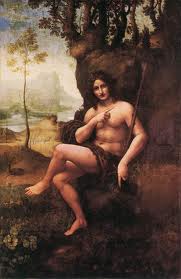
Above is a painting of John the Baptist ‘The Nazarite For Life’ that was turned into Bacchus the god of wine. Satan-Paul’s church bids those that enter to break the Nazarite Vow, by drinking wined and getting near a dead body – even ingesting the flesh of the dead.
Jon Presco
Copyright 2013
1
a: that cannot be removed, washed away, or erased
b: making marks that cannot easily be removed
2
a: lasting
b: unforgettable, memorable
Bacchus, formerly Saint John the Baptist, is a painting in the Musée du Louvre, Paris, France, based on a drawing by the Italian Renaissance artist Leonardo da Vinci. It is presumed to have been executed by an unknown follower, perhaps in Leonardo’s workshop. Sydney J. Freedberg assigns the drawing to Leonardo’s second Milan period.[1] Among the Lombard painters who have been suggested as possible authors are Cesare da Sesto,[2] Marco d’Oggiono, Francesco Melzi,[3] and Cesare Bernazzano. The painting shows a male figure with garlanded head and leopard skin, seated in an idyllic landscape. He points with his right hand off to his left, and with his left hand grasps his thyrsus and also points down to earth.
The painting originally depicted John the Baptist. In the late 17th century, between the years 1683 and 1693, it was overpainted and altered, to serve as Bacchus.[4]
Cassiano dal Pozzo remarked of the painting in its former state, which he saw at Fontainebleau in 1625, that it had neither devotion, decorum nor similitude,[5] the suavely beautiful, youthful and slightly androgynous Giovannino was so at variance with artistic conventions in portraying the Baptist— neither the older ascetic prophet nor the Florentine baby Giovannino, but a type of Leonardo’s invention, of a disconcerting, somewhat ambiguous sensuality, familiar in Leonardo’s half-length and upward-pointing Saint John the Baptist, also in the Louvre.[6]
The overpainting transformed the image of St. John into one of a pagan deity, by converting the long-handled cross-like staff of the Baptist to a Bacchic thyrsus and adding a vine wreath. The fur robe is the legacy of John the Baptist, but has been overpainted with leopard-spots relating, like the wreath, to Bacchus, the Roman god of wine and intoxication.
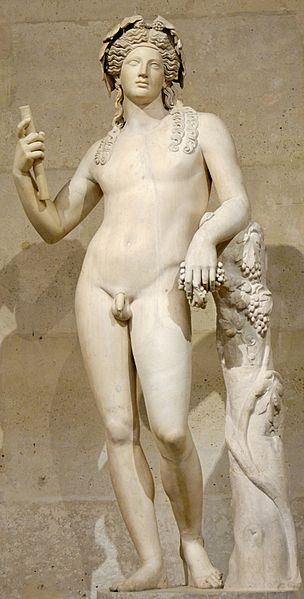
Dionysus pron.: /daɪ.əˈnaɪsəs/ dy-ə-NY-səs (Ancient Greek: Διόνυσος, Dionysos) was the god of the grape harvest, winemaking and wine, of ritual madness and ecstasy in Greek mythology. His name in Linear B tablets shows he was worshipped from c. 1500—1100 BC by Mycenean Greeks: other traces of Dionysian-type cult have been found in ancient Minoan Crete.[2] His origins are uncertain, and his cults took many forms; some are described by ancient sources as Thracian, others as Greek.[3][4][5] In some cults, he arrives from the east, as an Asiatic foreigner; in others, from Ethiopia in the South. He is a god of epiphany, “the god that comes,” and his “foreignness” as an arriving outsider-god may be inherent and essential to his cults. He is a major, popular figure of Greek mythology and religion, and is included in some lists of the twelve Olympians. Dionysus was the last god to be accepted into Mt. Olympus. He was the youngest and the only one to have a mortal mother.[6] His festivals were the driving force behind the development of Greek theatre. He is an example of a dying god.[7][8]
The earliest cult images of Dionysus show a mature male, bearded and robed. He holds a fennel staff, tipped with a pine-cone and known as a thyrsus. Later images show him as a beardless, sensuous, naked or half-naked androgynous youth: the literature describes him as womanly or “man-womanish.”[9] In its fully developed form, his central cult imagery shows his triumphant, disorderly arrival or return, as if from some place beyond the borders of the known and civilized. His procession (thiasus) is made up of wild female followers (maenads) and bearded satyrs with erect penises. Some are armed with the thyrsus, some dance or play music. The god himself is drawn in a chariot, usually by exotic beasts such as lions or tigers, and is sometimes attended by a bearded, drunken Silenus. This procession is presumed to be the cult model for the human followers of his Dionysian Mysteries. In his Thracian mysteries, he wears the bassaris or fox-skin, symbolizing a new life. Dionysus is represented by city religions as the protector of those who do not belong to conventional society and thus symbolizes everything which is chaotic, dangerous and unexpected, everything which escapes human reason and which can only be attributed to the unforeseeable action of the gods.[10]
He was also known as Bacchus (pron.: /ˈbækəs/ or /ˈbɑːkəs/; Greek: Βάκχος, Bakkhos), the name adopted by the Romans[11] and the frenzy he induces, bakkheia. His thyrsus is sometimes wound with ivy and dripping with honey. It is a beneficent wand but also a weapon, and can be used to destroy those who oppose his cult and the freedoms he represents. He is also the Liberator (Eleutherios), whose wine, music and ecstatic dance frees his followers from self-conscious fear and care, and subverts the oppressive restraints of the powerful. Those who partake of his mysteries are possessed and empowered by the god himself.[12] His cult is also a “cult of the souls”; his maenads feed the dead through blood-offerings, and he acts as a divine communicant between the living and the dead.[13]
In Greek mythology, he is presented as a son of Zeus and the mortal Semele, thus semi-divine or heroic: and as son of Zeus and Persephone or Demeter, thus both fully divine, part-chthonic and possibly identical with Iacchus of the Eleusinian Mysteries. Some scholars believe that Dionysus is a syncretism of a local Greek nature deity and a more powerful god from Thrace or Phrygia such as Sabazios[14] or Zalmoxis.[15]
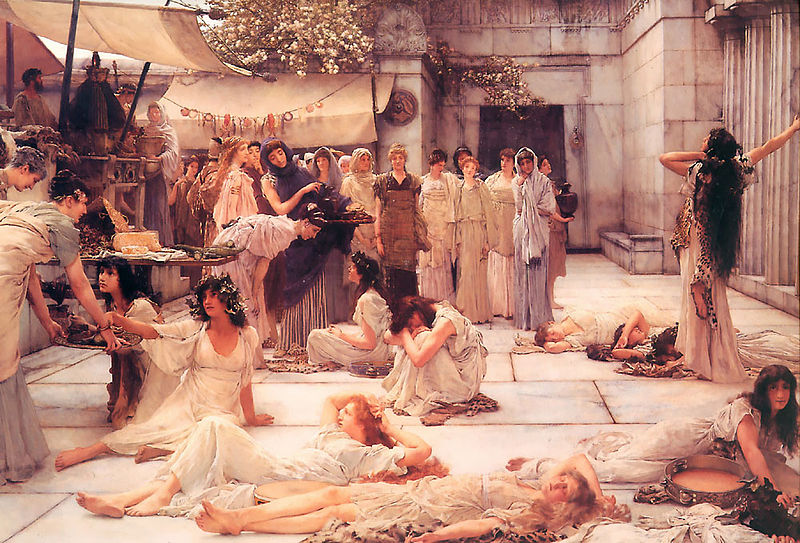
Maenads have been depicted in art as erratic and frenzied women enveloped in a drunken rapture, the most obvious example being that of Euripides’ play The Bacchae. His play, however, is not a study of the cult of Dionysus or the effects of this religious hysteria of these women. The maenads have often been misinterpreted in art in this way. To understand the play of Euripides though one must only know about the religious ecstasy called Dionysiac, the most common moment maenads are displayed in art. In Euripides’ play and other art forms and works the Dionysiac only needs to be understood as the frenzied dances of the god which are direct manifestations of euphoric possession and that these worshippers, sometimes by eating the flesh of a man or animal who has temporarily incarnated the god, come to partake of his divinity.
http://www.pbs.org/wgbh/pages/frontline/shows/religion/jesus/crucifixion.html
 Rosamond Press
Leave a comment