 My Rosamond-Hodge kindred ended up with property that once belonged to Rebecca de Mendes in Sount Carolina.
Jon Presco
Row 8, plot 85. With the coordinates in hand, it should be simple to find the grave of Rebecca de Mendes Benjamin. But the sun has set over the Dispersed of Judah cemetery, the moon is reduced to a crescent, and an ominous chill has settled in over otherwise warm-blooded New Orleans.
Ethan points a meager flashlight borrowed from the bed and breakfast to the ground and miraculously finds a marker for row 9. We move to the right, closer to cemetery wall, shining a small halo on the path, hoping to find row 8. No such luck. But wait! There’s row 10: The rows are numbered north to south, not east to west. We scramble off in the likely direction of row 8.
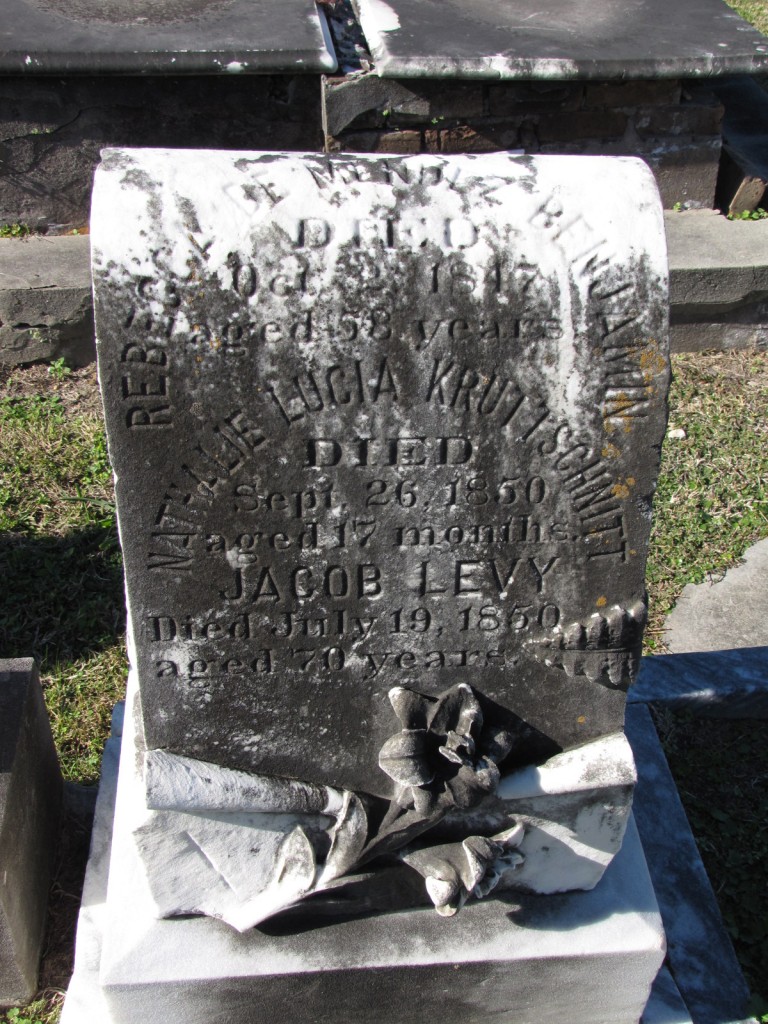
I had come here earlier in the day, in the late afternoon, scouring this Jewish Cemetery, where the mother of Judah P. Benjamin was buried, without the benefit the coordinates. According to a directory on ancestry.com, she shares a plot here with her uncle Jacob Levy, who helped the family settle in the United States, and the mysterious Nathalie Lucia Kruttschnitt, who may be her grand daughter.
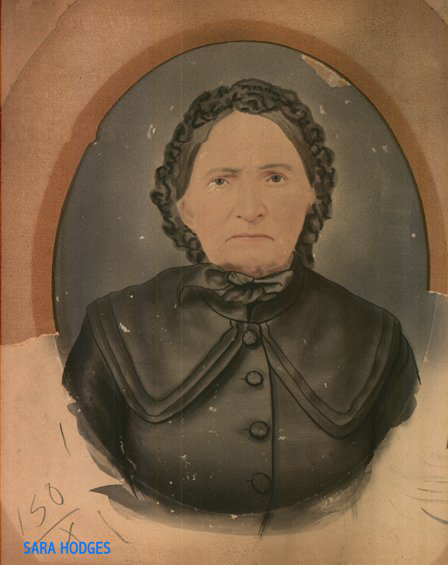
Rebecca de Mendes Benjamin, I explain to Ethan, is my fourth great grandmother, his fifth great grandmother, a Sephardic Jew from Portugal, related to us through my grandmother “Meanie” Thompson. She was the mother of Peninah Benjamin Kruttschnitt and Judah P. Benjamin, Secretary of State of the Confederacy. The kids barely indulge my family ancestry quest. But attitudes may change if the research involves a late-night graveyard search.
The Dispersed of Judah cemetery isn’t in the best part of town. It’s located near the intersection of Canal and Metarie Streets, a corner seemingly reserved for cemeteries. Even so, this smallish cemetery, founded in 1846 by Spanish and Portugese Jews, isn’t the easiest to find. Until you realize it’s one of the few on the street without crosses on the graves and where nearly everyone is buried in the ground.
The rusty gates are open, or at least ajar, day and night, perhaps because they can’t be closed. And the cemetery lawn is littered with remnants of the night—dented 24-ounce beer cans, faded carnival beads, and wadded up cigarette packs. An unassuring glow from nearby streetlights make this an unlikely place for a rendezvous or a sleep over, but you never know.
I hear a rustle as we move into what appears to be an older section of the graveyard.
We must be going in the right direction—Rebecca died in 1848, at 56, only two years after moving here from South Carolina. She came with her daughter, Peninah, to live at Judah P. Benjamin’s Bellechasse mansion. It must have been a big relief to Rebecca when Peninah married John Kruttschnitt, a successful merchant, the year before she died.
In the older part of the graveyard, the rows and plots aren’t as well marked. In fact, landmarks are few and far between. We stumble upon plot 88. Rebecca’s grave must be three spots away. We search in both directions, but we can’t find it.
It’s getting cold. As we stumble around in the dark, the noise I heard before gets louder. Then it escalates into a roar, quickly sending chills down my spine, making my hair seem to stand on end. “Shit,” I say, tripping over the edge of a plot.
“It must be a bat,” Ethan says, as the noise quiets down. Whatever it is has moved toward the neighboring cemetery. “You’re probably right,” I say, thinking that the flapping of wings sure was unlike any I had ever heard.
It’s difficult to read many of the worn-out gravestones in the old part of the cemetery, especially since the flashlight only illuminates part of the headstone. Some of the inscriptions are so faint that charcoal and trace paper may be the only way to reveal their secrets. Some plots are empty, or their headstones have been turned over and broken. A disquieting number of grave stones make reference to a ‘dearly departed child.’
It’s hopeless. We decide to call it a night.
That night I wonder whether the Kruttschnitts could have moved Rebecca’s grave. Unlikely. Perhaps she’s buried alongside her son Judah in France. Maybe it’s possible to find cemetery records somewhere. Perhaps I’ll look in the Tulane library tomorrow.
The next afternoon, I decide to give it one last try. The cemetery isn’t nearly as spooky in daylight, but it looks even more unkempt. Though some of graves have “perpetual care” written on them, it feels like people, including the maintenance staff, rarely visit. But at least you can read the plot numbers.
Returning to the general vicinity where we thought the grave might be the night before, I immediately find plot 86. And, looking to my left, I see a marker for Rebecca DeMendes Benjamin, wedged between two other stones. I can barely believe my eyes. Her name is tough to decipher–it’s written in a semi-circle over the top of the stone.
My first thought is that the marker is too inconspicuous for the mother of Judah P. Benjamn, the brains of the Confederacy and one of the brightest legal minds of his generation. Granted he was forced to flee the country after the Civil War, but he became fabulously wealthy as a barrister in England. You’d think he might have upgraded the tombstone. But Judah P’s stone in France isn’t that large, either.
My second thought is that I’ve found something special. This is the grave of a Jewish relative who sought refuge in the United States from persecution in Europe. Moreover, the de Mendes family can be traced back to Spanish Inquisition of the late 1400s. It’s listed among 30 prominent families that sought refuge in Portugal from Spain. During the reign of Ferdinand of Aragon, Jews in Spain were forced to either leave the country, convert to Catholicism, or face torture and death.
Three hundred years later, well after the persecution spread into Portugal, Rebecca’s father, Solomon de Mendes moved to Holland, where he met his wife-to-be, Eva Levy, a Dutch Jewess. After Rebecca was born in 1790, the family moved to England. At 18, Rebecca married Philip Benjamin, “a little dark-skinned man in his mid-20s” born in the Caribbean, on the British island of Nevis, according to Judah P. Benjamin’s biographer, Robert Douthat Meade. The couple may have run a corner stand in London that sold dried fruit.
Rebecca and Philip probably decided that opportunities would be better in the New World. So they moved to Nevis, where many of the older Jewish families were of Shepardic stock. Opportunity there wasn’t much better than in Europe. But the couple heard from Rebecca’s uncle, Jacob Levy, that there might be more opportunity in Wilmington, North Carolina, and moved there in 1813. After that didn’t work out, the family in 1821 moved to Charleston, South Carolina.
Rebecca separated from her husband in about 1838 after 30 years of marriage. One scholar described Phillip as far more interested in study than making a living. During the marriage, the family’s fortunes were always at “a very low ebb,” wrote Pierce Butler, another Judah P. Benjamin biographer.
However, Rebecca remained close to her uncle, Jacob Levy, who was buried in the same plot two years after she died. Nathalie Lucia Kruttschnitt, the other name on the gravestone, may well have been a child of John Kruttschnitt and Peninah Benjamin, though there are no other records to substantiate this. The couple were married in 1848, and Nathalie died in September of 1850.
As a reward for Benjamin’s loyalty, Davis appointed him as Secretary of State in March 1862. Benjamin arranged the Erlanger loan from a Paris bank to the Confederacy in 1863, which was the only significant European loan of the war.[12] In a round of “secondary diplomacy”, he sent commercial agents to the Caribbean to negotiate opening ports in Bermuda, the West Indies, and Cuba to Confederate blockade runners to maintain supplies, which the Union was trying to prevent. After mid-1863, the system was expanded and “brought rich rewards to investors, shipowners, and the Confederate Army”.[13]
Benjamin wanted to draw the United Kingdom into the war on the side of the Confederacy, but it had abolished slavery years before and public opinion was strongly divided on the war. In 1864, as the South’s military position became increasingly desperate, he publicly advocated a plan to emancipate and induct into the military any slave willing to bear arms for the Confederacy. Such a policy would have the dual results of removing slavery as the greatest obstacle in British public opinion to an alliance with the Confederacy, and easing the shortage of soldiers that was crippling the South’s military efforts. With Davis’ approval, Benjamin proclaimed, “Let us say to every Negro who wishes to go into the ranks, ‘Go and fight—you are free.”[14] Robert E. Lee supported the scheme as well, but it faced stiff opposition from conservatives. The Confederate Congress did not pass the measure until March 1865, by which time it was too late to salvage the Southern cause.
From London in late 1865, Benjamin provided considerable financial assistance to several friends in the former Confederacy. Joan Cashin, the biographer of Varina Howell Davis, said that Benjamin gave the Davis family a gift of $12,000. The gift supported not only the Davis extended family but many of their relatives and friends during the early years of the Reconstruction era.
Benjamin’s grave at Père Lachaise Cemetery in Paris
In June 1866, Benjamin was called to the bar in England, the beginning of his successful and eventually lucrative second career as a barrister, working in corporate law. In 1868, he published his Treatise on the Law of Sale of Personal Property, which came to be regarded as one of the classics of its field. The work’s current edition remains authoritative under the name Benjamin’s Sale of Goods. He was influential in commercial law that supported the rise of Great Britain as an imperial power. In 1872, he was selected as Queen’s Counsel.[1]
Benjamin appeared on several appeals from Canadian courts to the Judicial Committee of the Privy Council, the final court of appeal for the Empire.
Benjamin retired in 1883 on his doctor’s advice. He had earned $720,000 during his nearly two decades at the bar in London.[10] He moved to Paris, where his daughter Ninette and three grandchildren lived. He died there on May 6, 1884, and was interred at Père Lachaise Cemetery.[1]
Judah Philip Benjamin was born a British subject in 1811 in Saint Croix, to Phillip Benjamin, an English[citation needed] Sephardi Jew, and his wife, Rebecca de Mendes, a Sephardi Jew from Spain.[1] This was during the period of British occupation of the Danish West Indies (now U.S. Virgin Islands). His father was a first cousin and business partner of Moses Elias Levy, father of future Florida senator David Levy Yulee.[2]
He emigrated with his parents to the U.S. in 1813, where the family first lived in Wilmington, North Carolina. In 1822 they moved to Charleston, South Carolina, where his father was among the founders, with Isaac Harby, of the first Reform congregation in the United States, the “Reformed Society of Israelites for Promoting True Principles of Judaism According to Its Purity and Spirit”. The formation of the congregation was of such interest that it was covered by the North American Review, a national journal of the time.[3]

 Rosamond Press
Leave a reply to Royal Rosamond Press Cancel reply