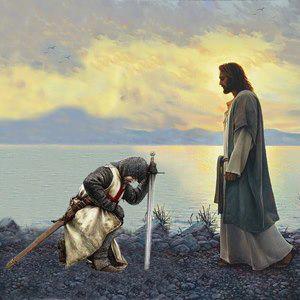
 The Arthurian Grail Legends came to owned by the conquering Normans, and had nothing to do with Jews, are, a lineage of Judah. These Norman butchered the Jews during the Crusades. The Jews, and their longtime allies, the Parthians, butchered Christians, and later helped Muslims do the same. Sephardic Jews, who do descend from the Kings of Judah, sided with the Confederacy. The Jewish lobby sides with the radical neo-Confederate Republicans who were reluctant to give aid to victims of hurricane Sandy, because these victims lived in Blue States. These radical Republicans are contemplating destroying our economy and the world economy in order to get their way, which amounts to revenge for General Lee losing the war.
Jesus is not the Holy Leader of Crusaders! Get over it!
Meanwhile, secular folk who do not own religious agenda, and, or not sympathetic to human being owning other human being, just want to get back to work, or, if you are young, get your first job so you can get married and have children.
And, that is that!
Jon Presco
http://www.jewishvirtuallibrary.org/jsource/History/The_Jewish_Claim_To_The_Land_Of_Israel.html
Persecution of Christians by Persians and Jews during Roman-Persian Wars
According to Antiochus Strategos, a 7th century monk in Palestine, shortly after the Persian army entered Jerusalem in 614, unprecedented looting and sacrilege took place. Church after church was burned down alongside the innumerable Christian artifacts, which were stolen or damaged by the ensuing arson. Given that Khosrau II generally practiced religious tolerance and did deem Christians respectfully, it is not known why Shahrbaraz ordered such a massacre. One reason could simply have been Shahrbaraz’s rage at the resistance that had been offered by Jerusalem’s Christian populace. Accounts from early Christian chroniclers suggest that 26,000 Jewish rebels entered the streets of the city. Some Jerusalem Christians were taken captive, gathered together and murdered in mass by Jews. The Greek historian Antiochus Strategos writes that captive Christians were gathered near Mamilla reservoir and the Jews offered to help them escape death if they “become Jews and deny Christ”. The Christian captives refused, and the Jews in anger had purchased the Christians from Persians and massacred them on spot. Antiochus writes: Then the Jews… as of old they bought the Lord from the Jews with silver, so they purchased Christians out of the reservoir; for they gave the Persians silver, and they bought a Christian and slew him like a sheep.
According to Antiochus, the total Christian death toll was 66,509, of which 24,518 corpses were found at Mamilla, many more than were found anywhere else in the city. Other manuscripts suggest less where found at Mamilla 4518 or 4618.[20] Other sources give a figure of 60,000 slain. The Jews destroyed the Christian churches and the monasteries, books were burnt and monks and priests killed. According to Israeli archeologists, there was no destruction of churches. A mass burial grave at Mamilla cave was discovered in 1989 by Israeli archeologist Ronny Reich.
The massacre appeared to have happened after Christians revolted a few months after the capture of Jerusalem. They were able to briefly retake the city for 19 days before the walls where breached. Killing the new ruler of Jerusalem the Exilarch Nehemiah ben Hushiel and his “council of the righteous” and dragging their bodies through the streets. Christians in this time period had allied themselves with the Eastern Roman Empire. Archaeological evidence does not currently support the idea that churches were burnt. Christian sources may well have reason to exaggerate the extent of the massacre as they would later in 628 massacre, forcible convert and expel the Jews.[21]
Early in the 4th century, Roman Empire split and Constantinople became the capital of the East Roman Empire known as the Byzantine Empire. Under the Byzantines, Christianity, dominated by the (Greek) Orthodox Church, was adopted as the official religion. Jerusalem became a Christian city and Jews were still banned from living there.
In 351–2, there was another Jewish revolt against a corrupt Roman governor.[48] The Jewish population in Sepphoris rebelled under the leadership of Patricius against the rule of Constantius Gallus. The revolt was eventually subdued by Ursicinus.
According to tradition, in 359 CE Hillel II created the Hebrew calendar based on the lunar year. Until then, The entire Jewish community outside the land of Israel depended on the calendar sanctioned by the Sanhedrin; this was necessary for the proper observance of the Jewish holy days. However, danger threatened the participants in that sanction and the messengers who communicated their decisions to distant congregations. As the religious persecutions continued, Hillel determined to provide an authorized calendar for all time to come.
During his short reign, Emperor Julian (361-363) abolished the special taxes paid by the Jews to the Roman government and also sought to ease the burden of mandatory Jewish financial support of the Jewish patriarchate.[49] He also gave permission for the Jews to rebuild and populate Jerusalem.[50] In one of his most remarkable endeavours, he initiated the restoration of the Jewish Temple which had been demolished in 70 CE. A contingent of thousands of Jews from Persian districts hoping to assist in the construction effort were killed en route by Persian soldiers.[51] The great earthquake together with Julian’s death put an end to Jewish hopes of rebuilding the Third Temple.[52] Had the attempt been successful, it is likely that the re-establishment of the Jewish state with its sacrifices, priests and Sanhedrin or Senate would have occurred.[49]
Jews probably constituted the majority of the population of Palestine until the 4th-century, when Constantine converted to Christianity.[53]
Jews lived in at least forty-three Jewish communities in Palestine: twelve towns on the coast, in the Negev, and east of the Jordan, and thirty-one villages in Galilee and in the Jordan valley. The persecuted Jews of Palestine revolted twice against their Christian rulers. In the 5th century, the Western Roman Empire collapsed leading to Christian migration into Palestine and development of a Christian majority. Jews numbered 10–15% of the population. Judaism was the only non-Christian religion tolerated, but there were bans on Jews building new places of worship, holding public office or owning slaves. There were also two Samaritan revolts in this period.[54]
In 438, The Empress Eudocia removed the ban on Jews’ praying at the Temple site and the heads of the Community in Galilee issued a call “to the great and mighty people of the Jews”: “Know that the end of the exile of our people has come”!
In about 450, the Jerusalem Talmud was completed.
According to Procopius, in 533 Byzantine general Belisarius took the treasures of the Jewish temple from Vandals who had taken them from Rome. In 611, Sassanid Persia invaded the Byzantine Empire. In 613, a Jewish revolt against the Byzantine Empire joined forces with the Persian invaders to capture Jerusalem in 614. The Jews gained autonomy in Jerusalem, until in 617 when the Persians betrayed agreements and withdrew their forces from the region. With return of the Byzantines in 628, the Byzantine Emperor Heraclius promised to restore Jewish rights and received Jewish help in ousting the Persians with the aid of Jewish leader Benjamin of Tiberias. Heraclius later reneged on the agreement after reconquering Palestine by issuing an edict banning Judaism from the Byzantine Empire and thousands of Jewish refugees fled to Egypt, following Byzantine and Ghassanid perpetrated massacres across the Galilee and Jerusalem. (Egyptian) Coptic Christians took responsibility for this broken pledge and still fast in penance.[55]
[edit] Tolerance under Islam (638-1099)See also: Byzantine–Arab Wars and Muslim Conquests
Islamic period
638
Umar allows Jews back
into Jerusalem
691-705
Islamization of the Temple Mount
720
Jews permanently excluded
from ascending Temple Mount
c. 750
Palestinian Gaonate based in
Tiberias
c. 850
Seat of the Gaonate
transferred to Jerusalem
875
Mourners of Zion reside in
Jerusalem
921
Controversy erupts regarding
calandarical calculations of
Aaron ben Meïr
960
Masorete Aaron ben Asher
dies in Tiberias
1071
Gaonate exiled to Tyre
In 638 CE, the Byzantine Empire lost the Levant to the Arab Islamic Empire. According to Moshe Gil, at the time of the Arab conquest in 7th century, the majority of the population was Jewish or Samaritan.[56] According to one estimate, the Jews of Palestine numbered between 300,000 and 400,000 at the time.[57] After the conquest, the majority of the population became Arabized in culture and language, many also adopting the new faith of Islam.[58] Until the Crusades took Palestine in 1099, various Muslim dynasties controlled Palestine. It was first ruled by the Medinah-based Rashidun Caliphs, then by the Damascus-based Umayyad Caliphate and after by the Baghdad-based Abbasid Caliphs.
After the conquest, Jewish communities began to grow and flourish. Umar allowed and encouraged Jews to settle in Jerusalem. It was first time, after almost 500 years of oppressive Christian rule, that Jews were allowed to enter and worship freely in their holy city.[59] Seventy Jewish families from Tiberias moved to Jerusalem in order to help strengthen the Jewish community there.[60] But with the construction of the Dome of the Rock in 691 and the Al-Aqsa Mosque in 705, the Muslims established the Temple Mount as an Islamic holy site. The dome enshrined the Foundation Stone, the holiest site for Jews. Before Omar Abd al-Aziz died in 720, he banned the Jews from worshipping on the Temple Mount,[61] a policy which remained in place for over the next 1,000 years of Islamic rule.[62] In around 875, Karaite leader Daniel al-Kumisi arrived in Jerusalem and established an ascetic community of Mourners of Zion.[63] Michael the Syrian notes thirty synagogues which were destroyed in Tiberias by the earthquake of 749.[64]
In the mid-8th-century, taking advantage of the warring Islamic factions in Palestine, a false messiah named Abu Isa Obadiah of Isfahan inspired and organised a group of 10,000 armed Jews who hoped to restore the Holy Land to the Jewish nation. Soon after, when Al-Mansur came to power, Abu Isa joined forces with a Persain chieftain who was also conducting a rebellion against the caliph. The rebellion was subdued by the caliph and Abu Isa fell in battle in 755.[65]
In 1039, part of the synagogue in Ramla was still in ruins, probably resulting from the earthquake of 1033.[66] Jews also returned to Rafah and documents from 1015 and 1080 attest to a significant community there.[67]
A large Jewish community existed in Ramle and smaller communities inhabited Hebron and the coastal cities of Acre, Caesarea, Jaffa, Ashkelon and Gaza.[citation needed] Al-Muqaddasi (985) wrote that “for the most part the assayers of corn, dyers, bankers, and tanners are Jews.”[68] Under the Islamic rule, the rights of Jews and Christians were curtailed and residence was permitted upon payment of the special tax.
Between the 7th and 11th centuries, Masoretes (Jewish scribes) in the Galilee and Jerusalem were active in compiling a system of pronunciation and grammatical guides of the Hebrew language. They authorised the division of the Jewish Tanakh, known as the Masoretic Text, which is regarded as authoritative till today.[69]
[edit] Persecution and decline under Crusader rule (1099-1291)See also: History of the Jews and the Crusades
Capture of Jerusalem, 1099According to Gilbert, from 1099 to 1291 the Christian Crusaders “mercilessly persecuted and slaughtered the Jews of Palestine.”[70]
In 1099, the Jews were among the rest of the population who tried in vain to defend Jerusalem against the Crusaders. When the city fell, a massacre of 6,000 Jews occurred when the synagogue they were seeking refuge in was set alight. Almost all perished.[71] In Haifa, the Jews and Muslims held out for a whole month, (June–July 1099).[72]
Under Crusader rule, Jews were not allowed to hold land and involved themseleves in commerce in the coastal towns during times of quiescence. Most of them were artisans: glassblowers in Sidon, furriers and dyers in Jerusalem.[citation needed] At this time there were Jewish communities scattered all over the country, including Jerusalem, Tiberias, Ramleh, Ashkelon, Caesarea, and Gaza. In line with trail of bloodshed the Crusaders left in Europe on their way to liberate the Holyland, in Palestine, both Muslims and Jews were indiscriminately massacred or sold into slavery.[73]
A large volume of piyutim and midrashim originated in Palestine at this time.[citation needed] In 1165 Maimonides visited Jerusalem and prayed on the Temple Mount, in the “great, holy house”.[74] In 1141 Spanish poet, Yehuda Halevi, issued a call to the Jews to emigrate to the Land of Israel, a journey he undertook himself.
In the crusading era, there were significant Jewish communities in several cities and Jews are known to have fought alongside Arabs against the Christian invaders.[75]
 Rosamond Press
Leave a comment