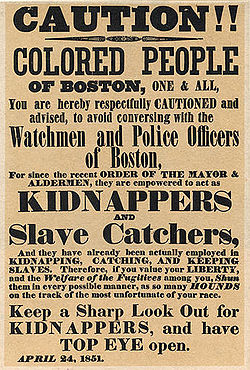
 Rand Paul attacks the Civil Rights Act because it interfered with Private Property. Slaves were considered Private Property, and thus came to be the most evil law passed in Congress, the Fugitive Slave Act. When democratic folks up North refused to comply, Southerners wanted them arrested.
Imagine if David Koresh had given sanctuary to fugitive slaves, and an armed Southern militia was sent to take back their property and arrest Koresh and his ‘Family’. Let’s say Koresh puts up such a good fight, the militia sneaks in foreign assasins to dispatch the Freedom Fighter.
Rand Paul is saying our President is acting like a king, is wanting to be a king, in regards to gun control. Soon after Rebel Traitors fired on Fort Sumter, the Bulloch ‘Family’ went to Britain and set up a gun-running operation, as well as contracting with a Monarchy to make Confederate war ships that TERRORIZED un-armed merchant vessels in the North. This is real Terrorism sponsored by foreigners loyal to the Monarch of Britain. This was done in order to keep human porperty that was more important then the Democratic Union of the United States.
Black slaves were not allowed to own guns. Does Obama and Michelle own a gun – just incase a determined crazed gun nut gets past security and wants to do harm to our First Family? I haven’t heard one of these armed Patriots swear they will protect our elected servant of the people of the United States – have you?
Now that we know the real history of these disloyal, un-patriotic Redneck Gun-loving Trailor Trash, we can confront their bullshit in the Land of the Free – whenever it appear!
Jon Presco
Naval service and European agent of Confederacy
Bulloch served in the United States Navy for 15 years before resigning his commission to join a private shipping company in 1854. When the southern states attempted to leave the Union and the Civil War began in 1861, one of the first acts of Washington was to begin a strangling Federal naval blockade on the Confederacy. In April 1861 while his ship was in New Orleans, he offered to assist the Confederate States of America, when he returned to New York, he found a letter from Confederate Attorney General Judah P. Benjamin accepting his offer and ordering him to Montgomery, Georgia for his assignment. Bulloch soon became a Confederate secret service agent and their “most dangerous man” in Europe according to Union State Department officials.[3]
In less than two months after the attack on Fort Sumter, Bulloch arrived at Liverpool, England, and established a base of operations there. Britain was officially neutral in the conflict between North and South, but private and public sentiment favored the Confederacy. Britain was also willing to buy all the cotton that could be smuggled past the Union blockade, which provided the South with its only real source of hard currency. Bulloch established a relationship with the shipping firm of Fraser & Trenholm to buy and sell Confederate cotton; Fraser Trenholm became, in effect, the Confederacy’s international bankers. Bulloch arranged for the construction and secret purchase of the commerce raider CSS Alabama as well as many of the blockade runners that acted as the Confederacy’s commercial lifeline. Bulloch arranged for cotton to be converted to hard currency, which he used to purchase war material including arms and ammunition, uniforms, and other supplies. Bulloch also arranged for the construction of the CSS Florida and with the Alabama, these two ships were destined to prey upon the Union’s merchant shipping. James’ brother, Irvine, would serve and fight on the CSS Alabama. James also purchased a large quantity of naval supplies. Next, realizing that he must arrange for a steady flow of new funds before he could go much farther with his purchasing program and also prompted by the fact that the materiel of war that he had already acquired would be useless to the Confederate cause as long as it remained in England—he decided to buy a steamship (the SS Fingal which was later renamed the CSS Atlanta), to fill it with the ordnance that he and an agent of the Southern War Department had accumulated, and to take her to America. Bulloch returned to England and continued his business relationship with Fraser & Trenholm in Liverpool. Bulloch was also involved in constructing and acquiring a number of other warships and blockade runners for the Confederacy, including purchase of the Sea King which was renamed the CSS Shenandoah. Bulloch instructed Captain James Iredell Waddell to sail “into the seas and among the islands frequented by the great American whaling fleet, a source of abundant wealth to our enemies and a nursery for their seamen. It is hoped that you may be able to greatly damage and disperse that fleet.” [4] The CSS Shenandoah fired the last shots of the war on 28 June 1865 during a raid on American whalers in the Bering Sea.
http://www.firearmsandliberty.com/cramer.racism.html
The historical record provides compelling evidence that racism underlies gun control laws — and not in any subtle way. Throughout much of American history, gun control was openly stated as a method for keeping blacks and Hispanics “in their place,” and to quiet the racial fears of whites. This paper is intended to provide a brief summary of this unholy alliance of gun control and racism, and to suggest that gun control laws should be regarded as “suspect ideas,” analogous to the “suspect classifications” theory of discrimination already part of the American legal system.
Racist arms laws predate the establishment of the United States. Starting in 1751, the French Black Code required Louisiana colonists to stop any blacks, and if necessary, beat “any black carrying any potential weapon, such as a cane.” If a black refused to stop on demand, and was on horseback, the colonist was authorized to “shoot to kill.” [1] Slave possession of firearms was a necessity at times in a frontier society, yet laws continued to be passed in an attempt to prohibit slaves or free blacks from possessing firearms, except under very restrictively controlled conditions. [2] Similarly, in the sixteenth century the colony of New Spain, terrified of black slave revolts, prohibited all blacks, free and slave, from carrying arms. [3]
See also: Blockade runners of the American Civil War
[edit] Confederate Secret Service OperationsFrom his base in Great Britain, Bulloch was the financier of covert Confederate naval operations within the British Empire. This aspect of his intelligence operations has eluded the many analysts and historians who have studied the Canadian elements of the conspiracy to assassinate President Lincoln. In late 1864, Confederate Secretary of the Navy Stephen Mallory ordered Bulloch to write a check drawn on “secret funds” to Patrick Martin, a Confederate blockade runner operating from Canada. These funds were intended to support the plot to kidnap Abraham Lincoln. Martin’s project later morphed into the successful assassination plot. Captain Martin and his ship were lost in a storm in December 1864, as he was en route to Maryland with supplies for John Wilkes Booth. When John Surratt, the last surviving member of the Lincoln assassination conspiracy, arrived in Liverpool in 1865, there is no evidence they made contact, but Bulloch had to maintain a very low profile.[5]
“I’m against having a king,” Sen. Rand Paul (R-Kentucky) said in an interview with CBN News. “I think having a monarch is what we fought the American Revolution over and someone who wants to bypass the Constitution, bypass Congress — that’s someone who wants to act like a king or a monarch.”
“I’ve been opposed to executive orders, even with Republican presidents. But one that wants to infringe on the Second Amendment, we will fight tooth and nail,” he continued.
The Civil Rights Act of 1964 (Pub.L. 88-352, 78 Stat. 241, enacted July 2, 1964) was a landmark piece of legislation in the United States[1] that outlawed major forms of discrimination against racial, ethnic, national and religious minorities, and women.[2] It ended unequal application of voter registration requirements and racial segregation in schools, at the workplace and by facilities that served the general public (“public accommodations”).
Powers given to enforce the act were initially weak, but were supplemented during later years. Congress asserted its authority to legislate under several different parts of the United States Constitution, principally its power to regulate interstate commerce under Article One (section 8), its duty to guarantee all citizens equal protection of the laws under the Fourteenth Amendment and its duty to protect voting rights under the Fifteenth Amendment. The Act was signed into law by President Lyndon B. Johnson, who would later sign the landmark Voting Rights Act into law.
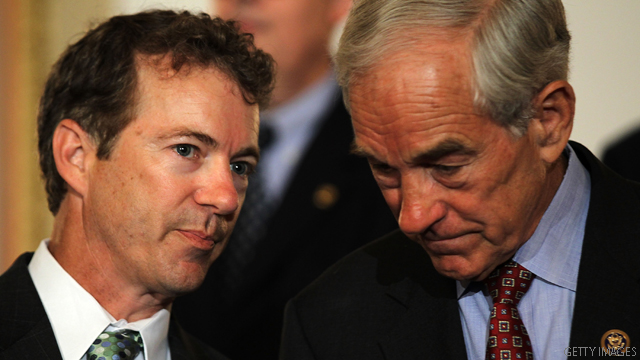
In 2004, presidential candidate Rep. Ron Paul (R-TX) voted against a resolution praising the 1964 law banning whites-only lunch counters and employment discrimination because he claimed that “the Civil Rights Act of 1964 did not improve race relations or enhance freedom. Instead, the forced integration dictated by the Civil Rights Act of 1964 increased racial tensions while diminishing individual liberty.” Ron Paul’s views were recently echoed by his son, Sen. Rand Paul (R-KY), who claimed that opposing the ban on whites-only lunch counters is the “hard part about believing in freedom.”
In an interview this morning on CNN, the younger Paul was asked to defend his father’s disregard for one of the most important legislative accomplishments in American history. His answer? Allowing private businesses to maintain a culture of virulent racism is the price we must pay in order to have cigar bars:
RAND PAUL: There are things that people were concerned about that were unintended consequences [of the Civil Rights Act], for example, people who believe very fervently in people having equal protection under the law, and are against segregation and all that, still worried about the loss of property rights…for example, I can’t have a cigar bar any more, and you say, “well, that has nothing to do with race” — the idea of whether or not you control your property, it also tells you, come in here I want to know the calorie count on that, and the calorie Nazis come in here and tell me. […] The point is that its not all about that. It’s not all about race relations, it’s about controlling property, ultimately.
The Fugitive Slave Law or Fugitive Slave Act was passed by the United States Congress on September 18, 1850, as part of the Compromise of 1850 between Southern slave-holding interests and Northern Free-Soilers. This was one of the most controversial acts of the 1850 compromise and heightened Northern fears of a “slave power conspiracy”. It declared that all runaway slaves were, upon capture, to be returned to their masters. Abolitionists nicknamed it the “Bloodhound Law” for the dogs that were used to track down runaway slaves.[1]
y 1843, several hundred slaves a year were successfully escaping to the North, making slavery an unstable institution in the border states.[2]
The earlier Fugitive Slave Act of 1793 was a Federal law which was written with the intention of enforcing Article 4, Section 2 of the United States Constitution, which required the return of runaway slaves. It sought to force the authorities in free states to return fugitive slaves to their masters.
Many Northern states wanted to circumvent the Fugitive Slave Act. Some jurisdictions passed “personal liberty laws”, mandating a jury trial before alleged fugitive slaves could be moved and others forbade the use of local jails or the assistance of state officials in the arrest or return of alleged fugitive slaves. In some cases, juries refused to convict individuals who had been indicted under the Federal law.
The Missouri Supreme Court routinely held that voluntary transportation of slaves into free states, with the intent of residing there permanently or definitely, automatically made them free.[3] The Fugitive Slave Law dealt with slaves who went into free states without their master’s consent. The U.S. Supreme Court ruled, in Prigg v. Pennsylvania (1842), that states did not have to offer aid in the hunting or recapture of slaves, greatly weakening the law of 1793.
After 1840, the black population of rural Cass County, Michigan, grew rapidly as families were attracted by white defiance of discriminatory laws, by numerous highly supportive Quakers, and by low-priced land. Free and runaway blacks found Cass County a haven. Their good fortune attracted the attention of southern slaveholders. In 1847 and 1849, planters from Bourbon and Boone Counties in northern Kentucky led raids into Cass County to recapture runaway slaves. The raids failed of their objective but strengthened Southern demands for passage of the Fugitive Slave Act in 1850.[4]
[edit] New law
Slavery
Contemporary slavery
Africa
Bangladesh
China
Europe
India
Mali
Mauritania
North Korea
Pakistan
Sudan
United States
Types
Bride-buying
Child labour
Debt bondage
Human trafficking
Peonage
Penal labour
Sexual slavery
Sweatshop
Wage slavery
Historic
History
Antiquity
Aztec
Ancient Greece
Rome
Medieval Europe
Thrall
Kholop
Serfdom
Slave ship
Slave raiding
Blackbirding
Galley slave
Panyarring
By country or region
Africa
Atlantic
Arab
Barbary Pirates
Spanish New World
Angola
Bhutan
Brazil
Britain and Ireland
British Virgin Islands
Canada
China
India
Iran
Japan
Libya
Ottoman empire
Portugal
Romania
Seychelles
Somalia
South Africa
Sweden
United States
Religion
The Bible
Judaism
Christianity
Islam
Related topics
Abolitionism
Exploitation
Indentured servant
Unfree labour
v
t
e
In response to the weakening of the original fugitive slave act, the Fugitive Slave Law of 1850 made any Federal marshal or other official who did not arrest an alleged runaway slave liable to a fine of $1,000 (About $26,600 in USD as of 2011). Law-enforcement officials everywhere now had a duty to arrest anyone suspected of being a runaway slave on no more evidence than a claimant’s sworn testimony of ownership. The suspected slave could not ask for a jury trial or testify on his or her own behalf. In addition, any person aiding a runaway slave by providing food or shelter was subject to six months’ imprisonment and a $1,000 fine. Officers who captured a fugitive slave were entitled to a bonus or promotion for their work. Slave owners only needed to supply an affidavit to a Federal marshal to capture an escaped slave. Since any suspected slave was not eligible for a trial this led to many free blacks being conscripted into slavery as they had no rights in court and could not defend themselves against accusations.[5]
[edit] Nullification
In 1854, the Wisconsin Supreme Court became the only state high court to declare the Fugitive Slave Act unconstitutional, as a result of a case involving fugitive slave Joshua Glover, and Sherman Booth, who led efforts that thwarted Glover’s recapture. Ultimately, in 1859 in Ableman v. Booth the U.S. Supreme Court overruled the state court.[6]
In November 1850, the Vermont legislature approved the “Habeas Corpus Law,” requiring Vermont judicial and law enforcement officials to assist captured fugitive slaves. This law rendered the federal Fugitive Slave Act effectively unenforceable in Vermont and caused a storm of controversy nationally because it was a “nullification” of federal law, a concept that had become highly charged in debates over slavery. The famous poet and abolitionist John Greenleaf Whittier had called for such laws and the Whittier controversy heightened angry pro-slavery reactions to the Vermont law. Virginia governor John B. Floyd warned that nullification could push the South toward secession, while President Millard Fillmore threatened to use the army to enforce the Fugitive Slave Act in Vermont. No actual events followed in Vermont, but the rhetoric of this flare-up echoed South Carolina’s 1832 nullification crisis and in Thomas Jefferson’s 1798 Kentucky Resolutions.[7]
The newly formed Confederate States was not officially recognized by the various foreign powers, a situation that led the seceded states to seek the aid of various private shipping companies and other businesses. To handle its important supply dealings and various business affairs the Confederacy turned to John Fraser & Company, a well known and respected Charleston based importing and exporting company which was well connected in England, France and elsewhere. Established in 1835, John Fraser (Sr.) turned the business over to his son, John Augustus Fraser and his senior partner George Alfred Trenholm who would later become Confederate Secretary of the Treasury.[28] The company operated out of Liverpool and New York. By 1860 the company had five seagoing vessels, among them the Kate, the Cecil and the Herald,[29] making shipping runs from Liverpool to New York and Charleston and back again. When the southern states seceded from the Union it opened the door to even greater business and in little time nearly all of their business was with the Confederate states.[30] The firm of Fraser, Trenholm and Company in Liverpool became the common connection for the Confederacy’s naval and financial institutions in Europe.[31]
Prior to the actual battles of the war John Fraser & Company had already begun negotiations for steamship service between England and points along the southern coast of the Confederacy. Taking advantage of the fact that neither side was fully prepared for war Trenholm and his partners began shipping arms from Liverpool and New York to Charleston. The state of South Carolina was the buyer for these first shipments which in turn sold them to the Confederacy for a substantial profit.[32]
Before war broke out military arms for the Confederacy were in short supply. There was also little gunpowder stored among the seceded states and the availability of fuses and percussion caps was also in very limited supply, the caps in the south amounting to only a half a million. There was no machine to produce them in any of the Confederate States. Powder supplies in Florida were so low that in April 1861 General John B. Grayson warned Jefferson Davis in Richmond:
“As sure as the sun rises, unless cannon powder, etc, be sent to Florida in the next
thirty days, she will fall into the hands of the North. Nothing human can prevent it.”
The same urgent demand for military ordnance and supplies was dispatched to Richmond from every military center throughout the south. Because of the incursions of the Union Army the Confederate navy was also in very short supply of coal, the only sources being located in North Carolina and Alabama.[33]
At this time the Confederate government depended almost entirely on privately owned blockade runners. However the Confederacy had enough foresight to realize that it needed its own vessels bringing in supplies. Acting for the Confederate Navy Department James Bulloch began procuring vessels in Europe, most notably the Fingal which made its famous run into Savannah carrying 10 thousand Enfield rifles, 1 million cartridges, 2 million percussion caps, 400 barrels of powder along with swords, revolvers and other military supplies.[34]
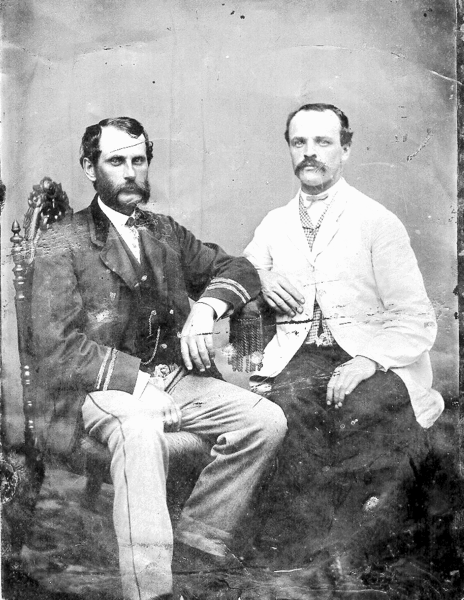
James Dunwoody Bulloch (25 June 1823 – 7 January 1901)[1] was the Confederate States of America’s chief foreign agent in Great Britain during the American Civil War. He was the half-brother of a distinguished Confederate naval officer, Irvine Bulloch and of Martha “Mittie” Bulloch Roosevelt. Mittie was the mother of future U.S. President Theodore Roosevelt and the grandmother of Eleanor Roosevelt.
James Dunwoody Bulloch, the half-brother of the a notable CSA officer, Irvine Bulloch, was the Confederacy’s chief foreign agent in Great Britain. Inside two months after the attack on Fort Sumter, Bulloch arrived at Liverpool where he established his base of operations. As his first order of business he made contact with Confederate Commissioners the Hon. William Yancy and the Hon. Dudly Mann in London. After being welcomed they discussed the diplomatic situation as they had not been officially received by the British Secretary of State for Foreign Affairs as the Confederate government had not permanently established themselves as an independent foreign power.[42] Bulloch then established a relationship with the shipping firm of Fraser & Trenholm where he arranged a conference with Fraser-Trenholm officials who were the designated financial agents of the new Confederate government.[43] They arranged the buying and selling of cotton and were ultimately responsible for shipping approximately seven-eights of all the cotton exported from the Confederate States during the war.[44] Bulloch also arranged for the building and purchase of the Florida, the Alabama and the Shenandoah. He also commissioned a shipbuilder in France to construct the Stonewall, an armored ram.[45]
Nugent is a strong advocate of the right to bear arms. When interviewed by Texas Monthly editor Evan Smith in season 5 of TexasMonthlyTalks he said, “I would rather that [a victim of violent crime] in Massachusetts last month who was taking her daughter to soccer when they were carjacked by a recidivist maggot, who had been in the prison system all his life but was let out again because we feel sorry for him, maybe he had a bad childhood. Instead of her being hijacked and murdered, I’d rather she just shot the bastard dead… But in Massachusetts, somebody decided she can’t do that. So she’s dead. I would rather she was alive and the carjacker was dead.”[32]
Nugent currently serves on the Board of Directors of the National Rifle Association (NRA).[33][34]
 Rosamond Press
Leave a comment