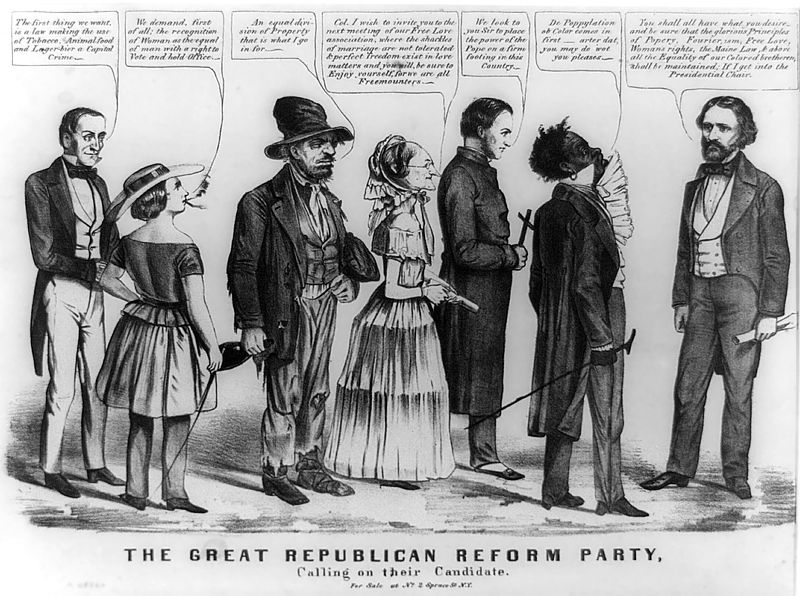
 The true Republican Party needs a fresh start. What went wrong for the Republican party was that they claimed much history they had no right to – including Biblical History. They ranted and raved that God was speaking through them, but, their God turned out to be a Flip-Flopper with nothing to say. Their god was all things to all Republican Men – and nothing to a Democratic! To behold a modern day political party peddle such HOG WASH – was frightening to sane folks all over the world!
Let us look the founders of the Republican Party, the Fremonts, who had roots in European thinking. Jessie and John were leaders in the new age of enlightenment that was heading West. Indeed, there is evidence the Fremonts were prepared to found Western America if the Confederacy won the war, and fight on a new frontier.
When you look at the voting map of America, you are looking at what the Fremont’s saw – a Red Menace creeping its way West.
The red states that went for Romney are very rural. Here is where the evangelical suburbanite, dwell, they dressed like farmers and cowboys as they claim they are the salt of the earth. Being stupid, is a badge of honor for them.
Senator Thomas Hart Benton, the author of’Manifest Destiny’ sent his daughter, Jessie, to Europe to be educated, so our young nation out west can take on the minions of European Kings who had a foothold in Oregon and Mexico.
The Tea Party Traitorship claims fellow Americans are the real enemy, but, they were in need of a mirror to see this was true! To declare war on women, was beyond stupid.
Jon
The United States of Jessie Benton Fremont: Corresponding with the Nation
Susan Lee Johnson
From: Reviews in American History
Volume 23, Number 2, June 1995
In 1899, Jessie Benton Frémont wrote from Los Angeles to Theodore Roosevelt, then governor of New York State: “You are an inspiration. I am very, very much pleased with you, if you will allow me to say so — at seventy-six one speaks. You are my typical American in everything.” Jessie was writing to the governor on behalf of a California businessman who had proposed building an arch to honor a Spanish American War hero. She described the businessman’s skill “in initiating good work,” explaining that he had promoted a similar tribute to her late husband (which took shape as the Frémont Gate in Los Angeles’s Elysian Park). Jessie concluded her recommendation on an imperious note; “Consider him introduced by me, I know I am among the more favored of nations.” From there she went on to write of her son, John Charles Frémont, Jr., who as supervisor of New York harbor had called Roosevelt’s attention to pollution there. Jessie was delighted by her son’s contact with the governor: “I am so glad of everything that brings my son into relations with you” (pp. 554-55). It was in this context, then, that Jessie offered Roosevelt her vote of confidence.
In this brief letter of no more than 250 words, Jessie Benton Frémont enacted again several of the dramas that gave her life purpose, direction, and meaning — dramas that, by their repetition, created a rather remarkable historical subject. While Jessie asked for Roosevelt’s indulgence as she penned her praises and attributed her boldness to age, in fact she had been addressing powerful men boldly for a half century. In this instance, she wrote on behalf of one man who was promoting the memorialization of another. But she also used the occasion to remind the governor of her own son, ambitious naval officer and namesake of the husband whom she had devoted the better part of her life to promoting and protecting. Then, too, in firing off a letter from California to New York and in addressing a northeastern politician known for his love of the West and his imperial visions of Anglo-America, Jessie drew on a lifetime of experience. As the daughter of a man whose name was synonymous with westward expansion, Jessie was schooled from childhood at mediating between the power that emanated from the East and the national promise embodied by the West. And as the wife of a man who was not only a western explorer but a player in national politics and an eager parson who lined his pockets by marrying eastern capital to western resources, Jessie’s lessons in the geography of power were ongoing.
But perhaps what is most striking in Jessie’s letter to the man who in two years would be president is her deep identification with the project of nation-building and nation-being. Hence, she introduces her friend to Theodore Roosevelt with the self-knowledge, “I know I am among the more favored of nations.” She grants Roosevelt her approval for all he represents in overtly possessive language, “You are my typical American in everything.” By what process did a white American woman of privilege in the nineteenth century arrive at such a sense of self, such a sense of nation?
These are among the questions raised by the publication of a wonderful collection of 271 letters written by Jessie Benton Frémont over a period of sixty-three years. Edited by Pamela Herr, a biographer of Jessie Benton Frémont, and Mary Lee Spence, historian and editor of a multivolume collection of documents relating to the western explorations of John Charles…
PARENTAGE AND EARLY YEARS
When John Charles Fremont was born, 21 January 1813, his
parents already had scandalized their community and moved away
in disgrace. The fact that they never married was to plague Fremont
all his life, but particularly during the presidential race of 1856
^ The poem is in the library of the Southwest Museum, Los Angeles, and
Jessie’s quotation is from a draft manuscript, “Great Events during the Life
of Major General John C. Fremont,” Bancroft Library, Berkeley. Hereafter,
libraries and other repositories will be referred to by the symbols used in the
National Union Catalog of the Library of Congress (see listing on pp.
xliii-xliv).
xxi
when the word “illegitimate” came frequently to the lips of his
political enemies.
The father was Charles Fremon, a Frenchman from the neigh-
borhood of Lyons, said to have made his way to Virginia from Santo
Domingo. One biographer says he was on his way to join an aunt in
Santo Domingo, about 1800, when he was captured by an English
man-of-war and held prisoner for a few years.^ Exactly when Fre-
mon came to Virginia is not known, but by the spring of 1808 he
seems to have been teaching French in the fashionable academy
operated by L. H. Girardin and David Doyle, near Richmond.
When he was dismissed after a year on the grounds that he was not
a fit person to give instruction to young ladies, he opened a night
school for the French language and tutored in private homes. He
later rejoined Girardin at a new location.^
By this time he had rented a small house from John Pryor and
had soon alienated the affections of Mrs. Pryor, the former Ann
Beverly Whiting, who was a good deal younger than her husband.
One source says the two lovers actually hoped for Pryor’s death so
that they might marry. Richmond society was rocked by the scandal
^ BiGELow, 11-12. This 1856 campaign biography was prepared from ma-
terial assembled by Jessie. Some of the problems she encountered, particularly
with regard to JCF’s mother, are reflected in letters to Elizabeth Blair Lee,
2 July [1856], and to John Bigelow, 7 July [1856], in the Blair-Lee Papers,
NjP, and Bigelow Collection, NN. Pierre-Georges Roy, a Canadian archivist,
believes that JCF’s father was actually Louis-Rene Fremont of Quebec, who
established himself in Virginia. See roy [1] and [2]. It is not clear when the
“t” was added to the name; in early newspaper advertisements the father’s
name is “Fremon.” In fact, receipts for French and dancing lessons in the
Wayne-Stites Anderson Papers, GHi, are signed “Jean Charles Fremon”
though Charles Fremon seems to have been the common form. Young Fre-
mont was variously called “J.C.,” “J. Charles,” or “Charles” in his early years.
He did not begin to use the accented form of “Fremont” until he began his
association with the French scientist Joseph N. Nicollet.
^ In an advertisement in the Richmond Enquirer of 8 March 1808, Girardin
mentions “a well-qualified native of France” as his assistant. Moncure Robin-
son (1802-91), an eminent engineer, claimed that he studied French under
Charles Fremon at the College of William and Mary (osborne). It is more
likely that he studied under Fremon at Girardin’s academy, which he at-
tended — as did also Thomas Jefferson’s grandson, T. Jefferson Randolph. For
Fremon’s dismissal, see letter of David Doyle to L. H. Girardin in the Vir-
ginia Patriot, 23 Aug. 1811. For Fremon’s proprietorship of his own school
and his reaffiliation with Girardin, see advertisements in the Richmond En-
quirer, 24, 27, and 31 Oct. and 10 and 14 Nov. 1809; 12 June, -27 July, and 11
Sept. 1810.
xxii
in July 1811. Girardin and his current partner, John Wood, lost their
academy and feuded publicly over the responsibility for the hiring
of Fremon. Finally Mrs. Pryor left her husband’s bed and board
and went with Fremon to Williamsburg, Norfolk, and then Charles-
ton.
In a divorce petition some months later, Pryor charged that his
wife had left the house voluntarily. But Ann wrote her brother-in-
law that she had been “turned out of doors at night and in an ap-
proaching storm” and threatened with “the most cruel and violent
treatment” if she remained in the house. She also wrote that she and
Fremon were poor, “but we can be content with little, for I have
found that happiness consists not in riches.” Pryor’s intention of
applying to the Virginia legislature for a divorce was widely circu-
lated, and of course Ann hoped that he would succeed. But the
House of Delegates rejected the petition 13 December 1811 without
giving a reason.’*
By the fall of 1811, the Fremons, as we shall now call the pair
although apparently they were never able to marry, were in Savan-
nah, Ga. During the next year Charles tried a number of ways to
make ends meet: he gave French lessons, worked in a dancing
academy, took in boarders, opened his own dancing school, gave
cotillion parties, and opened a livery stable at his residence.
So it was that John Charles Fremont was born into a nomadic
^ John Pryor was a veteran officer of the Revolution who kept livery stables
in Richmond and gave the city its first amusement resort, Haymarket Gar-
dens. In 1811, he was “far advanced in years,” according to his divorce
petition, and bigelow, 20, says he was sixty-two when he married seventeen-
year-old Ann Whiting in 1796. But he was vigorous enough to take the field
against the British in 1813, and did not die until 1823 (Richmond Enquirer,
9 Feb. 1813, and p. c. clark). Ann Beverly Whiting was the daughter of
the wealthy Thomas Whiting, a burgess for Gloucester in 1775-76, and
Elizabeth Sewell. She was born shortly before the death of her father, whose
will was dated 15 Oct. 1780. In 1796, with her “full consent” and that of her
stepfather and guardian, Maj. Samuel Carey, she was married to Pryor. See
BIGELOW, 13-20, and Pryor’s manuscript petition for divorce of 1 Dec. 1811,
Vi. For further details of the elopement and attempted divorce, see letter of
John Wood to the public, Virginia Patriot, 26 July 1811; letter of David
Doyle to Girardin, Patriot, 23 Aug. 1811; advertisements by Wood and
Girardin regarding their separation, Richmond Enquirer, 12 and 16 July
1811. No surviving copy has been found of a twenty-eight-page pamphlet pub-
lished by Girardin, “pregnant with calumny and slander” according to Wood.
Ann’s letter to John Lowry, 28 Aug. 1811, was abstracted by Pryor in support
of his divorce petition. For the negative decision on the divorce, see Journal
of the Virginia House of Delegates, 181 1-12.
xxiii
family of unstable finances on 21 January 1813. His nurse was Han-
nah, a family slave who had apparently been recovered after run-
ning away the previous year. We know little about the next few
years in the life of the family. They left Savannah, and a daughter,
who died in infancy, was born in Nashville in 1814. From there the
Fremons apparently wandered to Norfolk, where a second daugh-
ter and a second son were born in 1815 and 1817. After Charles
Fremon died in 1818, his widow and her small children stayed for
a time in Virginia, and John Charles received his first schooling
there. They were in Charleston by 1823, and in 1826 young John
Charles had entered the law office of John W. Mitchell. Gone now
was the family hope that he would become an Episcopal minister,
though in June 1827 he was confirmed in St. Paul’s Church by
Bishop Bowen for St. Philip’s congregation.^
The earliest Fremont document which has come to our attention
derives from his service with attorney Mitchell. It is a subpoena
issued by Mitchell to several persons and given to sixteen-year-old
John Charles to serve. An endorsement on the reverse side reads:
J. C. Fremont being duly sworn deponeth that he served on the
within named witnesses personally this writ & gave them tickets —
except the witness Alphy Berney whom he could not find.
Sworn to before me 14 July 1828 J. Charles Fremont
J. W. Mitchell”
^ For sparse information about the Fremons during this period, see ad-
vertisements in the Columbian Museum & Savannah Advertiser, 3 Oct. 1811,
and in the Republican and Savannah Evening Ledger, 7 Dec, 1811; 2 Jan.
and 31 Oct. 1812; 13 Feb. 1813. The assumption that the Fremons never
married is based on the fact that Pryor did not die until 1823, five years
after Fremon’s death. There is no record that Pryor ever received his divorce.
The MEMOIRS and bigelow do not mention the birth of a child named Ann in
Nashville, but see roy [1]. bigelow indicates that the youngest daughter (and
for him the only daughter) was born in Nashville. He does not name her or
the younger son. roy gives their names as Elizabeth and Thomas-Archibald,
but JCF’s letter to his mother on 8 June 1838 (our Doc. No. 3) refers to
“Frank,” presumably his brother.
A chronology of JCF’s life in the New York Times, 21 July 1856, puts him
in school in Virginia in 1820, in school in Charleston in 1823, and in Mitch-
ell’s law office in 1826. His confirmation in St. Paul’s is substantiated by rec-
ords inspected for us 6 Oct. 1966 by Sam T. Cobb, rector of St. Philip’s.
^ Subpoena of 10 July 1828, in Mitchell’s hand, with JCF’s signature on the
endorsement, lU.
XXIV
Mitchell apparently concluded that the pulpit, rather than the
bar, might be the better profession for John Charles after all, and
took him to the school of J. Roberton, who prepared boys for the
College of Charleston. It is from Roberton that we have our first
description of the youth. If the memory of an elderly scholar some
twenty-three years later can be relied upon, he was a boy of medium
size, “graceful in manners, rather slender, but well formed, and
upon the whole, what I would call handsome; of a keen, piercing
eye, and a noble forehead seemingly the very seat of genius.” To
Roberton’s astonishment, Fremont within a year had read Caesar,
Nepos, Sallust, six books of Virgil, nearly all of Horace, two books of
Livy, Graeca Minora, part of Graeca Majora, and four books of
Homer’s Iliad. He also made much progress in mathematics.”^
Fremont, who seems to have continued working in Mitchell’s law
office while reading the classics and doing his calculations, entered
the junior class in the College of Charleston in May 1829. The col-
lege records for 1830 list him as Charles or C. J. Fremont in the
Scientific Department. The records also show that he was away dur-
ing the first three months of 1830, “teaching in the country by
permission.” He resumed his studies in April, but as the year ad-
vanced his absences became frequent as he spent more and more
time with a Creole family who had a beguiling, black-eyed daughter
named Cecilia. He had fallen deeply in love, and though the college
faculty was patient because of his recent good scholarship and his
abundant promise, he was finally dismissed 5 February 1831 for
“incorrigible negligence.” He missed graduation by three months.
But about five years later he applied to the trustees for a B.A. degree
and his request was granted.^
That his career seemed in jeopardy was of little concern; he
treated the period of freedom from studies as a holiday: “The days
■^ROBERTON, 3-5. He does not mention JCF by name but the identity of
the student is almost certain; Roberton is quoted in bigelow, the memoirs,
and in an item on JCF in the New York Times, 27 June 1856. The Benton
Papers, MoSHi, contain two letters from Jessie to Roberton, one of which
expresses the hope that he will repeat his visits to the Fremonts and another
assuring him and “his inquiring friend” that JCF was born and reared in the
Protestant Episcopal Church.
^ For JCF’s college record, see the journal of the College of Charleston,
weekly record, Jan. 1830-Feb. 1831, and for his receipt of the B.A. degree,
the journal of the proceedings of the trustees, 19 March 1838, p. 263. One of
the trustees of the college when JCF received his belated degree was his
friend Joel Poinsett (easterby, 261).
XXV
went by on wings. In the summer we [Fremont and the two boys
in the Creole family] ranged about in the woods, or on the now
historic islands, gunning or picnicking, the girls dangerously near
the breakers on the bar. I remember as in a picture, seeing the
beads of perspiration on the forehead of my friend Henry as he
tugged frantically at his oar when we had found ourselves one
day in the suck of Drunken Dick, a huge breaker that to our eyes
appeared monstrous as he threw his spray close to the boat. For us
it was really pull Dick pull Devil.”
Evenings were also spent with Cecilia and her brothers, though
occasionally he absented himself to study a work on astronomy or to
read a chronicle of men “who had made themselves famous by
brave and noble deeds, or infamous by cruel and base acts.”^
The family’s poverty would not permit Fremont too long a holi-
day. He obtained positions as a teacher of mathematics in various
schools (including John A. Wooten’s private school), and also took
charge of an “Apprentices’ Library,” a collection of books with some
added instructional facilities, and labored as a private surveyor.^”
The death of his sister Elizabeth in 1832, and the departure of his
brother to try a career on the stage, awoke John Charles to sterner
realities and ended this desultory phase of his life.
He now began to come into association with a number of dis-
tinguished men. The first to exert an influence upon his career was
Joel Poinsett (1799-1851), whose home was on the outskirts of
Charleston. Poinsett had been minister to Mexico, and now during
Fremont’s teaching days was a principal leader of the Union men of
South Carolina in the nullification controversy of 1830-32. From
him, and from Thomas Hart Benton later, Fremont imbibed the
Unionist views, as opposed to sectional interests, which remained
with him all his life. It was certainly through Poinsett’s influence,
but not with his approval, that he obtained a civilian post as teacher
of mathematics to the midshipmen on board the U.S.S. Natchez,
which had been sent to Charleston to uphold the power of the fed-
eral government to collect the tariffs declared null and void by the
state of South Carolina. When compromise averted a possible out-
break of war between the state and federal governments in April
1833, the Natchez returned to Hampton Roads. The next month,
^ The period spent by JCF with the Creole family is discussed in memoirs,
20-21.
^’^ NEViNs, 17; BENTON [2]; Ncw York Times, 21 July 1856.
xxvi
under the command of Capt. John P. Zantzinger, she sailed with
Fremont abroad for a two-year cruise in South American waters.”
Fremont, who drew $25.00 a month plus rations, maintained that
the cruise had no future bearing on his career, though he “saw more
of the principal cities and people than a traveller usually does.” The
routine of the ship, on which David G. Farragut was one of the
lieutenants, was broken by a couple of duels while the vessel was
anchored off Rio de Janeiro. In the first, one of the principals was
killed; in the other, Fremont and Decatur Hurst, the seconds, put
only powder in the pistols and then rowed the duelists across the
bay. Finding “a narrow strip of sandy beach about forty yards long
between the water and the mountain,” they positioned their men
and gave the word to fire. Of course the men remained upright and
Fremont and Hurst were able to carry them “triumphantly back to
the ship, nobody hurt and nobody wiser.”^”
In 1835, Congress provided for several professorships of mathe-
matics in the Navy at $1,200 a year. Fremont received such an ap-
pointment on 13 June 1835, with pay retroactive to 3 March. When
the Natchez docked at New York, he went home to Charleston and
wrote the following letter to Secretary of Navy Mahlon Dickerson:
It will not perhaps be unknown to you that, when the U.S. Ship Natchez
arrived at New York, I was attached to her as Professor of Mathematics.
Immediately after information of the passage of the “Navy Bill” had been
received on the Brazilian Station, I received from Commodore James
Renshaw — to whose ship the Natchez, I had been attached as School-
master from the commencement of her cruise — an appointment as “Pro-
fessor of Mathematics in the Navy of the United States,” bearing date
June 13th 1835. Desirous of being again ordered to sea, I am somewhat
at a loss to know if you will deem the above circumstances sufficient for
that purpose, or whether references, with testimonials of character and
qualifications, will be thought previously requisite. Should such be the
case, I shall be happy to forward them to the Department, immediately
on receiving a notification to that effect. I should, however, suppose that
the fact of having been appointed to my station by Commodore Renshaw
11 DNA-45, muster roll of the U.S.S. Natchez, 1833-35, p. 68.
12 See MEMOIRS, 23. JCF says that Decatur Hurst was a nephew of Com-
modore Stephen Decatur and later died from wounds sustained in a duel
in Africa, callahan lists a William D. Hurst but not a Decatur Hurst. The
duelists were Robert P. Lovell, Poinsett’s nephew, and Enoch G. Parrott
(1815-79), senior officer during much of the blockade of Charleston in the
Civil War.
XXVll
will be deemed sufficient, and it may not be disadvantageous to me to
state that I received from him, when the Natchez was on the eve of
departure, an offer of being ordered to another ship of the squadron. It
being to you, Sir, a matter of indifference to what ship I am ordered, it
will not, I imagine, be considered out of rule respectfully to request that
in the event of being successful in my application, I may be attached to
the frigate United States, which vessel I understand will be shortly sent
to the Mediterranean. My situation not permitting me long to remain
unemployed, permit me to say, that, should it entirely suit your con-
venience, I would be much gratified to be favored with an early answer
to this communication.^^
Dickerson acknowledged Fremont’s request for an appointment,
saying that “When the public interest shall require the services of a
Professor of Mathematics, it will give me pleasure to recur to your
application.” Impatiently, Fremont wrote again on 16 January 1836,
sending Dickerson several enclosures including a testimonial from
Captain Zantzinger. Again Dickerson acknowledged the letter with-
out offering much hope. But in April he authorized Fremont to take
the examination for professor of mathematics, and sent him to
Baltimore for that purpose. He passed an examination conducted by
Professors Edward C. Ward and P. I. Rodriquez, who reported:
“Mr. J. C. Freemont was found qualified, & we take great pleasure in
stating that he is a gentleman whose talents will be very beneficial to
the Midshipmen of the navy.”^”*
That was in June. By October there still had been no assignment,
and again Fremont wrote to Dickerson :
Having been informed that several vessels are on the eve of sailing
from the harbors of Norfolk & New York I have thought the present a
fit opportunity respectfully to request that I may be appointed to one of
them. Should it suit your convenience to send me an appointment I
should be much gratified to find it for the Mediterranean— a wish which
I am only induced to express because I understand no selections have as
yet been made. A communication, with which I had the honor to be
favoured from yourself immediately subsequent to having passed an
examination at Bake, informs me that I shall be sent to sea as soon as my
services may be required. I should in consequence not have applied at
13 JCF to Dickerson, 31 Oct. 1835 (MeHi— Fogg Collection).
14 Dickerson to JCF, 23 April 1836, DNA-45, Gen. Lbk, 22:252; memo-
randum of the report of Ward and Rodriquez on the examination of profes-
sors of mathematics, 3 June 1836, DNA-45, Gen. Lbk, 22:331; memoirs, 23.
XXVlll
present but that I am led to believe such applications customary at the
times when ships are being fitted out for sea.^^
Dickerson annotated the letter by instructing his clerk: “Inform
him that a Professor of Mathematics is already detailed for the
North Carolina but it may be in my power in a short time to assign
you duty in a Cruising Vessel.” He struck out the words “probably in
a Ship destined to cruise on the Coast of Brazil.”
Not until 4 April 1837 did Dickerson write Fremont the long-
awaited orders to duty. “You will proceed to Boston and report to
Com. [John] Downes for duty as Professor of Mathematics on board
the U.S.S. Independence.” But a year and a half of waiting had been
too much, and the necessity of earning a living had already forced
Fremont to seek other opportunities. He declined the appointment.^
We have been able to trace in sketchy fashion Fremont’s brief
naval career. More hazy, however, is his service as a surveyor for
Captain William G. Williams of the U.S. Corps of Topographical
Engineers, who had been ordered to assist William G. McNeill in a
survey of a route for the projected Charleston, Louisville, and Cincin-
nati Railroad. This road would have done much to link the states
of the West and Northwest with those of the South. Leading
spirits in the enterprise were Fremont’s benefactor Poinsett and Rob-
ert Young Hayne, a prominent South Carolina politician who later
became president of the railroad company.
Fremont found the work congenial : “We were engaged in running
experimental lines, and the plotting of the field notes sometimes
kept us up until midnight. Our quarters were sometimes at a village
inn and more frequently at some farmer’s house, where milk and
honey and many good things were welcome to an appetite sharp-
ened by all day labor on foot and a tramp of several miles backward
and forward, morning ^and evening. . . . The summer weather in
the mountains was fine, the cool water abundant, and the streams
lined with azaleas. . . . The survey was a kind of picnic with work
enough to give it zest, and we were all sorry when it was over
J»17
i’^ JCF to Dickerson, 19 Oct. 1836, DNA-45, Misc. LR, No. 69.
i« Dickerson to JCF, 4 April 1837, DNA-45, Letters to Officers, Ships of
War, 24:33.
lUiEMoiRs, 23-24. See also J. J. Abert to W. G. Williams, 17 March 1836,
DNA-77, LS, 2:63; and the joint report of the chief and associate engineers of
the Charleston, Louisville, and Cincinnati Railroad, 7 Oct. 1837, Senate Doc.
158, 25th Cong., 2nd sess., U.S. Serial 316.
xxix
After the work on the railroad survey was suspended, Fremont
again was employed with Captain Williams as his assistant engi-
neer in the survey of the territory occupied by the Cherokee Indians.
The land lay mainly in Georgia, though some cut across into North
Carolina and Tennessee. Because the Cherokees were bitterly op-
posed to the federal government’s policy of transferring the major
tribes to the area west of the Mississippi River, the War Department
felt that a survey would aid military purposes if war broke out, or
facilitate the distribution of land among the frontiersmen if it did
not. It was a strenuous survey of forest and mountain country made
hurriedly in mid-winter, but here, Fremont wrote many years later,
“I found the path which I was ‘destined to walk.’ Through many of
the years to come the occupation of my prime of life was to be
among Indians and in waste places.”^^
In December 1837, Fremont applied for a commission in the U.S.
Corps of Topographical Engineers (Captain Williams had already
written a supporting letter). In February 1838, Williams was in-
structed to come to Washington as soon as his survey was completed
and to bring Fremont with him. In March, with the job done, Fre-
mont spent a few days in Charleston and then proceeded to Wash-
ington. His friend Poinsett, now Secretary of War, requested that the
twenty-five-year-old Fremont be assigned as a civilian assistant to
the distinguished French scientist Joseph Nicolas Nicollet, who was
about to embark upon an examination of the northern territory lying
between the Mississippi and Missouri rivers. While he was away on
the first of his two expeditions with Nicollet, Fremont’s commission
as a lieutenant in the Topographical Corps was approved.^^
From this point in Fremont’s life, the documents tell the story.
^^ MEMOIRS, 50. It is difficult to say just how long ICF worked on the
Cherokee survey in 1837-38, as the documents are few. Some of the field
notebooks in which he kept his raw surveying data are in DNA-77, and
there is one voucher which may not cover his complete service. Dated 19 April
1838, it lists payment for “Salary as Asst. Engr. in the Cherokee Nation N.C.
&c. for 43 days, viz. from the 6th March to the 18th April 1838 inclusively
at $1200.00 per annum, $141.04.” It appears to have been JCF’s final payment,
but may not have been the only one. DNA-217, Records of the Third Auditor,
Acct. No. 3649, Voucher No. 158.
^^ The foregoing summary of ICF’s early years is not intended as a com-
plete biography. For a more detailed account of this period, see nevins, 1-28.
XXX
THE DOCUMENTS AND THE PROJECT
“It is not a cheerful task, that of going over and destroying old
letters and papers, but it is better than having them get into wrong
hands. … I will be thankful when I am all through with it for it
is very hard to burn up the letters of those we love.”^^ So wrote Fre-
mont’s daughter Elizabeth in 1907 as she pillaged what was left of
her parents’ literary remains. It is an old story, and a source of an-
guish to the historian. But papers tend to survive all their natural
enemies: not only fire, flood, and mildew but the busy destructive-
ness of descendants. And so public a figure as Fremont must of
necessity lodge a great many documents in relatively safe places.
Of the mauscript materials available to the student of Fremont
and his times, most are in the National Archives and the Library of
Congress. Of the several smaller collections elsewhere, a few were
placed in the public trust by members of the family. There are, as
far as we can discern, no papers of John Charles or Jessie Benton
Fremont still in family hands, but there are many in private collec-
tions. All these sources — the public repositories and private holdings
— have been searched as thoroughly as possible for what is substan-
tial and informative. A man with as many business, political, and
military interests as Fremont could not avoid producing much trivia.
No sensible editor would undertake a complete edition of Fremont
papers. He would seize most gratefully upon every shred which
bears upon the expeditions of 1838-54, for such documents are not
plentiful. For other activities of Fremont, however, he would find it
necessary to be selective — even in regard to such vital events as the
Bear Flag Revolt.
In this series we combine unpublished manuscript materials with
Fremont’s published reports and selections from his Memoirs. The
previously published works have never been thoroughly annotated,
and the hitherto unpublished letters and documents provide much
new material for such annotation.
The published documents upon which Fremont’s reputation came
to rest in his own lifetime are here listed chronologically. Joseph N.
Nicollet’s map, but not the Report, is included, and both are dis-
-° Elizabeth Benton Fremont to Sarah McDowell Preston, 6 Aug. 1907
(KyU — Preston Family Papers).
XXXI
cussed elsewhere as a factor in Fremont’s development as an explorer
and scientific observer.
1. Northern Boundary of Missouri, H.R. Doc. 38, 27th Cong., 3rd
sess., U.S. Serial 420. A report of Fremont’s explorations of the Des
Moines River, as high as the Raccoon Fork, in 1841. The manuscript
version is used as a text in the present volume.
2. A Report on an Exploration of the Country Lying between the
Missouri River and the Rocky Mountains on the Line of the Kansas
and Great Platte Rivers, Sen. Doc. 243, 27th Cong., 3rd sess., U.S.
Serial 416.
3. Report of the Exploring Expedition to the Rocky Mountains in
the Year 1842, and to Oregon and North California in the Years
1843-44, Sen. Exec. Doc. 174, 28th Cong., 2nd sess., U.S. Serial 461.
4. Message of the President of the United States Communicating
the Proceedings of the Court Martial in the Trial of Lieutenant
Colonel Fremont, Sen. Exec. Doc. 33, 30th Cong., 1st sess., U.S.
Serial 507.
5. Geographical Memoir upon Upper California, in Illustration of
His Map of Oregon and California, Sen. Misc. Doc. 148, 30th Cong.,
1st sess., U.S. Serial 511.
6. Memoirs of My Life, vol. 1 (no others issued), Chicago and
New York, 1887. Originally published in ten parts in paper wrap-
pers.
Unfortunately the Memoirs carry the story of Fremont’s life only
to 1847 — through the conquest of California and his appointment
by Robert F. Stockton as governor of that territory. “I close the
page,” he wrote, “because my path of life led out from among the
grand and lovely features of nature, and its pure and wholesome air,
into the poisoned atmosphere and jarring circumstances of conflict
among men, made subtle and malignant by clashing interests.” The
principal events of his remaining forty-three years of life his wife
tried to chronicle, often with a view also to justifying his sometimes
controversial decisions and behavior, in “Great Events during the
Life of Major General John C. Fremont.” Intended as a sequel to the
Memoirs, the manuscript was never published.
Although the publication of the Memoirs, which draws at times
verbatim on the official Reports of his first two expeditions, was un-
doubtedly prompted by economic necessity, a book recounting his
daring and colorful achievements had long been envisioned. Theo-
dore Talbot, about to set out in 1845 on the third expedition, wrote
xxxn
to his mother that “Capt. Fremont intends pubHshing his 3 reports,
the two previous and the coming one, in one large and handsomely
illustrated volume.””^ At one time, too, according to Mrs. Fremont,
her husband and Senator Benton conceived a joint editorship of the
letters written by, to, and about Fremont from 1842 to 1854, but
many of the letters were burned in the fire that destroyed Benton’s
home in February 1855.””
Fremont had long been conscious of Baron Alexander von Hum-
boldt’s wish for “truth in representing nature,” and as early as 1842
had attempted to record his explorations photographically. On both
the first and second expeditions he had carried daguerreotype
cameras, and though he was unable to use them successfully they do
represent the first instances of the employment of a camera on west-
ern expeditions sent out by the government. Edward M, Kern accom-
panied the third expedition as an artist and on the fifth Solomon
Nunes Carvalho, an authority in the whole field of photography
and daguerreotyping, spent hours making “views.” Carvalho’s plates
survived the storms of the Sierras and the perils of an ocean voyage
and were brought back by Fremont to New York, where Mathew
Brady was engaged to copy them by the wet process so that paper
prints could be made. The paper prints, in turn, were used as copy
by artists and engravers in preparing plates to illustrate Fremont’s
proposed book; for he now entered into a contract with George
Childs of Philadelphia to bring out the journals of the various ex-
peditions as a companion book of American travel to the Arctic
journeys of Dr. Elisha Kent Kane, then being published so profitably
by the same house. The campaign of 1856 interrupted the work.^^
Soon after the election, work on the proposed book was begun
again, and Jessie wrote Ehzabeth Blair Lee: “Say to your Father that
the election looks ages back now that we are so interested in the
book and if he could see the beautiful pictures that are growing un-
der Mr. [James] Hamilton’s brush he would like us turn his back
on the ‘busy world’ & fly to the mountains on canvas.” In April she
wrote Mrs. Lee, “The book grows finely — not the text yet but the il-
lustrations and all the preparatory work.” And in May, Mrs. Blair re-
21 Theodore Talbot to Adelaide Talbot fSt. Louis], 30 May 1845 (DLC—
Talbot Papers).
22 Jessie B. Fremont to R. [U.?] Johnson, Los Angeles, 28 Aug. 1890
(James S. Copley Collection, La Jolla, Calif.).
23
MEMOIRS, XVI.
XXXlll
ceived the following note: “We are at work on the book which is
our baby and pet — the summer plans are not fairly fixed as yet, we
keep this house by the month for the convenience of having the
artists work under Mr. Fremont’s supervision. They have Lizzie’s
former bedroom & have made a grand collection of oily rags and
bad smelling bottles and paints but the results are beautiful. Frank &
Mr. Fremont grow young together over imaginary buffalo hunts
located in certain valleys which look out upon them like nature
from the canvas.”
On the same day in May she wrote Lizzie Lee, “All the astro-
nomical & tedious part of the work is now finished as far as Mr. Fre-
mont goes into it.” A bit later she wrote, “Jacob [presumably Jacob
Dodson, the Negro who had been JCF’s servant on the 1845 expedi-
tion] came on with me & I have had my pen in hand as much as
five hours & a half at a time — We finish with him today — that much
work is done.”^^
But the writing was interrupted by Fremont’s going to Califor-
nia and Jessie to Europe. After the return of both in the late fall of
1857, another attempt was made at writing, but soon all the Fre-
monts were packing for California and the Mariposa. And while
Jessie hoped “that Mr. Fremont will write as well as direct his work
there,” the book was not finished, the contract was canceled, and
George Childs had to be reimbursed for all the expenditures he had
made. The Civil War and the business schemes following it gave no
leisure for writing.
25
^^ See letters of Jessie B. Fremont to Elizabeth Blair Lee, Thursday night
[1857?], 7 April 1857, 4 May [1857?], 2 [June?] 1857, and to Mrs. Blair,
4 May 1857, all in NjP— Blair-Lee Papers.
25 Jessie B. Fremont to Elizabeth Blair Lee, 15 Dec. [1857?]. JCF gave
George Childs notes as a guaranty that he would be paid for the expenditures
on the book, and on 9 Feb. 1864 Childs sought the aid of Maj. Simon Ste-
vens to obtain an early settlement of the notes. Childs wrote, “I hope you are
arranging the Fremont matter so that I can surely get the balance next week.
Impress upon the General that it is of vital importance for me to have the
amount this month” (PPAmP). Childs eventually sold the notes to Drexels
(see George W. Childs to [Simon Stevens], Philadelphia, 20 Jan. 1865, NHi).
So common was the knowledge that Fremont was preparing a book that
Gouverneur Warren, in his Memoir to Accompany the Map of the Territory
of the United States from the Mississippi River to the Pacific Ocean, at p. 50
noted: “In press [1859] Colonel J. C. Fremont’s Explorations, prepared by
the author, and embracing all his expeditions. — Childs & Peterson, publishers.
No. 602 Arch Street, Philadelphia.”
xxxiv
Jessie Benton Fremont, from the portrait by T. Buchanan Read
Courtesy of the Southwest Museum
XXXV
When the Fremonts left for Arizona in 1878, the boxes containing
materials for the books were placed in safes below the pavement at
Morrell’s and were thus saved when fire destroyed that warehouse
and the many other Fremont treasures stored in it. In 1886, perhaps
inspired by the success of General Grant’s Personal Memoirs, work
was resumed. The Fremonts took a house in Washington so that
Mrs. Fremont could use the facilities of the Library of Congress, and
her daughter Lily typed copy. Fire at the publishers, Belford and
Clark and Co., once more threatened the book, but the plates were
not destroyed and publication was delayed only a few weeks. Com-
mercially the work was a disappointment, but after Fremont’s death,
Jessie — with the aid of her son Frank — continued what she hoped
would constitute the second volume of the Memoirs. She wrote Mrs.
George Browne, “I have such fine offers, which will complete the
General’s work, make money for Lil and give me a living object.”^^
Such is the long history of the making of the Memoirs.
In many ways, an edition of Fremont’s papers is not a documenta-
tion of the man, but rather of the events in vvhich he participated.
Occasionally we draw from the journals and letters of other partici-
pants in these events. The disastrous fourth expedition of 1848, for
example, could not be thoroughly presented in any other fashion.
And the letters of Jessie Benton Fremont are often more important
than those of her husband in illuminating the Fremont legend. In-
deed it may be said that because so many of Fremont’s letters were
composed and set to paper by Jessie, the documentary history of
these two persons is but a single subject of study.
ON THE ANNOTATION OF BOTANICAL MATTERS
The historical editor is taxed to make a meaningful contribution
to the botanical aspects of an expedition. He cannot tell the sys-
tematic botanist anything — indeed, must turn to him for counsel —
and can give little aid to the untrained reader. As a minimum, he
can attempt to give a recent scientific name, and perhaps a com-
monly accepted colloquial name, to the plants enumerated in the
text.
2^ Jessie Benton Fremont to Nell, Los Angeles, 27 Jan. 1891 (CU-B — Fre-
mont Papers).
xxxvi
Even this modest assignment becomes difficult. Taxonomists are
continually producing new combinations, referring plants to new
genera, with the result that many possibilities confront the editor
who is looking for the “correct” modern designation. The task is
made harder by the fact that collectors of an earlier day, and even
the scientists who analyzed their findings, followed no stabilized
pattern. “For want of anything better the men in the field employed
descriptive phrases or had recourse to colloquial names; misapplied
the Latin names of plants with which they were familiar to others
which to them appeared to be the same; employed Latin epithets
(at times misspelled) which subsequently, because of priority or
other rulings, came to be regarded as synonyms” (mc kelvey,
1097).
After bringing our own mediocre botanical knowledge to bear on
JCF’s narrative, we turned for expert counsel to Professor Joseph
Ewan, Tulane University, and his able research assistant, Nesta
Dunn Ewan. These two were able to solve many of the problems
that had puzzled us, and our gratitude to them is sincere and sub-
stantial. Because we turned to them while they were researching at
the Royal Botanic Gardens, Kew, England, far from such resources
as were available for the writing of Professor Ewan’s Rocky Moun-
tain Naturalists (Denver, Colo., 1950), and other works on Ameri-
can botany, our request was all the more inconvenient.
When JCF’s mention of a plant by common or scientific name is
in virtually modern terminology, we let it stand without augmenta-
tion. When a brief identification, either in brackets or in a note, will
keep the narrative going without undue intrusion, we use that de-
vice. And when a matter requires special comment, a somewhat
longer note is used. Our chief botanical aid, however, is the index.
Here we have placed every significant mention of a plant, by bino-
mial or common name, followed by the accepted modern equivalent.
Thus, when both JCF’s narrative and our running annotation fails
the reader, he may try the index.
Vernacular names are given to species when such are available, but
frequently the common name of the genus has necessarily been sub-
stituted. Plants in the montane area, especially, may have no specific
common names, and such generic names as aster, ragwort, and
goldenrod prevail.
xxxvii
EDITORIAL PROCEDURES
The Documents
The original text is followed as closely as the demands of typog-
raphy will permit, with several departures based on common sense
and the current practice of scholars. In the matter of capitalization
the original is followed, unless the writer’s intention is not clear, in
which case we resort to modern practice. Occasionally in the inter-
ests of clarity, a long, involved sentence, usually penned or dictated
by a bare literate, is broken into two sentences. Missing periods at
the ends of sentences are supplied, dashes terminating sentences are
supplanted by periods, and superfluous dashes after periods are omit-
ted. In abbreviations, raised letters are brought down and a period
supplied if modern usage calls for one. Words underscored in manu-
scripts are italicized. The complimentary closing is run in with the
preceding paragraph, and a comma is used if no other end punctua-
tion is present. The acute accent mark on the e in Fremont is sup-
plied when it appears in the document and omitted where it does
not appear, but it is used in all of our own headings and references
to Fremont, even in the pre-1838 period. It was probably Fremont’s
association with the French scientist, Joseph N. Nicollet, that
brought the accented e to the signature. Procedures for dealing with
missing or illegible words, conjectural readings, etc. are shown in
the list of symbols, pp. xliii-xliv. When in doubt as to how to proceed
in a trivial matter, modern practice is silently followed ; if the question
is more important, the situation is explained in a note.
When a related document or letter is used, that is, not one directly
to or from Fremont, extraneous portions are deleted and the deletion
is indicated by a symbol. If a manuscript contains only a brief refer-
ence to the pertinent subject, we are more likely to quote the passage
in a note to some related letter than to print it as a separate docu-
ment.
Because Jessie B. Fremont wrote and signed so many of her hus-
band’s letters, we have felt that there should be some indication of
this to the reader. Our solution to the problem is set forth in the list
of symbols.
The Notes
The first manuscript indicated is the one from which the tran-
scription has been made; other copies, if known, are listed next. If
xxxviii
endorsements or addresses are routine, their presence is merely noted,
but if they contribute useful information, they are quoted in full.
For example, see the endorsement on Fremont’s application for a
mountain howitzer for his third expedition, Vol. 1, Doc. No. 130.
Material taken from printed texts is so indicated (printed, larkin,
4:239-41), but no attempt is made to record other printed versions.
Senders, receivers, and persons referred to in the manuscripts are
briefly identified at first mention. For senders and receivers, this
identification is made in the first paragraph of the notes and no ref-
erence number is used. The reader can easily find the identification
of an individual by locating in the index the page on which he is
first mentioned.
No source is cited for the kind of biographical information to be
found in standard directories, genealogies, and similar aids.
Names of authors in small capitals are citations to sources listed
in the bibliography on pp. 807-17. This device enables us to keep
many long titles and other impedimenta out of the notes. In the case
of two or more works by the same author, a number is assigned as
in J. D. Mc DERMOTT [1]. When a published work is being discussed,
not merely cited, we often list it fully by author and title in the
notes.
To avoid the constant repetition of the Fremont names, we have
freely used the initials JCF and JBF for John Charles and Jessie.
 Rosamond Press
Leave a comment