



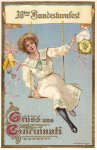


Earlier I heard exerts from Paul Ryan’s speech to his thirty million evangelical base that has found a home in the Republican party co-founded by Germans that belonged to the Turner Society, and took part in the Revolution of the Forty-Eighters who were my kindred on my father’s side.
Paul Ryan gave credit to Christian Values for making America great, but, suffragists were arrested for years in their attempt to own what men owned – THE RIGHT TO VOTE!
Black men, and black women, could not vote in America. So exactly when did the WHITE CHRISTIAN MALE begin to make America Great? Surely Christian Ministers had enough time to start an abolitionist movement in America, they spotting that terrible flaw in our Constitution. Make that two flaws!
Confederate Traitors who succeeded from the Union, listened to ministers down south give pro-slavery speeches from the pulpit. Southern women heard these anti-Christian rants, and nodded their heads in unison. But, it took FOREIGNERS – who came to America in 1848 – to Liberate America and turn it into the Land of the Free. Many of these Germans were Socialists who did not beiieve Church&King rule – was the answer. Church&King had made America great – long before 1776.
Ryan’s remarks to so callled ‘White Christian America’ were aimed at our black President and those who would vote for him. What is clear is the White Christian Man is all for folks voting in a secular matter – but only IF THEY – win! After Obama won four years ago, these White Righteous Ones were not for every American voting – and winning! I, and the world, have never seen such SORE LOSERS – who did all they could to make sure THE PRESDIENT OF UNTITED STATES FAILED IN ALL OF HIS ENDEAVORS. Why? Because evngelical End Day Doomsday Addicts want all secular answers to fail so their brand of Jesus will prove to be THE BIG WINNER! This is…………………………..INSANITY!
Yesterday, Rachel Maddow, pointed to a photo of the crowd that was cheering on Romney. There was not one black face in the crowd. Why do Republican white men see Romney as their champion? When Abraham Lincoln campaigned for President, the German Turners volunteered to be his bodyguards. These Forty-Eighters were the bodyguards for my kindred, John Fremont, and Jessie Benton Fremont. Radical Germans made Fremont their first choice for President. Fremont is in my family tree – that is a Liberty Tree!
A week ago I mailed a package off and talked with the post office guy about getting a law passed to make all Post Offices in America Government operated Voting Centers. This would keep them open, and counteract the efforts to SUPPRESS BLACK VOTERS in Ohio and other states. A few days later, my Congressman, Peter Defazion, spoke at the same post office. Pete is trying to save the Post Office.
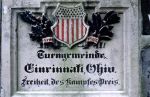
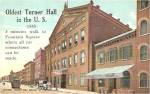
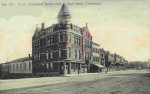
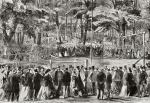
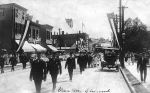
Above are photos of the Turner Halls in Ohio that had a large population of Liberal Germans who fled Europe and came to America. I told the postal clerk there should be pot belly stoves in post offices where folks can gather round, year round, and talk about coming elections, mull over the issues that concern them. That un-named billionaires can influence the American Vote employing stealth – is UN-AMERICAN!
I see Vote, Post and Trade Offices across America where folks can meet year round and empower one another with VOTING POWER vs. WHITE POWER!
Above is an ignorant ASSHOLE wearing a shirt that says; “PUT THE WHITE BACK IN WHITE HOUSE”. This stupid bubba is no doubt a Tea Party kind of guy who would also be wanting to TAKE THE MAN OUT OF WOMAN.
When you TAKE THE ASS OUT OF ASSHOLE, what you get is a bottomless black pit that spew out bigotry and ignorance that has cost the tax payers billions of dollars, and made America a disgraceful place to live. These White Holes beg this question be asked: Should white men be allowed to vote?
It has been a pleasure taking away the WHITE IDENTITY those ignorant Nascar Moonshiners have long cherished! A real pleasure!
Jon Presco
Abraham Lincoln and the German Immigrants:
Turners and Forty-Eighters
Introduction
Reporting from Springfield, Illinois, on December 9, 1860, only a matter of days after the election, Henry Villard, correspondent for the New York Herald, made a remarkable assertion about Lincoln’s election to the presidency:
In Ohio, Illinois, Indiana, Iowa, and Wisconsin, native Republicans now openly acknowledge that their victory was, if not wholly, at least to a great extent, due to the large accessions they received in the most hotly contested sections from the German ranks.
That an immigrant population should be the decisive element in a national election was unprecedented. Despite a cautious reservation (“if not wholly, at least to a great extent”), Villard offered a controversial assessment. He was saying, in effect, that Lincoln owed his success to German-Americans.* Historians since Villard have noted, on occasion, the formidable German vote for Lincoln, but assertions about its significance have been challenged. It is not surprising that the claims have been criticized or not taken at all seriously. Historians have ignored Villard’s perspective. Statistics available for the 1860 election do not provide the evidence required to corroborate Villard’s position. Are there other options? Is there a convincing test for Villard’s assertion about the German factor? Can it survive close scrutiny?
I. The Radical Turners of New York
“[Sigismund Kaufmann’s] name is indelibly linked with the history of the Turner Union and the Turner movement as one of the founders of the New York Turnverein. He was first chairman for many years. He was also one of the founders of the [national] Turner Union, whose chairman he became at that time.” [Heinrich Metzner], “Sigismund Kaufmann,” August 24, 1889
II. The Kansas Campaign
“There was in the action of those pioneers who left Boston and Worcester to settle in Kansas a moral grandeur that eclipsed anything in the history of emigration.” Eli Thayer, New York Times, August 4, 1854
“[Kansas has been] settled against the South by immigration. J. H. Stringfellow, letter to the Washington Union, January 7, 1858
“The Germans are a power here. They are Republicans and it is their right to be fairly represented in the party.” Champion Vaughan, Leavenworth Daily Times, September 4, 1858
Turners (German: Turner, gymnasts in English) are members of German-American gymnastic clubs. A German gymnastic movement was started by Turnvater (turners’ father) Friedrich Ludwig Jahn in the early 19th century when Germany was occupied by Napoleon. The Turnvereine (“gymnastic unions”) were not only athletic, but also political, reflecting their origin in similar “nationalistic gymnastic” organizations in Europe. The Turner movement in Germany was generally liberal in nature, and many Turners took part in the Revolution of 1848.[1] After its defeat, the movement was suppressed and many Turners left Germany, some emigrating to the United States. Several of these Forty-Eighters went on to become Civil War soldiers, the great majority in the Union Army, and American politicians. Besides serving as physical education, social, political and cultural organizations for German immigrants, Turners were also active in the American public education and the labor movements.[2][3][4] Eventually the German Turner movement became involved in the process leading to German unification.
he Turnvereine made an important contribution to the integration of German-Americans into their new home. The organizations continue to exist in areas of heavy German immigration, such as Iowa, Texas, Wisconsin, Indiana, Ohio, Minnesota, Missouri, Kentucky, New York City, and Los Angeles.
Together with Carl Schurz, the American Turners were supportive of the election of Abraham Lincoln as president of the United States. They provided the bodyguard at his inauguration on March 4, 1861, and at his funeral in April, 1865. In the Camp Jackson Affair, a large force of German volunteers helped prevent Confederate forces from seizing the government arsenal in St. Louis just prior to the beginning of the war.[5]
Like other German-American groups, the American Turners experienced discrimination during World War I. The German language was banned in schools and universities, and German language journals and newspapers were shut down, but the Turner societies continued to function.[2]
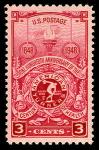
In 1948, the U.S. Post Office issued a 3-cent commemorative stamp marking the 100th anniversary of the movement in the United States.
Cultural assimilation and the two World Wars with Germany took a gradual toll on membership, with some halls closing and others becoming regular dance halls, bars or bowling alleys.[4] Fifty-four Turner societies still exist around the U.S. as of 2011. The current headquarters of the American Turners is in Louisville, Kentucky.[6]
The Turnverein, from their very beginning, were gathering places for German radical democrats. Thus, the Turners were a constant threat to the nobility and were ardent fighters for the Republic. They joined, and even started, many revolutionary uprisings in all the various German speaking countries. Their motto “Frisch, Fromm, Froehlich, Frei” (fresh, pious, merry, free) had its emphasis on the last word.
In 1848, when the German revolution took place, many of these Turnvereins were in existence. The failure of this revolution caused many Germans to immigrate to the United States. Once here the Turnvereins were quickly started with the one in Cincinnati being the first in 1848.
The most famous Turner from the Cincinnati area was President and Chief Justice of the United States William Howard Taft. Whenever President Lincoln traveled the country Turners would gather to serve as guards much like the Secret Service does today. The Turners are still going strong today, they moved out of Turner Hall on Walnut St. (see below) in the 1950s. They now are located on Pinney Lane in Springfield Township. The old Turner Hall was razed in 1972.
1. Cultural Life: The Forty-eighters contributed to a renaissance of German-American cultural life in the nineteenth century in the areas of the press, literature, theater, music, arts and crafts. In the area of education, they strongly supported German bilingual instruction, as well as physical education due to their support of public, secular educational systems.
2. Political Life: As political activities, the Forty-eighters sought to realize their ideals of humanitarianism, cosmopolitanism, liberty, justice, and education for all by means of active involvement in the political process. The Louisville Platform is a case in point, as it demonstrates two characteristics of the Forty-eighters. First, the Forty-eighters were people of principles, which had been thought out and structured into action. This was clearly evident in the 1850s and the Civil War, which need not be reviewed here. However, their role during the time of national political crisis has certainly been recognized, and was already at the time by Lincoln, who rewarded many Forty-eighters with military and political appointments.
The Forty-Eighters were Europeans who participated in or supported the socialist revolutions of 1848 that swept Europe. In Germany, the Forty-Eighters favored unification of the German people, a more democratic government, and guarantees of human rights.[1] Disappointed at the failure of the revolution to bring about the reform of the system of government in Germany or the Austrian Empire and sometimes on the government’s wanted list because of their involvement in the revolution, they gave up their old lives to try again abroad. Many emigrated to the United States, England, and Australia after the revolutions failed. They included Germans, Czechs, Hungarians, and others. Many were respected, wealthy, and well-educated; as such, they were not typical migrants. A large number went on to be very successful in their new countries.
Forty-Eighters in the USA
In the United States, many Forty-Eighters opposed nativism and slavery, in keeping with the liberal ideals that had led them to flee Germany. Several thousand enlisted in the Union Army, where they became prominent in the Civil War. In the Camp Jackson Affair, a large force of German volunteers helped prevent Confederate forces from seizing the government arsenal in St. Louis just prior to the beginning of the war.[2]
Many Forty-Eighters settled in the Texas Hill Country in the vicinity of Fredericksburg, and voted heavily against Texas’s secession. In the Bellville area of Austin County, another destination for Forty-Eighters, the German precincts voted decisively against the secession ordinance.[3]
More than 30,000 Forty-Eighters settled in the Over-the-Rhine neighborhood of Cincinnati, Ohio. There they helped define the distinct German culture of the neighborhood, but in some cases also brought a rebellious nature with them from Germany. During violent protests in 1853 and 1854, Forty-Eighters were held responsible for the killing of two law enforcement officers.[4]
In the Cincinnati Riot of 1853, in which one demonstrator was killed, Forty-Eighters violently protested the visit of the papal emissary Cardinal Gaetano Bedini, who had repressed revolutionaries in the Papal States in 1849.[5]
Many German Forty-Eighters settled in Milwaukee, Wisconsin, helping solidify that city’s progressive political bent and cultural Deutschtum. The Acht-und-vierzigers and their descendants contributed to the development of that city’s long Socialist political tradition.[6]
After the Civil War, Forty-Eighters supported improved labor laws and working conditions. They also advanced the country’s cultural and intellectual development in such fields as education, the arts, medicine, journalism, and business.
[edit] Notable German Forty-Eighters in the US
Architects, engineers, scientists: Louis Burger,[7] Adolf Cluss, Henry Flad
Artists: Friedrich Girsch;[8] Wilhelm Heine; Theodore Kaufman; Louis Prang; Henry Ulke; Adelbert John Volck
Businessmen, investment bankers: Solomon Loeb, Abraham Kuhn founders of Kuhn, Loeb & Co.
Generals in the American Civil War: Louis Blenker; Alexander Schimmelpfennig; Carl Schurz; Franz Sigel; Max Weber; August Willich; Frederick C. Salomon; Adolph von Steinwehr
Journalists, writers, publishers: Mathilde Franziska Anneke; Gustav Bloede (see Marie Bloede); Rudolf Doehn; Carl Adolph Douai; Carl Daenzer; Bernard Domschke; Christian Esselen (editor of Atlantis); Julius Fröbel; Karl Peter Heinzen; Rudolf Lexow (founder of Belletristisches Journal); Niclas Müller; Reinhold Solger;[9] Emil Praetorius; Oswald Ottendorfer; Friedrich Hassaurek;[10] Theodor Olshausen; Hermann Raster; Wilhelm Rapp;[11] Carl Heinrich Schnauffer;[12] Kaspar Beetz; Carl Dilthey; F. Raine; Heinrich Börnstein; Charles L. Bernays; Emil Rothe; Eduard Leyh;[13] George Schneider (who was also a banker); Albert Sigel;[14] Franz Umbscheiden; Edward Morwitz (who was also a physician)
Musicians: Charles Ansorge; Carl Bergmann; Otto Dresel; Herman Trost (band leader in Sherman’s army who later settled in Lexington, Kentucky, where he conducted the first band at the University of Kentucky; friend of John Philip Sousa); Carl Zerrahn
Physicians: Abraham Jacobi; Ferdinand Ludwig Herff; Herman Kiefer; Ernest Krackowizer;[15] Hans Kudlich; Wilhelm Loewe, Gustav C. E. Weber[16]
Poets: Konrad Krez;[17] Edmund Märklin; Rudolf Puchner
Political activists: Lorenz Brentano (later a member of the Congress); Friedrich Hecker; Carl Schurz (later US Secretary of the Interior); Gustav von Struve; Wilhelm Weitling; Joseph Weydemeyer; Rudolf Dulon; Edward Salomon; Louis F. Schade
Other: Margarethe Schurz (founder of the first kindergarten in the U.S.); Al Sieber (known as “Chief of the Scouts” in Arizona, who fought at Antietam, Fredericksburg, and Chancellorsville with Hecker, Schurz, and Sigel, and then in the Battle of Gettysburg); Joseph Spiegel (founder of the Spiegel Catalog); Hugo Wesendonck (founder of the Germania Life Insurance Company, now Guardian Life); Pauline Wunderlich (fought at the Dresden barricades); John Michael Maisch (father of adequate pharmaceutical legislation)
[edit] Notable Czech Forty-Eighters in the US
Prokup Hudek, one of the “Slavonic Artillerymen” of the 24th Illinois Infantry Regiment, and one of the co-founders of the Workingmen’s Party of Illinois[18]
František Korbel, winegrower in Sonoma County, California
Vojta Náprstek, Czech language publisher in Milwaukee
Hans Balatka, Moravian musician in Milwaukee and Chicago
[edit] Notable Hungarian Forty-Eighters in the US
Alexander Asboth
Charles Zagonyi
Julius Stahel
Albin Francisco Schoepf
Phineas Mendel Heilprin
Michael Heilprin
Edward R. Straznicky
Martin Koszta[19]
[edit] Notable Irish Forty-Eighters in the US
Thomas Francis Meagher[20]
John O’Mahony
Lola Montez (she fled from Bavaria via Switzerland, France and England)
[edit] Notable French Forty-Eighters in the US
Victor Prosper Considerant (also in Belgium for a time)
[edit] Forty-Eighters in England
Giuseppe Mazzini used London as a place of refuge before and after the revolutions of 1848. In the early years after the failure of the revolutions of 1848, a group of German Forty-Eighters and others met in a salon organized by Baroness Méry von Bruiningk in St. John’s Wood, England.[21] The baroness was a Russian of German descent who was sympathetic with the goals of the revolutionaries. Among the people who attended her salon, hosted by herself and her husband Ludolf August von Bruiningk, were Carl Schurz, Gottfried and Johanna Kinkel, Ferdinand Freiligrath, Alexander Herzen, Louis Blanc, Malwida von Meysenbug, Adolf Strodtmann, Johannes and Bertha Ronge, Alexander Schimmelfennig, Wilhelm Loewe-Kalbe and Heinrich Bernhard Oppenheim.[22]
Carl Schurz reports “A large number of refugees from almost all parts of the European continent had gathered in London since the year 1848, but the intercourse between the different national groups — Germans, Frenchmen, Italians, Hungarians, Poles, Russians — was confined more or less to the prominent personages. All, however, in common nourished the confident hope of a revolutionary upturning on the continent soon to come. Among the Germans there were only a few who shared this hope in a less degree. Perhaps the ablest and most important person among these was Lothar Bucher, a quiet, retiring man of great capacity and acquirements, who occupied himself with serious political studies.”[23]
Other Germans who fled to England for a time were Ludwig Bamberger,[24] Arnold Ruge, Alexandre Ledru-Rollin and Franz Sigel. Along with several of the above, Sabine Freitag also lists Gustav Adolf Techow, Eduard Meyen, Graf Oskar von Reichenbach, Josef Fickler and Amand Goegg.[25] Karl Blind became a writer in England.
Hungarian refugee Gustav Zerffi became an English citizen and worked as a historian in London. Lajos Kossuth, a Hungarian revolutionary, toured England and then the United States, and then formed a government in exile in England.
French refugees Pierre Leroux and Louis Blanc found refuge in England for a time.
FORTY-EIGHTERS. Forty-Eighters is a collective term for supporters of the European revolutions of 1848–49, which in Germany culminated in the meeting of a constitutional parliament in March 1848 and the Frankfurt National Assembly from May 1848 through June 1849. A prominent Forty-Eighter in Germany and the first president of the National Assembly was Prince Carl of Leiningenqv, a half-brother of Queen Victoria and promoter of the Adelsverein, the society which directed the settlement of New Braunfels and Fredericksburg and five other colonies. In addition to thousands of Forty-Eighters like Leiningen who stayed in Europe, about 4,000 came to the United States. Of these, at least 100 moved to Texas, where many settled in Sisterdale in Kendall County (see LATIN SETTLEMENTS OF TEXAS) and others temporarily in larger German towns and in San Antonio, before they moved on to American cultural and political centers.
In Germany, the Forty-Eighters favored unification, constitutional government, and guarantees of human rights. In Texas and elsewhere in the United States, they provided the leadership to oppose nativism and to support a continental foreign policy. They almost universally opposed slavery, some arguing for immediate emancipation, even at the price of war, and other gradualists suggesting subsidies to slave holders over a longer transition to non-slavery. Several Forty-Eighters, including Friedrich Kapp, who lived briefly in Texas, supported the new Republican party. Many were subsequently prominent during the Civil War, most as Unionists and several as military leaders, and even larger numbers took active public roles during Reconstruction. Throughout the second half of the nineteenth century Forty-Eighters in the United States supported improved labor laws and working conditions. They also advanced the country’s cultural and intellectual development in such fields as education, the arts, journalism, medicine, and business-notably insurance.
Oktoberfest in Nebraska
I’ve found four Oktoberfest festivals in Nebraska. That’s an embarrassingly low number for a state where more than 40% of the population claims German heritage. Did I miss the celebrations? Or do you just not like German beer anymore? Here’s what I found:
 Rosamond Press
Leave a comment