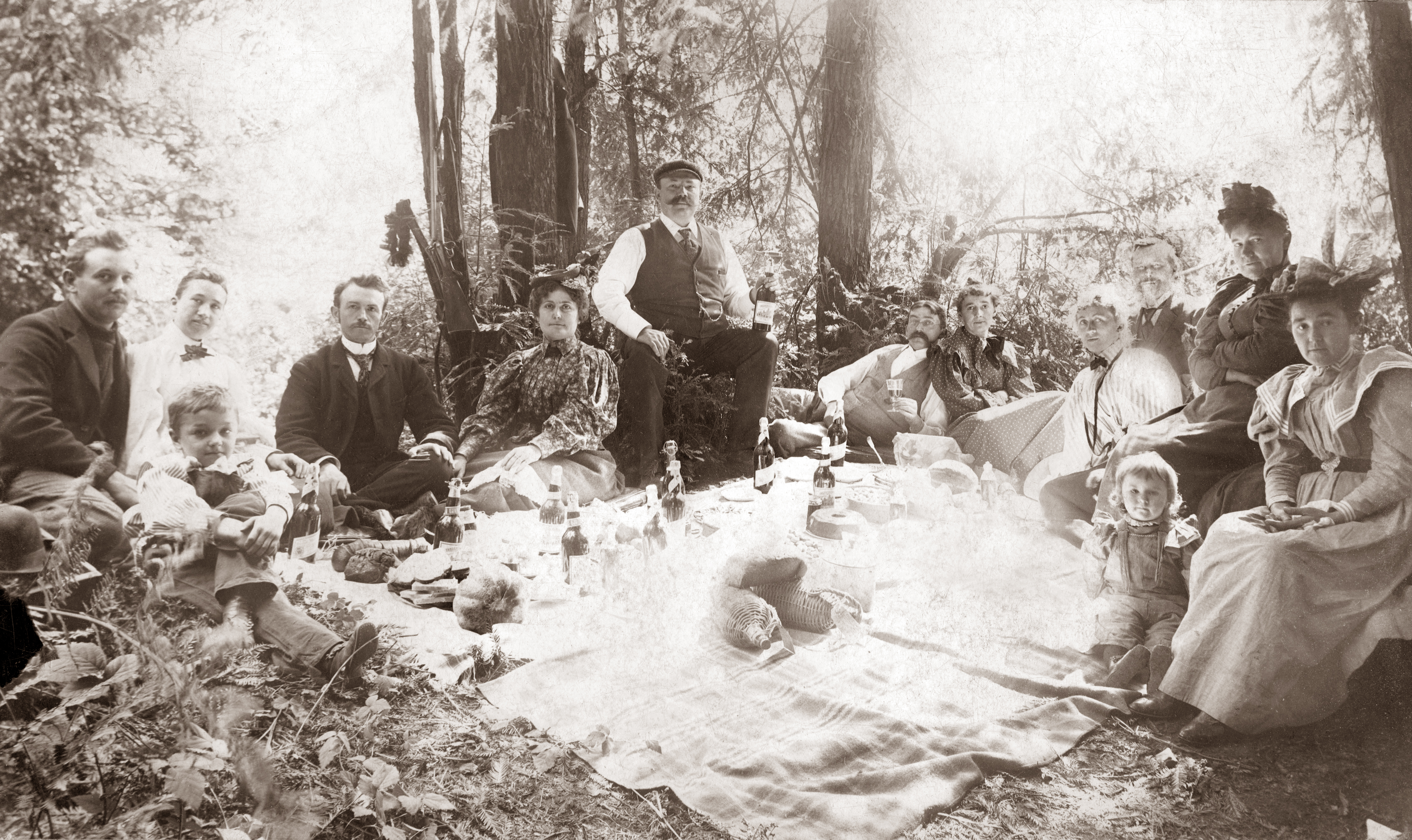
 When I asked my mother who the folks in the photo above were, she answered;
“Those are Bohunks. Your Bohemian ancestors.”
Here are Tolkeins – real folks – who have changed the world, as they were severely oppressed by those Prussian Pricks and Parasites, those lovers of war who at tax payers expence want to lounge about those all male military camps dreaming about how to fuck up other people’s shit – while kissing the ass of the ultra-rich
Here are Bohemain sanctuaries that have genernated billions of dollars in the service industry where 70% of us find employment.
My Muse beckons me to Berlin so that I may be the Hand of the Prophet across the water who will reveal the Berlin Way connection. Let there be a Bohemian Alliance.
United States
Greenwich Village, New York City [21]
North Beach, San Francisco, California
Venice Beach, California [22]
Topanga, California [23]
Carmel-by-the-Sea, California [24]
Tiburon, California [25]
Jon
Bohemianism.
Pierre-Auguste Renoir, The Bohemian (or Lise the Bohemian), 1868, oil on canvas, Berlin, Germany: Alte NationalgalerieBohemianism is the practice of an unconventional lifestyle, often in the company of like-minded people, with few permanent ties, involving musical, artistic, or literary pursuits. In this context, Bohemians may be wanderers, adventurers, or vagabonds.[citation needed]
This use of the word bohemian first appeared in the English language in the nineteenth century[1] to describe the non-traditional lifestyles of marginalized and impoverished artists, writers, journalists, musicians, and actors in major European cities. Bohemians were associated with unorthodox or anti-establishment political or social viewpoints, which often were expressed through free love, frugality, and—in some cases—voluntary poverty. A wealthy and privileged, even aristocratic, bohemian circle is sometimes referred to as the haut bohème (“high bohemians”).[citation needed]
The term Bohemianism emerged in France in the early nineteenth century when artists and creators began to concentrate in the lower-rent, lower class, gypsy neighborhoods. Bohémien was a common term for the Romani people of France, who had reached Western Europe via Bohemia.[2]
[edit] Origins[edit] European bohemianismLiterary “Bohemians” were associated in the French imagination with roving Romani people (called “bohemians” because they were believed to have arrived from Bohemia [3][4]), outsiders apart from conventional society and untroubled by its disapproval. The term carries a connotation of arcane enlightenment (the opposite of Philistines), and also carries a less frequently intended, pejorative connotation of carelessness about personal hygiene and marital fidelity. The Spanish Gypsy in the French opera “Carmen” set in Seville, is referred to as a “bohémienne” in Meilhac and Halévy’s libretto (1875).
The term Bohemian has come to be very commonly accepted in our day as the description of a certain kind of literary gypsy, no matter in what language he speaks, or what city he inhabits …. A Bohemian is simply an artist or “littérateur” who, consciously or unconsciously, secedes from conventionality in life and in art. (Westminster Review, 1862 [2])
Henri Murger’s collection of short stories “Scènes de la Vie de Bohème” (“Scenes of Bohemian Life”), published in 1845, was written to glorify and legitimize Bohemia.[5] Murger’s collection formed the basis of Giacomo Puccini’s opera La bohème (1896). Puccini’s work, in turn, became source material for Jonathan Larson’s musical Rent. Like Puccini, Larson explores a Bohemian enclave in a dense urban area, in this case, New York City at the end of the twentieth century. The show features a song, “La Vie Boheme”, which celebrates postmodern Bohemian culture.)
In English, Bohemian in this sense initially was popularized in William Makepeace Thackeray’s novel, Vanity Fair, published in 1848. Public perceptions of the alternative lifestyles supposedly led by artists were further molded by George du Maurier’s highly romanticized best-selling novel of Bohemian culture Trilby (1894). The novel outlines the fortunes of three expatriate English artists, their Irish model, and two very colorful Eastern European musicians, in the artist quarter of Paris.
In Spanish literature, the Bohemian impulse can be seen in Ramón del Valle-Inclán’s play Luces de Bohemia (Bohemian Lights), published in 1920.
In his song La Bohème, Charles Aznavour described the Bohemian lifestyle in Montmartre. The film Moulin Rouge! (2001) also reflects the Bohemian lifestyle in Montmartre at the turn of the 20th century.
[edit] American bohemianism
Bohemian Grove during the summer Hi-Jinks, circa 1911–1916In 1845, Bohemian nationals began to emigrate to the United States, and from 1848 the wave included some of the radicals and ex-priests who had wanted a constitutional government. In New York City in 1857, a group of some 15–20 young, cultured journalists flourished as self-described “Bohemians” until the American Civil War began in 1860.[6] Similar groups in other cities were broken up as well; reporters spread out to report on the conflict. During the war, correspondents began to assume the title “Bohemian”, and newspapermen in general took up the moniker. Bohemian became synonymous with newspaper writer.[6] In 1866, war correspondent Junius Henri Browne, who wrote for the New York Tribune and Harper’s Magazine, described “Bohemian” journalists such he was, as well as the few carefree women and lighthearted men he encountered during the war years.[7]
San Francisco journalist Bret Harte first wrote as “The Bohemian” in The Golden Era in 1861, with this persona taking part in many satirical doings, the lot published in his book Bohemian Papers in 1867. Harte wrote, “Bohemia has never been located geographically, but any clear day when the sun is going down, if you mount Telegraph Hill, you shall see its pleasant valleys and cloud-capped hills glittering in the West…”[8]
Mark Twain included himself and Charles Warren Stoddard in the Bohemian category in 1867.[6] By 1872, when a group of journalists and artists who gathered regularly for cultural pursuits in San Francisco were casting about for a name, the term Bohemian became the main choice, and the Bohemian Club was born.[9] Club members who were established and successful, pillars of their community, respectable family men, redefined their own form of bohemianism to include people like them who were bons vivants, sportsmen, and appreciators of the fine arts.[8] Club member and poet George Sterling responded to this redefinition:
Any good mixer of convivial habits considers he has a right to be called a Bohemian. But that is not a valid claim. There are two elements, at least, that are essential to Bohemianism. The first is devotion or addiction to one or more of the Seven Arts; the other is poverty. Other factors suggest themselves: for instance, I like to think of my Bohemians as young, as radical in their outlook on art and life; as unconventional, and, though this is debatable, as dwellers in a city large enough to have the somewhat cruel atmosphere of all great cities.[10]
Despite his views, Sterling associated very closely with the Bohemian Club, and caroused with artist and industrialist alike at the Bohemian Grove.[10]
Oscar Ferdinand Telgmann and George Frederick Cameron wrote the song “The Bohemian” in the 1889 opera Leo, the Royal Cadet[11]
I’ve written some Psalms and some songs, I’ve dabbled in most of the arts:
Quixote-like, righted some wrongs in fact, I have played many parts.
I have seen both the bright and the dark of the world and the things that are its,
like the dove that flew forth from the ark: In a word, I am given to flits.
For the life of a rover is mine, A rover by land and by sea:
With a lady to love and a flagon of wine, oh, the world is the village for me!
To-day, as you see, I am here, Enjoying my pipe and my bowl:
To-morrow, and I may appear inscribing my name on the Pole.
The next day may see me once more, content as a hog upon ice,
Far down on the Florida shore, existing on bacon and rice.
I have hobnobbed with peasant and king, with a hundred to run at my call;
I have seen the sweet flowers of spring lose their odor and grace before Fall.
I have loved with the warmth of the boy and adored with the passion of man,
But the altar’s it’s drop of alloy, so I came buck to where I began!
Chorus. For the life of a rover is mine etc.
The impish American writer and Bohemian Club member, Gelett Burgess, who coined the word blurb among other things, supplied this description of the amorphous place called Bohemia:
Gelett Burgess drew this fanciful “Map of Bohemia” for The Lark, March 1, 1896To take the world as one finds it, the bad with the good, making the best of the present moment—to laugh at Fortune alike whether she be generous or unkind—to spend freely when one has money, and to hope gaily when one has none—to fleet the time carelessly, living for love and art—this is the temper and spirit of the modern Bohemian in his outward and visible aspect. It is a light and graceful philosophy, but it is the Gospel of the Moment, this exoteric phase of the Bohemian religion; and if, in some noble natures, it rises to a bold simplicity and naturalness, it may also lend its butterfly precepts to some very pretty vices and lovable faults, for in Bohemia one may find almost every sin save that of Hypocrisy. …
His faults are more commonly those of self-indulgence, thoughtlessness, vanity and procrastination, and these usually go hand-in-hand with generosity, love and charity; for it is not enough to be one’s self in Bohemia, one must allow others to be themselves, as well. …
What, then, is it that makes this mystical empire of Bohemia unique, and what is the charm of its mental fairyland? It is this: there are no roads in all Bohemia! One must choose and find one’s own path, be one’s own self, live one’s own life.[12]
In New York City, an organization of musicians was formed in 1907 by pianist Rafael Joseffy with friends such as Rubin Goldmark, called “The Bohemians (New York Musicians’ Club)”.[13] Near Times Square Joel Renaldo presided over “Joel’s Bohemian Refreshery” where the Bohemian crowd gathered from before the turn of the twentieth century until Prohibition began to bite.[14][15][16][17]
[edit] PeopleThe term has become associated with various artistic or academic communities and is used as a generalized adjective describing such people, environs, or situations: bohemian (boho—informal) is defined in The American College Dictionary as “a person with artistic or intellectual tendencies, who lives and acts with no regard for conventional rules of behavior.”
Many prominent European and American figures of the nineteenth and twentieth centuries belonged to the bohemian subculture, and any comprehensive “list of bohemians” would be tediously long. Bohemianism has been approved of by some bourgeois writers such as Honoré de Balzac, but most conservative cultural critics do not condone bohemian lifestyles.
Laren Stover, the author of The Bombshell Manual of Style, breaks down the Bohemian into five distinct mind-sets or styles in Bohemian Manifesto: a Field Guide to Living on the Edge. The Bohemian is “not easily classified like species of birds,” writes Stover, noting that there are crossovers and hybrids. The five types devised by Stover are:
Nouveau: bohemians with money who attempt to join traditional bohemianism with contemporary culture
Gypsy: the expatriate types, they create their own Gypsy nirvana wherever they go
Beat: also drifters, but non-materialist and art-focused
Zen: “post-beat,” focus on spirituality rather than art
Dandy: no money, but try to appear as if they have it by buying and displaying expensive or rare items – such as brands of alcohol [18]
Maxwell Bodenheim, an American poet and novelist, was known as the King of Greenwich Village Bohemians during the 1920s and his writing brought him international fame during the Jazz Age.
In the twentieth century United States, the bohemian impulse was famously seen in the 1940s hipsters, the 1950s Beat generation (exemplified by writers such as William S. Burroughs, Allen Ginsberg, Jack Kerouac, and Lawrence Ferlinghetti), the much more widespread 1960s counterculture, and 1970s hippies.
Rainbow Gatherings may be seen as another contemporary worldwide expression of the bohemian impulse.[19] An American example is Burning Man, an annual participatory arts festival held in the Nevada desert.
In 2001, political and cultural commentator David Brooks contended that much of the cultural ethos of well-to-do middle-class Americans is Bohemian-derived, coining the paradoxical term “Bourgeois Bohemians” or “Bobos”.[20]
[edit] Former bohemian communitiesBy extension, Bohemia meant any place where one could live and work cheaply, and behave unconventionally; a community of free souls beyond the pale of respectable society. Several cities and neighborhoods came to be associated with bohemianism in the nineteenth and early twentieth centuries:
Europe
Montmartre and Montparnasse in Paris
Chelsea, Fitzrovia, and Soho in London
Beyoğlu (Pera) in Istanbul (Constantinople)
Mitte in Berlin
Schwabing in Munich
Skadarlija in Belgrade
Tabán in Budapest
Cais do Sodré, Mouraria, and Alfama in Lisbon
Užupis in Vilnius
United States
Greenwich Village, New York City [21]
North Beach, San Francisco, California
Venice Beach, California [22]
Topanga, California [23]
Carmel-by-the-Sea, California [24]
Tiburon, California [25]
Australia
Fremantle, Western Australia [26]
Newtown [27]
Potts Point, Sydney [28]
Fitzroy in Melbourne
 Rosamond Press
Leave a comment