

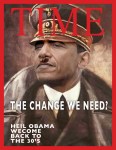
As Nazi troops marched int France, Hitler said;
“If the Jews didn’t exist, we would have had to invent them!”
American Jews were upset at the images used to oppose our President’s healthcare plan, they comparing him to Hitler. With the passing of State laws that bid voters to show photo IDs, we are on the brink of disaster. If Obama rules these new laws go against the Voter Right Laws – before the election – and bids all those who voted four years ago be allowed to vote by the old standards, then the Demonizing Racist Republican Church of the Red State Menace will be up in arms over State Rights as they were before the Civil War began.
In the past, Akin and his ilk have threatened to form a third party, thus destroying to the two major parties would be eliminating the opposition. Akin will not be attending the Republican Convention.
Meanwhile, the world economy continues to tank. Who would want to do business with a nation full of bat-crap crazy religious fanatics who invent stuff to go crazy over? There is no reasonining with this siditious cult.
Jon Presco
During the following break in the conference proceedings, I cornered Weyrich to make sure I had heard him correctly. He was adamant that, yes, the 1975 action by the IRS against Bob Jones University was responsible for the genesis of the Religious Right in
the late 1970s. What about abortion? After mobilizing to defend Bob Jones University and its racially discriminatory policies, Weyrich said, these evangelical leaders held a conference call to discuss strategy. He recalled that someone suggested that they had
the makings of a broader political movement—something that Weyrich had been pushing for all along—and asked what other issues they might address. Several callers made suggestions, and then, according to Weyrich, a voice on the end of one of the lines said, “How about abortion?” And that is how abortion was cobbled into the political agenda of the Religious Right.
The abortion myth serves as a convenient fiction because it suggests noble and altruistic motives behind the formation of the Religious Right. But it is highly disingenuous and renders absurd the argument of the leaders of Religious Right that, in defending the rights of the unborn, they are the “new abolitionists.” The Religious Right arose as a political movement for the purpose, effectively, of defending racial discrimination at Bob Jones University and at other segregated schools. Whereas evangelical abolitionists of the nineteenth century sought freedom for African Americans, the Religious Right of the late twentieth century organized to perpetuate racial discrimination. Sadly, the Religious Right has no legitimate claim to the mantle of the abolitionist crusaders of the nineteenth century. White evangelicals were conspicuous by their absence in the civil rights movement of the 1950s and 1960s. Where were Pat Robertson and Jerry Falwell and Billy Graham on August 28, 1963, during the March on Washington or on Sunday, March 7, 1965, when Martin Luther King Jr. and religious leaders from other traditions linked arms on the march from Selma to Montgomery, Alabama, to stare down the ugly face of racism?
Falwell and others who eventually became leaders of the Religious Right, in fact, explicitly condemned the civil rights movement. “Believing the Bible as I do,” Falwell proclaimed in 1965, “I would find it impossible to stop preaching the pure saving gospel
of Jesus Christ, and begin doing anything else—including fighting Communism, or participating in civil-rights reforms.” This makes all the more outrageous the occasional attempts by leaders of the Religious Right to portray themselves as the “new abolitionists” in an effort to link their campaign against abortion to the nineteenth century crusade against slavery.
U.S. Jews slam use of Nazi imagery by Obama critics
Ha’aretz
Jewish Democrats in the United States are furious over the use of Nazi imagery in the contentious debate over President Barack Obama’s proposed health care reform.
David Harris, the head of the National Jewish Democratic Council, condemned the “profoundly troubling” comparisons to Nazi Germany that have often been invoked by critics of Obama’s policies.
Raucous town hall meetings and right-wing Internet blogs have taken to using swastikas and other assorted Nazi associations in an effort to liken Obama’s health plan to that administered to concentration camp inmates during the Holocaust.
Harris slammed popular conservative commentator Rush Limbaugh for posting a graphic on his Web site which shows Obama’s health plan metamorphosing into a pictorial laden with swastikas.
“Limbaugh’s horrifying use of Hitler references and swastikas is deeply offensive and wildly inappropriate, and it has to stop now,” Harris said.
Harris called on Representative Eric Cantor, the lone Jewish Republican in Congress, to repudiate Limbaugh.
“Regardless of the political differences and the substantive differences in the debate over health care, the use of Nazi symbolism is outrageous, offensive and inappropriate,” Anti-Defamation League chief Abe Foxman told ABC News.
“Americans should be able to disagree on the issues without coloring it with Nazi imagery and comparisons to Hitler. This is not where the debate should be at all.”
The Post notes the ADL also condemned this Republican attacks on Obama:
Limbaugh slammed over Nazi imagery
Hilary Leila Krieger • Jerusalem Post
Democrats intensified their war with Republican icon Rush Limbaugh this week by lambasting the controversial talk show host for comments using Nazi imagery to attack the Democratic Party on health care.
The Anti-Defamation League also joined in the criticism Friday.
“Regardless of the political differences and the substantive differences in the debate over health care, the use of Nazi symbolism is outrageous, offensive and inappropriate,” ADL National Director Abraham Foxman said.
“Americans should be able to disagree on the issues without coloring it with Nazi imagery and comparisons to Hitler. This is not where the debate should be at all.”
He pointed to recent protests against US President Barack Obama’s health care initiative in which demonstrators appeared with swastikas. He also cited Limbaugh’s recent statement that, “They accuse us of being Nazis, and Obama’s got a healthcare logo that’s right out of Adolf Hitler’s playbook.”
The Democratic Party seized on his comments and others that compared Democratic policies to those of the Nazi party to drum up support from their constituents, continuing their use of Rush Limbaugh as a popular rallying cry.
The National Jewish Democratic Council appealed to their backers to sign a petition to the parent company of Limbaugh’s radio show to express displeasure at the top of the organization’s Web site home page.
Limbaugh, a political lightning rod, has been a tool of the new Democratic administration in making the case that the Republican party has shifted too far to the Right and is out of touch with average Americans, but Limbaugh’s show remains a broadcasting juggernaut and his place in the party firm.
Limbaugh could not be reached for comment.
June 23, 2006
President Bush and the Republican Party find strong support among evangelical voters. But in his new book, Thy Kingdom Come, author Randall Balmer says that allegiance is misplaced.
“I don’t find much that I recognize as Christian” in the religious right, says Balmer, a professor of religion at Barnard College, Columbia University and contributing editor to Christianity Today.
He says blind allegiance to the Republican Party has distorted the faith of politically active evangelicals, leading them to misguided positions on issues such as abortion and homosexuality.
“They have taken something that is lovely and redemptive and turned it into something that is ugly and retributive,” Balmer says.
He argues that modern evangelicals have abandoned the spirit of their movement, which was founded in 19th-century activism on issues that helped those on the fringes of society: abolition, women’s suffrage and universal education.
“I don’t find any correlation in the agenda of the religious right today,” Balmer says.
Book Excerpt: ‘Thy Kingdom Come’
by Randall Balmer
In the 1980s, in order to solidify their shift from divorce to abortion, the Religious Right constructed an abortion myth, one accepted by most Americans as true. Simply put, the abortion myth is this: Leaders of the Religious Right would have us believe that their movement began in direct response to the U.S. Supreme Court’s 1973 Roe v. Wade decision. Politically conservative evangelical leaders were so morally outraged by the ruling that they instantly shed their apolitical stupor in order to mobilize politically in defense of the sanctity of life. Most of these leaders did so reluctantly and at great personal sacrifice, risking the obloquy of their congregants and the contempt of liberals and “secular humanists,” who were trying their best to ruin America. But these selfless, courageous leaders of the Religious Right, inspired by the opponents of slavery in the nineteenth century, trudged dutifully into battle in order to defend those innocent unborn children, newly endangered by the Supreme Court’s misguided Roe decision.
It’s a compelling story, no question about it. Except for one thing: It isn’t true.
Although various Roman Catholic groups denounced the ruling, and Christianity Today complained that the Roe decision “runs counter to the moral teachings of Christianity through the ages but also to the moral sense of the American people,” the vast majority of evangelical leaders said virtually nothing about it; many of those who did comment actually applauded the decision. W. Barry Garrett of Baptist Press wrote, “Religious liberty, human equality and justice are advanced by the Supreme Court abortion decision.” Indeed, even before the Roe decision, the messengers (delegates) to the 1971 Southern Baptist Convention gathering in St. Louis, Missouri, adopted a resolution that stated, “we call upon Southern Baptists to work for legislation that will allow the possibility of abortion under such conditions as rape, incest, clear evidence of severe fetal deformity, and carefully ascertained evidence of the likelihood of damage to the emotional, mental, and physical health of the mother.” W.A. Criswell, former president of the Southern Baptist Convention and pastor of First Baptist Church in Dallas, Texas, expressed his satisfaction with the Roe v. Wade ruling. “I have always felt that it was only after a child was born and had a life separate from its mother that it became an individual person,” the redoubtable fundamentalist declared, “and it has always, therefore, seemed to me that what is best for the mother and for the future should be allowed.”
The Religious Right’s self-portrayal as mobilizing in response to the Roe decision was so pervasive among evangelicals that few questioned it. But my attendance at an unusual gathering in Washington, D.C., finally alerted me to the abortion myth. In November
1990, for reasons that I still don’t entirely understand, I was invited to attend a conference in Washington sponsored by the Ethics and Public Policy Center, a Religious Right organization (though I didn’t realize it at the time). I soon found myself in a conference room with a couple of dozen people, including Ralph Reed, then head of the Christian Coalition; Carl F. H. Henry, an evangelical theologian; Tom Minnery of Focus on the Family; Donald Wildmon, head of the American Family Association; Richard Land of the Southern Baptist Convention; and Edward G. Dobson, pastor of an evangelical church in Grand Rapids, Michigan, and formerly one of Jerry Falwell’s acolytes at Moral Majority. Paul M. Weyrich, a longtime conservative activist, head of what is now called the Free Congress Foundation, and one of the architects of the Religious Right in the late 1970s, was also there.
In the course of one of the sessions, Weyrich tried to make a point to his Religious Right brethren (no women attended the conference, as I recall). Let’s remember, he said animatedly, that the Religious Right did not come together in response to the Roe decision. No, Weyrich insisted, what got us going as a political movement was the attempt on the part of the Internal Revenue Service (IRS) to rescind the tax-exempt status of Bob Jones University because of its racially discriminatory policies.
Bob Jones University was one target of a broader attempt by the federal government to enforce the provisions of the Civil Rights Act of 1964. Several agencies, including the Equal Employment Opportunity Commission, had sought to penalize schools for failure to abide by antisegregation provisions. A court case in 1972, Green v. Connally, produced a ruling that any institution that practiced segregation was not, by definition, a charitable institution and, therefore, no longer qualified for tax-exempt standing.
The IRS sought to revoke the tax-exempt status of Bob Jones University in 1975 because the school’s regulations forbade interracial dating; African Americans, in fact, had been denied admission altogether until 1971, and it took another four years before unmarried African Americans were allowed to enroll. The university filed suit to retain its tax-exempt status, although that suit would not reach the Supreme Court until 1983 (at which time, the Reagan administration argued in favor of Bob Jones University).
Initially, I found Weyrich’s admission jarring. He declared, in effect, that the origins of the Religious Right lay in Green v. Connally rather than Roe v. Wade. I quickly concluded, however, that his story made a great deal of sense. When I was growing up within the evangelical subculture, there was an unmistakably defensive cast to evangelicalism. I recall many presidents of colleges or Bible institutes coming through our churches to recruit students and to raise money. One of their recurrent themes was,We don’t accept federal money, so the government can’t tell us how to run our shop—whom to hire or fire or what kind of rules to live by. The IRS attempt to deny tax-exempt status to segregated private schools, then, represented an assault on the evangelical subculture, something that raised an alarm among many evangelical leaders, who mobilized against it.
For his part, Weyrich saw the evangelical discontent over the Bob Jones case as the opening he was looking for to start a new conservative movement using evangelicals as foot soldiers. Although both the Green decision of 1972 and the IRS action against Bob Jones University in 1975 predated Jimmy Carter’s presidency, Weyrich succeeded in blaming Carter for efforts to revoke the taxexempt status of segregated Christian schools. He recruited James Dobson and Jerry Falwell to the cause, the latter of whom complained, “In some states it’s easier to open a massage parlor than to open a Christian school.”
Weyrich, whose conservative activism dates at least as far back as the Barry Goldwater campaign in 1964, had been trying for years to energize evangelical voters over school prayer, abortion, or the proposed equal rights amendment to the Constitution. “I was
trying to get those people interested in those issues and I utterly failed,” he recalled in an interview in the early 1990s. “What changed their mind was Jimmy Carter’s intervention against the Christian schools, trying to deny them tax-exempt status on the basis of so-called de facto segregation.”
During the meeting in Washington, D.C., Weyrich went on to characterize the leaders of the Religious Right as reluctant to take up the abortion cause even close to a decade after the Roe ruling. “I had discussions with all the leading lights of the movement in the late 1970s and early 1980s, post–Roe v. Wade,” he said, “and they were all arguing that that decision was one more reason why Christians had to isolate themselves from the rest of the world.”
“What caused the movement to surface,” Weyrich reiterated,”was the federal government’s moves against Christian schools.” The IRS threat against segregated schools, he said, “enraged the Christian community.” That, not abortion, according to Weyrich, was what galvanized politically conservative evangelicals into the Religious Right and goaded them into action. “It was not the other things,” he said.
Ed Dobson, Falwell’s erstwhile associate, corroborated Weyrich’s account during the ensuing discussion. “The Religious New Right did not start because of a concern about abortion,” Dobson said. “I sat in the non-smoke-filled back room with the Moral Majority, and I frankly do not remember abortion ever being mentioned as a reason why we ought to do something.”
 Rosamond Press
Leave a comment