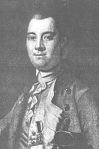
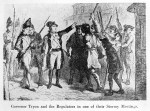

Lord Tyron was broke when he came to the New World. He levied a tax and built a church. He then built a mansion and used the tax money to defend his position as Govorner. Americans had seen this cookie-cutter pattern in Europe. This was the Church-State of England that made titled gentry Lords of the Land. Settlers recieved no tax money or support from the Church of England – and the King of England.
Governor Romney, and Paul Ryan are modeled after Lord Tyron. They pay no texes and have become rich and powerful off the debts of others. They are backed by a powerful church, and make secret deals with other American Lords of Captitalism who hold up Ayn Rand’s Totally Selfish philosophy as their permission to take, take, take till they are blue in the face. These two Lords know Jesus does not give them permission to be Utterly Greedy.
Jesse Benton was a lackey for Lord Tyron, but took the side of poor farmers in the Regulator Revolt that rebelled against paying taxes because it fueled the Land Grab by the Brtish Aritocracy and the Chhurch of
England in the name of the Divine King of England.
R MONEY is King of Mormons. His company, Bains, preys upon other compnaies that are in debt. R MONEY is a PARASITE. Lord Tyron was a PARASITE.
Jon Presco
William Tryon (8 June 1729 – 27 January 1788) was a British soldier and colonial administrator who served as governor of the Province of North Carolina (1765–1771) and the Province of New York (1771–1780).
Contents [hide]
1 Early life and career
2 Seven Years War
3 Governor of North Carolina
4 Governor of New York
5 Legacy
6 References
6.1 Further sources
7 External links
[edit] Early life and careerTryon was born 8 June 1729 at the family’s seat at Norbury Park, Surrey, England the son of Charles Tryon and Lady Mary Shirley.
In 1751, he entered the military as a lieutenant in the 1st Regiment of Foot Guards and was promoted to Captain in the same year. He had a daughter by Mary Stanton, whom he never married. In 1757, he married Margaret Wake, a London heiress with a dowry of 30,000 pounds. Her father had been the Honourable East India Company’s Governor in Bombay from 1742 to 1750, and had died on a ship off the Cape of Good Hope on the voyage home.[1] In 1758, he was promoted to lieutenant colonel.
[edit] Seven Years WarFurther information: Great Britain in the Seven Years War
During the Seven Years War, he and his regiment were involved in the Cherbourg-St. Malo operation. They landed at Cherbourg and destroyed all war making facilities. In September, they reembarked for St. Malo where the operation went smoothly until the withdrawal when they came under intense fire from the French at the Battle of St Cast. Tryon was twice wounded in the thigh and in the head.
[edit] Governor of North CarolinaOn 26 April 1764, through family connections, he obtained the position of acting lieutenant governor of the Province of North Carolina. He arrived in North Carolina with his family, including a young daughter,[2] as well as architect John Hawks,[3] in early October to find that the previous governor, Arthur Dobbs, had not left. He said that he would not be leaving until May.[1] Tryon found himself with no income (although he was Lieutenant Governor).[2] In 1765, a house called Russelborough on the Cape Fear River near Brunswick Town was renovated to serve as Tryon’s residence while he acted as Lieutenant Governor.[2] Tryon assumed his position as acting governor when Dobbs died on 28 March 1765. On 10 July, the King promoted him to governor.
After assuming the office of governor, Tryon worked to expand the Church of England in North Carolina.[3] There were only five Anglican clergy members in North Carolina at that time.[3] Tryon pushed for the completion of abandoned construction projects of Anglican churches in Brunswick Town, Wilmington, Edenton, and New Bern.[3] Tryon appointed members of the clergy for these churches and encouraged the construction of new churches, especially in rural areas.[3]
There was a strong opposition in North Carolina to the Stamp Act of 1765. When the Stamp Act Congress was held, the colonial assembly was not in session, and hence delegates could not be selected to this congress. Tryon refused to allow meetings of the Assembly from 18 May 1765 to 3 November 1766 to prevent the Assembly from passing a resolution in opposition to the Stamp Act. Tryon said that he was personally opposed to the Stamp Act and that he offered to pay the taxes on all stamped paper on which he was entitled to fees. Tryon requested troops to enforce the act, but instead he was informed on 25 June 1766 that the act was repealed.
Tryon composed plans for an elaborate governor’s mansion, which would also function as a central location for government business; Tryon worked with Hawks during 1764 and 1765 to draw up plans for an elaborate home for himself.[1][3] In December 1766, the North Carolina legislature authorized ₤5,000 for the building of Tryon’s mansion.[3] Tryon told the legislature that the sum was not substantial enough for the plans he and Hawk had created; building it “in the plainest manner” would cost no less than ₤10,000 without including the outbuildings he envisioned.[3] Hawks agreed to supervise the construction for three years and went to Philadelphia at Tryon’s behest to hire workers; Tryon said native North Carolina workers would not know how to construct such a building.[3] Tryon was able to convince the legislature to increase taxes to help pay for the project.[3] The unpopularity of the new taxes spawned the derogatory nickname ‘Tryon Palace’. In 1770, Tryon moved into the completed mansion.[3] The house was “a monument of opulence and elegance extraordinary in the American colonies.”[3]
Although he accomplished some notable improvements in the colony, such as the creation of a postal service in 1769, Tryon is most noted for suppressing the North Carolina Regulator uprising in western North Carolina during the period from 1768 to 1771. The uprising was caused partly by taxation imposed to pay for Tryon Palace at New Bern (which Tryon made the provincial capital) and partly by tax abuse and fraud by western officials.[3] Matters came to a head in May 1771, when colonial militia defeated 2,000 Regulators in the Battle of Alamance.[3]
Following the battle, Tryon ordered the execution of seven alleged Regulators, convicted by Judge Richard Henderson.[3] Most of the men were accused of violating the Riot Act, a crime temporarily made a capital offence by the General Assembly. The executed men included James Few, Benjamin Merrell, James Pugh, Robert Matear, “Captain” Robert Messer, and two others. Six other convicted Regulators – Forrester Mercer, James Stewart, James Emmerson, Herman Cox, William Brown, and James Copeland – were pardoned by King George III and released by Tryon. The Regulator uprising is viewed by some historians as a precursor to the American Revolution. Tryon then raised taxes again to pay for the militia’s defeat of the Regulators.[3]
Tryon’s governorship ended, and he left North Carolina on 30 June 1771. Tryon Palace was reconstructed in the 1950s using the original architectural plans drawn by John Hawks.
[edit] Governor of New YorkOn 8 July 1771, Tryon arrived in the Province of New York and became its governor. In 1771 and 1772 he was successful in having the assembly appropriate funds for the quartering of British troops and also on 18 March 1772 the establishment of a militia. Funds were also appropriated for the rebuilding of New York City’s defences.
In 1772, opposition in New York was strong against the Tea Act. In December, the Sons of Liberty “persuaded” the tea agents to resign. Tryon proposed to land the tea and store it at Fort George. The Sons of Liberty were opposed and Alexander McDougall said, “prevent the landing, and kill [the]governor and all the council”. When news of the Boston Tea Party arrived on 22 December, Tryon gave up trying to land the tea. He told London the tea could only be brought ashore “only under the protection of the point of the bayonet, and muzzle of cannon, and even then I do not see how consumption could be effected”. In 1774, the New Yorkers dumped their own consignment of tea into the harbour.
On 29 December 1773 the governor’s mansion and all its contents were destroyed by fire. The New York assembly appropriated five thousand pounds for his losses.
On 7 April 1774 Tryon departed for a trip to England. Cadwallader Colden was the acting governor of New York in Tryon’s absence. He arrived back in New York on 25 June 1775 after the American Revolutionary War had begun. Isaac Sears in July returned from the Continental Congress with orders to put Tryon under arrest, but George Washington had ordered Philip Schuyler, the commander in New York, to leave Tryon alone. On 19 October 1775, Tryon was compelled to seek refuge on the British sloop-of-war Halifax in New York Harbor. In 1776, he dissolved the assembly and called for new elections in February. The new assembly was for independence and Tryon dissolved it.
During the spring and summer of 1776, Tryon and New York City’s mayor, David Mathews, were conspirators in a miserably bungled plot to kidnap General George Washington and to assassinate his chief officers. One of Washington’s bodyguards, Thomas Hickey, was involved in the plot. Hickey, while in prison for passing counterfeit money, bragged to his cellmate Isaac Ketcham about the kidnapping plot. Ketcham revealed it to authorities in an effort to gain his own freedom. Hickey was court-martialled, and was hanged for mutiny on 28 June 1776.
In June, Admiral Howe arrived in New York City with the British army. Howe placed New York under martial law with James Robertson as the military commander. Tryon retained his position as governor, but with little power.
In early 1777, Tryon was given the rank of major-general of the provincials. In April, he was ordered to invade Connecticut and march on the city of Danbury to destroy an arsenal there. Tryon engaged and defeated Patriot forces under the command of General David Wooster and Benedict Arnold at the Battle of Ridgefield when attempting to return to an invasion fleet anchored in Westport. In May 1778 he was given the rank of major-general in the British army, but in America only, and also the colonelcy of the 70th Regiment of Foot. He became the British commander of the British forces on Long Island.
Tryon had long advocated engaging in attacks on civilian targets, but Clinton turned down Tryon’s proposals. In July 1779, Tryon commanded a series of raids on the Connecticut coast, attacking New Haven, Fairfield, and Norwalk, burning and plundering most of Fairfield and Norwalk. Tryon’s raids were intended to draw American forces away from the defence of the Hudson valley. In spite of pressure from Governor Jonathan Trumbull, George Washington did not move his troops. Americans condemned him for making war on “women and children”, and the British commander Clinton was also indignant about Tryon disobeying his orders. Tryon found approval of his conduct from Lord Germain, but Clinton refused to give Tryon any further significant commands.
In September 1780, Tryon returned to his home in London, England. He directed the affairs of his 70th Regiment of Foot still in the Colonies and he gave directions in 1783 for the regiment to be brought back to England for disbandment. In 1782 was promoted to lieutenant-general. In 1784 he was made colonel of the 29th Regiment of Foot, which was stationed in Canada.
He died at his home in London on 27 January 1788 and was buried at St. Mary’s Church, Twickenham, Middlesex.
[edit] LegacyTryon’s policies during the Revolutionary War were described as savagely brutal by persons on both sides of the conflict. Although he has been described as a tactful and competent administrator who improved the colonial postal service[citation needed], Tryon became unpopular first because he obeyed the instructions of his superiors prior to the war and then disobeyed them during the war by being overly harsh in his conduct of the war in the neutral ground in New York. For example, historian Thomas B. Allen notes on p. 202 of his book Tories that ‘Tryon’s desolation warfare shocked many British officers and outraged Patriots.’ According to Allen, ‘Joseph Galloway, a leading Tory, charged that marauding and even rape was officially tolerated by the British and the Loyalists. Galloway said that “indiscriminate and excessive plunder” was witnessed by “thousands within the British lines.” In a “solemn inquiry,” backed by affidavits, he said, “it appears, that no less than twenty-three [rapes] were committed in one neighborhood in New Jersey; some of them on married women, in presence of their helpless husbands, and others on daughters, while the unhappy parents, with unavailing tears and cries, could only deplore the savage brutality.” Similarily, in New York City, citizens and officers accused Hessians, Redcoats, and Loyalists of robbing houses, raping women, and murdering civilians.’
The Cherokees gave Tryon the name of “Wolf” for his dealings in setting a boundary for them in the western part of the colony[citation needed].
Benton Genealogyat Thomas Hart Benton Home and Studio State Historic Site
The Bentons were originally established in Lincolnshire England. A branch of the family went to South Wales. In 1731, three brothers, Benton, came from Wales to America. They intended to settle on Chesapeake Bay, but contrary winds drove the ship south, and the brothers landed on Albermarle Sound, North Carolina, whence they went to the uplands and settled at Hillsboro, Orange County, N.C. These brothers were Samuel, Abner, and Jesse. The latter never married. Abner married in Wales, Samuel in North Carolina. This sketch has to do with Abner Benton and heirs. To him was born Jesse B. and Catherine. The latter never married, both born in North Carolina U.S.A. Jesse B. Benton was sent to England and educated. On his return from England, he was appointed (by the Crown), Secretary to the Lord Tryon, Governor of the Province. Afterwards an ugly British General in the Revolutionary War, Jesse B. Benton broke with his chief in the War for American Independence, and was an officer in the American Patriot Army. He, Jesse B. Benton, was married during the War for Independence to Ann Gooch, the daughter of a disreputable English officer under Lord Tryon. Her mother was named Hart and was American born, and Ann Gooch always said, “I came from a family of Harts.” Her cousin Col. Nathaniel Hart was killed at the “River Raisin”, in a battle with British and Indians, during the War of 1812. To the union between Jesse B. Benton and Ann Gooch, there was born Thomas Hart [the Senator], Jesse, Samuel, Nathaniel, Susan, and Catherine Benton. Susan and Catherine never married. In 1793, at the age of 46, Jesse B. Benton died at Hillsboro, N.C.
In 1796, the year Tennessee was admitted to the Union, Jesse B. Benton’s widow Ann, with her family, moved to Tennessee, and settled some forty miles south of Nashville, on land provided by her husband during his life. In 1800 Ann Benton’s sons Thomas H. and Nathaniel returned to North Carolina and entered the State school at Chapel Hill. Neither of them graduated. Of the four brothers Thomas H., Jesse, Samuel, and Nathaniel, the following facts are worthy of record: Samuel married in 1808, a Miss Grundy, and raised six children all born in Carroll County, West Tennessee. Four of these were boys, Nathaniel, Abner, Thomas H., and Samuel (the latter twins) and Catherine and Sarah. Catherine never married. The elder, Nat, went to California and reared a family. Abner died in youth. Thomas H. settled in Iowa, was a Democrat, was a Colonel and Brig. General in the U.S. Army during the Civil War. Was father of Maria Benton, a brilliant woman who married Ben Cable of Illinois and is living. Samuel settled in Holly Springs, Mississippi, reared a family, was twice a Whig Candidate for Congress, was a Confederate Colonel and brevet Brigadier General, was wounded at Resaca, Ga., and died in 1864. Sarah married a Brandt, reared a family and lived and died in St. Louis. Jesse, son of Jesse B. and Ann Benton, married in middle Tennessee, Mary (Polly) Childress, both of whom in old age died near Nashville without children. Thomas Hart, the eldest son was a member of the Tennessee Legislature, a lawyer and a Lieut. Colonel in the War of 1812. An unfortunate break between Generals Jackson, Carroll and Coffee, and Thos. H., Jesse and Nathaniel Benton brothers, resulted in a street duel in Nashville, in September 1813, in which General Jackson and General Carroll were both shot. In 1814 Thos. H. and Nathaniel moved to the Territory of Missouri. Thos. Hart Benton was elected one of the two first United States Senators for Missouri, and served thirty consecutive years, followed by two years in the lower House of Congress. After becoming a Senator he married a daughter of Governor McDowell of Virginia. To this union were born: Sarah, Mary, Jesse Ann, Elizabeth, and Randolph Benton. The latter died in his minority. Sarah married Baron Bolieau, French Minister to the U.S. in the forties, and was the mother of the celebrated artist Philip Bolieau later of New York, now deceased. Mary married a Mr. Jacobs of Jefferson County, Kentucky, an extensive Planter. Jesse Ann married Jon C Fremont, a U.S. Lieutenant of French descent, and afterwards the California Pathfinder, and later in 1856 the first Republican Candidate for President, against James Buchanan, and was not supported by Col. Benton, his father-in-law. Fremont was a Major General U.S.A. in the Civil War. Fremont and Jesse Ann Benton, had born to them John C. (who was a U.S. Naval Captain), and Lilly, who never married but lived to be sixty years old. John C. Jr., died a Captain and has a son John C. now a Captain in the U.S. Navy, and two girls not married. Elizabeth married Commodore Jones, U.S.N. and died in Florence, Italy in 1903.
Nathaniel Benton (our direct ancestor), was born in February 1788, in Hillsboro, Orange County, North Carolina, moved with his mother and family to middle Tennessee in 1796, spent afterwards two years in the North Carolina University and in 1810 married Dorothy Myra Branch, daughter of Governor Branch of North Carolina. To this union were born Nathaniel in 1811, Alfred in 1814, Columbus in 1819, Abner in 1816, Susan in 1822, Thomas Hart in 1825, Rufus in 1829, and Maecenas in 1831. Nathaniel and Alfred were born in middle Tennessee; Abner, Columbus and Susan were born in Jefferson County, Missouri; Thomas Hart, Rufus and Maecenas were born in Dyer County, Tennessee. The elder of this family Nat Benton, spent two years at West Point Military Academy, resigned, and with his mother’s family (his father Nat Benton having died in 1833) moved to Texas in October 1835, and settled on the Brazos, near Waco. In February 1836, Nat Benton together with his brother Alfred joined the army of General Sam Houston for the liberation of Texas from Mexican domination. Nat Benton however, accidentally shot himself in the foot, and came near passing away. Alfred Benton and Ben McCulloch were with Houston at San Jacinto and helped in Texas Independence in 1836. Nat Benton in 1837 returned to Tennessee and married Harriet, the sister of Henry and Ben McCulloch. To this union was born Benjamine Eustace Benton. Nat Benton’s wife died in 1845. In 1853 Nat Benton and son left Dyersburg, Tennessee and went to Texas. Both he and his son Eustace were in the Texas Rangers, and while so engaged Eustace was badly wounded, losing one eye. Captain Nat Benton married again during the’50s to a Miss Harris and children were born to this marriage, but the family history to which I had access did not state how many children, nor where the second Mrs. Benton died.
Nat Benton was a soldier in the Confederate army attaining the rank of Colonel, and was badly wounded at Port Hudson. He returned to Sequing Texas, and lived there till his death which occurred in 1873. His son Capt. Ben Eustace Benton married during the Civil War on April 15 1863, Miss Margaret C. Walker, daughter of General B.W. Walker, and to this union was born Miss Eulalia Benton now living in Pine Bluff, Arkansas. Capt Ben E. Benton died at Pine Bluff, Arkansas June 13 1914.
Alfred Benton, second son of Nat and Dorothy M. Benton, after serving in the war for Texas Independence, died in Texas in 1838. Abner the third son, married Mary Ann Wardlaw of Ripley, Lauderdale County, Tenn., and to this union were born eleven children. Fannie, the eldest, married Tom W. Neal at Dyersburg, had two children. Ella N. Crook, now of Little Rock, Arkansas, and Lillian Simpson, and died in 1880. Alfred lives in Louisville, Ky., Ed at Trenton, Tennessee, Hattie at Memphis, Annie at Dyersburg, Tenn., and Minne at Memphis, others all dead. Columbus Benton died in infancy. Susan married one Boggess, had eleven children, none of whom are living to my knowledge, and she died in June 1885.
Thos H. Benton Jr, son of Nat and Dollie Benton, married Mary Ellen Eason, whose father was Carter T. Eason, and mother Ellen, daughter of Gen. Daniel Morgan who defeated Tarleton at the “Cow Pens”. To this union were born Maecenas E., Mary Ellen, Nat (both the latter died in infancy), Jesse Ann, Thomas H. (both of whom died when about grown), Dollie who married Frank E. Miller and had one child named Mary Ruth Miller. Dollie Benton Miller died May 1895. Samuel Abner born in 1863 died in 1894, and Fannie May, who married E.L. Logan and has had two children, Sam Benton and Ernestine. They live in Little Rock, Arkansas.
Maecenas E. Benton, the eldest of this family is a lawyer, born in Obion County, Tennessee, removed to Missouri in 1869. Was two terms State’s attorney, one term as State Representative, one term United States Attorney, and five terms a member of Congress. He was married in 1888 to Elizabeth Wise of Waxahachie, Texas and of Kentucky parentage. To whom were born Thomas Hart [the artist], Mary Elizabeth, Nathaniel Wise, and Mildred Benton, all now grown.
Rufus and Maecenas, the youngest of the children of Nat and Dorothy Benton and brothers of Nat, Abner, and Thomas H., died in youth.
This statement covers the direct line from Abner Benton the Englishman who came to America in 1731, down to and including all of the present generation of whom the writer has any knowledge.
Compiled by Maecenas E Benton of Neosho, Missouri from old family records, from Dorothy Myra Benton’s family bible and from his personal knowledge.
Dated July 22, 1915 (signed) ME Benton
.
[edit] CausesThe origins of the War of Regulation stem from a drastic population increase within North Carolina during the 1760s, followed by immigration from the large eastern cities to the rural west. While the inland section of the colony had once been predominately composed of planters with an agricultural economy, merchants and lawyers from the coastal area began to move west, upsetting the current social and political structure. At the same time, the local agricultural community was suffering from a deep economic depression, due to severe droughts throughout the past decade. The loss of crops caused farmers to lose not only their direct food source, but also their primary means of income, which led many to rely on the goods being brought in by newly arrived merchants. Since income was cut off, the local planters often fell into debt, which could not be paid off immediately. The merchants, in turn, would rely on lawyers and the court to settle the debate. Debts were not uncommon at the time, but from 1755 to 1765 the number of cases brought to the docket increased 15 fold, from seven annually to 111 in Orange County alone.[1] Court cases could often lead to planters losing their homes and property, so they grew to resent the presence of the new merchants and the lawyers. The shift in population and politics eventually led to an imbalance within the colony’s courthouses, where the newly arrived and well-educated lawyers used their superior knowledge of the law to their sometimes unjust advantage. A small clique of wealthy officials formed and became an exclusive inner circle in charge of the legal affairs of the area. The group was seen as a ‘courthouse ring’, or a small bunch of officials who obtained most of the political power for themselves.
In 1764, several thousand people from North Carolina, mainly from Orange, Anson, and Granville counties in the western region, were extremely dissatisfied with the wealthy North Carolina officials, whom they considered cruel, arbitrary, tyrannical, and corrupt. Taxes were collected by local sheriffs supported by the courts; the sheriffs and courts had sole control over their local regions. Many of the officers were very greedy and often would band together with other local officials for their own personal gain. The entire system depended on the integrity of local officials, many of whom engaged in extortion; taxes collected often enriched the tax collectors directly. At times, sheriffs would intentionally remove records of their tax collection in order to further tax citizens. The system was endorsed by the colonial governor, who feared losing the support of the various county officials.
The effort to eliminate this system of government became known as the Regulator uprising, War of the Regulation, or the Regulator War. The most heavily affected areas were said to be that of Rowan, Anson, Orange, Granville, and Cumberland counties. It was a struggle between mostly lower class citizens, who made up the majority of the population of North Carolina, and the wealthy ruling class, who comprised about 5% of the population, yet maintained almost total control of the government.
The primary aim of the Regulators was to form an honest government and reduce taxation. The wealthy businessmen/politicians who ruled North Carolina at this point saw this as a grave threat to their power. Ultimately, they brought in the militia to crush the rebellion and then hung its leaders. It is estimated that out of the 8,000 people living in Orange County at the time, some six or seven thousand of them were in support of the Regulators.
Although the “War of the Regulators” is considered by some to be one of the first acts of the American Revolutionary War, it was waged against corrupt local officials and not against the king or crown. In reality, many anti-Regulators went on to become Patriots during the American Revolution, such as William Hooper, James Robertson, and Francis Nash; while many Regulators became Loyalists.
[edit] RegulatorsHerman Husband became one of the unofficial leaders of the Regulators. Husband was originally from Maryland, born into a Quaker family. One of the major flaws in Husband’s campaign was that he tried to invite good relations with the eastern regions of North Carolina, mostly unaffected by local sheriffs. Husband retained very little control over the group of Regulators, which generally went against his policies of winning over public sentiment by committing acts of minor violence at regular intervals.
Another leader of the Regulators was James Hunter. He refused to take control of the Regulators after Husband’s departure before the Battle of Alamance.
Captain Benjamin Merrill had about 300 men under his control and would have assumed control over military leadership after James Hunter, but he was unable to serve in the Battle of Alamance.
[edit] OppositionGovernor Arthur Dobbs, who authored popular works at the time such as “Trade and Improvement of H’elend” and “Captain Middleton’s Defense,” served as the Royal Governor of North Carolina until his death in 1765.
Governor William Tryon assumed the position following the death of Governor Dobbs. Tryon had an extremely lavish home built in 1770 in New Bern (now known as Tryon Palace), which became one of the main points of resentment for the Regulators, who were already paying substantial taxes. William (The Regulator) Butler was quoted as saying “We are determined not to pay the Tax for the next three years, for the Edifice or Governor’s House, nor will we pay for it.”
Governor Josiah Martin succeeded Governor Tryon in office just after the end of the rebellion. His policies eased the burden on former Regulators and allowed them to be assimilated back into society.
Edmund Fanning was the main opposition to the Regulators. A graduate of Yale College, he was generally regarded by his friends as well disciplined and firm. He held many political offices in Orange County. He was found guilty of embezzling money (along with Francis Nash) but was fined only one cent per charge.
[edit] Events[edit] Breaking up the courtNorth Carolina’s colonial court met in Hillsborough. In 1768, the Regulators entered Hillsborough, broke up the court, and dragged those they saw as corrupt officials through the streets.[2] The mob attempted to have the judge try the cases that were pending against several Regulator leaders, including Husband. The presiding judge (Richard Henderson) quickly adjourned the court until the next morning to avoid being forced to make a ruling in the presence of an angry mob of Regulators, and escaped in the night. The Regulators rioted, destroying public and private property alike. Fanning was among the lawyers beaten, found after taking refuge in a shop neighboring the courthouse. According to judge Richard Henderson, Fanning’s beating was so severe that “one of his eyes was almost beaten out.”[1] The courthouse was systematically and symbolically vandalized. Human waste was placed on the judge’s seat, and the body of a long deceased slave was placed upon the lawyers bar. The mob continued to destroy shops and property in the town, and ultimately brought their destruction to Fanning’s personal residence. After destroying all of the furniture and drinking all of his alcohol, the entire house was picked apart. Henderson’s barn, along with his stables and home were also burned to the ground.[3] They cracked the church bell of the Church of England, but stopped short of looting the church further due to their religious beliefs.[2]
[edit] DocumentsThere were several different publications and petitions circulated to promote the end of taxation and other issues. A number of influential members of the area communities signed the Regulator Advertisement and the Regulator Petition, of which there were several versions of each. Each document identified concerns and issues relevant to the Regulator Movement. The terms “Regulation” and “Regulator” were introduced in the Regulator Advertisement in 1768.[4]
[edit] WarWhile small acts of violence had been taking place for some time, mainly out of resentment, the first organized conflict was in Mecklenburg County in 1765. Settlers in the region, who were there illegally, forced away surveyors of the region assigned with designating land. Minor clashes followed for the next several years in almost every western county, but the only true battle of the war was the Battle of Alamance on May 16, 1771.
The governor and his forces which numbered just over 1,000, with roughly 150 officers, arrived at Hillsborough on May 9. At the same time, General Hugh Waddell, supporting Governor Tryon, en route with his contingent of 236 men was met by a large contingent of Regulators. Realizing his force was outnumbered, he fell back to Salisbury. On May 11, having received word of the retreat from a messenger, Tryon sent the force to support General Waddell. He intentionally chose a path that would lead his forces through Regulator territory. He gave strict orders that nothing was to be looted or damaged. By May 14, his troops had reached Alamance and set up a camp. Leaving about 70 men behind to guard the position, he moved the remainder of his force, slightly under 1,000 men, to find the Regulators.
About 10 miles (16 km) away, a force of approximately 2,000 Regulators (by some accounts, 6,000)[2] without any clear leadership or supplies was gathered mainly as a display of force, and not a standing army. The general Regulator strategy was to scare the governor with a show of superior numbers in order to force the governor to give in to their demands. The first clash of the battle was on May 15 when a rogue band of Regulators had captured two of the governor’s militia soldiers. Governor Tryon had informed the Regulators that they were displaying open arms and rebellion and that action was to be taken if they did not disperse. The Regulators did not understand the severity of the crisis they were in and ignored the warning. Despite hesitation from his own forces, Governor Tryon allegedly initiated the main battle of Alamance on May 16 by shooting Robert Thompson, who was the first death of the battle. The Regulators resistance crumbled somewhat quickly. Captain Merrill, a Regulator, was supposed to arrive on the battlefield but was delayed. The battle was over with nine deaths for the governor’s forces and about the same for the Regulators. Virtually everyone captured in the battle was fully pardoned in exchange for an allegiance to the crown; however, seven Regulators were executed for their part in the uprising.
[edit] AftermathFollowing the battle, Tryon’s militia army traveled through Regulator territory where he had Regulators and Regulator sympathizers sign loyalty oaths and destroyed the properties of the most active Regulators. He also raised taxes to pay for his militia’s defeat of the Regulators.[2]
At the time of their defeat at the battle of Alamance, public opinion was decidedly against them. They were seen as a bunch of “lawless desperadoes” and Governor William Tryon was praised for his actions in stamping out the rebellion.[5] As news articles spread the word of his victory, Tryon was branded a hero of the colonies for defeating the larger group of Regulators with his small, well prepared militia. However as the initial excitement over the glorious battle died down, many newsmen, especially in the Boston area, began to question the reasons behind the rebellion and investigated further to find its cause. Several reasons were found to see the destruction of the Regulators as an act of an oppressive government. Most particularly admonished was the methods in which Tryon himself had used to win the battle of Alamance. The use of a riot act, and the execution of rebellion leaders after the battle was frowned upon. Reports also indicated that severe battlefield misconduct had taken place on the governor’s side, including giving the farmers a 2 hour warning period before the battle began, and subsequently breaking that agreement to bombard them with artillery fire.[5]
Several trials were held after the war, resulting in the hanging of six Regulators at Hillsborough on June 19, 1771. Many of the main leaders remained in hiding until 1772, when they were no longer considered outlaws.
Many Regulators moved further west into places such as Tennessee, notably establishing both the Watauga Association at Sycamore Shoals (1772) in present day Elizabethton, Tennessee, the first independent white republic on American soil, and the State of Franklin (1784), another short-lived republic that failed to join the Union of the United States.
The Regulators are important characters in Jimmy Carter’s historical novel The Hornet’s Nest (2003). The Battle of Alamance is also a significant event in the novel The Fiery Cross (novel), the fifth book in the Outlander series of novels by author Diane Gabaldon.
[edit] Regulation in South CarolinaAt the same time as the regulation in North Carolina, the South Carolina colony had a similar group of men calling themselves regulators, albeit with very different goals. The regulators of the south were also farming class, landowning men who were upset with injustices of the officials. However their main problems stemmed not from corruption, but a lack of representation and of government-provided services such as courts and churches. These regulators also found an enemy in local groups of hunters (who were seen as undesirables due to their profession) and bandits. It can be argued that the South Carolina regulation is also a partial cause for the revolutionary war, as the reason it was taking so long for their demands to be met was the struggle with England.
The Regulators of South Carolina were formed during the mid 1760s, and active mainly between 1767 and 1769. Over the past few decades the population of the frontier had boomed, thanks to the planning of governor Robert Johnson. His enthusiasm for sending yeoman out to the frontier in mass was in fact to provide a buffer for the coastal cites from Cherokee attacks. The slave population alone grew 19% (however the entire slave population of the frontier only accounted for 8% of total of the colony).
During this time violent crimes and organized bandit raids threatened the welfare of the settlers inland of the colony. The fallout of the Cherokee war of 1760-1761 left many settlers without homes, and children were abandoned during native raids. These people would fall back on the only trade they could use to sustain themselves and their families, which was hunting for their food. In the colonial period on the western frontier this was not seen as an honorable profession, and hunters were labeled as vagrants and universally hated by the planters. The planters had numerous reasons not to like hunters, as many of them were also bandits that would steal livestock. The method of fire hunting, which was a practice of hunting at night, and using fire to blind deer. However this endangered the livestock of farmers, as hunting in the dark often led to cattle being mistaken for deer. Many unused animal corpses were also left as a result, which drew wolves and scavengers closer to populated areas. Along with this, hunting also pushed well into the boundary of the local natives, the Creek Indians, hurting the already tense relationship with colonists. The bandit problem had become so bad that it was found they had an organized network even larger than the regulators, numbering at roughly 200 strong. Eventually the thieves were bold enough to attack members of the magistrate, and one regulator James Mayson was dragged from his home in the night. The bandits, while originally being composed of the hunting groups, were not an exclusive group. Into their fold they accepted Mulattos (free blacks) and runaway slaves, and any outlaw available. Some members of the bandit network were well established farmers as well.
The South Carolina regulators were a much smaller organization than their North Carolina counterpart. There were 100 known regulators, and of these 32 of them went on to become justices of the peace, and 21 were militia leaders. Of the regulation members, 31 of them owned slaves, and 14 in fact owned 10 or more. These men banded together initially to form a vigilante law force to protect themselves and their assets from bandits. Unlike their neighbors to the north, this was not a rebellion, and in fact South Carolina regulators were in cooperation with their colonial government for their entire active time. The secondary cause of this group was to get courts, churches and schools established in their quickly growing communities. Unfortunately the only court in the colony was in Charleston, through which all legal documentation had to go. In fact, the inland settlers had the sympathy of the coastal elite, but the circuit court act, which would establish the jails, courts, sheriffs and 14 judicial districts, was held up due to a dispute with Parliament concerning the tenure of judges.
In stark contrast to the outcome of Herman Husband’s Sandy Creek association and regulators, the South Carolina regulation movement was a great success. Their manifesto, written by Anglican missionary Rev. Charles Woodmason forcefully argued their case.[6] Eventually a series of acts were passed that met the needs of the yeoman frontiersman. These included vagrancy acts, which outlawed many staples of hunter lifestyle, such as their trespassing on native lands. This, coupled with the 1769 ordinance for the preservation of wolves, which prevented the act of fire hunting, led to many hunters being whipped and banished from the area. In 1768 the Charleston grand jury began urging the creations of new schools in the back country, as per regulator request. And finally in 1769 the circuit court act was passed, making way for the new courthouses and jails, as well as setting up four new judicial districts. The cooperation between frontier and coastal colonists was so effective, that by 1771 Governor Montague of South Carolina had issued a full pardon for any actions taken by the regulators in his state.[7

 Rosamond Press
Leave a comment