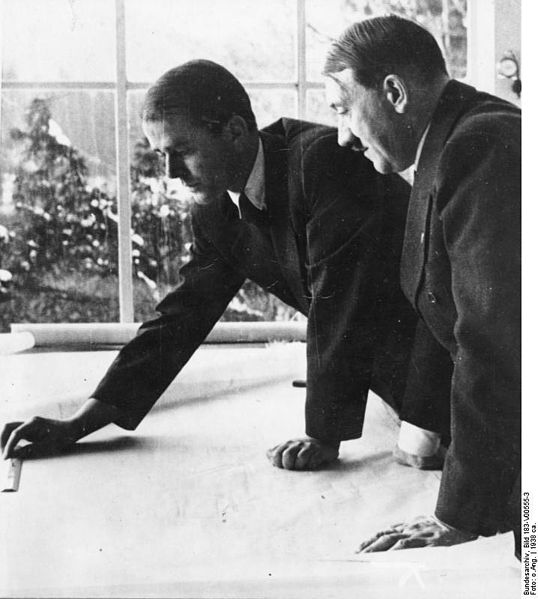
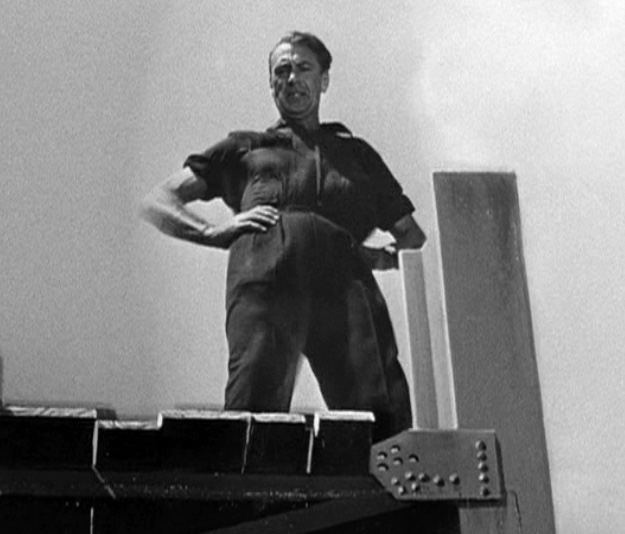
 In his autobiography ‘My Life’ Hitler titles Jews “parasites”. Hitler was a failed artist, his instructor telling him to take up architecture because his cityscapes were devoid of people. Inferior people got in the way of Hitler’s vision. His closest friend was Albert Speer, an architect who designed buildings for the Master Race, and, for the elevation of the Mass Mind. Hitler was like Howard Roark in Fountianhead. Like Howard he needed a huge cast to make his individuality stand out. Being a dictator and Father of his nation, is the “I stand alone” philosophy that forty million evangelical sheep have adopted as a means of Denial. The truth is, they love to back the latest charismatic prophet to lead them wherever his will will lead them.
Ryan Rand, and Stormon Mormon, have led the Republican Party over a cliff. In each passing day it is clear their Selfish Master Plan is made for the Super Rich and Powerful – by the Super Rich and Powerful, and, is not for everyone. Indeed, it is tailor-made for just a few, those builders of skyscrapers wherein the little sheep will be stuffed and fleeced as they pay their debt to the Lord of the Land.
If these Architects of Greed manage to do away with all secular offices of government, then when We the Poor People elect Democrats, there will be no offices for them to go to. Little people will have no power, and no vice. The Randy Hitlers of America will have scrubbed the city streets clean of beggars and parasites.
Jon Presco
Albert Speer (born Berthold Konrad Hermann Albert Speer;[1] pronounced [ˈʃpeːɐ̯] ( listen); March 19, 1905 – September 1, 1981) was a German architect who was, for a part of World War II, Minister of Armaments and War Production for the Third Reich. Speer was Adolf Hitler’s chief architect before assuming ministerial office. As “the Nazi who said sorry”,[a] he accepted responsibility at the Nuremberg trials and in his memoirs for crimes of the Nazi regime. His level of involvement in the persecution of the Jews and his level of knowledge of the Holocaust remain matters of dispute.
Speer joined the Nazi Party in 1931, launching him on a political and governmental career which lasted fourteen years. His architectural skills made him increasingly prominent within the Party and he became a member of Hitler’s inner circle. Hitler commanded him to design and construct a number of structures, including the Reich Chancellery and the Zeppelinfeld stadium in Nuremberg where Party rallies were held. Speer also made plans to reconstruct Berlin on a grand scale, with huge buildings, wide boulevards, and a reorganized transportation system.
As Hitler’s Minister of Armaments and War Production, Speer was so successful that Germany’s war production continued to increase despite massive and devastating Allied bombing. After the war, he was tried at Nuremberg and sentenced to 20 years in prison for his role in the Nazi regime, principally for the use of forced labor. He served his full sentence, most of it at Spandau Prison in West Berlin.
Following his release from Spandau in 1966, Speer published two bestselling autobiographical works, Inside the Third Reich and Spandau: The Secret Diaries, detailing his often close personal relationship with Hitler, and providing readers and historians with a unique perspective on the workings of the Nazi regime. He later wrote a third book, Infiltration, about the SS. Speer died of natural causes in 1981 while on a visit to London, England.[2]
Jon Presco
Although it is thought of as having been ‘written’ by Hitler, Mein Kampf is not a book in the usual sense. Hitler never actually sat down and pecked at a typewriter or wrote longhand, but instead dictated it to Rudolf Hess while pacing around his prison cell in 1923-24 and later at an inn at Berchtesgaden.
Reading Mein Kampf is like listening to Hitler speak at length about his youth, early days in the Nazi Party, future plans for Germany, and ideas on politics and race.
The original title Hitler chose was “Four and a Half Years of Struggle against Lies, Stupidity and Cowardice.” His Nazi publisher knew better and shortened it to “Mein Kampf,” simply My Struggle, or My Battle.
In his book, Hitler divides humans into categories based on physical appearance, establishing higher and lower orders, or types of humans. At the top, according to Hitler, is the Germanic man with his fair skin, blond hair and blue eyes. Hitler refers to this type of person as an Aryan. He asserts that the Aryan is the supreme form of human, or master race.
And so it follows in Hitler’s thinking, if there is a supreme form of human, then there must be others less than supreme, the Untermenschen, or racially inferior. Hitler assigns this position to Jews and the Slavic peoples, notably the Czechs, Poles, and Russians.
In Mein Kampf, Hitler states: “…it [Nazi philosophy] by no means believes in an equality of races, but along with their difference it recognizes their higher or lesser value and feels itself obligated to promote the victory of the better and stronger, and demand the subordination of the inferior and weaker in accordance with the eternal will that dominates this universe.”
Hitler then states the Aryan is also culturally superior.
“All the human culture, all the results of art, science, and technology that we see before us today, are almost exclusively the creative product of the Aryan…”
“Hence it is no accident that the first cultures arose in places where the Aryan, in his encounters with lower peoples, subjugated them and bent them to his will. They then became the first technical instrument in the service of a developing culture.”
Hitler goes on to say that subjugated peoples actually benefit by being conquered because they come in contact with and learn from the superior Aryans. However, he adds they benefit only as long as the Aryan remains the absolute master and doesn’t mingle or inter-marry with inferior conquered peoples.
But it is the Jews, Hitler says, who are engaged in a conspiracy to keep this master race from assuming its rightful position as rulers of the world, by tainting its racial and cultural purity and even inventing forms of government in which the Aryan comes to believe in equality and fails to recognize his racial superiority.
“The mightiest counterpart to the Aryan is represented by the Jew.”
Hitler describes the struggle for world domination as an ongoing racial, cultural, and political battle between Aryans and Jews. He outlines his thoughts in detail, accusing the Jews of conducting an international conspiracy to control world finances, controlling the press, inventing liberal democracy as well as Marxism, promoting prostitution and vice, and using culture to spread disharmony.
Throughout Mein Kampf, Hitler refers to Jews as parasites, liars, dirty, crafty, sly, wily, clever, without any true culture, a sponger, a middleman, a maggot, eternal blood suckers, repulsive, unscrupulous, monsters, foreign, menace, bloodthirsty, avaricious, the destroyer of Aryan humanity, and the mortal enemy of Aryan humanity…
“…for the higher he climbs, the more alluring his old goal that was once promised him rises from the veil of the past, and with feverish avidity his keenest minds see the dream of world domination tangibly approaching.”
This conspiracy idea and the notion of ‘competition’ for world domination between Jews and Aryans would become widespread beliefs in Nazi Germany and would even be taught to school children.
This, combined with Hitler’s racial attitude toward the Jews, would be shared to varying degrees by millions of Germans and people from occupied countries, so that they either remained silent or actively participated in the Nazi effort to exterminate the entire Jewish population of Europe.
Mein Kampf also provides an explanation for the military conquests later attempted by Hitler and the Germans. Hitler states that since the Aryans are the master race, they are entitled simply by that fact to acquire more land for themselves. This Lebensraum, or living space, will be acquired by force, Hitler says, and includes the lands to the east of Germany, namely Russia. That land would be used to cultivate food and to provide room for the expanding Aryan population at the expense of the Slavic peoples, who were to be removed, eliminated, or enslaved.
But in order to achieve this, Hitler states, Germany must first defeat its old enemy France, to avenge the German defeat of World War I and to secure the western border. Hitler bitterly recalls the end of the First World War, saying the German Army was denied its chance for victory on the battlefield by political treachery at home. In the second volume of Mein Kampf he attaches most of the blame to Jewish conspirators in a highly menacing and ever more threatening tone.
When Mein Kampf was first released in 1925 it sold poorly. People had been hoping for a juicy autobiography or a behind-the-scenes story of the Beer Hall Putsch. What they got were hundreds of pages of long, hard to follow sentences and wandering paragraphs composed by a self-educated man.
However, after Hitler became Chancellor of Germany, millions of copies were sold. It was considered proper to own a copy and to give one to newlyweds, high school graduates, or to celebrate any similar occasion. But few Germans ever read it cover to cover. Although it made him rich, Hitler would later express regret that he produced Mein Kampf, considering the extent of its revelations.
Those revelations concerning the nature of his character and his blueprint for Germany’s future served as a warning to the world. A warning that was mostly ignored.
 Rosamond Press
Leave a comment