Jon Rose Man
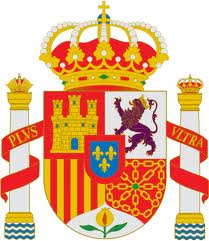
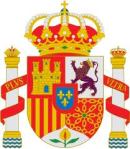
The current coat of arms of Spain, although it has its roots centuries ago, was approved by law[1] in 1981, when the present established replaced the interim version which, in turn, replaced the official arms of Francoist Spain. The coat of arms appears in the flag of Spain.
The Spanish coat of arms symbolizes the country, the old kingdoms of Spain, the Royal Crown, the Imperial Crown, the Constitutional monarchy, the Spanish national motto: Plus Ultra, and the Pillars of Hercules with the Spanish geographic situation.
The rose is the official flower of the Guild and fresh roses are present at all Guild meetings. The placement, color, and state of bloom of the roses carry subtle messages for Guild members on the nature of the meeting and how to conduct themselves. There are no posted announcements of the subject matter of meetings or printed rules of behavior. Only the silent message of the rose guides members on a heart-to-heart basis.
Historically, roses represent the presence of our founder and patron, Wilhelm von Rosenberg, whose family name means literally “mountain of roses.” The rose carried deep personal meaning for him. The five-petaled red rose figures prominently in his personal coat of arms (shown at left), and the rose symbol is present in many other forms at all of his family estates.
To understand the archetypal signature of the rose, it is necessary to suspend one’s intellectual and cultural connections to it and simply be open to the “presence” of the rose. This popular flower has a complicated symbology with paradoxical meanings. It is at once a symbol of both purity and passion, both heavenly perfection and earthly desire; both virginity and fertility; both death and life. The rose is the flower of the goddesses Isis and Venus but also the blood of Osiris, Adonis, and Christ.
Originally a symbol of joy, the rose later indicated secrecy and silence but is now usually associated in the common mind with romantic love. But the rose is much more meaningful, much older and more deeply embedded in the human unconscious than most people believe. Rose fossils 35 million year old have been found in Europe, and petrified rose wreaths have been unearthed from the oldest Egyptian tombs. At Guild meetings, the symbology of the rose is associated with the color (or combinations of colors) of its petals:
Red Roses: passion, love; vitality, feeling of being alive; masculine or active energy; creative projects; workshops
White Roses: purity, innocence; acceptance; unconditional love; feminine or passive energy; initiation of new members, construction projects
Black (or Withered) Roses: love is gone or over; disaster; depression; death; problem discussions; emergency meetings
Pink Roses: gentleness; softness; thankfulness; loving and supportive friendship; awards and honors
Yellow Roses: compassion; camaraderie; free-flowing conversations; joy and security; social affairs; dinners; intellectual lectures
Orange Roses: enthusiasm; fascination; optimism; planning meetings
Blue Roses: spiritual longing; promise of a perfect world; group meditations
Golden (or Gilded) Roses: completion of important project; perfection of oneself; invocation of cosmic energy; invocation of past masters
The numerological elements of the rose are also present in Guild documents and meetings. In general, the rose represents the number five. This is because the wild rose has five petals, and the total petals on roses are in multiples of five. Geometrically, the rose corresponds with the pentagram and pentagon. Five represents the Fifth Element, the life force, the heart or essence of something. In an absolute sense, the rose has represented the expanding awareness of life through the development of the senses. Six-petaled varieties indicate balance and love; seven-petaled varieties indicate transformative passion; and rare eight-petaled roses indicate regeneration, a new cycle, or a higher level of space and time.
The rose is one of the fundamental symbols of alchemy and became the philosophical basis of Rosicrucian alchemy. It was so important to alchemists that there are many texts called “Rosarium” (Rosary), and all these texts deal with the relationship between the archetypal King and Queen. We have noted the Rosarium of Jaros Griemiller, an original member of the Guild. Another important Rosarium was prepared by alchemist Arnold de Villanova, who also interacted with Guild members.
In alchemy, the rose is primarily a symbol of the operation of Conjunction, the Mystical Marriage of opposites. It represents the regeneration of separated essences and their resurrection on a new level. In the Practice of Psychotherapy, Carl Jung discussed the archetypal underpinnings of love between people in terms of the rose: “The wholeness which is a combination of ‘I and you’ is part of a transcendent unity whose nature can only be grasped in symbols like the rose or the coniunctio (Conjunction).”
In alchemy the red rose is regarded as a masculine, active, expansive principle of solar spirit (Sulfur), where the white rose represents the feminine, receptive, contractive principle of lunar soul (Salt). The combination of white and red roses (spirit and soul) symbolizes the birth of the Philosopher’s Child (Mercury). During the operation of Conjunction, the relationship of the masculine red rose to the feminine white rose is the same relationship depicted in alchemical images of the Red King and the White Queen or the Red Sun and White Moon. White roses were linked to the White Phase of the Work (albedo) and the White Stone of Multiplication, while the red rose was associated with the Red Phase and the Red Stone of Projection.
The single golden (or gilded) rose is a symbol completion of the Great Work or of some consummate achievement in personal or laboratory alchemy. The Popes used to bless a Golden Rose on the fourth Sunday in Lent, as a symbol of their spiritual power and the certainty of resurrection and immortality. In alchemical terms, the golden rose means a successful marriage of opposites to produce the Golden Child, the perfected essence of both King and Queen.
Because Mary is the Christian model of union with God, the rose and the rosary became symbols of the union between god and mankind. Scenes of Mary in a rose garden or under a rose arbor or before a tapestry of roses reinforces this idea. Mary holds a rose and not a scepter in the art of the Middle Ages, which means her power comes from divine love. The rose garden in alchemical drawings is a symbol of sacred space. It could mean a meditation chamber or tabernacle, an altar, a sacred place in nature, or paradise itself. In all these instances, the rose garden is the mystical bridal chamber, the place of the mystic marriage.
The rose has obvious connections with sexual energy in alchemy. The “rose colored blood of the alchemical redeemer” or the “warm red tincture” were references to healing effects of purified (alchemically distilled or sublimated) sexual energy. For instance, the Renaissance alchemist Gerhardt Dorn calls rose-colored blood a vegetabile naturae whereas ordinary blood was a vegetabile materiae. In other words, rose-colored blood carries the natural essence or soul, while ordinary blood simply functions on the physical level to supply oxygen to cells, etc. That is the meaning of the alchemical phrase, “The soul of the Stone is in its blood,” or as Carl Jung put it: “The rose red color is related to the aqua permanens and the soul, which are extracted from the prima materia.” The sword and knife, symbols of the Separation operation, carry such power in alchemy partly because of their ability to draw blood.
In spiritual alchemy, the single red rose represents the mystic center of a person, his or her heart of hearts – one’s true nature. It also represents the process of purification to reveal one’s essence or the inner “pearl beyond price.” Sufi spiritual alchemist Rumi described this idea when he wrote: “In the driest whitest stretch of pain’s infinite desert, I lost my sanity and found this rose.” As a symbol of the Mystical Marriage on a personal level, the red rose represents a special kind of love in which one “melts away” into the beauty of another, and the old identity is surrendered for that of the beloved or a higher identity within oneself. In this sense, the rose is a symbol of complete surrender and permanent transmutation.
Alchemist Daniel Maier discusses the symbolism of the rose in his Septimana Philosophica: “The rose is the first, most beautiful and perfect of flowers. It is guarded because it is a virgin, and the guard is thorns. The Gardens of Philosophy are planted with many roses, both red and white, which colors are in correspondence with gold and silver. The center of the rose is green and is emblematical of the Green Lion [First Matter]. Even as a natural rose is a pleasure to the senses and life of man, on account of its sweetness and salubrity, so is the Philosophical Rose exhilarating to the heart and a giver of strength to the brain. Just as the natural rose turns to the sun and is refreshed by rain, so is the Philosophical Matter prepared in blood, grown in light, and in and by these made perfect.”
Because of its association with the workings of the heart, the rose in alchemy has come to symbolize secrets of the heart or things that cannot be spoken or an oath of silence in general. In the folded structure of the rose, the flower seems to be concealing a secret inner core. “Mystery glows in the rose bed and the secret is hidden in the rose,” wrote the twelfth-century Persian alchemist Farid ud-din Attar.
During Alchemy Guild meetings, a red rose hung from the ceiling indicates the material to be discussed is confidential for members only and is to be kept secret. On the Guild’s websites and in its printed matter, a red rose icon or the Latin phrase “sub rosa” (“under the rose”) indicates the material is secret. Clicking on this icon on websites will take the visitor to password-protected areas intended for members only. This concept originates in the hermetic tradition of hanging red roses from the ceiling of meetings to indicate that discretion was called for and none of the information discussed should leave the room. The symbol was used in a number of hermetic organizations in the late Middle Ages and Renaissance and was well known to alchemists. For instance, in Sebastian Brant’s fifteenth-century alchemical treatise “Narrenschiff” (“Ship of Fools”), the author warns: “What here we do say, shall under roses stay.”
Rudolf II, Holy Roman Emperor
From Wikipedia, the free encyclopedia
Jump to: navigation, search
“Rudolf II” redirects here. For 13th century Duke of Austria, see Rudolf II, Duke of Austria.
Rudolf II
King of Germany (King of the Romans)
Reign
27 October 1575 – 1612
Coronation
1 November 1575, Regensburg
Predecessor
Maximilian II
Successor
Matthias
King of Hungary and Croatia
Reign
1572–1608
Coronation
25 September 1572, Pressburg
Predecessor
Maximilian II
Successor
Matthias
King of Bohemia
Reign
1576–1611
Coronation
22 September 1575, Prague
Predecessor
Maximilian II
Successor
Matthias
Holy Roman Emperor;
Archduke of Austria
Reign
12 October 1576 – 20 January 1612
Predecessor
Maximilian II
Successor
Matthias
House
House of Habsburg
Father
Maximilian II
Mother
Maria of Spain
Born
18 July 1552
Vienna, Austria
Died
20 January 1612(1612-01-20) (aged 59)
Prague, Bohemia
Burial
St. Vitus Cathedral, Prague
Religion
Roman Catholicism
Rudolf II (July 18, 1552 – January 20, 1612) was Holy Roman Emperor (1576–1612), King of Hungary and Croatia (1572–1608), King of Bohemia (1575–1608/1611) and Archduke of Austria (1576–1608). He was a member of the House of Habsburg.
Rudolf’s legacy has traditionally been viewed in three ways:[1] an ineffectual ruler whose mistakes led directly to the Thirty Years’ War; a great and influential patron of Northern Mannerist art; and a devotee of occult arts and learning which helped seed the scientific revolution.
Contents
[hide]
1 Biography
2 Patron of arts
3 Occult sciences
4 Ancestors
5 See also
6 Notes
7 References
8 External links
[edit] Biography
Archduke Rudolf
Rudolf was born in Vienna on 18 July 1552. He was the eldest son and successor of Maximilian II, Holy Roman Emperor, King of Bohemia, and King of Hungary and Croatia; his mother was Maria of Spain, a daughter of Charles V and Isabella of Portugal.
Rudolf spent eight formative years, from age 11 to 19 (1563–1571), in Spain, at the court of his maternal uncle Phillip II. After his return to Vienna, his father was concerned about Rudolf’s aloof and stiff manner, typical of the more conservative Spanish court, rather than the more relaxed and open Austrian court; but his Spanish mother saw in him courtliness and refinement.[2] Rudolf would remain for the rest of his life reserved, secretive, and largely a homebody who did not like to travel or even partake in the daily affairs of state.[2] He was more intrigued by occult learning such as astrology and alchemy, which was mainstream in the Renaissance period, and had a wide variety of personal hobbies such as horses, clocks, collecting rarities, and being a patron of the arts. He suffered from periodic bouts of “melancholy” (depression), which was common in the Habsburg line. These became worse with age, and were manifested by a withdrawal from the world and its affairs into his private interests.
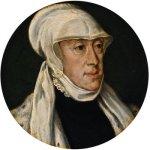
Maria van Hongarije (1505-1558) | Thuis in Brabant
Maximilian was born at Wiener Neustadt on 22 March 1459. At the time, the Dukes of Burgundy, a cadet branch of the French royal family, with their sophisticated nobility and court culture, were the rulers of vast territories on the eastern and northern boundaries of modern-day France. The reigning duke of Burgundy, Charles the Bold, was the chief political opponent of Maximilian’s father Frederick III. Frederick was concerned about Burgundy’s expansive tendencies on the western border of his Holy Roman Empire, and to forestall military conflict, he attempted to secure the marriage of Charles’s only daughter, Mary of Burgundy, to his son Maximilian. After the Siege of Neuss (1474–75), he was successful. The wedding between Maximilian and Mary took place on the evening of 16 August 1477.[2]
[edit] Reign in Burgundy and The Netherlands
Maximilian’s coin with the Burgundian Order of the Golden Fleece
Maximilian’s wife had inherited the vast Burgundian domains in France and the Low Countries upon her father’s death in the Battle of Nancy on 5 January 1477. Already before his coronation as the King of the Romans in 1486, Maximilian decided to secure this distant and extensive Burgundian inheritance to his family, the House of Habsburg, at all costs.[3]
The Duchy of Burgundy was also claimed by the French crown under Salic Law,[4] with Louis XI, King of France vigorously contesting the Habsburg claim to the Burgundian inheritance by means of military force. Maximilian undertook the defence of his wife’s dominions from an attack by Louis XI and defeated the French forces at Guinegate, the modern Enguinegatte, on 7 August 1479.[5]
The wedding contract between Maximilian and Mary stipulated that only the children of bride and groom had a right to inherit from each, not the surviving parent. Mary tried to bypass this rule with a promise to transfer territories as a gift in case of her death, but her plans were confounded. After Mary’s tragic death in a riding accident on 27 March 1482 near the Wijnendale Castle, Maximilian’s aim was now to secure the inheritance to one of his and Mary’s children, Philip the Handsome.[3]
Some of the Netherland provinces were hostile to Maximilian, and they signed a treaty with Louis XI in 1482 that forced Maximilian to give up Franche-Comté and Artois to the French crown.[4] Maximilian continued to govern Mary’s remaining inheritance in the name of Philip the Handsome. After the regency ended, Maximilian and Charles VIII of France exchanged these two territories for Burgundy and Picardy in the Treaty of Senlis (1493). Thus a large part of the Netherlands (known as the Seventeen Provinces) stayed in the Habsburg patrimony.[4]
Karl von HabsburgFrom Wikipedia, the free encyclopediaJump to: navigation, search
This article is about the living politician. For other uses, see Archduke Charles of Austria (disambiguation).
Karl von Habsburg
Prince Imperial and Archduke of Austria, Prince Royal of Hungary and Bohemia
Head of the House of Habsburg-Lorraine
Period 1 January 2007 – present
(&100000000000000050000005 years, &10000000000000213000000213 days)
Predecessor Crown Prince Otto
Heir apparent Archduke Ferdinand
Spouse Baroness Francesca Thyssen-Bornemisza
Issue
Eleonore Habsburg-Lothringen
Ferdinand Zvonimir Habsburg-Lothringen
Gloria Habsburg-Lothringen
Full name
Karl Thomas Robert Maria Franziskus Georg Bahnam
House House of Habsburg-Lorraine
Father Otto von Habsburg
Mother Princess Regina of Saxe-Meiningen
Born (1961-01-11) 11 January 1961 (age 51)
Starnberg, Bavaria, Germany
Karl von Habsburg (Karl Thomas Robert Maria Franziskus Georg Bahnam; born 11 January 1961), referred to in Austria as Karl Habsburg-Lothringen, in France as Charles de Habsbourg-Lorraine, in the Czech Republic as Karel Habsbursko-Lotrinský, in Hungary as Habsburg Károly, and by his royal name as Archduke Karl of Austria,[1] or, by monarchists, Karl II of Austria or Károly V of Hungary, is an Austrian politician, and the current Head of the House of Habsburg, and the Grand Master of the Order of the Golden Fleece. Born in Starnberg, Bavaria, Germany, he is the son of Otto von Habsburg and Princess Regina of Saxe-Meiningen, and the grandson of the last Austrian emperor, Charles I. He served as a Member of the European Parliament for the Austrian People’s Party 1996–1999.
Contents [hide]
1 Political career
2 House of Habsburg
3 Business career
4 Private life
5 Ancestry
5.1 Patrilineal descent
6 Notes
7 References
[edit] Political careerSince 1986, Karl von Habsburg has been president of the Austrian branch of the Paneuropean Union. After studying law for 12 years, in 1992/1993, he had a TV game show with Austrian public TV broadcaster ORF, called Who is Who.[2][3] In October 1996, he was elected to the European Parliament for the Austrian People’s Party (ÖVP). Two years later, it emerged that the ÖVP’s election campaign had benefitted from 30,000 euros of World Vision donation money via Paneurope Austria while Karl von Habsburg sat on the board of World Vision Austria, apparently without noticing the director’s dubious activities.[4]
His father exacerbated the controversy when he complained that his son was being attacked unfairly and drew a parallel between the name “Habsburg” and a yellow badge.[4] ÖVP did not nominate Karl von Habsburg again for the 1999 elections.[2][5] In 2004, Karl von Habsburg paid 37,000 euros to the new World Vision Austria branch.[5]
On 19 January 2002, he was appointed Director General of UNPO (Unrepresented Nations and Peoples Organization) by the UNPO Steering Committee.[6] Since 7 December 2008, he is the President of the Association of National Committees of the Blue Shield.[7]
[edit] House of HabsburgAustrian Imperial Family
HI&RH Archduke Karl
HI&RH Archduchess Francesca
HI&RH Archduchess Eleonore
HI&RH Archduke Ferdinand
HI&RH Archduchess Gloria
——————————————————————————–
HI&RH The Hereditary Countess of Neipperg
HI&RH The Duchess of Santangelo
HI&RH Archduchess Michaela
HI&RH Archduchess Gabriela
HI&RH Archduchess Walburga
HI&RH Archduke Georg
HI&RH Archduchess Eilika
HI&RH Archduchess Zsófia
HI&RH Archduchess Ildiko
HI&RH Archduke Károly-Konstantin
——————————————————————————–
Extended family[show]
——————————————————————————–
Descendants of Archduke Robert:
——————————————————————————–
HI&RH The Dowager Archduchess
HI&RH Archduchess Maria BeatrixHI&RH The Archduke of Austria-Este
HI&RH The Archduchess of Austria-Este HI&RH Prince AmadeoHI&RH Princess Maria LauraHI&RH Prince JoachimHI&RH Princess Luisa MariaHI&RH Princess Laetitia MariaHI&RH Archduke GerhardHI&RH Archduke Martin
HI&RH Archduchess Katharina HI&RH Archduke BartholomaeusHI&RH Archduke EmmanuelHI&RH Archduchess HeleneHI&RH Archduke LuigiHI&RH Archduchess Isabella
——————————————————————————–
Descendants of Archduke Felix:
——————————————————————————–
HI&RH Archduchess Anna-Eugénie
HI&RH Archduchess PilarHI&RH Archduke Carl Philipp
HI&RH Archduchess Annie-ClaireHI&RH Archduchess KingaHI&RH Archduchess BettineHI&RH Archduchess MiriamHI&RH Archduke István
HI&RH Archduchess Paola HI&RH Archduke AndreasHI&RH Archduke PálHI&RH Archduchess MargueriteHI&RH Archduchess Viridis
——————————————————————————–
Descendants of Archduke Carl Ludwig:
——————————————————————————–
HI&RH Archduchess Yolande
HI&RH Archduke Rudolf
HI&RH Archduchess Marie Hélène HI&RH Archduke Carl Christian
HI&RH Archduchess Estelle HI&RH Archduchess ZitaHI&RH Archduchess AnežkaHI&RH Archduchess PriscillaHI&RH Archduke JohannesHI&RH Archduke ThomasHI&RH Archduchess MarieHI&RH Archduke Franz-LudwigHI&RH Archduke MichaelHI&RH Archduke JosephHI&RH Archduchess AlexandraHI&RH Archduke Carl Christian
HI&RH Archduchess Marie Astrid HI&RH Archduchess Marie ChristineHI&RH Archduke ImreHI&RH Archduke ChristophHI&RH Archduke AlexanderHI&RH Archduchess GabriellaHI&RH Archduchess Maria Constanza
——————————————————————————–
Descendants of Archduke Rudolf:
——————————————————————————–
HI&RH Archduchess Anna Gabriele
HI&RH Archduchess Maria AnnaHI&RH Archduke Karl Peter
HI&RH Archduchess Alexandra HI&RH Archduchess AntoniaHI&RH Archduke LorenzHI&RH Archduke Simeon
HI&RH Archduchess María HI&RH Archduke JohannesHI&RH Archduke LudwigHI&RH Archduchess IsabellaHI&RH Archduchess CharlotteHI&RH Archduke PhilippHI&RH Archduchess Catharina-Maria
Extended family[show]
——————————————————————————–
Descendants of Archduke Maximilian Eugen:
——————————————————————————–
HI&RH Archduchess Helene HI&RH The Princess of Windisch-GrätzHI&RH Archduke Maximilian
HI&RH Archduchess Maya HI&RH Archduke Nikolaus HeinrichHI&RH Archduke ConstantinHI&RH Archduchess KatharinaHI&RH Archduke Heinrich
HI&RH Archduchess Ludmilla HI&RH Archduke Philipp
HI&RH Archduchess Mayasuni HI&RH Archduchess Amaya AnnaHI&RH Archduchess Marie-ChristineHI&RH Archduke Ferdinand
HI&RH Archduchess Katharina HI&RH Archduke Jakob-MaximilianHI&RH Archduchess PaulinaHI&RH Archduchess Lara SophieHI&RH Archduke Konrad
HI&RH Archduchess Ashmita
——————————————————————————–
Descendants of Archduke Joseph Francis:
——————————————————————————–
HI&RH Archduke Joseph Arpád
HI&RH Archduchess Maria HI&RH Archduchess Monika-IlonaHI&RH Archduke Joseph Karl
HI&RH Archduchess Margarete HI&RH Archduchess JohannaHI&RH Archduke Joseph AlbrechtHI&RH Archduke Paul LeoHI&RH Archduchess ElisabethHI&RH Archduchess Maria ChristineHI&RH Archduke Andreas-Augustinus
HI&RH Archduchess Marie-Christine HI&RH Archduke Friedrich-CyprianHI&RH Archduke PierreHI&RH Archduchess Célina MariaHI&RH Archduchess Maria-FlorianaHI&RH Archduke Benedikt-AlexanderHI&RH Archduchess AlexandraHI&RH Archduke Nicolaus
HI&RH Archduchess Eugenia HI&RH Archduke Nicolas AugustinHI&RH Archduchess Sofia EugeniaHI&RH Archduke SantiagoHI&RH Archduke Johannes Jacobus
HI&RH Archduchess Maria Gabriela HI&RH Archduke Johannes MariaHI&RH Archduke IstvánHI&RH Archduchess Maria KyngaHI&RH Archduke GézaHI&RH Archduke Michael Koloman
HI&RH Archduchess Christina HI&RH Archduke Eduard
HI&RH Archduchess Marie Therese HI&RH Archduchess Anne CarolineHI&RH Archduchess Theresa MariaHI&RH Archduke Paul BenediktHI&RH Archduchess SophieHI&RH Archduchess LadislayaHI&RH Archduchess RosaHI&RH Archduke PaulHI&RH Archduchess Margherita
Extended family[show]The Grand Ducal Family of TuscanyThe Ducal Family of Hohenberg
v ·t ·e
In 1961, his father Otto von Habsburg renounced all claims to the Austrian throne, as a necessary legal condition to being allowed to return to Austria.
On 30 November 2000 Karl’s father transferred over to him the position of Head and Sovereign of the Order of the Golden Fleece.[8]
In 2005, Karl von Habsburg filed an unsuccessful suit before Austria’s constitutional court after a failed attempt to have former properties of the Habsburg family returned. The family’s estates had been expropriated by the First Republic, this had in part been reverted under Austrofascism, and then the Nazis had expropriated them again. The family tried to get their former property returned under rules for victims of the Nazi regime. The attempt failed because the law of expropriation still has constitutional status.[9]
On 1 January 2007, his father, Otto von Habsburg, relinquished his position as the head of the House of Habsburg, a status which then devolved on Karl.[10]
Habsburg’s full legal name in Austria is Karl Thomas Robert Maria Franziskus Georg Bahnam Habsburg-Lothringen. All noble, royal, and imperial titles are illegal in Austria and in Hungary, and the family does not use them in these countries.[fn 1]
[edit] Business careerKarl von Habsburg is one of the three co-founders of BG Privatinvest, a Vienna-based investment company. In December 2010 the company acquired the two most important Bulgarian daily newspapers, Dneven Trud and 24 Chasa.[11] After ongoing conflicts with Bulgarian partners, BG Privatinvest sold the newspapers in April 2011.[12]
[edit] Private lifeKarl von Habsburg was born in Germany. He was baptised in Pöcking, Bavaria, as Archduke Karl of Austria (Erzherzog Karl von Österreich), the name entered in the baptismal records.[13] At the time of his birth, his father was de facto stateless and possessed a Spanish diplomatic passport, while his mother was a German citizen. Like his father and siblings, he was banished from Austria for the first years of his life.
He has lived in Salzburg, Austria, since 1981. He resides in Casa Austria, formerly called Villa Swoboda, in Anif, near the city of Salzburg.[14]
On 31 January 1993, he married Francesca Thyssen-Bornemisza, the only daughter of Baron Hans Heinrich Thyssen-Bornemisza de Kászon, a European industrialist, and his second wife, Fiona Campbell Walter.[15] The marriage received the dynastic authorization of Karl’s father, as head of the House of Habsburg, despite objections from some members of the family inasmuch as the bride, although a baroness in the nobility of pre-republican Hungary and Transylvania, did not descend in the canonically legitimate male line from a family of dynastic, mediatised or alter Adel status.[16][17] Karl and Francesca have three children:
Eleonore Jelena Maria del Pilar Iona, born 28 February 1994 in Salzburg
Ferdinand Zvonimir Maria Balthus Keith Michal Otto Antal Bahnam Leonhard, born 21 June 1997 in Salzburg
Gloria Maria Bogdana Paloma Regina Fiona Gabriela, born 15 October 1999 in Salzburg; her godmother is Gloria, Princess of Thurn and Taxis.[18]
Karl and Francesca separated in 2003.[19]
In July 1998 an Austrian court fined Karl von Habsburg 180,000 schillings ($14,300); he had failed to declare immediately to customs officials that he had an antique diadem in his luggage when he crossed the border from Switzerland in July 1996.[20] The diadem belonged to his wife who intended to wear it at a wedding ceremony.
[edit] Ancestry[show]Ancestors of Karl von Habsburg
16. Archduke Karl Ludwig of Austria
8. Archduke Otto of Austria
17. Princess Maria Annunciata of Bourbon-Two Sicilies
4. Charles I of Austria
18. George of Saxony
9. Princess Maria Josepha of Saxony
19. Infanta Maria Anna of Portugal
2. Otto von Habsburg
20. Charles III, Duke of Parma
10. Robert I, Duke of Parma
21. Princess Louise Marie Thérèse d’Artois
5. Princess Zita of Bourbon-Parma
22. Miguel of Portugal
11. Infanta Maria Antonia of Portugal
23. Princess Adelaide of Löwenstein-Wertheim-Rosenberg
1. Karl von Habsburg
24. Georg II, Duke of Saxe-Meiningen
12. Prince Friedrich Johann of Saxe-Meiningen
25. Princess Feodora of Hohenlohe-Langenburg
6. Georg, Prince of Saxe-Meiningen
26. Ernst, Count of Lippe-Biesterfeld
13. Countess Adelaide of Lippe-Biesterfeld
27. Countess Caroline von Wartensleben
3. Princess Regina of Saxe-Meiningen
28. Count Maximilian Frederick von Korff gen. Schmising-Kersonbrock
14. Count Alfred von Korff gen. Schmising-Kersonbrock
29. Countess Gabrielle von Mirbach-Kosmanos
7. Countess Clara Maria von Korff gen. Schmising-Kersonbrock
30. Baron Francis Richard von Hilgers
15. Baroness Hélène von Hilgers
31. Agnes Zernentsch
[edit] Patrilineal descentKarl is a member of the House of Habsburg-Lorraine, descended from the Dukes of Lorraine, of Frankish origin.
Karl’s patriline is the line from which he is descended father to son. It follows the Emperors of Austria, the Dukes of Lorraine and before them, the Counts of Norgau. The line can be traced back more than 1,400 years and is one of the oldest in Europe.
1.Aymes (490)
2.Wago, Count of Montreuil 512-XXX
3.Leuthaire, Duke of Allemania (d533/4)
4.Erchenaud (Erkembald)
5.Leuthaire [II] (Laetharus)
6.Erchinold, Major Domo of France (d657/661)
7.Leuthaire [III], aka Leudisius of Peronne, Major Domo of France (d673)
8.Adalric or Etichon, c. 630 – bef. 690, Duke of Alsace from 670; brother of Gandalen, Abbot of Béze who died aft. 677
9.Adalric or Haicon, c. 670 – aft. 726, Count of Norgau
10.Albéric, c. 710 – c. 760, Count of Norgau c. 730 – 735
11.Eberard I, c. 745 – c. 795, Count of Norgau 765 – 777
12.Eberard II, c. 790 – c. 864, Count of Norgau in 864
13.Eberard III, 830 – c. 900, Count of Norgau in 885
14.Hugues I, bef. 875 – c. 940, Count of Norgau
15.Eberard IV, 905 – 18 December 967, Count of Norgau until 951
16.Adalbert, c. 955 – aft. 1033, Count of Metz in c. 890, Founder of the Monastery of Bougainville
17.Gerard de Bouzonville, Count of Metz, c. 985 – 1045
18.Gerard, Duke of Lorraine, c. 1028 – 1070; his older brother Adalbert, c. 1016 – 1048, Count of Longwy, Duke of Haute Lorraine from 1047 to 1048, was the patrilineal ancestor of the Counts of Burgundy and the Kings of Castile from the 12th century to the 15th century
19.Theodoric II, Duke of Lorraine, c. 1055 – 1115
20.Simon I, Duke of Lorraine, c. 1080 – 1138; his younger brother Thierry of Alsace, d. c. 1168, Count of Flanders, was the patrilineal ancestor of the House of Flanders
21.Matthias I, Duke of Lorraine, c. 1110 – 1176
22.Frederick I, Duke of Lorraine, c. 1140 – 1207
23.Frederick II, Duke of Lorraine, c. 1165 – 1213
24.Matthias II, Duke of Lorraine, c. 1192 – 1251
25.Frederick III, Duke of Lorraine, c. 1230 – 1303
26.Theobald II, Duke of Lorraine, c. 1260 – 1312
27.Frederick IV, Duke of Lorraine, 1282–1328
28.Rudolph, Duke of Lorraine, c. 1310 – 1346
29.John I, Duke of Lorraine, 1346–1390
30.Frederick of Lorraine, 1371–1415
31.Antoine of Vaudémont, c. 1395 – 1431
32.Frederick II of Vaudémont, 1417–1470
33.René II, Duke of Lorraine, 1451–1508
34.Antoine, Duke of Lorraine, 1489–1544
35.Francis I, Duke of Lorraine, 1517–1545
36.Charles III, Duke of Lorraine, 1543–1608
37.Francis II, Duke of Lorraine, 1572–1632
38.Nicholas II, Duke of Lorraine, Cardinal, 1609–1679
39.Charles V, Duke of Lorraine, 1643–1690
40.Leopold, Duke of Lorraine, 1679–1729
41.Francis I, Holy Roman Emperor, 1708–1765
42.Leopold II, Holy Roman Emperor, 1747–1792
43.Francis II, Holy Roman Emperor, 1768–1835
44.Archduke Franz Karl of Austria, 1802–1878
45.Archduke Charles Louis of Austria, 1833–1896
46.Archduke Otto Francis of Austria, 1865–1906
47.Blessed Charles I of Austria, 1887–1922
48.Otto von Habsburg, 1912-2011
49.Karl von Habsburg, 1961-
The descent before Gerard de Bouzonville is taken from a work published by Portuguese genealogist Luís Paulo Manuel de Meneses de Melo Vaz de São Paio and is not certa

 Rosamond Press
Leave a comment