
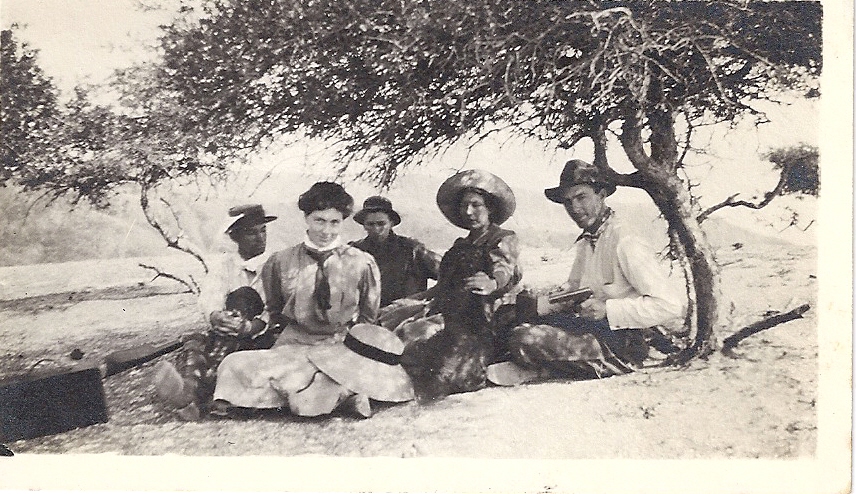
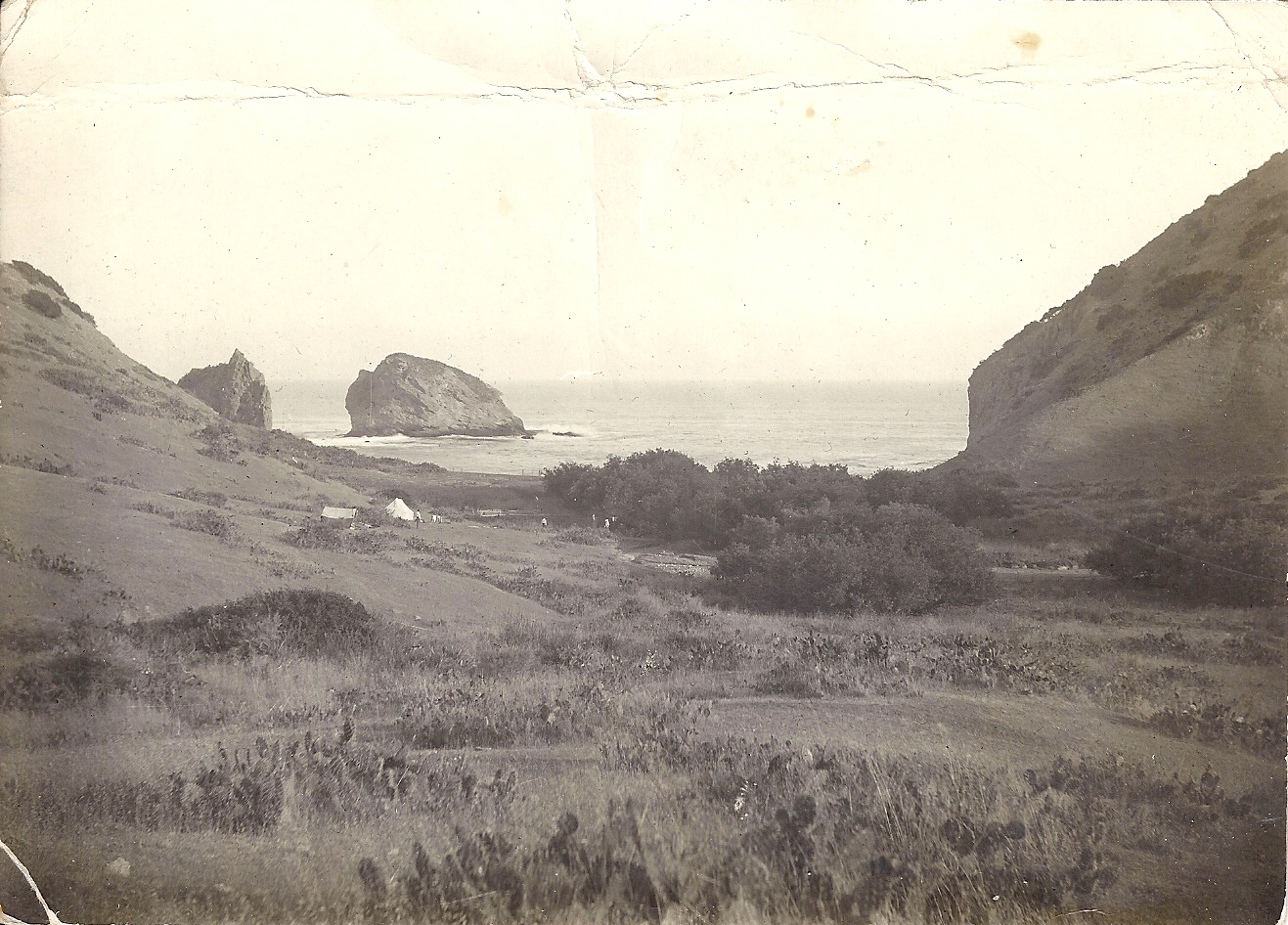

Monday I talked with Drew and Vicki about doing a painting of our grandmother sitting under a tree with her and Royal’s friends. Royal Rosamond camped on the Channel Islands. I believe he took the photographs. I will consult with a Channel Island historian who would want these photos. Mary is the woman with the large hat.
Jon Presco
Pre-European settlement
Prior to the modern era, Avalon Bay was inhabited by people of the Gabrielino/Tongva tribe. In addition to Catalina Island, the Tongva occupied present-day Los Angeles County, northern Orange County, and San Clemente Island. The island was a major source of soapstone to the Tongva, who used the material to make stone vessels for cooking.[5] The Tongva called the island Pimu or Pimugna and referred to themselves as the Pimugnans.[6] The Pimugnans had settlements all over the island at one time or another. Their biggest villages, most likely, were located at Avalon Bay, as well as at the Isthmus and Emerald Bay.[citation needed] By the 1830s, the entire island’s native population had either died off, or had migrated to the mainland to work in the missions or as ranch hands for the many private land owners.[7]
[edit] Early developers
In the 1840s, the Mexican governor Pio Pico gave the island of Catalina as a grant to Don Jose Corruvias of Santa Barbara. The island traded hands dozens of times in the ensuing years. In 1864, during the Civil War, it was occupied by Union troops, who built and occupied Camp Santa Catalina Island for most of that year. Federal commanders planned to use the island as an Indian reservation for the tribes they were fighting in northwestern California and as a coastal fortification. It was finally acquired in the 1860s by James Lick, whose estate maintained control of the island for approximately the next 25 years.[8]
The first owner to try to develop Avalon Bay into a resort destination was George Shatto, a real estate speculator from Grand Rapids, Michigan. Shatto purchased the island for $200,000 from the Lick estate at the height of a real estate boom in Southern California in 1887. Shatto created the settlement that would become Avalon, and can be credited with building the town’s first hotel, the original Hotel Metropole, and pier.[9] His sister-in-law Etta Whitney came up with the name Avalon, which was pulled as a reference from Alfred, Lord Tennyson’s poem “Idylls of the King”, about the legend of King Arthur.
Mr. and Mrs. Shatto and myself were looking for a name for the new town, which in its significance should be appropriate to the place, and the names which I was looking up were ‘Avon’ and ‘Avondale,’ and I found the name ‘Avalon,’ the meaning of which, as given in Webster’s unabridged, was ‘Bright gem of the ocean,’ or Beautiful isle of the blest.’
—Etta Whitney[8]
The total population as of the 2000 census was 3,696 persons, almost 85 percent of whom live in the island’s only incorporated city, Avalon (pop. 3,728 (2010), with another 195 south of town, outside of the city limits). The second center of population is the unincorporated village of Two Harbors, in the north, with a population of 298. Development occurs also at the smaller settlements of Rancho Escondido and Middle Ranch. The remaining population is scattered over the island between the two population centers. The island has an overall population density of 49.29/mi² (19.03/km²).
On 27 June 1542, Cabrillo set out from Navidad (in Jalisco) in New Spain with three ships: the 200-ton galleon and flagship San Salvador, the ship La Victoria (c. 100 tons), and the lateen-rigged, twenty-six oared “fragata” or “bergantin” San Miguel.[2] On 1 August Cabrillo anchored within sight of Cedros Island. Before the end of the month they had passed Baja Point (named “Cabo del Engaño” by de Ulloa in 1539) and entered “uncharted waters, where no Spanish ships had been before”.[3] On 28 September, he landed in what is now San Diego Bay and named it “San Miguel”.[4] A little over a week later he reached Santa Catalina Island (7 October), which he named “San Salvador”, after his flagship.[5] On sending a boat to the island “a great crowd of armed Indians appeared” — which, however, they later “befriended”. Nearby San Clemente was named “Victoria”, in honor of the third ship of the fleet. The next morning, October 8, Cabrillo came to San Pedro Bay, which was named “Baya de los Fumos” (English: Smoke Bay), after the burning chapperal that raised thick clouds of smoke. The following day they anchored overnight in Santa Monica Bay. Going up the coast Cabrillo saw Anacapa Island, which they learned from the Indians was uninhabited. On 18 October the expedition saw Point Conception, which they named “Cabo de Galera”. The fleet spent the next week in the northern islands, mostly anchored in Cuyler Harbor, a bay on the northeastern coast of San Miguel Island. On 13 November they sighted and named “Cabo de Pinos” (Point Reyes), but missed the entrance to San Francisco Bay, something mariners would repeat for the next two centuries and more. The expedition reached as far north as the Russian River before autumn storms forced them to turn back. Coming back down the coast, Cabrillo entered Monterey Bay, naming it “Bahia de los Pinos”.[6]
On 23 November 1542, the little fleet limped back to “San Salvador” (Santa Catalina Island) to overwinter and make repairs. There, around Christmas Eve, Cabrillo stepped out of his boat and splintered his shin when he stumbled on a jagged rock while trying to rescue some of his men from Chumash attack. The injury developed gangrene and he got infected. He died on 3 January 1543 and was buried. A possible head stone was later found on San Miguel Island. His second-in-command brought the remainder of the party back to Navidad, where they arrived 14 April 1543.[7]
A notary’s official report of Cabrillo’s inconclusive expedition was lost; all that survives is a summary of it made by another investigator, Andrés de Urdaneta, who also had access to ships’ logs and charts. No printed account of Cabrillo’s voyage appeared before historian Antonio de Herrera’s account early in the 17th century.[citation needed]
First settled by the Celts around 700 BC, Portugal was invaded many times, first by the Romans, the Visigoths from Germany, the Moors, and later by conquered by Ferdinand of Spain. Portugal was recognized as an independent country in 1143, under the rule of King Alfonso Henriques. Although the country was once again invaded – this time by Napoleon – the would-be conqueror was defeated by an Anglo-Portuguese alliance. In the 19th century, Portugal fell under dictatorial rule that ended in 1968; today, Portugal is a member of the European Community (EC).
Although Portugal’s 19th and 20 century history is one of instability and turmoil, in the 15th century it was one of the world’s major powers, establishing a global maritime empire.
Portugal’s great age of discovery was due in great part to Prince Henry the Navigator (1394-1460), who provided ships and money to Portuguese captains. Ships ventured out into the world’s oceans, opening up the globe for an era of exploration.
Madeira was discovered in 1419 and the Azores in 1427. In 1492, Columbus (Portuguese-trained) discovered the West Indies, Vasco da Gama sailed around Africa to reach India, and Brazil became a colony following the landing of Pedro Álvares Cabral in 1500. In 1542-43, Portuguese-born Juan Rodriguez Cabrillo was the first European to explore the coast of the present-day California.
The bison aren’t native to the island, but descend from animals brought over in 1924 for a movie. They never appeared in the film, but have become permanent fixtures on the island.
San Nicolas Island
From Wikipedia, the free encyclopedia
Jump to: navigation, search
Map of Channel Islands
San Nicolas Island is the most remote of California’s Channel Islands. It is part of Ventura County. The 14,562 acre (58.93 km² or 22.753 sq mi) island is currently controlled by the United States Navy and is used as a weapons testing and training facility, served by Naval Outlying Field San Nicolas Island. The uninhabited island is defined by the United States Census Bureau as Block Group 9, Census Tract 36.04 of Ventura County, California.[1] The Nicoleño Native American tribe inhabited the island until 1835. As of the 2000 U.S. Census, the island has since remained officially uninhabited, though the census estimates that at least 200 military and civilian personnel inhabit the island numbers at any given time. The island has a small airport and several buildings, including telemetry reception antennas.[2]
Contents
[hide]
1 Current
2 History
2.1 Lone Woman of San Nicolas Island
2.2 Whaling
2.3 Munitions testing
3 Geology
4 Biota
5 References in popular culture
6 References
7 External links
[edit] Current
San Nicolas Island serves as a detachment of Naval Base Ventura County. In addition to Port Hueneme and Point Mugu, San Nicolas Island is military-owned and operated.
[edit] History
San Nicolas was originally the home of the Nicoleño people, who were probably related to the Tongva of the mainland and Santa Catalina Island. It was named for Saint Nicholas by Spanish explorer Sebastián Vizcaíno after he sighted the island on the saint’s feast day (December 6) in 1602. The Nicoleños were evacuated in the early 19th century by the padres of the California mission system after a series of conflicts with Russian-led Aleutian fur trappers decimated their population.[citation needed] Within a few years of their removal from the island, the Nicoleño people and their unique language became extinct.
[edit] Lone Woman of San Nicolas Island
Main article: Juana Maria
The most famous resident of San Nicolas Island was the “Lone Woman of San Nicolas Island”, christened Juana Maria; her birth name was never known to anyone on the mainland. She was left behind (explanations for this vary) when the rest of the Nicoleños were moved to the mainland. She resided on the island alone for 18 years before she was found by Captain George Nidever and his crew in 1853 and brought back to Santa Barbara. She died seven weeks later, her system unprepared for the different nutritional and environmental conditions on the California mainland.[citation needed] Her story was the basis for Scott O’Dell’s Newbery Medal-winning 1960 novel Island of the Blue Dolphins.
Juana Maria
From Wikipedia, the free encyclopedia
Jump to: navigation, search
Juana Maria
Born
Before 1811
Died
18 October 1853
Santa Barbara Mission
Nationality
Native American
Known for
Inspiring Island of the Blue Dolphins
Juana Maria (died October 18, 1853), better known to history as the Lone Woman of San Nicolas Island (her Indian name is unknown), was a Native American woman who was the last surviving member of her tribe, the Nicoleño. She lived alone on San Nicolas Island from 1835 until her discovery in 1853. Scott O’Dell’s award-winning children’s novel Island of the Blue Dolphins (1960) was inspired by her story.
Contents
[hide]
1 Lost woman of San Nicolas Island
2 Discovery
3 Life at Santa Barbara Mission
4 Death
5 Legacy
6 See also
7 References
[edit] Lost woman of San Nicolas Island
A plaque commemorating Juana Maria at Santa Barbara Mission cemetery, placed there by the Daughters of the American Revolution in 1928.
In 1811, approximately 30 Aleutian hunters from Russian Alaska began scouring the California coast for otters, whose pelts were referred to as “soft gold.” Under contract to the Russian-American Company, the Aleuts were hired to hunt for several weeks on San Nicolas. This outing grew into a year. The otter population was decimated, and a bloody conflict between the Aleutians and islanders (who opposed the hunting) drastically reduced the population of the local men. By 1835, the island’s Native American population, which had once numbered 300, had shrunk to around 20. Some sources give the number as seven, all female except for one man named Black Hawk.
When news of the massacre reached the mainland, the Santa Barbara Mission decided to sponsor a rescue operation. In late November 1835, the schooner Peor es Nada, commanded by Charles Hubbard, left Monterey, California under contract to remove the remaining people living on San Nicolas Island. Upon arriving at the island, Hubbard’s party gathered the Indians on the beach and brought them aboard. Juana Maria, however, was not among them by the time a strong storm arose, and the Peor es Nada’s crew, realizing the imminent danger of being wrecked by the surf and rocks, panicked and sailed toward the mainland, leaving her behind. A more romantic version tells of Juana Maria diving overboard after realizing her child had been left behind , although archeologist Steven Schwartz notes “The story of her jumping overboard does not show up until the 1880s… By then the Victorian era is well underway, and literature takes on a flowery, even romantic flavor.”[1] This version is recorded by Juana Maria’s eventual rescuer, George Nidever, who heard it from a hunter who had been on the Peor es Nada; however, he makes it clear he may be misremembering what he heard.[2]
Hubbard brought the islanders to San Pedro Bay, where many chose to live at the San Gabriel Mission. The missions, however, despite their best intentions, had a high fatality rate, since the Indians had no immunity to Old World diseases. Black Hawk, the last male islander, reportedly became blind shortly thereafter and drowned after falling from a steep bank. Hubbard was unable to return for Juana Maria at the time, as he had orders to take a shipment of lumber to Monterey, and unfortunately, within a month the Peor es Nada sank at the entrance to San Francisco Bay after hitting a “heavy board” which caused the schooner to roll “over and over and over” until it sank. A lack of available ships in the mid-1830s delayed any further rescue attempts.
[edit] Discovery
In 1850, Father Gonzales of the Santa Barbara Mission paid one Thomas Jeffries $200 to find Juana Maria, though he was unsuccessful. However, the tales Jeffries told upon returning managed to capture the imagination of George Nidever, a Santa Barbara fur trapper, who launched several expeditions of his own. He failed to find her at first, but on an attempt in the fall of 1853, one of Nidever’s men, Carl Dittman, discovered human footprints on the beach and pieces of seal blubber which had been left out to dry. Further investigation led to the discovery of Juana Maria, who was living on the island in a crude hut partially constructed of whale bones.[3] She was dressed in a skirt made of greenish cormorant feathers.
Afterwards, Juana Maria was taken to the Santa Barbara Mission, but was unable to communicate with anyone. The local Chumash Indians could not understand her, so the mission sent for a group of Tongva or Gabrieleño who had formerly lived on Santa Catalina Island, but they were unsuccessful as well. Four words and two songs recorded from Juana Maria suggest she spoke one of the Uto-Aztecan languages native to Southern California, but it is not clear to which branch it is related. A University of California, Los Angeles study by linguist Pamela Munro focusing on the words and songs suggests that her language was most similar to those of the Luiseños of Northern San Diego County and of the Juaneños near San Juan Capistrano. Both groups traded with the San Nicolas islanders and their languages may have had some influence. This evidence, when taken as a whole, suggests that Juana Maria was a native Nicoleño. However, other scholars contend that because all attempts to decipher her dialect by local Indians were in vain, Juana Maria may have been the descendant of an Aleut man and a Nicoleño widow.
[edit] Life at Santa Barbara Mission
Juana Maria was reportedly fascinated and ecstatic upon arrival, marveling at the sight of horses, along with European clothing and food. She was allowed to stay with Nidever, who described her as a woman of “medium height, but rather thick… She must have been about 50 years old, but she was still strong and active. Her face was pleasing as she was continually smiling. Her teeth were entire but worn to the gums.”[2] Juana Maria apparently enjoyed visits by curious Santa Barbara residents, singing and dancing for her audiences.
One of the songs Juana Maria sang is popularly called the “Toki Toki” song. Knowledge of this song came from a Ventureño man named Malquiares, an otter hunter who had joined Nidever’s expedition to the island and who had heard Juana Maria sing it.[4] Malquiares later recited the words to his friend Fernando Kitsepawit Librado (1839 – 1915). The song’s words are as follows:
Toki Toki yahamimena (x 3)
weleshkima nishuyahamimena (x 2)
Toki Toki…(continue as above)
Librado recited the words to a Cruzeño Indian named Aravio Talawiyashwit, who translated them as “I live contented because I can see the day when I want to get out of this island;” however, given the lack of any other information on Juana Maria’s language, this translation’s accuracy is dubious, or perhaps was an intuitive guess.[4] Anthropologist and linguist John P. Harrington recorded Librado singing the song on a wax cylinder in 1913.[5]
The following text was published by an anonymous writer in a Sacramento newspaper on October 13, 1853:
“
The wild woman who was found on the island of San Nicolas about 70 miles from the coast, west of Santa Barbara, is now at the latter place and is looked upon as a curiosity. It is stated she has been some 18 to 20 years alone on the island. She existed on shell fish and the fat of the seal, and dressed in the skins and feathers of wild ducks, which she sewed together with sinews of the seal. She cannot speak any known language, is good-looking and about middle age. She seems to be contented in her new home among the good people of Santa Barbara.
”
[edit] Death
Just seven weeks after arriving on the mainland, Juana Maria died. Modern analysis suggests she contracted dysentery, but Nidever claimed her fondness for green corn, vegetables and fresh fruit after years of little such nutrient-laden food caused the severe and ultimately fatal illness.[2] Before she died, Father Gonzales baptized and christened her with the Spanish name Juana Maria. She was buried in an unmarked grave on the Nidever family plot at the Santa Barbara Mission cemetery. In 1928, a plaque commemorating her was placed at the site by the Daughters of the American Revolution.
Juana Maria’s water basket, clothing and various artifacts, including bone needles which had been brought back from the island, were part of the collections of the California Academy of Sciences, but were destroyed in the 1906 San Francisco earthquake and fire. Her cormorant feather dress was apparently sent to the Vatican, but it appears to have been lost.
[edit] Legacy
Scott O’Dell’s Island of the Blue Dolphins was largely based on Juana Maria’s story. The novel’s protagonist, Karana, endures many of the trials that Juana Maria must have faced while alone on San Nicolás. In the 1964 film version of the novel, Celia Kaye played Karana.

 Rosamond Press
Leave a comment