At my second reading at the Berkeley Psychic Institute in 1994, I was told I go each night to the cathedral of the Souls that was discovered by the Knights of the Rose Cross where I have a reserved seat at a great oval table. There is a hooded figure behind me in a monks robe denoting I am the Grand Master of the Rosy Cross.
King Arthur may have had a near-death experience in the castle Caer Sidi.
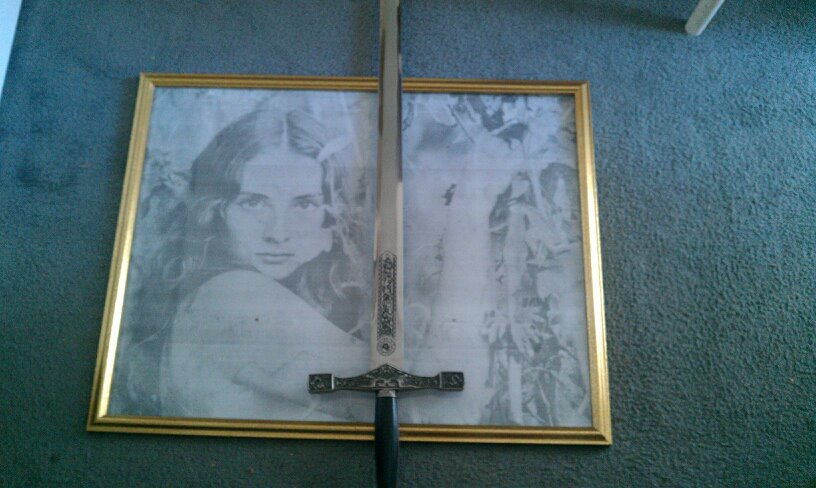
Rena is an Aries, the Midwest goddess of War who found no Vietnam War Hero to be he champion, so she could give him her sword. She went in search of her Hero. She found him.
On our mount above Monte Rio there was a small lake, a resivore for the cities below. No one was allowed to swim in it – accept the Maiden of the Lake. At night, when there was just a rainbow of light in the west. she would emerge from our tent wrapped in a towel. Men in the campsite could make our her silhouette rise as she walked up the hill to the lakes;s edge, drop the towel, and dive in. It was then one could see the glowing of the cigarettes like fireflies as they took a long drag of satisfaction, knowing all is well in America, because she has chosen to be born here – in our lifetime.
Do you not know I have freed all the Heros for the coming battle. And here she come – with the sword.
And the people of Monte Rio drank of the Grail when they turned on their tap.
Thrice enough to fill Prydwen, we went into it;
Except seven, none returned from Caer Sidi.
Jon the Nazarite
Caer Sidi
Caer Sidi (or Caer Siddi or Caer Sidydd) is the name of a legendary otherworld fortress mentioned in two Middle Welsh mythological poems in the Book of Taliesin.
One such is Song Before the Sons of Llyr (poem 14 as translated by William F. Skene, 1868):
Complete is my chair in Caer Sidi,
No one will be afflicted with disease or old age that may be in it.
It is known to Manawyd and Pryderi.
Three utterances, around the fire, will he sing before it,
And around its borders are the streams of the ocean.
And the fruitful fountain is above it,
Is sweeter than white wine the liquor therein.
The other is The Raid on the Otherworld (poem 30, ibid.):
I will praise the sovereign, supreme king of the land,
Who hath extended his dominion over the shore of the world.
Complete was the prison of Gweir in Caer Sidi,
Through the spite of Pwyll and Pryderi.
No one before him went into it.
The heavy blue chain held the faithful youth,
And before the spoils of Annwvn woefully he sings,
And till doom shall continue a bard of prayer.
Thrice enough to fill Prydwen, we went into it;
Except seven, none returned from Caer Sidi.
The poems are attributed to the 6th century poet Taliesin but are of later date. Some attempts have been made to give the fortress a physical location, e.g. as the island of Grassholm off the coast of Pembrokeshire,[1] but Caer Sidi is more likely to belong to the class of otherworldly forts and islands so prevalent in Celtic mythology.
The precise meaning of the name ‘Sidi’ in Caer Sidi is problematic (caer means “fort”, “fortress”, “stronghold”). One possible meaning of Caer Sidi is the ‘turning fortress’, but it is more likely to mean the ‘Fortress of the Zodiac’, as sidydd means “Zodiac” in modern Welsh.
A castle with a spiral construction (as suggested by some in connexion with the spiral mazes found at Glastonbury Tor), or a ‘revolving fortress’ is unlikely.
The Rosy Cross (also called Rose Cross and Rose Croix) is a symbol largely associated with the semi-mythical Christian Rosenkreuz, alchemist and founder of the Rosicrucian Order.[1][2] The Rose Cross is said to be a cross with a white rose at its centre[3] and symbolizes the teachings of a tradition formed within the Christian tenets[citation needed]:
What think you, loving people, and how seem you affected, seeing that you now understand and know, that we acknowledge ourselves truly and sincerely to profess Christ, condemn the Pope, addict ourselves to the true Philosophy, lead a Christian life, and daily call, entreat and invite many more unto our Fraternity, unto whom the same Light of God likewise appeareth?[4]
It has several meanings, depending on the source. Some groups, such as the Ancient and Mystical Order Rosae Crucis, from a non-sectarian or non-religious view, suggest that the rosy cross predates Christianity, where “the cross represents the human body and the rose represents the individual’s unfolding consciousness.[5]
The Rosicrucian Fellowship and kindred groups of rosicrucianists, promulgating an Esoteric Christian viewpoint, hold that the Rosicrucian Brotherhood was founded in the early 14th century, or between the 13th and 14th centuries,[6] as an Invisible College of mystic sages, by a highly evolved entity having the symbolic name of Christian Rosenkreuz in order “to prepare a new phase of the Christian religion to be used during the coming age now at hand, for as the world and man evolve so also must religion change”.[7]
Paracelsus, who was called the “Luther of Medicine”,[8] describes these mystics sages as “persons who have been exalted (verzueckt) to God, and who have remained in that state of exaltation, and have not died (…) nobody knew what became of them, and yet they remained on the earth”.[9] Modern groups and researchers of the “Rosicrucian Enlightenment”[10] suggest that there is much evidence that the Rosicrucian Order not only has made herself known in the early 17th century through the Rosicrucian Manifestos, but has been active since the beginning of the Renaissance period, not only as an hermetic Order, but also through forerunners – geniuses of the western world, sometimes also known to be Freemasons – in the literary,[11][12] cultural, ethical, political, religious and scientific fields.
Freemasonry
Main article: Freemasonry
Within the Southern Jurisdiction of the Scottish Rite concordant body of Freemasonry, the Eighteenth Degree is specifically concerned with the rose cross and confers the title of “Knight Rose Croix”. Of one version of the degree, Albert Pike wrote in 1871,
The Degree of Rose Cross teaches three things;—the unity, immutability and goodness of God; the immortality of the Soul; and the ultimate defeat and extinction of evil and wrong and sorrow, by a Redeemer or Messiah, yet to come, if he has not already appeared.[20]
He goes on to give an explanation of what he believes to be the symbolism of the Rose Cross in that degree:
But [the cross’s] peculiar meaning in this Degree, is that given to it by the Ancient Egyptians. Thoth or Phtha is represented on the oldest monuments carrying in his hand the Crux Ansata, or Ankh, (a Tau cross, with a ring or circle over it). […] It was the hieroglyphic for life, and with a triangle prefixed meant life-giving. To us therefore it is the symbol of Life—of that life that emanated from the Deity, and of that Eternal Life for which we all hope; through our faith in God’s infinite goodness. The ROSE, was anciently sacred to Aurora and the Sun. It is a symbol of Dawn, of the resurrection of Light and the renewal of life, and therefore of the dawn of the first day, and more particularly of the resurrection: and the Cross and Rose together are therefore hieroglyphically to be read, the Dawn of Eternal Life which all Nations have hoped for by the advent of a Redeemer.”[20]
[edit] Golden Dawn
Main article: Hermetic Order of the Golden Dawn
The Hermetic Order of the Golden Dawn made use of the rosy cross as well, including ‘The Ritual of the Rose Cross,” designed for spiritual protection and as preparation for meditation. Based on the Rosicrucian symbolism of the Red Rose and the Cross of Gold, it is also a key symbol of the Golden Dawn’s Second Order. According to Regardie, the Golden Dawn rosy cross contains attributes for the Elements, Planets, Zodiac, Hebrew alphabet, alchemical principles, the hexagram and pentagram, the sephiroth of the Tree of Life, and the formula of INRI. On the back side of the rosy cross is inscribed the motto of the Zelator Adeptus Minor at the bottom, “The master Jesus Christ, God and Man” between four Maltese crosses, and in the center, written in Latin, “Blessed be the Lord our God who hath given us the Symbol Signum.”
Regardie says of the rosy cross in The Golden Dawn:
The Lady of the Lake is the most mystical character of any in the Arthurian tales. Much has been written about her and the land of Avalon, Ynes Affalon, which means the Land of Apples. Morgan le Fay is one of these women, and she herself is a half sister of King Arthur, an enchantress, healer, queen, and goddess. Morgana is sometimes regarded as one of the aspects of the goddess Morrigan.
The Lady of the Lake is the name of several related characters who play integral parts in the Arthurian legend. These roles include giving King Arthur his sword Excalibur, taking the dying king to Avalon after the battle of Camlann, enchanting Merlin, and raising Lancelot after the death of his father (hence calling him Lancelot du Lac). Different writers and copyists give her name as Nimue, Viviane, Elaine, Niniane, Nyneve, Nimueh and other variations. The Lady of the Lake’s origins are probably ancient and pagan, like Morgan le Fay’s, and she and Morgan may have ultimately derived from the same tradition.
Alfred Tennyson adapted several stories of the Lady of the Lake in his “Idylls of the King.” He said that the Lady of the Lake was the good fairy queen Vivian that raised Lancelot, and gave King Arthur Excalibur by holding the sword up from the middle of her Lake. Then he ‘demonized’ Morgan le Fay as another part of the Lady, who was Arthur’s evil half sister and tried to destroy him. Morgan also was said to have stolen the scabbard to Excalibur. Excalibur could never be defeated. The scabbard could heal anyone and Morgan stole that and threw it back into the lake, so that Arthur could be killed. Yet another aspect of the Lady in Tennyson’s tales was Nimue, who seduced Merlin into teaching her all of his magick, and then trapped him in an oak tree or cave. It is likely that all three of these aspects, or queens, were the ones who took King Arthur in a boat to Avalon to be healed after his final battle.
In Caitlin Matthews book, “Ladies of the Lake”, there are nine sisters who are priestesses, queens and enchantress-healers, who live on the island of Avalon. Morgana, Igraine, Guinevere, Argante, Nimue, Enid, Kundry, Dindraine, and Ragnell. Argante is the head Lady of the Lake here, although Morgan is the head Lady in other books.
 Rosamond Press
Leave a comment