

Jon Presco
Historic roleThe Tocharians, living along the Silk Road, had contacts with the Chinese, Persians, Indian and Turkic tribes. They adopted Buddhism, which, like their alphabet, came from northern India in the 1st century of the 1st millennium, through the proselytism of Kushan monks. The Kushans and the Tocharians seem to have played a part in the Silk Road transmission of Buddhism to China. Many apparently also practised some variant of Manichaeanism.[
[edit] Name
Around the beginning of the 20th century, archaeologists recovered from oases in the Tarim Basin a number of manuscripts written in two closely related but previously unknown Indo-European languages. Another text recovered from the same area, a Buddhist work in Old Turkic, included a colophon stating that the text had been translated from Sanskrit via a toxrï language, which Friedrich W. K. Müller guessed was one of the newly discovered languages.[1]
Müller called the languages “Tocharian” (German Tocharisch), linking this toxrï with the ethnonym Tókharoi (Ancient Greek: Τόχαροι, Ptolemy VI, 11, 6, 2nd cent. AD) applied by Strabo to one of the Scythian tribes that overran the Greco-Bactrian kingdom (present day Afghanistan-Pakistan) in the second half of the 2nd century BC.[2] This term was itself derived from Indo-Iranian (cf. Old Persian tuxāri-, Khotanese ttahvāra, and Sanskrit tukhāra), the source of the term “Tokharistan” usually referring to 1st millennium Bactria, as well as the Takhar province of Afghanistan. The Tókharoi are often identified by modern scholars with the Yuezhi of Chinese historical accounts, who founded the Kushan empire.[3][4] These people are now known to have spoken Bactrian, an Eastern Iranian language that is quite distinct from the Tocharian languages, and Müller’s identification is now a minority position among scholars. Nevertheless “Tocharian” remains the standard term for the languages of the Tarim Basin manuscripts and for the people who produced them.[1][5]
The two languages are known as Tocharian A (also East Tocharian or Turfanian, from the city of Turpan) and Tocharian B (also West Tocharian or Kuchean, from the city of Kucha).[1] The native name of the historical Tocharians of the 6th to 8th centuries was, according to J. P. Mallory, possibly kuśiññe “Kuchean” (Tocharian B), “of the kingdom of Kucha and Agni”, and ārśi (Tocharian A); one of the Tocharian A texts has ārśi-käntwā, “In the tongue of Arsi” (ārśi is probably cognate to argenteus, i.e. “shining, brilliant”). According to Douglas Q. Adams, the Tocharians may have called themselves ākñi, meaning “borderers, marchers”.
[edit] Early inhabitants of the Tarim BasinJ. P. Mallory and Victor H. Mair argue that the Tocharian languages were introduced to the Tarim and Turpan basins from the Afanasevo culture to their immediate north. The Afanasevo culture (c. 3500–2500 BC) displays cultural and genetic connections with the Indo-European-associated cultures of the Central Asian steppe yet predates the specifically Indo-Iranian-associated Andronovo culture (c. 2000–900 BC) enough to isolate the Tocharian languages from Indo-Iranian linguistic innovations like satemization.[6]
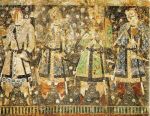
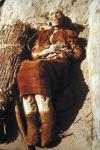
[edit] Tarim mummiesThe Tarim Basin mummies (1800 BC) have been found in the same general geographical area as the Tocharian texts and frescoes from the Tarim Basin (3rd to 9th centuries AD), and are both connected to an Indo-European origin and point to Caucasoid types with light eyes and hair color. However it is unknown whether the mummies and frescoes are connected.
In 2008, the remains of another male were discovered near Turpan. Thought by researchers to be a member of the Gushi culture, the man was buried with a number of practical and ceremonial objects, including archery equipment and a harp, and 789 grams of cannabis. Through genetic analysis and carbon dating, the burial has been dated to roughly 700 BC. Only two of the 500 graves at the site contain cannabis, leading researchers to suggest shamanic roles for the two individuals.
In 2009, the remains of 30 individuals found at the Xiaohe Tomb complex were analyzed for Y-DNA and mtDNA markers. They suggest that an admixed population of both western and eastern origin lived in the Tarim basin since the early Bronze Age. The Xiaohe people maternal lineages were predominantly East Asian haplogroup C with smaller numbers of H and K, while the paternal lines were all West Eurasian R1a1a. The geographic location of this admixing is unknown, although south Siberia is likely.[7]
[edit] YuezhiThe Historical Records by the Western Han historian Sima Qian describe a people called the Yuezhi who lived between the Qilian Mountains and Dunhuang, until they were driven out by the Xiongnu in the 2nd century BC. The majority (the Greater Yuezhi) are said to have moved west and conquered Bactria (Chinese: 大夏 Dàxià), while a smaller group (the Lesser Yuezhi) took refuge in the “Southern Mountains”.[8]
The Greater Yuezhi are often identified with the Tókharoi mentioned by the Greek historians.[3] A minority of scholars also connect them to the Tocharians.[9] Based on comparison of names used by ancient authors, Christopher Beckwith has argued that these people were originally Tocharian-speakers who switched to the local Iranian language on entering the region. He claims that the first character of their name, 月, usually read as Old Chinese *ŋʷjat > Mod. yuè,[10] could have been pronounced in an archaic northwestern dialect as *tokwar or *togwar, a form that resembles the Bactrian name Toχοαρ (Toχwar ~ Tuχwar) and the medieval form Toχar ~ Toχâr.[4][11]
[edit] LanguageMain article: Tocharian languages
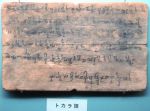
Wooden plate with inscriptions in the Tocharian language. Kucha, China, 5th-8th century. Tokyo National Museum.The Tocharians appear to have originally spoken two distinct languages of the Indo-European Tocharian family, an Eastern (“A”) form and a Western (“B”) form. According to some, only the Eastern (“A”) form can be properly called “Tocharian”, as the native name for the Western form is referred to as Kuchean (see below). Tocharian shares of course commonalities with all other Indo-European languages, which does not help in identifying a next neighbor. However, nearly all lexicostatistical studies put it as next neighbor to Hittite, with which it e.g. shares the absence of palatalization, common among the regional neighbors as Indic and Iranian.
Tocharian A of the eastern regions seems to have declined in use as a popular language or mother tongue faster than did Tocharian B of the west, where it was more insulated from outside linguistic influences.[12] It appears that Tocharian A ultimately became a liturgical language, no longer a living one, at the same time that Tocharian B was still widely spoken in daily life. Among the monasteries of the lands inhabited by Tocharian B speakers, Tocharian A seems to have been used in ritual alongside the Tocharian B of daily life.[citation needed]
[edit] Historic roleThe Tocharians, living along the Silk Road, had contacts with the Chinese, Persians, Indian and Turkic tribes. They adopted Buddhism, which, like their alphabet, came from northern India in the 1st century of the 1st millennium, through the proselytism of Kushan monks. The Kushans and the Tocharians seem to have played a part in the Silk Road transmission of Buddhism to China. Many apparently also practised some variant of Manichaeanism.[13]
Protected by the Taklamakan Desert from steppe nomads, elements of Tocharian culture survived until the 7th century, with the arrival of Turkic immigrants from the collapsing Uyghur Khaganate of modern day Mongolia.[14]
Ogham, what is it?
Ogham, what is it? Scholars are still asking this question today. Some scholars believe it’s an ancient language used by the druids and the upper class, while some believe it’s used just by the druids for divinatory purposes. Leon Patsalides says that it is; “The Goidelic Ogham script of England and Ireland, developed separately from that of its European Counterpart (Runic) and was originally composed of 18 letters.” I can hardly believe either one of these. For one, in the epic story of “The Tain Bo Cuailnge”, Queen Maeve was unable to read the ogham letters that Cuchulainn had wrote on the trees. If the druids used this language for divinatory purposes, why did Cuchulainn know of it? Finally, from my knowledge the original Ogham script contained twenty letters and not eighteen. Some scholar’s claim there is no evidence to support that ogham was used in divination. We are not even sure that ogham has anything to do with trees.
In fact, some believe there is more than one type of ogham. There are rumors of bird ogham, hand ogham, tree ogham, color ogham, river-pool ogham, and many more types of ogham. Steve Blamires says; “poets had to learn at least one hundred and fifty different oghams, all of which were used to illustrate grammatical laws and instructions.” Robert Graves claims that ogham was used as a calendar system. He makes claims of the Celtic tree calendar. According to the sources provided to us by scholars there is no evidence of these claims. I don’t discredit Graves for his work, but I do wish to know where he got his information. Here we now sit in a rut in wonder of the true use of ogham. It is improbable that we will ever be able to use ogham the same way as the druids of history did. For one reason, we live in an entirely different situation then they, and we really don’t have much evidence to prove how it was used. We must go by those scholars who did this stuff up and translate inscriptions for us.
Ogham and Uses!
Ogham or ogam, is said to be created by Ogma, “Sun-face”, the god of learning and writing. It seems as if there were originally only 20 letters and the other five were added. Ogham script consist of five groups, the first three groups being consonants, the fourth being vowels, and the fifth being diphthongs. I find it quite odd that the last group all consist of crosses. Alwyn Rees seems to thinks so as well. She says; “Are we to consider it an accident that each of theses five characters of the fifth group are formed by crosses.” I found this comment to be most interesting. It appears to me that the Christian monks had their way with ogham. However, there is no proof that the Christians had anything to do with the last five letters, but there is a good possibility.
Ogham consists of three groups, not the same type as noted above. These three groups are that of chieftain trees, peasant trees, and shrub trees. There is a little controversy on the setup of these ranks, all the information isn’t clear. For an example given in Caitlin and John Mathews book, “The Encyclopedia of Celtic Wisdom”, it says there eight chieftain trees which are Alder, Oak, Hazel, Vine, Ivy, Sloe, Furze, and Heather. There are eight peasant trees, which consist of Birch, quicken tree, Willow, Ash, Whitethorn, Whin, Viz, and Apple. The article doesn’t say anything about the names of the shrub trees.
Douglas Monroe has his own version in his book; “The 21 Lessons of Merlyn”. He says the ranks go as follows, the chieftain trees are Oak, Alder, Birch, Apple, and Willow. The peasant trees are Hawthorn, Ash, Aspen, Pine, and Yew. The shrub trees are Holly, Rowen, Hazel, Blackthorn, and Ivy. He also has a fourth category, which is Bramble, and they are Furze, Reed, Heather, Vine, and Ivy. It appears that Mr. Monroe has used the ancient number five to support his ideas. I personally think he has made his own system, which works for him. Although he doesn’t claim that this information is true, and he doesn’t say he made it. He leaves it for the readers to make up their own mind whether or not he knows what he is talking about.
There is one problem with both of these systems, there are twenty-five trees. Neither system adds up to twenty-five. So what do we believe? This is a great question to ask; does anyone know what they’re talking about? We will never know, but we can take this information and delve deep within ourselves and find a system that works for us. This can be done through meditation or through prose and magical means. I have provided some information for each tree. If the information is not yet available, give it some time, it will be her soon.
In the 60s, Reform Jewish rabbis started to use psychedelic drugs for the pursuit of God. Some came to the conclusion that the psychedelic experience was in every way more real and important than the religious experience, even going so far as to say that any comparison between the two would only serve to desecrate the sanctity of psychedelics. In 2000, a group of Orthodox Jews living in Queens was found to be selling more than 100,000 MDMA tablets a week. Police seized a million tablets from their apartment. Some papers reported it to be the largest drug bust in New York history. But why is any of this surprising? Everybody gets high. At this moment somewhere there is a nun robo-tripping and a monk inhaling computer duster. What matters is how it’s done. While some of their contemporaries quibble about whether or not it is permissible to smoke weed on the Sabbath or if LSD is kosher, the Magic Jews have completely ridden themselves of religious bureaucracy and distilled what they know of Judaism to its tastiest essences, shamelessly consuming it and hoping others will follow by example. In that way, it is psychedelic religion at its purest.
During my trip to the Catskills, a sheet of LSD was acquired and then greedily consumed in a matter of minutes. Magic Jews were frothing at the mouth with psychedelic lust. Hershel took my arm and said he would like to speak with me alone. We walked down an unlit road and looked at each other’s silhouettes. “You know, Hamilton, some people want to do this for the wrong reasons,” Hershel said. I nodded as he went on. “Sometimes they only want orgies, and sometimes we have orgies, but you must understand your intentions.” I nodded again, wondering what he was suggesting. He continued, “These are powerful places. When you bring light back into the picture, it automatically takes care of a lot of darkness, but I don’t think it’s inherently good. I think it destroys everything you’ve got. If you’re focused, you can rebuild. But not everybody is.” By that point both of us were tripping pretty hard and I was capable of understanding about as much as he was capable of making sense. Still, I think his point was something along the lines of: We are toying with powerful things here, and some of us are naive people. Therefore some of us could be permanently damaged by the stuff we’re doing now.
A few hours later one of the Magic Jews railed a line of ketamine while navigating the lake in a rowboat. He staggered onto the shore, then collapsed in the driveway, spewing vomit all over himself and dropping into a deep and unresponsive K-hole while everyone watched in horror. Eventually they got distracted, turned him onto his side, and returned to a bonfire to snort more ketamine. As the sun rose and the alien chirps of what I can now only identify as glass harmonica birds lulled me into a trance, I saw Hershel emerge from the woods. He was alone with a prayer book in his hands, grinning and smoking a cigarette. We both listened to the birds sing for a minute while I accepted the weirdest thing of all—the real possibility that it all made sense.
To take a moment and clarify my religious background: I am a Jew. I was bar-mitzvahed (at Masada no less) but I never went to Hebrew school. I never went to temple. I learned a CliffsNotes version of Hebrew and memorized my Torah portion from a recording on a MiniDisc. In short, I know nothing about Judaism. I am also not religious or “spiritual” in any way. I feel awkward even saying the word “prayer.” The Jews I met at Ridge Street come from Hasidic and Orthodox Brooklyn neighborhoods. Most speak Yiddish as their first language. Aside from a love of psychedelics and maybe some shared genetics from way back when, we have nothing in common. I was introduced to all of them by a friend of a friend of a friend. A psychedelic mushroom is called a magic mushroom, and by that logic these Jews could be called Magic Jews. So that’s how I started to think of them.
Hand Ogham!
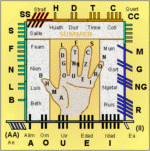
Hand Ogham is just another version of ogham. It allows those that are knowledgable in ogham, to be able to communicate to others that are also enlightened. With this power “at hand” the druids can talk accross the ritual circle without interrupting ceremony. It would also allow them to talk in public without anyone knowing what they are saying. Just listen to what some other scholars have to say about hand Ogham.
“The hand version is a secret cipher code and can be used covertly in communicating with ones fellow at close quarters. Basically the joints of the fingers of the left hand acted very much like a keyboard, while the right hand was used to indicate by pointing with the forefinger the letters for each word of a phrase. (“Patsalides”)
“..the table of the hand, with its finger joints were used in as a mmemonic method of recalling associative images..”(“Mathews”)
Tzadikim Nistarim
From Wikipedia, the free encyclopedia
Jump to: navigation, search
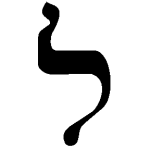
The Tzadikim Nistarim (Hebrew: צַדִיקִים נִסתָּרים, hidden righteous ones) or Lamed Vav Tzadikim (Hebrew: ל”ו צַדִיקִים, 36 righteous ones), often abbreviated to Lamed Vav(niks)[a], refers to 36 Righteous people, a notion rooted within the more mystical dimensions of Judaism. The singular form is Tzadik Nistar (Hebrew: צַדִיק נִסתָר).
Contents
[hide]
1 Origins
2 Their purpose
3 Lamedvavniks
4 Notes
5 References in popular culture
6 References
7 External links
[edit] Origins
The source is the Talmud itself, explained as follows:
As a mystical concept, the number 36 is even more intriguing. It is said that at all times there are 36 special people in the world, and that were it not for them, all of them, if even one of them was missing, the world would come to an end. The two Hebrew letters for 36 are the lamed, which is 30, and the vav, which is 6. Therefore, these 36 are referred to as the Lamed-Vav Tzadikim. This widely-held belief, this most unusual Jewish concept is based on a Talmudic statement to the effect that in every generation 36 righteous “greet the Shechinah,” the Divine Presence (Tractate Sanhedrin 97b; Tractate Sukkah 45b).[1]
Tree Ogham!
“Beithe (Birch)”
Word Ogham of:
Morainn: FEOCHAS FOLTCHAIN, which means, faded trunk and fair hair.
Cuchulain: MAISI MALACH .i.CRECCAD, which means, Browed beauty, worthy of pursuit.
Aonghus: GLAISEM CNIS, which means, most silver of skin.
Meaning: “New beginnings; change to a higher level; self- sacrifice for the common good; devotion to the great work”. (Blamires, 1997)
Yellow Birch
Species: Betula Alleghaniesis
Local Name: Gray Birch, “Silver Birch”
Yellow birch grows to be about 100’ tall. The leaves are three to five inches in length, and about one to two inches in width. The leaves are dark green and are short pointed or rounded at the base, and are hairy when they are young. The undersides of the leaves are of light yellow-green in color, and they turn yellow in autumn. It has very thin, yellowish or silvery gray bark, separating into papery curly strips. The tree grows in cool moist uplands including mountain ravines.
European White Birch
Species: Betula Pendula
Local Name: European Birch, “European Weeping Birch”
This tree grows to be about 50’ high. Its leaves grow to be about one to three inches in length, and about one and a half inches wide. The leaves are ovate of nearly triangular, pointed at the tip and almost straight at the base. Its color is of a dull green above, paler beneath, turning yellow in autumn. The bark is white, flaky, and peels into papery strips. The tree grows in moist soils on lawns, and in parks and cemeteries. Sometimes it grows in escape thickets and in open forest areas. This tree is not natural to the Western New York area. It has made it this far due to transplanting or growing the tree in our realm.
“Luis (Rowan)”
Word Ogham of:
Morainn: LI SULA, delight of eye
Cuchulain: LUTH CETHRA LEAM, strength (or friend) of cattle, the elm
Aonghus: CARAE CEATHRA, friend of cattle
Meaning: “Magical work; concentrated inner effort needed”. (Blamires, 1997)
American Mountain Ash
Species: Sorbus americana
Local Name: American Rowan Tree, “Roundwood”
American Mountain Ash grows to be about 30′ tall and about 8″ in diameter. The leaves grow to be 1-4″ long with 11 to 17 leaves per pinnate stalk. Leaves are yellow-green above, and paler beneath that turn yellow in autumn. The bark is light gray which is smooth or scaly. It sprouts beautiful white flowers in spring that grow in upright clusters. In autumn, the tree grows small bright red berries. This tree grows in moist soils in valleys and on slopes, usually in coniferous forest.
European Mountain Ash
Species: Sorbus aucuparia
Local Name: Rowan Tree
European Mountain Ash grows to be 20-40’ tall at an approximate width of 1’. The leaves grow in pinnately compounds that are 4-8” long with about 9-17 leaves per pinnate stalk. The leaflets are 1-2” long and about a half an inch wide. Leaves are dull green above, with white hairs beneath that turn reddish in autumn. The bark is dark gray, smooth, with horizontal lines. This tree also sprouts white flowers in spring that grow in clusters of about 75 flowers. It grows small red apple like fruits that are bitter if eaten. This tree likes to grow along roadsides forming thickets.
“Fearn (Alder)”
Word Ogham of:
Morainn: AIREINECH FIANN, sheild of warrior bands.
Cuchulain: DIN CRIDE SCIATH, protection of the heart, a sheild.
Aonghus: COIMET LACHTA, guarding of milk.
Meaning: Strength
Speckled Alder
Species: Alunus rugosa
Local Name: Tag alder, “Gray Alder”
Speckled Alder a low clump forming shrub, which is sometimes a small tree. It grows to be about 20’ tall to about 4” in diameter. Leaves grow in rows of three’s that are about 2”-4” long and 1.25”-3” wide. They are dark green with network of sunken veins above, whitish-green and often with hairs, also with veinlets arranged in rows like a ladder beneath. The bark is gray which is smooth. This male alder grows small catkins about 1.5”-3” long, while the female grows cones about .5” long. This tree grows in wet soil along streams, lakes, and swamps.
European Alder
Species: Alunus glutinosa
Local Name: Black Alder, “European Black Alder”
European Alder is a large tree which grows 50’-70’ tall and 1’-2’ wide. The leaves grow in three’s and are about 1.5”-4” long, 1”-2.5” wide. Leaves are nearly round with saw like edges. There are 5-7 parallel veins on each side that are gummy when they are young. The leaves are a shinny dark green above and light green with tufts of rusty hairs beneath, that remain green and shed late in the fall. The bark is brown and smooth, which also becomes furrowed into broad plates. The flowers appear the same way as its Speckled Alder family member. This tree likes to grow in wet soils in humid, cool temperatures.
“Sail (Willow)”
Word Ogham of:
Morainn: LI AMBI, hue of the lifeless.
Cuchulain: TOSACH MELA SAIL, beginning of loss, Willow.
Aonghus: LUTH BEACH, strength of bees.
Meaning: “New journeys; otherworld contacts”. (Blamires, 1997)
Weeping Willow
Species: Salix babylonica
Local Name: Babylon Weeping Willow
The willow grows to be about 30′-40′ high and 2′ in diameter. This tree is well known for its foliage. The leaves are 2.5”-5” long and ¼”- 1/2” wide. The leaves are narrow with pointed tips that are finely saw-toothed. They are dark green above and whitish or gray beneath. The bark is gray, rough and thick. It sprouts catkins that are about 3/8”- 1” long. This tree likes to grow in parks, gardens, and cemeteries, especially near water.
Pussy Willow
Species: Salix discolor
Local Name:
Pussy willow grows to 20’ height and 8” in diameter. The leaves are 1 ½”-4 ½” long, and 3/8”-1 ¼” wide. The leaves are lance shaped and are shiny green above, and whitish beneath. The bark is gray and scaly. This tree likes to grow in wet meadow soils and on the borders of lakes and streams. They are also found in coniferous forests.
“Nion (Ash)”
Word Ogham of:
Morainn: CODTUD SIDE, checking for peace.
Cuchulain: BAG MAISI GARMEN, flight of beauty, a weaver’s beam.
Aonghus: BAG BAN, the flight of women.
Meaning: change of outlook required.
White Ash
Species: Fraxinus americana
Local Name:
White ash grows to be about 80’ high and 2’ in diameter. Its leaves are a pinnately compound about 8”-12” long. There are usually about 7 leaves per pinnate stalk. The leaves are 2 ½”-5” long, and 1 ¼”-2 ½” wide. The leaves are ovate with finely saw-toothed teeth. They are dark green above and whitish below, that turn purple or yellow in autumn. The bark is dark gray, thick, with forking ridges. This tree likes moist soils in valleys and slopes in forests with other hard woods.
Black Ash
Species: Fraxinus nigra Marsh
Local Name: Basket Ash, “Hoop Ash”
Black ash grows to 30’-50’ in height and 1’ in diameter. The leaves grow in a pinnately compound, 12”-16” in length. There is usually 7-11 leaflets, about 3”-5” long and 1”-1 ½” wide, per pinnate compound. The leaves are dark green above and paler beneath with rust covered hairs along its mid vein that turn brown in autumn. The bark is gray and it rubs off easy. Black ash likes to grow in wet soil of swamps, streams, or in coniferous and hardwood forests.
“Huath (Hawthorn)”
Word Ogham of:
Morainn: CONDAL CON, pack of wolves.
Cuchulain: ANNSAM AIDHCHE HUATH, difficult night, Hawthorn.
Aonghus: BANAD GNUISI, whitening of face.
Meaning: Something unpleasant about to happen, or a completion of something.
Biltmore Hawthorn
Species: Crataegus intricata
Local Name: Thicket Hawthorn, “Alleghany Hawthorn”
Biltmore hawthorn is more of a shrub than that of a tree. It grows to 20’ height and about 6” in diameter. The leaves are 1”-2 ½” long and 1”-2” wide As we can tell from the measurements given, hawthorns leaves are extremely ovate and they are mostly blunt at the ends. The leaves are saw-toothed, green above, and paler beneath. The bark is brown or gray and scaly. This type of tree grows small fruits called haws, thus the name hawthorn. This tree likes to grow upland and in moist valleys. It is also common to see these trees growing in open areas, borders of woods, and near stream banks.
Oneflower Hawthorn
Species: Crataegus uniflora
Local Name: Dwarf Hawthorn
Oneflower hawthorn is a low spreading shrub, sometimes a bushy tree, with a short, stout trunk and dense, stout, crooked branches. It grows to be 2’-5’ in height and 6” in diameter. The leaves are extremely small, only growing to be 1 ½” long. They are spooned shaped and taper to almost a stalkless base. The bark is gray-brown, smooth that becomes fissured into scaly plates near its base. The oneflower likes to grow in dry sandy and rocky uplands in open woods, forest borders, and in old fields.
“Duir (Oak)”
Word Ogham of:
Morainn: ARDDAM DOSSA, highest of bushes and TRAIN a third.
Cuchulain: SLECHTAIN SAIRE .i. NIAMA SAIRTE, kneeling work, bright and shinning work.
Aonghus: GRES SAIR, craft work.
Meaning: High powers at work, fatherly figure.
White Oak
Species: Quercus alba
Local Name: Stave Oak
White oak is the classic eastern oak tree. It grows 80’-100’ high and 3’-4’ wide, or more. I personally have seen these trees at about 5’ in diameter and about 120’ high. The leaves are 4”-9” long and 2”-4” wide that scallop. They are bright green above and gray-green beneath which turn red or brown in autumn. The bark is light gray and it forms ridges like cliff walls. All oaks grow acorns, which is the seed of the tree. They like to grow in moist well-drained soils, often in pure stands.
Northern Red Oak
Species: Quescus rubra
Local Name: Red Oak, “Gray Oak”
Northern red oaks grow to be 60’-90’ high and 1’-2 ½’ wide. The leaves are 4”-9” long and 3”-6” wide. They are dull green above and dull light green beneath with hairs along the mid-vein. The bark is dark gray or blackish while the inner bark is reddish. This oak also grows acorns, for more information read my sources. They like to grow moist, loamy, sandy, rocky, and clay type soils.
“Tinne (Holly)”
Word Ogham of:
Morainn: TRAIN ROITH, third of a wheel.
Cuchulain: TRAIN NN_AIRM .i. TINNE IAIRM, a third of weapons, and iron bar.
Aonghus: SMIU GUAILE, fires of coal.
Meaning: Things are not what they seem, watch for a change in direction.
Mountain Winterberry
Species: Ilex montana
Local Name: Mountain Holly
Mountain Winterberry is a spreading shrub or small tree. It grows to 30’ high and 8” in diameter. Its leaves are 2 ½”-5” long, and ¾”- 2 ¼” wide. They are ovate and pointed at the tip. Leaves are a dull green above and paler beneath with hairs along the vein, which turn yellow in autumn. The bark is light brown to gray and is thin as well as smooth. It bears bright orange-red fruits that are ripe in autumn and sometimes remain into the beginning months of winter. It likes to grow in moist soils in mixed hardwood forests.
American Holly
Species: Ilex opaca
Local Name: Holly, “White Holly”
American Holly is an evergreen tree with narrow, rounded spiny leaves. It grows 40’- 70’ high and 1’-2’ in diameter. Leaves spread in two rows of leafs being 2”-4” long, and ¾”-1 ½” wide. The leaves are spinney toothed, thick and are dull green above, and yellow green beneath. The bark is light gray, smooth, and can be rough and warty. This tree sprouts beautiful white flowers in spring and it bears bright red berries that mature in autumn, and remain attached in winter. This tree likes to grow in moist or wet well-drained soils, especially in flood plains.
“Coll (Hazel)”
Word Ogham of:
Morainn: CAINIU FEDAIR, fairest of trees.
Cuchulain: MILLSEM FEDHO .i.CNO, sweetest of woods, a nut.
Aonghus: CARA BLOISC, friend of cracking.
Meaning: Death, change, and wisdom.
Common Hazelnut / Beaked Hazelnut
Species: Corylus americana / Corylus cornuta
Local Name:
“Hazelnut, common name applied to any of a genus of trees and shrubs of the birch family. Hazelnut trees grow throughout the temperate regions of North America and Eurasia. Each plant has separate male flowers borne in catkins and female flowers borne in clusters. The fruit, called the filbert or hazelnut, is an ovoid nut. Two species, the common hazelnut and the beaked hazelnut, are native to the United States. Nuts of these species are small, and the trees, which grow to a height of about 3 m (about 9 ft), are not cultivated. Commercially grown filberts consist mainly of the European filbert, the cobnut, the giant filbert, and several hybrids. They are raised in Europe and the United States, and often attain a height of 9 m (30 ft). Several varieties are grown as ornamental trees.
Scientific classification: Hazelnuts belong to the family Betulaceae. The common hazelnut is classified as Corylus americana, the beaked hazelnut as Corylus cornuta, the European filbert as Corylus avellana pontica, and the cobnut as Corylus avellana grandis. The giant filbert is classified as Corylus maxima.”(Encarta®)
“Queirt (Apple)”
Word Ogham of:
Morainn: CLITHCHAR BOSICILL, shelter of hind, BOSCELL equals lunatic, BAS CEALL equals death sense, the time when a lunatic’s senses come back to him.
Cuchulain: DIGHU FETHAIL .i.CUMDAIGH, excellent emblem, protection.
Aonghus: BRIG ANDUINE, force of a man.
Meaning: Awareness of otherworld sences within, and or anything spiritual and mystical.
Apple
Species: Malu sylvestris
Local Name: Common Apple, “Wild Apple”
Apple trees are the source of apples. It grows to 30’-40’ high and 1’-2’ in diameter. Its leaves are 2”-3 ½” long and 1 ¼”-2 ¼” wide. Leaves are ovate and saw-toothed, and grow on hairy stalks. They are green above and densely covered with hairs beneath. The bark is gray and very scaly. It sprouts white flowers with pink tinge in the spring, and later apples. These trees prefer to grow in moist soils near houses, fences, roadsides, and clearings.
Sweet Crab Apple
Species: Malus coronaria
Local Name: Garland-Tree
Sweet Crab Apple is small tree with a short trunk. It grows to be 30’ high and 1’ in diameter. Its leaves are ovate, coarsely saw-toothed, and the only get 2”-4” long and 1 ½” wide. The leaves are yellow green above, and paler beneath, turning yellow in autumn. The bark is reddish-brown and scaly. It grows white or pink flowers in spring, grouping into clusters. This tree likes to grow in moist soils in openings and borders of forests.
 Rosamond Press
Leave a comment