“When the persecution of the Jews began in Nazi Germany a half-century ago, Jews were labeled a “disease” or “parasites”; Hitler talked of the “Jewish bacilli’’ and the “demon of Communism.” This metaphoric language was essential for dehumanizing the “enemy.”
When Heather Hanson and Bill Cornwell called me a “parasite” I wondered if Bill was sympathetic to the rhetoric of Neo-Nazis who use the term “upholding family values”. Bill told me he was a traditional kind of guy, he an upholder of family values. Why then was he bent on severing me from my family, and making my family – his family? This is a great sin amongst the Jews. Any man who would do such a thing, would be titled “evil” rather then “righteous”.
After I cornered Heather in our conversation where she alas admitted there was a pee stain in the back seat of that rental car, and after I proved to her my grandson would not have done this – as she now claimed – my daughter now went into a tirade about me being so mentally ill, I should be locked up for life. I told her my friend Mark does not believe I should be locked up, and her reply was I needed to see a real psychiatrist, not just a psychologist graduate from Harvard. I think Heather was saying I needed to see a Nazi Doctor, the kind that were Euphemizing the mentally ill before Hitler invaded Poland.
Mark is a Jew, as was my grandfather, Hugo Presco, whose mother was Marie Roth. In 1998 I co-authored a play titled ‘Daughter Dead’ based upon the murder of mentally ill seventeen year old girl in Nazi Germany. This play was to be warning about turning over our social safety net to right-wing Christians who were taking over the Republican party, founded by my kindred.
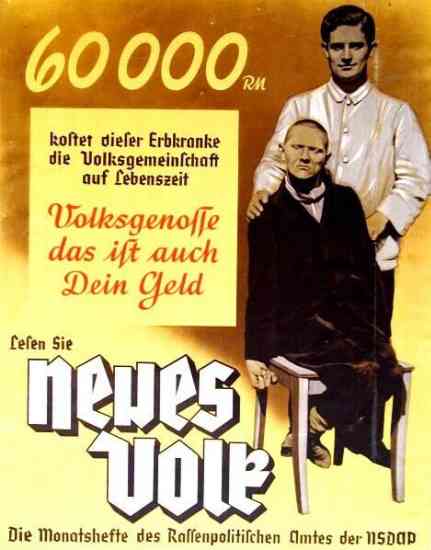
Above is a poster that is applicable to the image Heather Hanson, and her lover, Bill Cornwell, are applying to me. When this unmarried couple told me motherless, Linda Constock, wanted them to bring her a baby girl next time they came to Arizona, I understood my consent was not needed because I was sub-human. Here is what that poster says;
“This poster (from around 1938) reads: “60,000 Reichsmarks is what this person suffering from a hereditary defect costs the People’s community during his lifetime. Fellow citizen, that is your money too. Read ‘[A] New People’, the monthly magazine of the Bureau for Race Politics of the NSDAP.”
Heather said I did not deserve SSI, and if I dare make an argument I dod, then that is proof I do not. I said this in reply;
“Not only do I no longer love you. I do not even like you – who you are!”
For several years now my grandson, Tyler Hunt, has been in trouble with the school system for physical attacks on other students. He seems to lack empathy for others. His needs come first. He does not need an overly aggressive type like Bill Cornwell who is very territorial – with another man’s family! This leads me to suspect Bill believes he is a Defender of American Family Values, and is saving us from ourselves – for our own good! Is this what Heather meant when she called the person she is fornicating with out of wedlock a “righteous man”? Hitler tried to breed a race of Supermen, but ended up with a nation full of serial killers that cost the German people trillions of dollars, their cities lying in ruin.
That Bill shows no empathy for a senior that got “tired” or a stranger in a wheelchair – and even his own disabled mother – suggests he suffers from Narcissistic Personality Disorder. He has convinced my daughter these people should be thrown away, removed and cleansed from the family tree. But, Heather did not need much convincing. I have noticed that Heather’s peers suffer from NPD, she raised in Sonoma where very wealthy Republicans call home. However, there are poor children mixed in who are locked into the idea you must look down your noses at people. Add to this the truth Patrice Hanson raised our daughter to be a Super Star – and that Bill and Heather were born on my narcissistic parents birthdays – then it is vital that my grandson be supervised by professionals, for it was he who ruined Bill Cornwell’s trip to the Grand Canyon, not I. Because Tyler is a member of the Master Race, he will be shown mercy by Big Brother Bill. However, a scapegoat is needed for this show of disloyalty. An exemple must be made of someone so Tyler can see his disobedience has consequences. The weak link will be removed. There will be no more playtime with Papa Prescowitz – the alien outsider!
It appears Tyler said he wanted to go back to the cave store to get another arrowhead after failing to find one on the ground where I said these arrowheads were found. Tyler was holding a mirror up to Bill and Heather who conned me and my sister into getting them to Linda’s house where Flip was preparing to record and promote my daughter, he owning professional recording equipment. I was not told of this latest attempt by a surrogate Daddy to make my daughter a Super Star.
Bill and Heather believe I feel no pain, and am not hurt by their actions, because I am sub-human. Because I got “tired” I don’t seserve a family -and thus should not complain about being hurt. Need I say Hitler was a Narcisistic Super Star of all time, he not able consider the tears the of Jewish mothers whose children were taken from them and gassed for the good the Fatherland.
Patrice Hanson presented several surrogate Daddys to our daughter, gave fatherless men the chance to bond with a beautiful young girl in a family way, who they captured with video cameras. Heather did not have to return any mutual adoration, or show these strangers any respect or loyalty, because they were not her real father. They were throw-away Dads, a means to an end. When the real thing came along, Heather was real confused, because I demanded respect and loyalty, and thus, I moved into the mirror her mother held up to her daughter, and, ruined the show, her perfect image of herself. Bill is trying to restore that mirror, as is Linda, who also vicariously lives through an innocent child.
Bill can not handle the truth a seven year old boy is going to compete with him for his mother’s attention, and, it is only going to get worse. This is why Bill launched his campaign to Change the Child, cure The Child of his whining, his fake pains, his tricks he employs in order to be the apple of his mother’s eye.
In that phone call, Bill tried to get me to sign off on his New Deal, where his wants will always come first, because, children don’t have a job, thus any money. Indeed, they are liken to parasites who exploit the generosity of their parents. However, if you are a military brat, then you are sucking off the government, thus, one is bid to become a soldier any pay Generous Uncle Sam back. Did Bill, a military brat, join the armed forces?
No. However Bill wanted to, thus, the checks in the mail! How much do want to bet he wants my grandson to join the Army in order get him away from his mother as soon as possible because he is sick of Tyler’s whining? Bill Cornwell believes my grandson really owes him for taking him into his house, this uttterly helpess person, who can not fend for himself, who doesn’t know right from wrong, who acts like a basket case, a retard, and needs a nap because he gets tired. For – SHAME!
When will the world get tired of Bill types?
How many drinks has my daughter bought Bill out of the money she earns as a receptionist in a dental office? Bill does not have a steady job, so, why was he on vacation in Bullhead City? Bill may never have held down a real job. Check out the bums below who blame affirmative action for taking their jobs from them and giving them to black workers. How many of these righteous dudes – want a job?
Take note of the Father figure, the alpha-male type, who puts himself in charge of these wanna-be Bubba-Nazis. These rank and file punks – owe Big Daddy big time. They are bid to do anything to prove they are loyal to Big Bubba Daddy, especially after he goes into the weapon’s locker and brings out a case of cold ones!
Jon Presco
Copyright 2012
When the persecution of the Jews began in Nazi Germany a half-century ago, Jews were labeled a “disease” or “parasites”; Hitler talked of the “Jewish bacilli’’ and the “demon of Communism.” This metaphoric language was essential for dehumanizing the “enemy.” Defining people as microorganisms and as subhuman made it easier to justify their extermination. As Richard Grunberger points out in Twelve-Year Reich: A Social History of Nazi Germany [Holt, Rinehart & Winston, 1971], “the incessant official demonization of the Jew gradually modified the consciousness even of naturally humane people,” so that the populace became indifferent to Jewish suffering, “not because it occurred in wartime and under conditions of secrecy, but because Jews were astronomically remote and not real people.”Dehumanizing People and Euphemizing War
EUTHANASIA” KILLINGS
Forced sterilization in Germany was the forerunner of the systematic killing of the mentally ill and the handicapped. In October 1939, Hitler himself initiated a decree which empowered physicians to grant a “mercy death” to “patients considered incurable according to the best available human judgment of their state of health.” The intent of the socalled “euthanasia” program, however, was not to relieve the suffering of the chronically ill. The Nazi regime used the term as a euphemism: its aim was to exterminate the mentally ill and the handicapped, thus “cleansing” the “Aryan” race of persons considered genetically defective and a financial burden to society.
Action T4 (German: Aktion T4) was the name used after World War II[1] for Nazi Germany’s “Euthanasia programme” during which physicians killed thousands of people who were “judged incurably sick, by critical medical examination”.[2] The programme officially ran from September 1939[3][4] until August 1941, but it continued unofficially[5] until the end of the Nazi regime in 1945.[6]
During the official stage of Action T4 70,273 people were killed,[7] but the Nuremberg Trials found evidence that German and Austrian physicians continued the murder of patients after October 1941 and that about 275,000 people were killed under T4.[8] More recent research based on files recovered after 1990 gives a figure of at least 200,000 physically or mentally handicapped people killed by medication, starvation, or in the gas chambers between 1939 and 1945.[9]
During the official stage of Action T4 70,273 people were killed,[7] but the Nuremberg Trials found evidence that German and Austrian physicians continued the murder of patients after October 1941 and that about 275,000 people were killed under T4.[8] More recent research based on files recovered after 1990 gives a figure of at least 200,000 physically or mentally handicapped people killed by medication, starvation, or in the gas chambers between 1939 and 1945.[9]
The idea of killing the incurably ill was posed well before 1939. In the 1920s, debate on this issue centered on a book coauthored by Alfred Hoche, a noted psychiatrist, and Karl Binding, a prominent scholar of criminal law. They argued that economic savings justified the killing of “useless lives” (“idiots” and “congenitally crippled”). Economic deprivation during World War I provided the context for this idea. During the war, patients in asylums had ranked low on the list for rationing of food and medical supplies, and as a result, many died from starvation or disease. More generally, the war undermined the value attached to individual life and, combined with Germany’s humiliating defeat, led many nationalists to consider ways to regenerate the nation as a whole at the expense of individual rights.
In 1935 Hitler stated privately that “in the event of war, [he] would take up the question of euthanasia and enforce it” because “such a problem would be more easily solved” during wartime. War would provide both a cover for killing and a pretext–hospital beds and medical personnel would be freed up for the war effort. The upheaval of war and the diminished value of human life during wartime would also, Hitler believed, mute expected opposition. To make the connection to the war explicit, Hitler’s decree was backdated to September 1, 1939, the day Germany invaded Poland.
Fearful of public reaction, the Nazi regime never proposed a formal “euthanasia” law. Unlike the forced sterilizations, the killing of patients in mental asylums and other institutions was carried out in secrecy. The code name was “Operation T4,” a reference to Tiergartenstrasse 4, the address of the Berlin Chancellery offices where the program was headquartered.
Physicians, the most highly Nazified professional group in Germany, were key to the success of “T-4,” since they organized and carried out nearly, all aspects of the operation. One of Hitler’s personal physicians, Dr. Karl Brandt, headed the program, along with Hitler’s Chancellery chief, Philip Bouhler. T-4 targeted adult patients in all government or church-run sanatoria and nursing homes. These institutions were instructed by the Interior Ministry to collect questionnaires about the state of health and capacity for work of all their patients, ostensibly as part of a statistical survey.
The completed forms were, in turn, sent to expert assessors physicians, usually psychiatrists, who made up “review commissions.” They marked each name with a “+,” in red pencil, meaning death, or a “” in blue pencil, meaning life, or “?” for cases needing additional assessment. These medical experts rarely examined any of the patients and made their decisions from the questionnaires alone. At every step, the medical authorities involved were usually expected to quickly process large numbers of forms.
The doomed were bused to killing centers in Germany and Austria walled-in fortresses, mostly former psychiatric hospitals, castles, and a former prison — at Hartheim, Sonnenstein, Grafeneck, Bernburg, Hadamar, and Brandenburg. In the beginning, patients were killed by lethal injection. But by 1940, Hitler, on the advice of Dr. Werner Heyde, suggested that carbon monoxide gas be used as the preferred method of killing. Experimental gassings had first been carried out at Brandenburg Prison in 1939. There, gas chambers were disguised as showers complete with fake nozzles in order to deceive victims — prototypes of the killing centers’ facilities built in occupied Poland later in the war.
by Haig Bosmajian
Dr. Bosmajian , a professor of speech communication at the University of Washington in Seattle, in 1983 received the George Orwell Award. Presented by the National Council of Teachers of English, for his book The Language of Oppression (Public Affairs Press). This article appeared in the Christian Century December 5, 1984, p. 1147. Copyright by the Christian Century Foundation and used by permission. Current articles and subscription information can be found at http://www.christiancentury.org. This material was prepared for Religion Online by Ted & Winnie Brock.
——————————————————————————–
In his definitive work The Destruction of the European Jews (Quadrangle, 1961), Raul Hilberg presents some insights that are as relevant to the United States today as they were to Nazi Germany a half-century ago. If we believe that we must remember the tragedies of history so that we will not repeat them, we ought to pay special attention to Hilberg’s assertion that
in a Western society, destructive activity is not just a technocratic phenomenon. The problems arising in a destructive process are not only administrative but also psychological. A Christian is commanded to choose good and to reject evil. The greater his destructive task, therefore, the more potent are the moral obstacles in his way. These obstacles must be removed — the internal conflict must somehow be resolved. One of the principal means through which the perpetrator will attempt to clear his conscience is by clothing his victim in a mantle of evil, by portraying the victim as an object that must be destroyed.
Hilberg’s observations apply equally to today’s nuclear age, when destroying one’s “enemy” carries with it the possibility that one may kill most of humankind and devastate the earth in the process. To remove the moral obstacles to such a course, leaders, both political and religious, euphemize killing and the weapons of destruction and dehumanize the potential victims in order to justify their extermination.
In his novel 1984 and in his famous essay “Politics and the English Language,” George Orwell warns against those who use words to defend the indefensible. He contends that our language “becomes ugly and inaccurate because our thoughts are foolish, but the slovenliness of our language makes it easier for us to have foolish thoughts.” Some ugly and foolish thoughts expressed in slovenly language were put forth by President Ronald Reagan when, during a 1982 conference with some eastern Carribean leaders, he called Marxism a “virus”; when, in 1983, he labeled the Soviet Union an “evil empire,” telling the assembled National Association of Evangelicals in Orlando, Florida, that communism “is the focus of evil in the modern world” and that “we are enjoined by Scripture and the Lord Jesus to oppose it with all our might”; and when, while conferring in 1984 with 19 conservative and religious leaders, he vowed to fight the “communist cancer.”
When the president takes us into a metaphoric world where his language invites extermination of the “enemy,” he clothes the ‘‘victim in a mantle of evil, by portraying [him or her] as an object that must be destroyed” (The Destruction of the European Jews). A virus, a cancer, and an evil empire all invite destruction and extermination.
When the persecution of the Jews began in Nazi Germany a half-century ago, Jews were labeled a “disease” or “parasites”; Hitler talked of the “Jewish bacilli’’ and the “demon of Communism.” This metaphoric language was essential for dehumanizing the “enemy.” Defining people as microorganisms and as subhuman made it easier to justify their extermination. As Richard Grunberger points out in Twelve-Year Reich: A Social History of Nazi Germany [Holt, Rinehart & Winston, 1971], “the incessant official demonization of the Jew gradually modified the consciousness even of naturally humane people,” so that the populace became indifferent to Jewish suffering, “not because it occurred in wartime and under conditions of secrecy, but because Jews were astronomically remote and not real people.”
We cannot, therefore, dismiss Reagan’s language as mere political hyperbole. Linguistically, the president’s metaphors for defining the “enemy” are frightfully similar to the Nazis’ dehumanizing terms for Jews, communists and other “un-Germans.” To some, the metaphors may appear to be harmless stylistic devices used by government officials to emphasize a point of view or an argument; they may appear as oratorical ornaments. However, such metaphoric language is more than ornament, affecting people’s conceptual systems and thought processes, influencing how they perceive others, and determining their political views and behavior.
Unfortunately, dehumanizing metaphors carry some plausibility, for they allow the expression of aggressive sentiments and attitudes. Belligerent metaphors’ functions and effects can readily be understood when one compares their use to that of Reagan’s “aggressive” jokes. When during the microphone testing episode in August 1984, the president declared, “My fellow Americans, I’m pleased to tell you today that I’ve signed legislation that will outlaw Russia forever. We begin bombing in five minutes,” this “joke” allowed him to express in an acceptable way the unacceptable view that millions of human beings — Russian children, women and men — ought to be killed and their nation destroyed. The metaphors and jokes permit the speaker to imply brutally hostile sentiments and thoughts which, if stated directly, would be considered coarse and inhumane.
When Ronald Reagan was asked whether homosexuals should be barred from public office in the United States, he replied jokingly that they should certainly “be barred from the department of beaches and parks.” He was, of course, “just kidding.” When he stated that “we [were] told four years ago that l.7 million people went to bed hungry every night. Well, that was probably true. They were all on a diet,” he was, of course, “just kidding.” The metaphors and jokes allow audiences to cheer language that, at another level, expresses destructive aggression against the “enemies”: Marxists, homosexuals, the hungry poor.
Dehumanizing metaphors are more than just figures of speech; they affect our thoughts and behavior. “The trouble with metaphors is that they have a strong pull on our fancy. They tend to run away with us. Then we find that our thinking is directed, not by the force of the argument at hand, but by the interest in the image in our mind,” says philosopher Monroe Beardsley (Thinking Straight [Prentice-Hall, 1965]). The images of Russia as the evil empire and of communism as a virus and a cancer encourage us to take severe measures against them. Such language invites hostility and aggression, not coexistence and compromise.
The barriers created by using words that denigrate and dehumanize others are clearly illustrated by the January 1984 “Man of the Year” issue of Time magazine. On the cover, Reagan and Andropov stand back to back. The first paragraph of the lead article begins “In the beginning were the words,” the second paragraph “After the words, the walkouts.” Using dehumanizing language not only affects our perceptions of the “enemy”; it also affects the “enemy’s” perceptions of us. As Seweryn Bialer states, “Among the Soviet elites, who have spent much of their lives manipulating the nuances of ideology, words are taken very seriously. . . . For Soviet leaders and high officials President Reagan’s decision to use bellicose language was and is a political fact that amounts to a policy pronouncement (New York Review of Books [February 16, 1984]). In our nuclear age, such misunderstandings may threaten our survival. “The destruction of the Jews was no accident,” asserts Hilberg. “When in the early days of 1933 the first civil servant wrote the first definition of a ‘non-Aryan’ into a civil service ordinance the fate of European Jewry was sealed.” Similarly, the destruction of humankind would be no accident; the virus-cancer-evil empire view of reality, coupled with the admonition that Scripture and Jesus Christ authorize us to destroy those so characterized, are but an initial part of a definitional process leading to destruction.
Our nation has, of course, always contained people who, needing to denigrate and dehumanize others, have relied on racist and sexist language. Unchallenged, such language has, among other things, given the denigrators power, helping them to keep the subjugated in their place and influencing people’s perceptions of those dehumanizingly defined. The power to subjugate that comes with the power to define others is well illustrated not only by the Nazis’ characterization of the Jews as bacilli and parasites, but also by the American colonist’s and settler’s redefinition of the “American Indians.” When Columbus arrived in America the native population of what was to become the United States was 1 million; by the late 19th century that population was down to 250,000! To defend the indefensible, the invaders defined the victims as savages, heathens and barbarians. As the New Mexico Supreme Court judges said in an 1896 court opinion, “The idea that a handful of wild, half-naked, thieving, plundering, murdering savages should be dignified with the sovereign attributes of nations enter into solemn treaties . . . is unsuited to the intelligence and justice of this age, or the natural rights of mankind” (United States v. Lucero, l N. M. 422, 1896). When such language becomes institutionalized, when it is spoken by judges, religious leaders or presidents, it receives the imprimatur of authorities who have the power and influence to impose their metaphors. In the heat of a political discussion, it is one thing for a private citizen to declare that Marxism is a virus and a cancer that must be destroyed. It is an entirely different thing when the president of the United States uses the same dehumanizing language in public discourse.
Not only is destroying other human beings rationalized and justified through metaphorizing them into creatures, into microorganisms needing to be eradicated, but moral obstacles are also overcome by euphemizing the weapons of destruction and the pain, suffering and death that their use would bring. The brutality and inhumanity of our policies and practices are hidden behind euphemisms. During the Vietnam war, when government officials talked of “regrettable by-products,” they meant civilians killed by mistake; “pacification” meant the forcible evacuation of Vietnamese from their huts, the rounding up of all males, the shooting of those who resisted, the slaughtering of domesticated animals and the burning of dwellings; “incursion” meant another invasion of another country; creating a “sanitized belt” meant forcibly removing all the inhabitants of the area being “sanitized,” cutting down the trees, bulldozing the land and erecting “defensive positions” with machine guns, mortars and mines. “By-products,” “pacification,” “sanitized belts” — such language hides the truth that human beings are dying and families are being destroyed.
This past August, Reagan’s national security adviser, Robert McFarlane, neutralized and euphemized the horror and inhumanity of war by declaring that America must remain prepared for “low-intensity conflict.” In comments prepared for delivery to the Commonwealth Club in San Francisco, McFarlane said, “The use of force can never be our preference or our only choice. It cannot yet be discarded, however, as an instrument of policy.
We must be prepared to deal with low-intensity conflict in whatever form it takes.” His examples of low-intensity conflicts included the Soviet Union’s “risktaking in Angola, Ethiopia” and other nations. “Rational and resolute management of Western power in the face of Soviet pressure will deter major war,” McFarlane concluded (the Seattle Times, August 4).
“Low-intensity conflicts,’’ “risk-taking,” “management of power,” “instrument of policy”: such language suggests an encounter group dealing with personal problems or a union-management negotiation. One hardly senses that war and killing are being discussed. The destruction of human life has been euphemized through using abstractions. Discussing the language of war, Aldous Huxley focused on the word “force”: “The attempt to secure justice, peace and democracy by ‘force’ seems reasonable enough until we realize, first, that this non-committal word stands, in the circumstances of our age, for activities which can hardly fail to result in social chaos; and second, that the consequences of social chaos are injustice, chronic warfare and tyranny” (The Olive Tree [Harper & Row, 1937]). Huxley’s prenuclear concept of the social chaos resulting from using force pales when compared to the probable consequences of a nuclear war.
Pentagon documents refer to fighting a nuclear war “over a protracted period” and argue that American nuclear forces “must prevail and be able to force the Soviet Union to seek earliest termination on terms favorable to the United States.” The Federal Emergency Management Agency, responsible for civil defense preparations, tells us that “the United States could survive a nuclear attack and then go on to recovery within a relatively few years.
What is a “protracted period’’? ‘‘Protracted” means prolonged, dragged out; does that mean that nuclear weapons would be fired as long as someone were left alive to push the buttons, long after major cities had been destroyed and millions of humans killed? What does it mean to “prevail”? The American Heritage Dictionary tells us that it is ‘‘to triumph or win a victory.’’ After a protracted nuclear war, it might be difficult to determine who had triumphed amid the massive death and destruction.
To say that the “United States could survive a nuclear attack” is ambiguous. “The United States” is an abstraction; in this context, “survive” is an abstraction. Asserting that “the United States could survive” is not the same as saying that its people and other living creatures could survive. What will survive? The military weapons still to be fired by programmed computers? To say that the “United States could survive” is so ambiguous as to be meaningless, and yet the language gives the impression that life would go on as usual after a nuclear war.
Acronyms are still another means used to hide the horrors and the weapons of war. Functioning as euphemisms, they make unpleasant or embarrassing things appear tolerable. This becomes especially evident when we consider some of our everyday acronyms: at one time cancer was the “Big C”; children have “to do a BM”; while “syphilis” may be difficult to utter, “VD” is less of a problem; the “SOB” may hand out a lot of “BS”; “HO” is to be dreaded; and of course we have our “F—” word.
Nuclear weapons are called ABMs, SLCMs, MIRYs, and other letters of the alphabet. One reason that “the question of universal death grows stale,” Robert Scheer has written, is that the arguments are couched in ‘‘terms that pointedly mute just what it is these bombs will do, which is, to start with, to kill the people one loves and nearly everyone else as well.” If we seriously are considering using those SLCMS and MIRVs, knowing that they will lead to the killing of the people we love, and if we are willing to consider the possibility of ‘‘prevailing” in a “protracted period” of mutual destruction, then how much easier it is to consider exterminating an enemy defined as a cancer, virus or demon.
Our political and religious leaders, as well as ordinary citizens, must be persuaded to refrain from dehumanizing people into viruses and cancers residing in an evil empire which Scripture admonishes us to destroy. The euphemisms of war must be exposed for what they are — words and phrases that fool us into accepting the unacceptable. Dehumanizing the “enemy” and euphemizing the weapons of war and war itself is a deadly combination that, unfortunately, has historically been successful in defending the indefensible.
A half-century after the Nazis began their persecution of the Jews, a process demanding, in Hilberg’s words, that “moral obstacles must be removed — the internal conflicts must somehow be resolved,” an American launch control officer at an Intercontinental Ballistics Missile base, cited in David Barash and Judith Lipton’s Stop Nuclear War (Grove, 1982), indicated that “we have two tasks: The first is not to let people go off their rockers. That’s the negative side. The positive side is to ensure that people act without moral compunction.”

 Rosamond Press
Leave a reply to Royal Rosamond Press Cancel reply