










Jon Presco
Copyright 2012
I did not decide to write the book Bloodline of the Holy Grail. The book happened by accident, not by design. It happened by virtue of the fact that for about the last ten years I have been the appointed historian and sovereign genealogist to thirty-three royal families. It happened because during those early periods I was documenting evidence on the history of those royal families and their noble offshoots, and the chivalric archives of those noble and sovereign families.
What I was doing was putting together written chronological accounts of things that these families knew the substance of but did not necessarily know the detail of. It is the reason why in Britain and Europe I necessarily spend far less time on this biblical aspect, because there’s a lot of what we’ll talk about tonight that in Europe is taken as read. It was never any secret when my book came out, for the majority of these people, that Jesus was married and that Jesus had heirs, because it was written as such in very many family archives, not necessarily just private but in the open domain. The published papers of Mary, Queen of Scots talk about it at length. The papers of James II of England, who was wasn’t deposed until 1688, talk of it at length.
In putting together the detail, generation by generation, of this story, we were actually compiling something for posterity that, at that point in time when I began the work, was locked away in boxes and cupboards, and I was actually in a position where I was presented with things and said, “Look, this says, ’Last opened in 1732!”. So, some very, very old documentation, not only last opened in seventeen-whenever, but actually documented and written down hundreds of years before that.
The book happened by accident. Over a period of time-probably, looking back now, ten or twelve years ago-I began this work with separate commissions from separate families, doing work on these genealogies. What happened was they began to converge. It became very apparent-and it took a long time because genealogies have to be done backwards, put together backwards and constructed backwards-but what was happening was that a triangle, from a large top base with numerous family lines, was pulling in to a point.
I suddenly realized what this point was, and I said, “Wow, do you realize what I’ve found here?”; and they said, “Ah, you know the father of so and so?”; and I said, “No, no, no; I’m actually finding that this comes out of the House of Judah in the first century”; and they said, “Oh, yeah, we know all that; what we wanted you to do was for you…”; and I said, “Well, there are millions of people out there who do not know about it, so let’s turn this triangle upside down and turn it into a book!”. So that’s how the book happened.
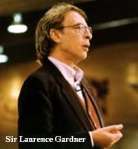
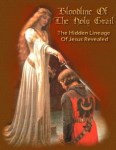
Laurence Gardner’s first book Bloodline of the Holy Grail was published in 1996. [1] The book was serialized in the Daily Mail and a best seller.[2] He used his books to propose several theories, including a belief that Jesus and Mary Magdalene had married and had children, whose descendants included King Arthur and the House Of Stuart.[2] In Lost Secrets of the Sacred Ark he claimed that the Ark of the Covenant was a machine for manufacturing “monatomic gold” – a supposed elixir which could be used to extend life.[3] His books also included theories about Freemasonry, the Knights Templar, The Holy Grail and proposed connections between Atenism and Judaism.
Gardner referred to himself as “Chevalier Labhran de Saint Germain”, and “Presidential Attache to the self-styled European Council of Princes” also “Prior of the self-styled Celtic Churches Sacred Kindred of Saint Columbia”.[4] He also claimed to be Jacobite Historiographer Royal of the Royal House of Stewart. He was a supporter of Michael Lafosse, in particular his claims to be descended from the House of Stuart, which Gardner claimed was descended from Jesus Christ.[5][6]
Historians and scholars regard him as a conspiracy theorist,[7] and treat his work as pseudohistory.[5] Michel Lafosse’s claims have been dismissed.[8]
Laurence Gardner was also known in the United States for his radio phone-ins.[2]
It was announced on his personal website that he had died on 12 August 2010 after a prolonged illness.[9]
DaVinci seems to have had a “thing” for John the Baptist, which seems quite consonant with the apparent “PoS” interest in Johannism (the idea that John was the true Messiah and Jesus a false one, or, alternatively, that they were equal co-Messiahs). Johannites believe that there was a secret teaching passed from John the Baptist to John the Beloved Disciple (whose given name was Lazarus, but he took the “alias” of John to honor the Baptist), and to a “John” ever since. (Supposedly, every PoS GrandMaster takes the name “Jean” as an honorary title, in addition to being known as “Nautonnier” or Navigator.) Pincknett and Prince believe Da Vinci put his own face on the Shroud of Turin (despite accounts which suggest it was first shown at Lirey 200 years earlier), which was confirmed to them by someone they believed to be a member of the PoS, “Giovanni”.
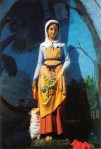
The Rose: Rosicrucianism, the Rosy Cross, and rose-line symbolism is all over the place in this mystery. In Sauniere’s church, St. Germaine de Pribrac releases a bevy of roses from her apron. The “Fleury Mural” seems to show a rose-filled flowery landscape, associated with the Fleury family. Go to Rodez, and you will find a rose-colored cathedral with rose windows emblazoned with the Star of David. In the Middle Ages, the rose was a symbol of esotericism – sub rosa means to do something in secret. The Templars’ cross pattee was a red or rose cross.
How interesting, then, to discover, as I have recently, that the name of several places in France – Rhedae/Rennes, Rouen/Rhodom, Rodez/Rhodes, are derived from the Greek Island of Rhodes, whose name itself comes from the rose-goddess Rhoda. Contemporary texts say that the red-haired Celtic “Redones” or “rose people” (Rutheni/Rhodanim) setlled both Rennes in the Midi and Rennes in Brittany – the name derives from the ethnic group. It is said that the resident goddess of Mount Sion-Vaudemont, the “other Sion” of the “priory of Sion” in Switzerland, is Rosemertha – the Rose mother. Interestingly, one interpretation of the King Arthur legends is that “Arthur” or “Ursus” was really Riothamus, a Dark Age Celt ruler of a “thalassocracy” that spanned Brittany in France and Cornwall in England. Many of the places near Breton Rennes are associated with Arthur and the Grail legends, and many of the Breton kings had Judaic names. And some derive Riothamus’ name from… Joseph of Arimathea, the supposed bearer of the Grail to Glastonbury.
A time came when that was not enough for her. You have to realize that this was her life. Her entire existence up until this time when the Lord introduced her to the Mass was at best, dreary. She developed a hunger for the Eucharist, which was to be the catalyst which brought about the beginning of one of the miracles given to St. Germaine. One day, the Lord spoke to her heart. She was out in the field, tending the sheep. She heard the bells which called the people to Mass. She knew they were calling her to Mass. She could not be without the Lord. She took her distaff, a staff with a cleft end for holding flax, which she used for spinning her wool, and thrust it into the ground. From that day on, it didn’t matter what time of the year it was, the summertime when the ground was soft, or the coldest day of winter when the ground was rock solid. When she thrust the piece of wood into the ground, it stayed. She then huddled her flock of sheep around the distaff, and told them to stay there, and stay together. Do not wander off. Then she ran off to the Church on those days to take part in the Mass.
Now, to those of us who have no experience in sheep herding, what she did was not only ill-advised, it was ridiculous, almost impossible. There’s no way you can keep the sheep together unless the shepherd is with them, guiding them. In addition, in the forest where she tended sheep, it was infested with wolves, which always attacked unattended herds of sheep. However, her sheep were never touched. She never lost a sheep. The wolves didn’t attack, and no sheep ever wandered off.
While these types of mythical stories of a Holy Grail make for interesting reading and exciting movies, they should not be of great concern for true Christians. As born-again believers of Christ, our hope is not in some vessel that might have held Christ’s blood or might have been used by Him at the Last Supper; our hope and assurance is in His sinless life, His atonement on the cross, His resurrection from the dead, and His promise of eternal life to all who believe in Him. Christians do not need to look to a priest who traces his authority back to Christ by apostolic succession when we have the authority of the Word of God and direct access to the only mediator between man and God, Jesus Christ (1 Timothy
According to the (pseudepigraphic) Letter of Aristeas, and repeated with embellishments in Philo, Josephus and various later Jewish and Christian sources, Jewish scholars first translated the Torah (the first five books of the Bible) into Koine Greek in the 3rd century BCE.[12][13] The traditional explanation is that Ptolemy II sponsored the translation [14] for use by the many Alexandrian Jews who were fluent in Koine Greek, but not in Hebrew. The Talmud perpetuates the false story of the Letter of Aristeas:
‘King Ptolemy once gathered 72 Elders. He placed them in 72 chambers, each of them in a separate one, without revealing to them why they were summoned. He entered each one’s room and said: “Write for me the Torah of Moshe, your teacher.” God put it in the heart of each one to translate identically as all the others did.'[15]
In religious context, immortality is often stated to be among the promises by God (or other deities) to human beings who show goodness or else follow God’s law (cf. resurrection). In this view, while the material human body dies, God is able to save the soul of the person, and for that soul crafts a new “spirit body” which is immortal.[3] (cf. resurrection of the dead) and According to this type of religious belief, human beings on Earth are already immortal in the spiritual sense —already guaranteed immortality —and the only obstacle to this immortality is sin. [4] Moreover, only God is regarded as truly immortal, hence it is only through God’s resources for resurrection and salvation that human beings may transcend death and live eternally.
According to some traditions the Holy Grail was the cup from which Jesus and his disciples drank at the Last Supper. According to other traditions, it was the cup in which Joseph of Arimathea caught Jesus’ blood as he hung on the cross. Some traditions might even assume that the Grail was both of these. And yet, despite the apparent value of such a relic, there is no reference to it whatever from the time of Jesus until the height of the crusades, a period of more than a thousand years. In fact, the earliest references to the Holy Grail coincide with the Frankish kingdom of Jerusalem in its full glory, when the Templars were at the apex of their overt power, and when the Cathar heresy was gaining a momentum that actually threatened to displace the creed of Rome.*
Much of what we know about the Holy Grail comes from the Grail romances, which appeared out of the area of the Lorraine (formerly associated with the Merovingian dynasty) in the early twelfth century. In fact, Godfroi de Bouillon, our consummate leader of the first crusade, was according to medieval legend and folklore, descended from Lohengrin, the Knight of the Swan; and Lohengrin, in the Grail romances was the son of Perceval or Parzival, the chief protagonist of all the early Grail stories.
Initially the Grail romances rested heavily on a pagan foundation — a ritual connected with the cycle of the seasons, the Death and Rebirth of the year. (Recall the spring equinox ritual the Cathars followed during the critical two week truce before capitulation from the Siege of Montsegur? — and the subsequent escape of four parfaits with the “treasure” of the Templars?) In its most primordial origins the pagan rituals would appear to involve a vegetation cult, closely related in form to, if not directly derived from, those of Tammuz (aka Dumuzi — the consort of Inanna), Attis, Adonis, and Osiris in the Middle East. However, during the mid to late twelfth century, the originally pagan foundation for the Grail romances underwent a curious and extremely important transformation. At that time, the Grail became specifically associated with Christianity.
Increasingly, I am finding more evidence of Surrealists at work in this mystery. Henry Lincoln first pointed out that Cocteau’s Mural in Notre Dame de France seems to have a pentagram centered on Cocteau’s forehead. My research suggests that this pentagram is a reference to Cocteau’s surrealist colleagues, Guillaume Apollinaire, who had a star-shaped wound on his head, and Raymond Roussel, who wrote a play, The Star in the Forehead. The Mural also contains a Blue Rose, which is an apparent allusion to a Russian Symbolist art group that influenced Marc Chagall and other painters. According to Simon Miles, the Surrealist poem Le Serpent Rouge contains symbolism from Jung’s _Mysterium Coniunctionis_, which was of key interest to Surrealists. Most importantly, Gerard de Sede in the 1940s belonged to two Surrealist groups, Les Reverberes and La Main a Plume. Members of these groups would go on later to form the Workshop for Potential Literature (Oulipo) in the 1960s. Oulipo was interested in cryptograms, ciphers, textual reversals and inversions, geometric figures in paintings (Oupeinpo), and one key Oulipo text even used the Knight’s Tour of the Chessboard as a organizing device. Jean-Pierre Deloux seems to be connected to Oupolipo, the offshoot of Oulipo devoted to creating detective police fictions. And Philippe de Cherisey seems to have written several articles on Alfred Jarry, the founder of the Surrealist College de Pataphysique.
I believe that people get lost in certain obsessive details regarding this mystery, in particular details having to do with the life of Jesus, the idea of some type of mysterious bloodline with genes from (G-d/aliens/angels/Nephilim/Merovech/take your pick), lost artefacts (the Shroud of Turin, the Ark of the Covenant, the Holy Grail, the head of John the Baptist, etc.), or conspiracy theories (on the part of the Catholic Church, the French Geographic Institute/IGN, and various ludicrous New World Orders). In this essay, I’m going to attempt to present my current, “millennial” take on this mystery. I will actually attempt to argue beyond the mere basis of statements a and b, but I will attempt to present why I believe this is the case. Since this is not a scholarly essay, it will not be heavily referenced and footnoted, but I believe all assertions in here are defensible, and can present the sources on which I think they are based. Many ideas in here come from the three years of discussion I have had on the priory-of-sion egroups list, with a wide-ranging variety of erudite minds.
According to the “prieure documents,” a conclave of Calabrian monks who left from the Belgian Abbey of Orval in 1090 helped secure the election of Godfroi de Bouillion as de facto king of Jerusalem during the First Crusade (but as is well known, he refused the title, accepting only Defender of the Holy Sepulchre), based on their belief that he was a descendant of the Merovingians, and by that fact, according to these documents, also a descendant of King David through Jesus and Merovech. In return, Godfroi secured their installation into an Abbey on Mount Sion. These documents also claim that the Ordre of Sion and the Order of the Temple (officially, the Poor Knights of the Temple of Solomon, later known as the Knights Templar, and officially recognized as such in 1118) were, until 1188, one unified organization with the same leadership.
Is there any basis to these claims? Here is what it is apparently true: there was indeed an Order of Sion based on Mt. Sion, and according to a papal bull of the 12th century, it had monasteries and abbeys elsewhere in Palestine (in particular, Mount Carmel), in southern Italy (Calabria), and in France. There is little in the official histories linking Godfroi to this order, but he is said to have founded the Order of the Holy Sepulchre, whose relationships to these other orders (the Temple and Sion) are unclear. And the official histories do not indicate any overlap between these monks and the soldier-monks of the Knights Templar. The Order seems to have occupied its “mother” abbey, Notre Dame de Sion/St. Mary of Mt. Zion, built on the foundations of the original apostolic Cenacle or Coelaneum, up until around 1291 or so, when like many Crusader holdings, it was overwhelmed by the Moslem onslaught. It actually was in the hands of the Franciscans for several more centuries, until it finally was lost to Christian ownership and was converted to a mosque.
I have found interesting links between the Order de Sion and the Carmelites. St. Berthold, the founder of the Carmelites, also originated from Calabria. Fra Lippi, a tutor of Botticelli, who is listed as a PoS GM, lived in Calabria and was known as “The Carmelite”. Crotone in Calabria was the home of the Pythagorean school, and Pythagoras is said by Iamblichus to have visited Mount Carmel. Calabria was the “stomping grounds” of Joachim of Fiore and Giordano Bruno. Most interestingly, recent archaeological articles suggest the Essenes had encampments on both Mount Carmel and Mount Zion. St. Therese of Liseux turns up in a number of “PoS churches”, and she took her name both from Theresa of Avila, a Discalced Carmelite and mystic, and Therese of Lidoine, a Carmelite nun who was murdered by the Revolutionary Terror in Compeigne.
http://www2.fiu.edu/~mizrachs/poseur3.html
Equally in dispute has been the fate of the Templars after their 1312 dissolution. In many countries, they were simply folded into “new” military orders which consisted of the same people under a different name – for example, the Knights of Christ in Portugal. In England and in many countries, some went on to join their former friendly rivals, the Hospitallers. This may have been a good decision, considering the number of assets of the Templars turned over to their rivals. In France, most of the knights hung up their swords and retired to non-military monasteries, although a few went “rogue” and became mercenaries, pirates, or freebooters. However, there have always been the persistent rumors that the Templar order “survived” in some clandestine form after its own dissolution. For example, the Charter of Larmenius says that before de Molay died, he appointed a “clandestine” Grand Master to continue the order in defiance of the Pope’s bull. Many of the “neo-Templar” orders of today claim they are the continuation of this ‘survival’, often with little or no proof. And, of course, there are those who say the Freemasons are the heirs of the Knights Templar.

 Rosamond Press
Leave a comment