 Children are coming to believe alcohol is a legal way to get high. The rich Republican-right condone alcohol over drugs. The rich drink martinis, and are real smart.
Jon ‘The Nazarite’
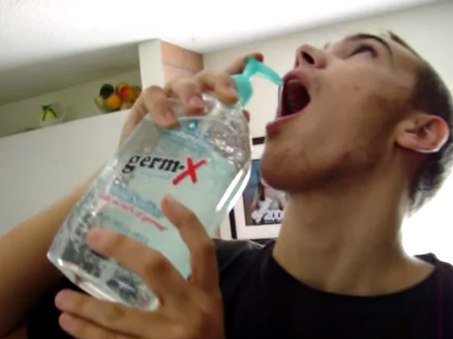
The best way to drink hand sanitizer is straight, like whisky, and down it “like a shot,” explains Tyler, a Grade 10 student who lives in Toronto. Undiluted, the alcohol-based liquid tastes a little like “vodka and bug spray,” he adds.
The alarming comment from the 15-year-old mirrors a growing number of news reports about teenagers and children drinking the antiseptic hand-cleaning products. Most hand sanitizers have an alcoholic content between 60 and 90 per cent, which means that even small amounts have led to a number of cases of alcohol poisoning in younger children. That percentage is much higher than even that of most hard liquors, giving it an appeal to kids looking for a quick high, explains Jane Wells, a drama teacher at Toronto’s after-school Care Program. Wells has come to know a lot about this subject: she discovered that a group of eight- and nine-year-olds drank hand sanitizer at school just before she took them on a school walk. When she noticed them acting strange and giggling, they first told her they had been drinking alcohol, but after some probing, confessed it was really the hand cleaner. They told her they’d been enticed by the promise of alcohol “right on the bottle,” she says.
This kind of situation creates a problem for schools. The liquid, jokingly called “booze ooze” on parenting blogs, is one of the best defences against H1N1 and other colds and flus, says Jonathan Kerr, a Belleville, Ont.-based family doctor and member of the board of directors for the Ontario College of Family Physicians. But with reports of children drinking it or setting it alight (it’s flammable), Kerr says, schools face an “interesting dilemma.”
A number of Canadian schools have banned alcohol-based hand sanitizer from the premises. In some schools in Cape Breton, it isn’t allowed in the classroom, and provided to children only when there isn’t soap and water. Parents are discouraged from giving bottles to kids, although it’s not confiscated unless it “causes problems” at school, explains Ambrose White, director of operational services for the Cape Breton-Victoria school board. Lee County schools in Florida initially banned the substance, but then relented last month because of the threat of swine flu. Winnipeg schools won’t use the alcohol-based kind for safety reasons, but have introduced non-alcohol-based sanitizers, which are about as effective, according to studies, but can be more expensive.
Ossington/Old Orchard Junior Public School in Toronto allows kids to use it in the classroom, but the bottles are kept under close scrutiny on the teacher’s desk or within eyesight. “Teachers have control over it,” says someone who works at the school but did not want their name used. Kids are allowed to use it, but they are watched “as they squirt so they don’t lick it.”
The preference among kids who have tried it, according to an informal poll done by Maclean’s, is to drink hand sanitizer straight. It dries out the throat, and tastes bitter and foul—in short, nothing like the fruity flavours it promises, such as warm vanilla sugar, Japanese cherry blossom, coconut lime verbena, cucumber melon, midnight pomegranate and nectarine mint. These not only sound enticing, they come in “pretty bottles” that are seductive to young children, explains Christine Crosby, a grandmother who publishes Grand, an online magazine about grandparenting. Crosby, who has two grandchildren aged five and eight, is hyper-vigilant around the product—she’s heard of children being rushed to hospital with alcohol poisoning after taking a swig. “It’s everywhere at the moment,” she says, “and it can be scary.”
Eighteen-year-old Kyle, who did not want his last name used, lives in Barrie, Ont. He drank strawberry-flavoured hand sanitizer on a dare at a party, but he draws the line at sniffing, because it would “burn your nose right out.” That’s not to say it isn’t done: online footage of kids sniffing hand sanitizer makes it look painful. But it might be more common than its enjoyment factor would suggest: a Texas teen was accused of sniffing the hand sanitizer to “induce a condition of intoxication, hallucination and elation,” according to a Denton County court petition. The charges were dropped because hand sanitizer is not an abusive inhalant under the Texas Health and Safety Code. His father, Richard Ortiz, claimed his son sniffed only because he liked the smell.
Having had one scare already, Wells is extra careful and vigilant with it now around her students. “It’s worrying,” she says. “You are loath to say ‘Don’t drink that!’ because they might not have thought of it until you said it.”
We shouldn’t have to say, “don’t drink the hand sanitizer,” but a recent report from Australia has us reeling. To be honest, it’s not the sort of thing that we ever thought of pointing out, but if you’re thinking of drinking from that dispenser of hand sanitizer on the wall by the sink, just don’t do it. Even if you’ve already twigged to the fact that some of the brands contain mostly alcohol, bear in mind that hand sanitizer comes in two flavors, one of which contains isopropyl alcohol—quite different from ethyl alcohol, a.k.a ethanol, the kind that you drink. Isopropyl alcohol is commonly used as a solvent and as a cleaning fluid, and is also encountered in the formulation known as rubbing alcohol. Kitty Dukakis tried drinking rubbing alcohol once. It is not a cocktail, and it can kill you if you manage to put down enough of it.
And in Australia recently, somebody tried. Doctors at a Melbourne hospital went into emergency mode after a patient laid hands on six bottles of Aqium Gel hand sanitizer and put away about a half-gallon of the stuff. With a blood alcohol level at five times the legal limit, the 45-year old man, who had a history of substance abuse, and who had been admitted for alcohol-related gastritis, was lucky—his hand sanitizer of choice contained ethyl alcohol. Still, “it surprised us that he drank this stuff,” an internist at the hospital told AP. “It’s horrendous. You’d think it would taste pretty bad.”
A 43-year old alcoholic in Cincinnati was not so lucky awhile back, after he was admitted to a hospital with chest pains, treated, discharged, and immediately readmitted when he became sick and delirious. This time, “the patient was seen in the bathroom drinking the alcohol-based hand wash from its dispenser,” according to a case study cited in the New England Journal of Medicine. “When asked why he ingested the hand cleaner, he pointed to the label, which read ‘Active ingredient 63% v/v isopropyl alcohol.’ He explained that this percentage is higher than that in vodka.”
We’ve also seen sporadic reports of teens drinking hand cleaner. That’s just sick and wrong, crew.
 Rosamond Press
Leave a comment