 Reading the Bible for the first time at forty years of age, I was in the light after reading all of Luke. But, when I got into Acts and read about Paul, I knew something had gone terribly wrong. I wish Paul was never born, because he drove me from the Christian Fellowship I should be enjoying.
Members of the original church were not buying it, that a resurrected Jesus made Paul an Apostle on the road to Damascus. This meant Jesus would resurrect a THIRD TIME to finish what he started, what God sent him to do. I wondered why the Son of God, and God Incarnate – DID NOT GET IT RIGHT THE FIRST TIME! There were long established schisms in the Torah God would want to put behind the Chosen Children of God – so why would he choose Paul to creat 10,000 thousand new schims that would drive Jews – members of the first church – from the church Paul now ruled with an iron hand.
Paul fights with Mark-John and Barnabas, who was considered an Apostle. To ignore these fights is impossible! They create a terrible pall that bids one to ignore them – or be titles a Son of Satan. This is to say Paul is electing Sons of Satan – after admitting he tortured Jewish Saints – and their families in order to get them to blaspheme against “their Lord”. Was Paul hunting down Cohens – and their genealogies?
Paul had to be concerned about the Jewish Christians – and Judaizers – building a new temple in the name of Jesus -something seventy million evangelicals want their desecendants to do. Evangelicals in the church and in our government are electing Sons and Daughters of satan – like crazy! Is this how Satan get’s his followers?
Paul put a virus in the original teaching that is tearing this nation – in twain!
Jon Presco
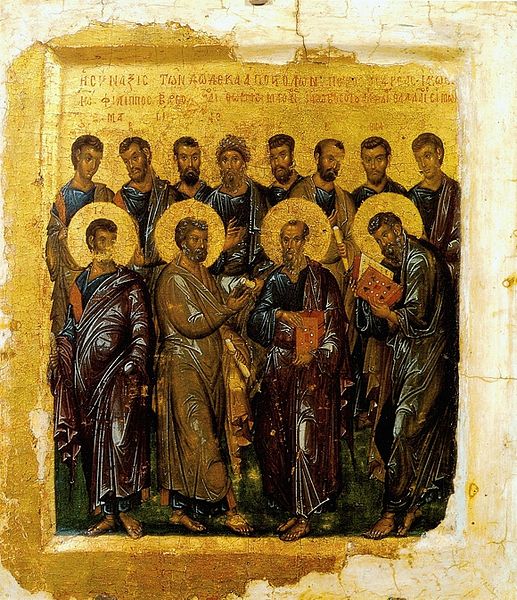
Before their sending away the Twelve had been mere “Disciples”, from Latin discipulus, one who learns, from disco, to learn.[3] This event was for them thus a form of graduation,[4] when they stepped-up from being students to teachers. Apostle is the Greek equivalent of the Hebrew word shaliah. Jesus is stated in the Bible to have had twelve apostles who by the Great Commission spread the message of the Gospel to all nations after his resurrection. There is also an orthodox tradition derived from the Gospel of Luke of Seventy Apostles.
Saul of Tarsus (aka Paul), not one of the Twelve or the Seventy and a recent convert, claimed the title of Apostle to the Gentiles, even though other apostles actively recruited Gentiles (non-Jews) and St. Peter’s role was never restricted to just Apostle to the Jews (see also Circumcision controversy in early Christianity, Incident at Antioch, Primacy of Simon Peter, and Paul of Tarsus and Judaism), indeed traditionally the first Gentile convert is considered to be Cornelius the Centurion, who was recruited by Peter. Paul claimed a special commission from the resurrected Jesus, separate from the Great Commission given to the Twelve. Paul did not restrict the term apostle to the Twelve, referring to his mentor Barnabas and others as apostles, either because he didn’t know it or resisted it.[5] This restricted usage appears in Revelation.[5][6] In modern usage, major missionaries are sometimes termed apostles, as in Saint Patrick, Apostle of Ireland.[5]
The sub-period of Early Christianity during the lifetimes of the apostles is called the Apostolic Age.[7] In the 2nd century, association with the apostles was esteemed as evidence of authority and such churches are known as Apostolic Sees. Paul’s epistles were accepted as scripture (see Development of the New Testament canon), and two of the four gospels were associated with apostles, as were other New Testament works. Various Christian texts, such as the Didache and the Apostolic Constitutions, were attributed to the twelve apostles. Bishops traced their lines of succession back to individual apostles, who were said to have established churches across great territories. Christian bishops have traditionally claimed authority deriving, by apostolic succession, from the Twelve.[5] Early Church Fathers came to be associated with apostles, such as Pope Clement I with Peter the Apostle (see Apostolic Fathers). The Apostles’ Creed, popular in the West, was said to have been composed by the Apostles themselves.
Original Twelve picked by Jesus:
Peter, crucified upside-down in Rome c. AD 64.
James, son of Zebedee was beheaded in AD 44, first of the Twelve to die (since the addition of Matthias)
John, son of Zebedee, no biblical record of death, he is believed to have died of natural causes due to old age. Members of the The Church of Jesus Christ of Latter-day Saints believe that John was immortalized and he will live to see the Second Coming of Christ.[22][23]
Andrew, Peter’s brother, was crucified upon a diagonal or X-shaped cross.
Philip was crucified in AD 54.
Bartholomew (also known as Nathaniel) was flayed alive (skinned) and then beheaded; some sources locate his death at Derbend on the Caspian Sea.[24]
Matthew killed by an axe in AD 60.
Thomas was killed by a spear in Mylapore, Madras, India in AD 72.
James, son of Alphaeus, stoned at age 90 then clubbed to death.
Jude was crucified.
Simon the Zealot was crucified in AD 74.
Judas Iscariot, according to Matthew, hanged himself after betraying Jesus. In Acts, he is described as falling in a field and bursting open. Apologists explain this apparent discrepancy by presuming that he decayed on the tree resulting in a bloating with gas and a weakening of the skin. Then when he was let down from the tree he burst open upon impact. A third account by Papias records Judas “walking the world”, his body having become swollen before being crushed by a chariot.” “[25]
Replacement for Judas Iscariot picked by the surviving eleven:
Matthias, Judas’ replacement, was stoned and beheaded.

 Rosamond Press
Leave a comment