 In 1990 I had a second reading at the Berkeley Psychic Institute and was told I go each night to the Cathedral of the Souls where I have a reserved seat at a great table, where a hooded figure stands vigiliant behind me.
The Winter King and Queen of Bohemia were Rosicrucian Royalty. Their offspring would rule Britian and other nations. My great grandfather, Wensel Anton Prescowitz, came from Bohemia. I have long wondered if we are kin to Wenzel Anton Kaunitz.
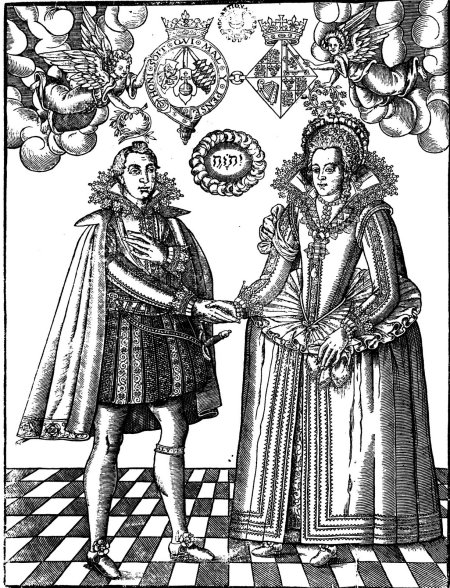
What are these symbols in the drawing above of the Winter Royalty?
Jon Presco
Yates begins by describing a “royal wedding” between Princess Elizabeth and Frederick V, Elector Palatine of the Rhine. These two became known mockingly as “the Winter King and Queen of Bohemia” after Frederick’s failed attempt to take the throne of Bohemia and their flight from Prague. Their union was supposed to represent a Protestant front against Hapsburg aggression and the forces of Catholic reaction. Yates shows the influence of Shakespeare and the theater on the pair as well as Spenser who wrote the _Faerie Queene_. It was at around this time that three Rosicrucian manifestos appeared. These include two pamphlets which first appeared in 1614 and 1615 with abbreviated titles of the _Fama_ and the _Confessio_ and a third publication appearing in 1616, an alchemical romance with the title _The Chemical Wedding of Christian Rosencreutz_. This last romance is believed to have been written by Johann Valentin Andreae, a Lutheran pastor with socialist interests. These writings inform the reader of an invisible and hidden society of Rosicrucians founded by Christian Rosencreutz and explain his exploits and adventures as well as delving into alchemical symbolism. Yates suggests that they express political support for “the Winter King and Queen”.
The word Rosicrucian refers at once to the semi-mythical (at least believed to be mythical by most modern scholars) hero of the manifestos Christian Rosencreutz but also to the Rosy Cross (combining “Rose + Cross” or perhaps “Ros” (dew) and “Crux” in an alchemical interpretation). Yates emphasizes two aspects of the Rosicrucian movement. First, she wants to ground this movement in the Hermetic philosophy, cabbalism, and magical traditions of the Renaissance (emphasizing her earlier studies on such Renaissance figures as Giordano Bruno and Marsilio Ficino). Second, she wants to emphasize the influence of the Elizabethan magus John Dee on Rosicrucianism.
Wenzel Anton, Prince of Kaunitz-Rietberg (Czech: Václav Antonín z Kounic a Rietbergu, German: Wenzel Anton Fürst von Kaunitz-Rietberg) (2 February 1711 – 27 June 1794) was a diplomat and statesman of the Holy Roman Empire. In 1764 he was made a prince of the Holy Roman Empire as Reichfürst von Kaunitz-Rietberg and in 1776 prince of the Kingdom of Bohemia.
[edit] Early lifeKaunitz was born in Vienna, one of 19 children[1] of Maxmilian Ulrich, third count of Kaunitz, and Marie Ernestine née von Ostfriesland-Rietberg, an heiress. The Kounic family was an old Bohemian noble family descending from the Duchy of Troppau, settled in Slavkov (Austerlitz) Castle, Moravia. As the second son, it was at first intended that he should become a clergyman, and at thirteen he held a canonry at Münster.[2] With the death of his elder brother, he decided on a secular career, and studied law and diplomacy in Vienna, Leipzig and Leyden. He became a chamberlain of the emperor Charles VI, and continued his education by traveling for some years in Germany, Italy, France, and England.[1]
In 1735, he was appointed aulic councillor of the empire (German: Reichshofrath). At the German Diet of Ratisbon in 1739 he was one of the imperial commissaries. In March 1741, he was sent on a diplomatic mission to Florence, Rome, and Turin, and in August 1742 was appointed Austrian ambassador at Turin. In October 1744, he became minister in the Austrian Netherlands. Its ruler, Prince Charles of Lorraine, was commanding the Austrian army in Bohemia against the King of Prussia, and after the December 1744 death of the governor, Archduchess Maria-Anna, who was Charles of Lorraine’s wife and sister of Maria Theresa, Kaunitz was virtually the head of government.[2][3]
In 1746 he was forced to leave Brussels after it was besieged by French forces and move with the government of the Austrian Netherlands, first to Antwerp, then to Aachen. His request to be recalled from his difficult situation was heeded in June 1746. In 1748, he represented Holy Roman Empire at the Congress of Aachen at the close of the War of the Austrian Succession. Extremely displeased with the provisions that deprived Austria of the provinces of Silesia and Glatz and guaranteed them to Frederick II of Prussia, he reluctantly signed the resulting Treaty of Aix-la-Chapelle on 23 October 1748.[2]
In 1749 Maria Theresa appealed to all her counsellors for advice as to the policy Austria ought to pursue in view of the changed conditions produced by the rise of Prussia. The great majority of them, including her husband Francis I, were of opinion that the old alliance with the sea powers, England and Holland, should be maintained. Kaunitz had long been a strong opponent of the Anglo-Austrian Alliance, which had existed since 1731, and gave it as his opinion that Frederick was now the “most wicked and dangerous enemy of Austria,” that it was hopeless to expect the support of Protestant nations against him, and that the only way of recovering Silesia was by an alliance with Russia and France. The empress eagerly accepted views which were already her own, and entrusted the adviser with the execution of his own plans.[4] Thus Kaunitz was ambassador at Versailles 1750-53, where he cooperated in laying the groundwork for the future Bourbon-Habsburg alliance.
[edit] Foreign Minister
Kaunitz-Rietberg (part of the Maria Theresa monument in Vienna)Kaunitz’s most important and extremely influential office was that of the chancellor of state and minister of foreign affairs, which he held 1753-93 and where he had Empress Maria Theresa’s full trust. Thanks in large part to him, Habsburg Austria entered the Treaty of Versailles (1756) with her old enemy France (in 1757 expanded to include Russia and Sweden) against the Kingdom of Prussia to win back Silesia. This alliance was considered a great feat of diplomacy, and established Kaunitz as the recognized master of the art.[4]
Thus began the Seven Years’ War, which ultimately failed to bring the lost provinces back to Austria. Kaunitz founded the Austrian Council of State (German: Staatsrat), 1761, overseeing the reorganization of the army under Daun and worked towards the goal of subjecting the church to the state. He followed the thoughts of the Age of Enlightenment and among his aims was also the better education of the commoners. Following the end of the Seven Years’ War, Kaunitz gained the title of Reichsfürst[5] (prince of the Holy Roman Empire). The lack of a navy during the war had demonstrated Austria’s vulnerability at sea, and he was instrumental in the creation of a small Austrian navy to boost the state’s presence in the Mediterranean Sea, laying the foundations for the future Austro-Hungarian Navy.
Although Joseph II generally shared such ideas, his reforms moved too fast and too thoroughly for Kaunitz whose influence grew less during Joseph’s reign (1765–90), and even less when Joseph’s brother Leopold II reigned; he resigned his office upon the accession of Francis II. Kaunitz died in Vienna and was buried in his family vault beneath the Church of St. John the Baptist in Slavkov u Brna cemetery.
Kaunitz was a liberal patron of education and art.[6] He married Maria Ernestine von Starhemberg on 6 May 1736. She died on the 6 September 1754. Four sons were born of the marriage.[4] His granddaugther Eleonora (daugther of Kaunitz’s son Ernest) married his successor in the office of the State Chancellor, Prince Klemens von Metternich.
 Rosamond Press
Leave a comment