


Anne was the last ruler of Scotland before it became a part of Great Britain. The House of Hanover, a descendant of the Bohemian King and Queen of Bohemia, became the ruler of Scotland.
The House of Orange and the Glorious Revolution plays a big role.
John Knox opposed Mary Queen of Scots, and his Scottish descendant, John Witherspoon, signed the Declaration of Independence which opposed the House of Hanover. The Scot-Irish did most of the fighting in the Revolutionary War.
Jon Presco
Copyright 2012
Robert Bruce was the next in line to the throne according to proximity of blood. As such, his arguments centered on this being a more suitable way to govern the succession than primogeniture. His lawyers suggested that this was the case in most successions and as such had become something of a ‘natural law’. Unfortunately for Bruce, the Scots’ tradition for the preceding 200 years had been demonstrably different, relying on primogeniture instead. They also put before the court the suggestion that Alexander II had designated Bruce as heir when he himself was still childless.[7] Whatever the truth of this, the fact remained that Alexander did eventually produce a male heir and that in the same period John Balliol also produced sons, all of whom would have a stronger claim than Bruce. Bruce also began by arguing alongside Balliol that the kingdom was indivisible, but when it became apparent that his own claim was going to fail he instead performed a rapid U-turn and joined Hastings in arguing that it be split amongst the three senior claimants,[4] a fact for which he has been excoriated by many modern historians.
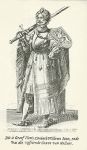
Floris V’s argument was that Earl David had resigned the right of himself and his heirs.[3] Although Floris was not a direct descendent of David I, he claimed that David had given up his right to the throne to his brother William in exchange for a grant of land in Aberdeenshire. If true, this would make Floris the rightful King of Scotland. Floris claimed that although he did not possess copies of the documents detailing, the handover of power one must exist somewhere in Scotland, and Edward postponed the court for a full ten months while a search was made through various castle treasuries.[3] No copy was found at the time, but copies later surfaced at Pluscarden.[3] One of the early “certified copies”, dating the certification seals of the bishop of Moray and the prior of Pluscarden to 1291, is currently located in the Hague.[3] This document is thought to be a forgery.[3]
Floris’s case was rejected for lack of evidence. However, there is evidence that he entered into an agreement with Bruce in which if one of them was to successfully claim the throne, he would grant the other one third of the kingdom as a feudal fief.[1] Other clauses in the agreement strongly suggest that of the two, only Bruce could really expect to be a successful claimant. This has been interpreted to mean that Floris and Bruce were in collusion, with Bruce hoping that taken together their arguments could defeat Balliol, with Bruces’s claim then being upheld in favour of Floris’.[3] It is striking that there is no record of Bruce and Floris being at loggerheads during the proceedings.
Floris V was the son of Count William II of Holland and Elisabeth of Brunswick-Lüneburg. In ca 1271 Foris married Beatrice of Flanders, daughter of Guy de Dampierre, count of Flanders and Matilda, heiress of Bethune, Dendermonde, Richebourg and Warneton.[6] Floris and Beatrice had several children including:[7]
John I, Count of Holland, who married Elizabeth, daughter of King Edward I of England. No issue. After John’s death Elizabeth returned to England and married Humphrey de Bohun, 4th Earl of Hereford.
Margaret, engaged to Alphonso, Earl of Chester, son of King Edward I of England from 1281 to his death in 1284.
Further children are mentioned in the Chronologia Johannes de Beke, giving a total of eleven children:[8]
Dirk (Theodricum), Floris (Florencium), William (Wilhelmum), Otto (Ottonem), William (Wilhelmum), Floris (Florencium), Beatrice (Beatricem), Mechtild (Machtildim), and Elizabeth
Floris had several illegitimate children, including:[7]
Witte van Haemstede, son of Anna van Heusden (daughter of Jan van Heusden). Married Agnes van der Sluys had issue.
Catherina van Holland (Katherin), married Zweder van Montfoort
FLORENT V AND THE SCOTTISH THRONE (Dutch title: Floris V en de Schotse Troon, Conserve, Schoorl, 1995)
When the child-queen Margaret of Scotland dies, thirteen pretenders arise to claim the Scottish crown. One of them is Florent V, count of Holland and Zeeland, a descendant of King William the Lion. In 1292, a succession parliament convenes in Berwick-upon-Tweed on the Scottish border. The Dutch count and most of his rivals, among them the lords Bruce and Balliol travel there to await the judgment of King Edward I of England, to whom the claimants have subjected their case.
To prove his claim, count Florent needs an old charter. Unfortunately, this seems to have been removed from the Edinburgh treasury, and the messenger sent to retrieve it is mysteriously murdered. The count’s agent, Arnoud of Ranst, starts a hunt for the missing charter, while his young assistant, Folkert Crepel, tries to find out who murdered the messenger. They both succeed, though neither the charter nor the murderer turn out to be what one would have expected. And in the end the prize, the Scottish crown, does not go to Holland.
Scottish history from William the Lion to William Wallace.
THE LAST DAYS OF FLORENT V (Dutch title: De laatste dagen van Floris V, Conserve, Schoorl, 1996)
It is the year 1296. When count Florent V of Holland deserts Edward of England and turns to Edward’s arch-rival Philip of France instead, many people have reason to be outraged. One of them, the powerful lord of Cuyck, cuts his feudal ties with the count. When the chaplain who acted as his messenger is poisoned during a Pentecost Mass, even the count’s faithful subjects look askance at their lord. Annoyed by this, Florent commands Folkert Crepel, clerk and minstrel, to investigate the affair. This turns out to be highly problematic, and even more so when a daughter of one of the count’s malcontent vassals succumbs to the very same poison.
In the mean time, Florent’s agent Arnoud of Ranst is to find out what the lord of Cuyck is up to. But the lord of Cuyck is as elusive as the poisoner, and master Arnoud, moreover, has his own reasons to be less zealous than usual. When young Folkert at last manages to unravel the mystery, it is too late to unmask the fatal conspiracy lying at its heart…
The life and death of Floris V inspired songs, plays, and books in the Netherlands. Best known is the play “Gijsbrecht van Aemstel” by 17th century playwright and poet Joost van den Vondel, which is about the sacking of Amsterdam in the days after the death of Floris V.
The nickname “God of the Peasants” was introduced after his death in the nobility, and was originally intended to be an insult. He earned the name because he behaved “as if he were the Good Lord himself with his peasants”. He apparently knighted 40 peasants as members of the Order of St. James without permission of the church, provoking the anger of the church and of the 12 existing noble members of that knightly order. This story has no historical basis, just like another story that claims that Gerard of Velzen participated in the conspiracy because Floris supposedly raped his wife. What is certain is that Floris was remembered as a saint by the peasants of Holland, and that the “God of the Peasants” became a symbolic hero in the struggle for independence from Spain in the Eighty Years’ War (1568–1648).
1. Floris V, Count of Holland, son of William II, Count of Holland, son of Floris IV, Count of Holland, son of William I, Count of Holland, son of Floris III, Count of Holland by his wife Ada, daughter of Henry, Earl of Huntingdon, son of King David I. He claimed that Earl David of Huntingdon had renounced his hereditary rights to throne of Scotland.
Elizabeth Stuart, Queen of Bohemia (19 August 1596 – 13 February 1662) was the eldest daughter of King James VI and I, King of Scotland, England and Ireland, and Anne of Denmark. As the wife of Frederick V, Elector Palatine, she was Electress Palatine and briefly Queen of Bohemia. Due to her husband’s short reign in Bohemia, Elizabeth is often referred to as the Winter Queen.
With the demise of the Stuart dynasty in 1714, her descendants, the Hanoverian rulers, succeeded to the British throne.
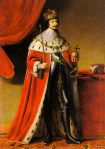
Frederick V (German: Friedrich V.) (16 August 1596 – 29 November 1632)[1] was Elector Palatine (1610–23), and, as Frederick I (Czech: Fridrich Falcký), King of Bohemia (1619–20, for his short reign he is often nicknamed the Winter King, Czech: Zimní král; German: Winterkönig).
Frederick was born at the jagdschloss Deinschwang (a hunting lodge) near Amberg in the Upper Palatinate. He was the son and heir of Frederick IV and of Louise Juliana of Nassau, the daughter of William the Silent and Charlotte de Bourbon-Monpensier. He – an intellectual, a mystic, and a Calvinist – succeeded his father as Prince-Elector of the Rhenish Palatinate in 1610. He was responsible for the construction of the famous Hortus Palatinus gardens in Heidelberg.
In 1618 the Protestant estates of Bohemia rebelled against the Roman Catholic King Ferdinand and offered the crown of Bohemia to Frederick, choosing him since he was the leader of the Protestant Union, a military alliance founded by his father. Frederick duly accepted the crown (coronation on 4 November 1619), which triggered the outbreak of the Thirty Years’ War.
In 1618 the Protestant estates of Bohemia rebelled against the Roman Catholic King Ferdinand and offered the crown of Bohemia to Frederick, choosing him since he was the leader of the Protestant Union, a military alliance founded by his father. Frederick duly accepted the crown (coronation on 4 November 1619), which triggered the outbreak of the Thirty Years’ War.
Frederick’s father-in-law, James VI of Scotland and I of England, opposed the takeover of Bohemia from the Habsburgs. Additionally, Frederick’s allies in the Protestant Union failed to support him militarily by signing the Treaty of Ulm (1620). His brief reign as King of Bohemia ended with his defeat at the Battle of White Mountain on 8 November 1620 – a year and four days after his coronation. This earned him the derisive nickname of ‘the Winter King’. After this battle, the Imperial forces invaded Frederick’s Palatinate lands and he had to flee to Holland in 1622. An Imperial edict formally deprived him of the Palatinate in 1623. He lived the rest of his life in exile with his wife and family, mostly at the Hague, and died in Mainz in 1632.
George I (George Louis; German: Georg Ludwig; 28 May 1660 – 11 June 1727[1]) was King of Great Britain and Ireland from 1 August 1714 until his death, and ruler of the Duchy and Electorate of Brunswick-Lüneburg (Hanover) in the Holy Roman Empire from 1698.
George was born in Hanover, in what is now Germany, and inherited the titles and lands of the Duchy of Brunswick-Lüneburg from his father and uncles. A succession of European wars expanded his German domains during his lifetime, and in 1708 he was ratified as prince-elector of Hanover. At the age of 54, after the death of Queen Anne of Great Britain, George ascended the British throne as the first monarch of the House of Hanover. Although over fifty Roman Catholics bore closer blood relationships to Anne, the Act of Settlement 1701 prohibited Catholics from inheriting the British throne. George, however, was Anne’s closest living Protestant relative. In reaction, Jacobites attempted to depose George and replace him with Anne’s Catholic half-brother, James Francis Edward Stuart, but their attempts failed.
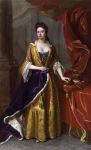
Anne (6 February 1665 – 1 August 1714[1]) ascended the thrones of England, Scotland and Ireland on 8 March 1702. On 1 May 1707, under the Act of Union, two of her realms, the kingdoms of England and Scotland, were united as a single sovereign state, the Kingdom of Great Britain.
Anne’s Catholic father, James II and VII, was deposed during the “Glorious Revolution” of 1688. Her Protestant sister Mary and Mary’s husband William III (Anne’s brother-in-law and cousin), became joint monarchs. After Mary’s death in 1694, William continued as sole monarch until his own death and Anne’s accession in 1702.
Anne favoured moderate Tory politicians, who were more likely than their opponents, the Whigs, to share her Anglican religious views. The Whigs grew more powerful during the course of the War of the Spanish Succession, until in 1710 Anne dismissed many of them from office. Her close friendship with Sarah Churchill, Duchess of Marlborough, turned sour as the result of political differences.
Despite seventeen pregnancies, Anne died without surviving children and was the last monarch of the House of Stuart. She was succeeded by her second cousin George I of the House of Hanover, who was a descendant of the Stuarts through his maternal grandmother, Elizabeth, daughter of James VI and I.
“Glorious Revolution”
In what became known as the “Glorious Revolution”, Anne’s brother-in-law, William of Orange, invaded England on 5 November 1688 in an action that ultimately deposed King James. Forbidden by James to pay Mary a projected visit in the spring of 1687,[44] Anne corresponded with her and was aware of William’s plans to invade.[45] On the advice of the Churchills,[41] she refused to side with James after William landed and instead wrote to William on 18 November declaring her approval of his action.[46] Churchill abandoned the unpopular king on the 24th. Prince George followed suit that night,[47] and in the evening of the following day James issued orders to place Sarah Churchill under house arrest at St James’s Palace.[48] Anne and Sarah fled from Whitehall by a back staircase, and put themselves under the care of the bishop of London, spending one night in his house, and subsequently arrived at Nottingham on 1 December.[49] Two weeks later, Anne travelled to Oxford, where she met Prince George in triumph, escorted by a large company.[50] “God help me!”, lamented James on discovering the desertion of his daughter on 26 November, “Even my children have forsaken me.”[51] On 19 December, Anne returned to London, where she was at once visited by her brother-in-law William, and James fled to France on the 22nd.[52] Anne showed no concern at the news of her father’s flight, and instead merely asked for her usual game of cards. She justified herself by saying that “she was used to play and never loved to do anything that looked like an affected constraint.”[53]
Engraving of King William and Queen Mary
In 1689, a Convention Parliament assembled in England and declared that James had effectively abdicated when he fled, and that the thrones of England and Ireland were therefore vacant. The Parliament or Estates of Scotland took similar action, and William and Mary were declared monarchs of all three realms.[54] The Bill of Rights 1689 and Claim of Right Act 1689 settled the succession. Anne and her descendants were to be in the line of succession after William and Mary, and they were to be followed by any descendants of William by a future marriage.[55] On 24 July 1689, Anne gave birth to a son, Prince William, Duke of Gloucester, who, though ill, survived infancy. As King William and Queen Mary had no children, it looked as though Anne’s son would eventually inherit the crown.[56]
[edit] William and Mary
Soon after their accession, William and Mary rewarded John Churchill by granting him the Earldom of Marlborough and Prince George was made Duke of Cumberland. Anne requested the use of Richmond Palace and a parliamentary allowance. William and Mary refused the first, and unsuccessfully opposed the latter, both of which caused tension between the two sisters.[57] Anne’s resentment grew worse when William refused to allow Prince George to serve in the military in an active capacity.[58] In January 1692, suspecting that Marlborough was secretly conspiring with James’s followers, the Jacobites, William and Mary dismissed him from all his offices. In a public show of support for the Marlboroughs, Anne took Sarah to a social event at the palace, and refused her sister’s request to dismiss Sarah from her household.[59] Lady Marlborough was subsequently removed from the royal household by the Lord Chamberlain, and Anne angrily left her royal lodgings and took up residence at Syon House, the home of the Duke of Somerset.[60] Anne was stripped of her guard of honour; courtiers were forbidden to visit her, and civic authorities were instructed to ignore her.[61] In April, Anne gave birth to a son who died within minutes. Mary visited her, but instead of offering comfort took the opportunity to berate Anne once again for her friendship with Sarah. The sisters never saw each other again
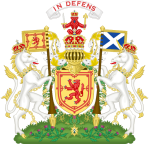
The Kingdom of the Picts just became known as Kingdom of Alba in Gaelic, which later became known in English as Scotland; the terms are retained in both languages to this day. By the late 11th century at the very latest, Scottish kings were using the term rex Scottorum, or King of Scots, to refer to themselves in Latin. The title of King of Scots fell out of use in 1707 when the Kingdom of Scotland merged with the Kingdom of England to form the Kingdom of Great Britain. Thus Queen Anne became the last monarch of Scotland (and concurrently, the last monarch of England) and the first monarch of Great Britain. The two kingdoms had shared a monarch since 1603 (see Union of the Crowns), and Charles II was the last Scottish monarch to actually be crowned in Scotland, at Scone in 1651.
1714-1727
After the death of Anne, the German George (from the house of Hannover) becomes king of England. This had been decided already in 1701 by the English parliament. He didn’t speak English and left all state affairs to Sir Robert Walpole. In 1715, the first Jacobite rebellion took place, but in 1716 they were driven away. Jacob (James) was the nephew of the old James VII who had been king before William, a Stewart.
1727-1760
George II, only son of George I, also was a German, more than an Englishman, but at least he spoke the language. After Walpole, William Pit took over his job and ruled the country energetically. The next Jacobite rebellion (under the leadership of Charles Edward Stuart, also called Bonnie Prince Charlie) penetrated England in 1745 deeply and caused a lot of panic. But eventually they had to face the superior English forces, which forced them back into Scotland. In April 1746, both armies clashed at Culloden Moor near Inverness, where the Jacobites were slaughtered. After this rebellion many things became forbidden in Scotland, like wearing a tartan, having weapons, or playing the bagpipe. Rulers who had taken part in the rebellion lost their land and the Highlands were placed under military authority.
1760-1820
George III was the cause the British empire did not expand in the northern regions of America. Also because of his attitude, the Americans started the war of independance (1774-1783) against the English, which they won. On the European continent there is a lot of change, but there are many other places where you can read about this turbulent period. Scotland was ppor and many people abandoned their country to go off to America. Land-owners chased away their tenants and forced them t a meager life, working as season worker or as small farmer.
1542-1567
Mary was only one week old when she officially ascended the throne. Henry VIII of England immediately tries to couple her to his 5-year old son Edward, to take control over Scotland. In 1544 he initiates a series of destroying attacks on Scotland, a period which would be called later the ‘rough wooing’, by the famous writer Sir Walter Scott. The Scottish called upon the French for support and in 1548 the 6-year old Mary went to France to marry the French dauphin. After his death, she returned to Scotland in 1561.
She herself being a roman catholic, she didn’t undertake any actions against the protestants at first.
Scottish parliament had put protestantism first in 1560, by forbidding the mass and no longer acknowledging the authority of the pope. This was just a statement of Scottish nationalism, this time directed against the growing dependency on France. The minister John Knox also had great influence and preached against Mary and catholicism as much as he could.
Her attitude changed after marrying the catholic Lord Darnley. But shortly after, the marriage was dissolved and Darnley murdered. Mary got married for a third time, but had to flee t England when Scottish nobles, who suspected her to be accessory to the death of Darnley and didn’t agree with her marriage to Bothwell, committed a coup in 1567. Her son, James VI, was crowned king, but regents who were in favour of England ruled and he was raised in a protestant way.
 Rosamond Press
Leave a comment