
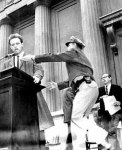
We will OCCUPY till the Jubilee Jesus comes, and takes the side of Liberty and Free Speech!
Gone are the days when only one man spoke the truth, and we all had to listen – or else!
Play both videos at the same time to know the People are United, and God is Universal Love.
Jon
http://www.mindfully.org/Reform/2004/Mario-Savio-FBI-COINTELPRO10oct04.htm
. Edgar Hoover strode into a closed congressional chamber and delivered a blunt warning to the House Appropriations subcommittee about a threat to national security in the Bay Area.
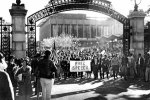
The 1964 Free Speech Movement at UC Berkeley, which staged the nation’s first major campus sit-ins of the ’60s, was being used in a Soviet plot against America. Hoover implied that the Communist Party USA was manipulating Mario Savio, the Berkeley student who’d become famous for leading the FSM. “Communist Party leaders feel that based on what happened on the campus at the University of California at Berkeley, they can exploit similar student demonstrations to their own benefit in the future,” Hoover testified on March 4, 1965.
But FBI files show Hoover knew there was no evidence Savio or the Free Speech Movement were under the influence of any group plotting to overthrow the U.S. government. He knew the FSM was a nonviolent protest against a university rule barring students from engaging in political activity on campus. He knew Savio broke no federal law. He knew because his agents had told him.
Hoover’s FBI spied on Savio for years because he had emerged as the nation’s most prominent student leader, a symbol of revolt against the establishment. Savio gave the speech that sparked the massive sit-in at Sproul Hall that fall, his words striking at not only the impersonal nature of the modern university but at all of bureaucratic society: “There is a time when the operation of the machine becomes so odious, makes you so sick at heart, that you can’t take part, you can’t even tacitly take part, and you’ve got to put your bodies upon the gears and upon the wheels, upon the levers, upon all the apparatus, and you’ve got to make it stop,” the 21-year-old said. “And you’ve got to indicate to the people who run it, to the people who own it, that unless you’re free, the machine will be prevented from working at all.”
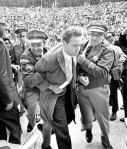
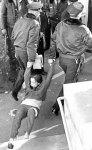
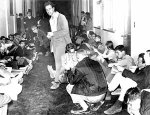
Savio spoke and hundreds of people occupied the administration building overnight, leading police to make the largest mass arrest in of students in U. S. history and shocking a public accustomed to campus conformity.
A few days later at FBI headquarters in Washington, D.C., Hoover told his aides he feared Savio and his fellow protesters would inspire student rebellion “at other colleges across the land. We need to and will give continuous attention to this matter.”
Hoover turned his surveillance machine on Savio: the indexes, dossiers, watch lists and informers; the liaisons with local police and the CIA; the discreet contacts with neighbors, school officials and employers; and, finally, covert action to “disrupt” and “neutralize” him. In 1976, a U.S. Senate subcommittee exposed these kinds of unconstitutional activities on a huge scale and forced the FBI to adopt strict investigative guidelines.
Cartha “Deke” DeLoach, the third highest FBI official under Hoover, denied the FBI abused its power in Savio’s case. “We looked at him more or less as fomenting various activities which could promote anarchy,” he said in an interview.
LaRae Quy, an FBI spokeswoman in San Francisco, declined to comment on the Savio case. “It’s not today’s FBI,” she said. The FBI now has more oversight — from Congress and others — and “the highest standards of integrity.”
As the Free Speech Movement hits its 40th anniversary this month, some say the FBI’s treatment of Savio illustrates the potential for abuse in the bureau’s greatly expanded surveillance apparatus since Sept. 11, 2001. Attorney General John Ashcroft has loosened bureau guidelines, and the Patriot Act has given federal agents more power to pry. “You have a very wide-open playing field,” said Jim Dempsey, executive director of the Center for Democracy and Technology, in Washington, D.C.
When I first met Savio in 1982, he told me he suspected FBI agents had monitored campus rallies but did not think they had targeted him. Before he died in 1996, he gave me permission to request his FBI files, which were released only after I sued under the Freedom of Information Act.
Those previously secret files show the FBI caught Savio in the gears and wheels and levers of its intelligence machinery, even as the reluctant radical leader was mysteriously withdrawing from politics and struggling with his own inner conflicts.
An Altar Boy
Savio came to Berkeley from New York City in fall 1963 to study philosophy. He brought an overriding sense of morality and troubling questions about authority. He was born Dec. 8, 1942, to a steelworker father from Sicily who served in the U.S. Army during World War II. His mother was a housewife. He had one older brother. The family was devoutly Catholic. Two aunts were nuns, and he was an altar boy who planned to be a priest. From the beginning, he said later, his mission in life was not to get rich or have a career, but to fight evil and do good.
Growing up in the ’50s, Savio was part of the first generation raised under the threat of nuclear war. He participated in air-raid drills at school and believed J. Edgar Hoover when he said communists wanted to overthrow America. But as a teen, Savio began asking questions. He doubted whether diving under his desk would save him from an atomic blast. He came to reject the Bible stories he’d been taught as fact. “Not that things couldn’t have happened that way,” he said, “but there seemed to be lots of reasons to think maybe they hadn’t.”
Holocaust photographs hit him hardest. “Heaps of bodies. Mounds of bodies. Nothing affected my consciousness more than those pictures,” he said. “They meant to me that everything needed to be questioned. Reality itself.” Savio was stunned by his realization that many Germans, and many others, had accepted mass murder. “I mean, how could it possibly [be]? I started to get the idea that people weren’t really coming clean about things … that there was almost a conspiracy not to tell the truth to oneself, even on a mass scale. ”
After graduating from high school, Savio worked with a church group building sanitary facilities in the slums of Taxco, Mexico. When he arrived at Berkeley he found student life dominated by sororities and fraternities. The dry logic of analytic philosophy ruled the lecture halls, but existentialism held court in the coffeehouses. Savio and other students were following the civil rights movement in the South. In August 1963, the Rev. Martin Luther King Jr. led 250,000 people in a march on Washington and declared, “I Have a Dream.” In September, Ku Klux Klan members bombed a Birmingham church, killing four girls.
 Rosamond Press
Leave a comment