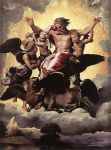


Stephen may have been born in Asia Minor where Paul was born – and Gessius Florus! After being dismissed by Rome as the protectorate of Judea, did Flous encounter Stephen Asia Minor, and approve of his stoning, if not instigate it? This is not out of the question, for Saul takes on Stephens identity and mission which is questioned by the Super-Apostles who do not recognized their bitter enemy who murdered and tortured Nazarite Saint in Jerusalem. As Paul, now, he defends himself from accusations he is bilking the Corinth church our of it tithe. He threatens to do physical harm – do unto them what he did unto Stephen, whose face was all aglow as he beheld God! Paul steals this sighting called, and put on Stephens crown, which is a glowing halo – the first! Did everyone John baptized experience a theophany? Consider the transfiguration.
“The term theophany has acquired a specific usage for Christians and Jews with respect to the Bible: It refers to the manifestation of God to man; the sensible sign by which the presence of God is revealed. Only a small number of theophanies are found in the Hebrew Bible, also known as the Old Testament.”
In every Murder Case, MOTIVE has to be established. Florus probably learned the Nazarites were Aboltionists from the Zealot bandits. They were a threat to Rome. Florus saw the temple system as a gold making scheme – and he wanted that holy gold. So did Paul. Paul created a facsimile religion that would create great schisms that would destroy the Nazarite Democracy. His replacement church would put much gold in Paul’s pocket – and thus Satan Paul-Saul is the forerunner of the evil plague the church would know for two thousand years!
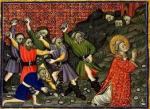
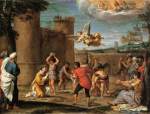
Paul’s evil quill later put Paul’s words in Stephen’s mouth. In one of the paintings above you can see Saul-Paul sitting on a hill looking down on Stephen being murdered, while he holds his clothes, I assume he is allowed to keep -and sell! Consider Hitler.
Come out of that long dark tunnel into the light! Take the Vow of the Nazarite!
Jon the Nazarite
Copyright 2012
The “Hellenistic Jews”—those Jews born outside of Israel who migrated to Israel but who still had a separate language and culture derived from their exile—have already been introduced in Acts. They were those Jews who, at Pentecost, heard the apostles “speaking of the mighty deeds of God” in their own native tongues. It would not be unreasonable to assume that it was some of the “native Hebrews”—those Jews born and raised in Israel who spoke Aramaic or some Semitic language—who thought the sounds they heard (since they could not understand these foreign languages) were the mere mindless babblings of those who had had too much to drink (Acts 2:13).
According to The Acts of the Apostles, Stephen was tried ca. A.D. 34–35 by the Sanhedrin (Acts 6:13–14). Acts 6–7 describe his trial:
Stephen is depicted as successfully preaching to his fellow Jews and bringing many to accept Jesus as the Messiah. After a dispute with the members of a synagogue of “Roman Freedmen,” he is denounced for blasphemy against God and Moses (Acts 6:11) and speaking against the Temple and the Law. Stephen’s defense is presented as accusing the Jews of persecuting the prophets who had spoken out against the sins of the nation:
“Which one of the Prophets did your fathers not persecute, and they killed the ones who prophesied the coming of the Just One, of whom now, too, you have become betrayers and murderers.” (7:52)
While on trial, he experienced a theophany in which he saw both God the Father and God the Son:
“Behold, I see the heavens opened, and the Son of man standing on the right hand of God.” (Acts 7:56)
He is condemned and stoned to death by an infuriated mob, which is encouraged by Saul of Tarsus, later to be known as Saint Paul the Apostle.[3]
Theophany, from the Ancient Greek (ἡ) θεοφάνεια (theophaneia,[1] meaning “appearance of God”),[2] refers to the appearance of a deity to a human or other being, or to a divine disclosure.[3]
This term has been used to refer to appearances of the gods in the ancient Greek and Near Eastern religions. While the Iliad is the earliest source for descriptions of theophanies in the Classical tradition (and they occur throughout Greek mythology), probably the earliest description of a theophany is in the Epic of Gilgamesh.
The term theophany has acquired a specific usage for Christians and Jews with respect to the Bible: It refers to the manifestation of God to man; the sensible sign by which the presence of God is revealed. Only a small number of theophanies are found in the Hebrew Bible, also known as the Old Testament.
Paul set the tone for Christianity, including its emphasis on celibacy and the theory of divine grace and salvation, as well as eliminating the circumcision requirement. It was Paul who called the New Testament euangelion, ‘the gospel’.
Paul met James, the brother of Jesus, and Peter, the Apostle, in Jerusalem. He then went on to Antioch where he converted Gentiles. This helped make Christianity a universal religion.
St. Stephen was a Jew living in the Hellenic provinces, related to the Apostle Paul and one of the first seven deacons ordained by the Apostles to serve the Church in Jerusalem (thus making him an archdeacon).
In the words of Asterias:St Stephen was “the starting point of the martyrs, the instructore of suffering for Christ, the foundation of righteous confession, since Stephen was the first to shed his blood for the Gospel.”
The Holy Spirit worked powerfully through his faith, enabling him to perform many miracles and always defeat the Jews who would dispute with him.
The Jews in their hatred of St. Stephen lied about him to the people, but St. Stephen with his face illumined reminded the people of the miracles God had worked through him and even rebuked the Jews for killing the innocent Christ.
The people were enraged by what they thought was blasphemy and ‘gnashed their teeth’ at Stephen. It was then that he saw his Christ in the heavens and declared it so. Hearing this, the Jews took him outside the city and stoned him to death, with his kinsman Saul (later St. Paul) holding their coats while they did it. Afar off on a hill was the Virgin Mary and St. John the Theologian who witnessed this first martyrdom for the Son of God and prayed for him while he was being stoned. This occurred about a year after the first Pentecost.
Relics
The body of the holy Protomartyr Stephen, was left at the foothill of the city for two days to be eaten by dogs. But on the second night, Gamaliel— teacher of the Apostle Paul and the Apostle Barnabas— along with his son, secretly came and took the body to his own estate, in Capharganda, to be buried.
Nicodemus, who died while weeping at this grave, was also buried there along with Gamaliel’s godson Abibus and Gamaliel himself upon his repose.
After many years the memory of St. Stephen’s burial place had left the minds of men, until 415 when Gamaliel appeared three times to Father Lucian, priest at Capharganda. He revealed to Fr. Lucian the place of his burial and everything about it. Fr. Lucian received the blessing of the Patriarch to exhume the saints from their grave where a strong, sweet fragrance filled the cave.
Relic of St. Stephen in Russia [1]
St. Stephen’s relics were translated to Zion and honorably buried, and many of the sick were healed by his relics. The other three relics were placed inside a church atop the cave on a hill. Eventually, his relics were translated to Constantinople.
Today, you wil find his whole right arm at The Holy Trinity of St. Sergius Lavra, established by St. Sergius of Radonezh in 1345, at Sergiyev Posad, Russia Video of The Holy Trinity monastery
The martyrdom of St. Stephen, proto-martyr of the Church, and the involvement of Saul of Tarsus in the act is one of the most interesting and ironically tragic events recorded in the early history of the Church. St. Stephen, a young and zealous representative of the period when the Christian faith was all afire, because he was the earliest proponent of the freedom and universality of the Gospel, and because of the great trials and death he underwent for his preaching, is often recognized to be a type or forerunner of the great Apostle to the Gentiles. And the fact that it is this same Apostle, who, prior to his conversion, was the main instrument in bringing about the death of the arch-deacon, makes the incident all the more startling; and that death was to linger on for many years to come in the mind of the Apostle after he had become a chosen vessel of Christ.
In considering the clash between Stephen and the Jewish religious establishment it is important to understand the difference between two groups whom the Holy Bible calls “Hebrews” and “Hellenists”.i Both groups were Jews, yet different in culture and language. Hebrews attended synagogues in which the services were held in Hebrew and used Aramaic in their normal speech; Hellenists spoke mainly Greek and held their synagogue worship in that language. The difference was the result of the history of the Diaspora: the Babylonian, Persian, and Greek captivities of the Jewish people caused them to disperse all over the Mediterranean world, where they became assimilated to the manners and speech of their respective lands of immigration. Since in the time of our Lord the Mediterranean world spoke Greek, most of the emigrant Jews took up the Greek language and culture; and thus they were “Hellenists” (Hellenas Gk “Greek”). It is said that Philo, a noted Alexandrian Jew, knew no Hebrew. In contrast, those Jews who remained in Jerusalem retained the traditional culture and language of the Jewish peoplethus, “Hebrews”.
The state of affairs was not too unlike the present geographical dispersion of the Coptic Church. We have, like the Jews had, two major groups: those who reside in the mother country and those residing in lands of immigration. One believer may live in Egypt, naturally using the national tongue and culture; while another believer may live in America, using a foreign tongue and culture. The first we may call “Egyptian” (Hebrew), and the second “American” (Hellenist) but they are both alike “Copts” (Jews) and are unified in faith and doctrine. And just as the Hebrew prided himself on adhering to the traditional language and ways of Jerusalem, so the Egyptian may feel a similar satisfaction. And as the Hellenist prided himself on having a more “free mind” than his fellow Hebrew, and having a greater understanding of foreign cultures, so the American may have similar sentiments. But just as the Hebrew/Hellenist dichotomy was abolished and transcended by the victory of the universal spirit of Christian love and unity among believers in the early centuries, so we find the Egyptian/Immigrant dualism quickly fading with the increase in mutual recognition and understanding among Copts worldwide.
There were also some families of the Diaspora who insisted on teaching their children the traditional customs and language of the Hebrews. The most eminent example is the family of Saul, which resided in Tarsus of Cilicia yet which raised him to be a “Hebrew of the Hebrews”.ii
St. Stephen was most eminently a Hellenist; and this fact was to play a cardinal role in his preaching on the Gospel and in his trial. Up till his time Christianity had been regarded as merely a new branch of Judaism. The Twelve still lingered at the doors of the synagogue; and although they believed that their faith would one day be the faith of the entire world, there was till no trace that they ever considered the abrogation of the Mosaic Law or the free admission of uncircumcised Gentiles into a full equality of spiritual privileges. The first Jewish Christians never neglected to be on their knees in the temple; they had their children duly circumcised; and they kept the prescribed feasts and single fast of the Pentateuch. They were quietly accepted as Jews by the government and might have been called, “the Synagogue of the Nazarenes”.iii The reason for this lingering attachment to Judaism was that all of the first Christians leadersas the Twelve and St. James the Lords Brotherwere “Hebrews”, and earliest geographical center of Christian authority was the city of Jerusalem.
But this acceptance with the people could only be temporary and illusory. For if the Church had never advanced beyond this first stand-point, Christianity might have been seen as nothing more than a phase of Pharisaism, heretical in its acceptance of a crucified Messiah, and eventually destined to vanish with the undulations of religious history. It was necessary for the Church and for the world that this hollow semblance of unison be abruptly shattered. This truth had been preached by the Lord Jesus Christ to His disciplesiv, but, like many other of His words, it lay dormant in their minds. And the first inkling of the full freedom and universality of the Gospel, of which St. Paul would later become the ordained Apostle and champion, was first breathed by St. Stephen.
We may gather from the accusations leveled against St. Stephen that he spoke of “changing the laws of Moses” and that Jesus of Nazareth would destroy the temple how remarkably his teaching was an anticipation of St. Pauls. As a Hellenistic Jew, he was less entangled in the prejudices of Hebrew nationality than his Aramaic (Hebrew) brethren; he could more clearly see the diffusion of the good news to those distant lands where the light of God had scarcely ever shone, than the Apostles, who for the time being limited their preaching to Judea, could imagine. Not doubting the Mosaic economy, and not faithless to the God of Abraham, Isaac, and Jacob, he yet saw that the time was coming when the “true worshippers” would worship Him not in the Temple only or in any sacred spot, but everywhere throughout the earth, “in spirit and in truth”: and for this doctrine he would seal his martyrdom.
It is interesting to note that this doctrine, which was to impact the entire world for all time to come, found its beginning in Stephen. The original seed was surely to be found in the words of our Lord “Go and make disciples of all the nations” but the first budding of the plant appeared in the first deacon of the Church. The rest of the Apostles were still under the notion that Christianity was a religion mainly for the Jews; but St. Stephen came bearing a more brilliant light, as a lone voice crying in the wilderness. And in many respects he was very much like the great forerunner of the Lord; he was young and strong in faith, fearless and zealous, and his service was relatively short-lived, until he was early called to die for his faith. In all these things St. Stephen mimicked St. John the Baptist; and as God had called the latter to prepare the way for the blessed Savior, so the former was called to prepare the way for the great Apostle.
The first attempts to put down the new faith came from the Sadducees. They hated the doctrine of the resurrection, and the Resurrection of Christ was the corner-stone of all of St. Peter’s teaching. He and the Apostles were brought before the Sanhedrin time and again, once for a threatening and once for a beating; and thus the faith met great resistance and tribulation in Jerusalem. Up to this time the conflict had been maintained mainly with the Aramaic Jews (Hebrews); St. Stephen would be the first to take the Gospel into the territory of the Hellenists. The learned members of the foreign synagogues attempted to refute Stephens teachings; and the Cilician synagogue is particularly mentioned (Acts 6:9,10). Because Tarsus is a city of Cilicia, it is of little question that Saul himself was a member of the synagogue of the Cilicians; and as a disciple of Gamaliel and a zealous Pharisee, he must have occupied a prominent position in all activities and debates carried within the synagogue walls.
Although the Saul of this period must have differed widely from the St. Paul the Apostle of Christ, yet the main features of his personality must have remained the same. He could not have failed to recognize the moral beauty, the dauntless courage, the burning passion emanating from St. Stephens speech. The dead remains of a religion which had decayed into formalism lay thickly scattered over Sauls heartall day long he was vexed by the artificiality of his fellow Phariseesyet the glow of a genuine sincerity burned in his own heart. While he listened to St. Stephen, he must have felt the contrast between a dead theology and a living faith; between a kindling inspiration of words and a barren exegesis; between a mindless scrutiny into unimportant rites and a preaching which stirred the inmost depths of the human soul. But however much he may have pitied the death of such an ardent soul; his rage at the “blasphemies” uttered decreed that the deacon must die.v
It was not doubted much that the learned members of the Sanhedrin would triumph over the young Hellenist heretic; there were not many who were ever able to stand up to such an eminent and formidable council. But as the debates took their course, the Sanhedrin came to a disturbing realization: “They were not able to resist the wisdom and the Spirit by which he spoke.” Saul himself had possibly never been foiled in argument before: profoundly knowledgeable in the Law, abundant in zeal for the traditions of the fathers, and trained by the most highly respected of all teachers, Gamaliel, any solitary defendant would have little chance against the fiery Pharisee. But now he and his follow council members were losing sorely; for they had always before met with mere human arguments: but now they faced God Himselfdwelling inside St. Stephen. It was perhaps akin to the awe they felt when they saw his face “as the face of an angel”, for they were gazing upon the brightness of God. It was a type of foreshadowing; for all the times they had visited the Temple in Jerusalem, they had never seen such a divine radiance; but now the glory of God which had been removed from the physical Temple was manifested in the new living temple: the believer in Christ.
His final trial before the Sanhedrin proceeded. The president put to St. Stephen the judicial question which every defendant was required to answer, “Are these things so?” And St. Stephen’s clear voice was heard through the silent council-hall as he went through the history of the chosen people, proving his own deep faith in the Jewish economy, but suggesting here and there the spiritual meaning of salvation that was hidden in it, which was now openly manifested in Christ. He wisely started with the call of Abraham, then progressed historically through all the great stages of their national existence from Abraham to Joseph from Joseph to Moses and Moses to David and Solomon choosing those incidents which best served the purpose of his argument. He showed that God’s blessing rested on Abraham, though he had “not so much as set his foot on” in the Promised Land (v. 5); on the piety of Joseph, though he was an exile in Egypt (v. 9); and on the holiness of the Burning Bush, though it was in the desert of Sinai (v. 30).
Near the end of the speech he makes mention of the temple (v. 47) and then quickly remarks that “the Most High does not dwell in temples made with hands,” and quotes from Isaiah a passage showing the mistakenness in equating God with any physical site. Thus subtly did St. Stephen show how independent of time and place were the blessings of God, since many of the great events in their history happened outside of Judea and before the erection of Solomon’s temple! Thus far the council listened intently; it was the story of the chosen people, which every Jew listened to with interest and pride.vi
It is remarkable, as we have said before, how fully St. Stephen was the forerunner of St. Paul, both in the style and content of his defense. His securing the attention of the Jews by using the historical method is exactly what St. Paul would do in the synagogue at Psidia years later.vii His insistence on his fidelity to the true principles of the Mosaic religion just what the Apostle confessed before Agrippa.viii It is quite interesting to think of Saul listening to the martyrs voice, as he heard arguments which he was destined to reiterate before synagogues and kings. And it is not improbable that every time St. Paul was to mention his former persecution of the Churchix, the face and voice of St. Stephen was the first to come to his mind. It is also of little doubt that the image of St. Stephen falling upon his knees as he courageously awaited his death was one of the primary sources of inspiration St. Paul would draw from in later years for the endurance of his great trials of afflictions.
“You stiff-necked,” St. Stephen suddenly exclaimed; the pent-up feelings of frustration and indignation at the Jews obstinacy finally surfaced “and uncircumcised in heart and ears! You always resist the Holy Spirit; as your fathers did, so do you. Which of the prophets did your fathers not persecute? And they killed those who foretold of the coming of the Just One, of whom you have now become the betrayers and murderers, who have received the law by the direction of angels and have not kept it.” A denunciation so scathing and fearless, from the lips of a prisoner whose life was completely under their command, might have well startled them. Few words could have been so calculated to sear their consciences and kindle their fury. And the underlying force of his words was akin to that which was expressed in the previous history. His accusation that they were “uncircumcised in heart and ears” implied that physical circumcision, unless joined with a more important inner purity, was of little advantage a point little noticed by the majority of Pharisees. Neither was their ancestral lineage nor their Law two bulwarks of Jewish pride of any great benefit to them since their ancestors persecuted the prophets and they failed to keep the law. Thus, that which was hidden and subtle in Stephen’s address, he now proclaimed openly: the foolishness in trusting in outward religious ceremonials for salvation, and the implicit approval of non-Jewish peoples who were inwardly circumcised and who followed the spiritual law. These had been the original grounds for St. Stephens accusation; and they foreshadow remarkably similar teachings that St. Paul would later express in his epistles.x
The members of the council were roused to fury by the undaunted audacity of St. Stephen’s final invective. “When they heard these things they were cut to the heart, and gnashed at him with their teeth.” It is difficult for Western nations to understand the raging passion which maddens a crowd of Eastern fanatics. This is most evident today when we observe the see thing hatred that leaches from the mouths of certain religious fanatics of the Middle East, who are not content to express their fury in any way except in destroying both self and others in the populated cities of their enemies, particularly the West. The warm glow of emotion characteristic of eastern nations (which we are) that turns hospitality and kindness into such great virtues also turns hatred and resentment into diabolical vices.
The flame of holy wrath quickly died away in St. Stephens breast as his attention turned from the maddening faces of the council-chamber to a glorious vision of his Redeemer in heaven. There, in ecstasy of vision, he saw the Shechinahthe Glory of GodJesus standing at the right hand of God. In all other places in Scripture, when Christ is mentioned in His glorified state He is described as seated, not standing, at the right hand of God.xi Here alone He is said to be standing. It is as if (according to St. John Chrysostoms beautiful thought) He has risen from His throne to support His persecuted servant, and to receive him to Himself.xii And when St. Stephen saw His Lord perhaps with memories what he saw on earth crowding into his mind he suddenly exclaims: “Behold! I see the heavens opened and the Son of Man standing at the right hand of God!”
This was too much for the Jews to bear. “They cried out with a loud voice, stopped their ears, and ran at him with one accord.” The gathering had no longer had the semblance of an organized trial; they cast a savage and disorderly judgment that he should die, and making a sudden rush and tumult through the streets, they hurried him to one of the nearest gates of the city to end his life.
The contrast is striking between the uncontrolled hatred of the mob that sought to murder St. Stephen and his own serenity and even forgivingness in those last moments of his life. As the unjust slaying begins he utters a prayer for himself which he knew came from the lips of Christ Himself on the cross which he himself may have heard “Lord Jesus, receive my spirit.” And when bruised and bleeding, he is able to drag himself to his knees and again in the spirit of his Master to ask the forgiveness of his murderers “Lord, do not charge them with this sin.” With that cry he passed from the wrath of men to the peace of God. St. Luke ends the narrative with the beautiful and weighty words, “He fell asleep.”
“And the witnesses laid down their clothes at the feet of a young man named Saul.” In the blind darkness of the three days following the Lords manifestation to Saul, how often he must have thought back upon St. Stephen and with what agony! With what spite and scorn he had heard the martyr proclaim that he saw Jesus in heaven, standing at the right of God, and yet it was true! With what pity he looked upon the dying youth as he ignorantly asked Jesus to “not hold this wrong against them”, and now he realized that the prayer was directly necessary for his own salvation. He had consented to St. Stephen’s death from a sincere, yet mistaken, motive; but how little comfort that could afford the converted St. Paul! St. Stephen was dead; but his message and faith would live on in St. Paul and eventually spread to all corners of the inhabitable world. The spectacle of so much constancy, so much faith, so much love, could not be lost. And it is hardly too much to say with St. Augustine, that “the Church owes St. Paul to the prayer of St. Stephen”.xiii
 Rosamond Press
Leave a comment