To listen to the Republicans, and the holy men who back them, talk about doing away with Social Security, Welfare, and Food Stamps – is surreal! One only need look at the history of the the potato blight in Ireland to know incredible chaos will ensue in a domino effect.
And all the Queen’s horses and men could not put Mr. Patato Head back together again!
Two days ago I took my homeless friend to a Veterans group that will try to find him a home. When he was evicted from Safeway for hanging around too much, I wrote a letter to the manager reminding him of his bosses letter bidding employees to volunteer at the Youth Farm, where my friend has helped process food for the hungry. I have studied how my friend exploits the slim resources available to him – that can not sustain any more homeless people. He is sixty years of age, and part Cherokee.
The treatment of the Irish Catholics in Protestant England was and is, unjust. How much is the Vatican responsible, in light of the Pope’s interference with our National Healthcare system that just became the law of the land. Is the Pope in Rome willing to allow the Republicans to tear down the Social Safety Net because he perceives a secular threat coming from the Democrats? This is a highly specialized church, that has made it almost impossible for others – NOT LIKE THEM – to coexist!
If the Republicans are correct about taking down the National Debt to save America, then the Vatican just got in the way with their dire emergency to keep Catholic women from using contraception – which most of them do anyway! What a costly empty gesture! It’s like buying a four hundred pound stick of incense costing five hundred billion dollars! Talk about a gorilla in the room.
To behold our whole election process come to a grinding halt, and our government chambers being used to discuss what ammounts to Religious Vanity, is to hold down the pig the Pope puts lipstick on!
Jon Presco
Irish diaspora and Typhus epidemic of 1847
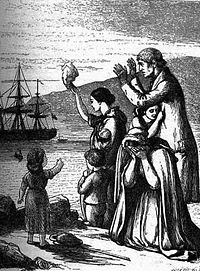
Emigrants Leave Ireland, engraving by Henry Doyle (1827–1893), from Mary Frances Cusack’s Illustrated History of Ireland, 1868.
While the famine was responsible for a significant increase in emigration from Ireland, of anywhere from 45% to nearly 85% depending on the year and the county, it was not the sole cause. Nor was it even the era when mass emigration from Ireland commenced. That can be traced to the middle of the 18th century, when some 250,000 people left Ireland to settle in the New World alone, over a period of some 50 years. From the defeat of Napoleon to the beginning of the famine, a period of 30 years, “at least 1,000,000 and possibly 1,500,000 emigrated”.[86] However, during the worst of the famine, emigration reached somewhere around 250,000 in one year alone, with far more emigrants coming from western Ireland than any other part.[87]
Families did not migrate en masse but younger members of families did. So much so that emigration almost became a rite of passage, as evidenced by the data that show that, unlike similar emigration throughout world history, women emigrated just as often, just as early, and in the same numbers as men. The emigrant started a new life in a new land, sent remittances “[reaching] £1,404,000 by 1851″[88] back to his/her family in Ireland which, in turn, allowed another member of the family to emigrate.
Emigration during the famine years of 1845-1850 was to England, Scotland, the U.S., Canada, and Australia.[89] Many of those fleeing to the Americas used the well-established McCorkell Line.[90]
Of the 100,000 Irish that sailed to Canada in 1847, an estimated one out of five died from disease and malnutrition, including over 5,000 at Grosse Isle.[91] Mortality rates of 30% aboard the coffin ships were common.[92][93]
By 1854, between 1.5 and 2 million Irish left their country due to evictions, starvation, and harsh living conditions. In America, most Irish became city-dwellers: with little money, many had to settle in the cities that the ships they came on landed in. By 1850, the Irish made up a quarter of the population in Boston, Massachusetts; New York City; Philadelphia, Pennsylvania; and Baltimore, Maryland. In addition, Irish populations became prevalent in some American mining communities.
A graph of the populations of Ireland [left axis] and Europe [right axis] indexed against date.The 1851 census reported that more than half the inhabitants of Toronto, Ontario were Irish, and in 1847 alone, 38,000 famine Irish flooded a city with fewer than 20,000 citizens. Other Canadian cities such as Saint John, New Brunswick; Quebec City and Montreal, Quebec; Ottawa, Kingston and Hamilton, Ontario also received large numbers of Famine Irish since Canada, as part of the British Empire, could not close its ports to Irish ships (unlike the U.S.), and they could get passage cheaply (or free in the case of tenant evictions) in returning empty lumber holds. However fearing nationalist insurgencies the British government placed harsh restrictions on Irish immigration to Canada after 1847 resulting in larger influxes to the U.S. The largest Famine grave site outside of Ireland is at Grosse-Île, Quebec, an island in the St. Lawrence River used to quarantine ships near Quebec City. In 1851, about a quarter of Liverpool’s population was Irish-born.
Catholics made up 80% of the population, the bulk of whom lived in conditions of poverty and insecurity despite Catholic emancipation in 1829. At the top of the “social pyramid” was the “ascendancy class”, the English and Anglo-Irish families who owned most of the land, and who had more or less limitless power over their tenants. Some of their estates were vast: the Earl of Lucan owned over 60,000 acres (240 km2). Many of these landlords lived in England and were called “absentee landlords”. The rent revenue was sent to England,[14] collected from “impoverished tenants” paid minimal wages to raise crops and livestock for export.[15]
In 1843, the British Government considered that the land question in Ireland was the root cause of disaffection in the country. They set up a Royal Commission, chaired by the Earl of Devon, to inquire into the laws with regard to the occupation of land in Ireland. Daniel O’Connell described this commission as perfectly one-sided, being made up of landlords and no tenants.[16] Devon in February 1845 reported that “It would be impossible adequately to describe the privations which they [Irish labourer and his family] habitually and silently endure . . . in many districts their only food is the potato, their only beverage water . . . their cabins are seldom a protection against the weather… a bed or a blanket is a rare luxury . . . and nearly in all their pig and a manure heap constitute their only property.” The Commissioners concluded that they could not “forbear expressing our strong sense of the patient endurance which the labouring classes have exhibited under sufferings greater, we believe, than the people of any other country in Europe have to sustain.”[17]
The Commission stated that the principal cause was the bad relations between the landlord and tenant. There was no hereditary loyalty, feudal tie or paternalism as existed in England. Ireland was a conquered country, with the Earl of Clare speaking of the landlords saying “confiscation is their common title.” According to the historian Cecil Woodham-Smith, the landlords regarded the land as a source of income from which to extract as much money as possible. With the Irish “brooding over their discontent in sullen indignation” according to the Earl of Clare, Ireland was seen as a hostile place in which to live, and as a consequence absentee landlords were common, with some visiting their property once or twice in a lifetime, or never. The rents from Ireland were then spent in England, it being estimated[who?] that in 1842 £6,000,000 was remitted out of Ireland.[citation needed]
The Corporation of Dublin sent a memorial to the Queen, “praying her” to call Parliament together early (Parliament was at this time prorogued), and to recommend the requisition of some public money for public works, especially railways in Ireland. The Town Council of Belfast met and made similar suggestions, but neither body asked for charity, according to Mitchel. “They demanded that, if Ireland was indeed an Integral part of the realm, the common exchequer of both islands should be used—not to give alms, but to provide employment on public works of general utility.” It was Mitchel’s opinion that “if Yorkshire and Lancashire had sustained a like calamity in England, there is no doubt such measures as these would have been taken, promptly and liberally.”[43]
Eviction
Landlords were responsible for paying the rates of every tenant who paid less than £4 in yearly rent. Landlords whose land was crowded with poorer tenants were now faced with large bills. They began clearing the poor tenants from their small plots, and letting the land in larger plots for over £4 which then reduced their debts. In 1846, there had been some clearances, but the great mass of evictions came in 1847.[75] According to James S. Donnelly Jr, it is impossible to be sure how many people were evicted during the years of the famine and its immediate aftermath. It was only in 1849 that the police began to keep a count, and they recorded a total of almost 250,000 persons as officially evicted between 1849 and 1854.[76]
Donnelly considered this to be an underestimate, and if the figures were to include the number pressured into “voluntary” surrenders during the whole period (1846–1854) the figure would almost certainly exceed half a million persons.[77] While Helen Litton says there were also thousands of “voluntary” surrenders, she notes also that there was “precious little voluntary about them.” In some cases, tenants were persuaded to accept a small sum of money to leave their homes, “cheated into believing the workhouse would take them in.”[75]
West Clare was one of the worst areas for evictions, where landlords turned thousands of families out and demolished their derisory cabins. Captain Kennedy in April 1848 estimated that 1,000 houses, with an average of six people to each, had been levelled since November.[78] The Mahon family, Strokestown House alone in 1847 evicted 3,000 people, and according to John Gibney were still able to dine on lobster soup.[79]
After Clare, the worst area for evictions was County Mayo, accounting for 10% of all evictions between 1849 and 1854. The Earl of Lucan, who owned over 60,000 acres (240 km2) was among the worst evicting landlords. He was quoted as saying ‘he would not breed paupers to pay priests’. Having turned out in the parish of Ballinrobe over 2,000 tenants alone, the cleared land he then used as grazing farms.[80] In 1848, the Marquis of Sligo owed £1,650 to Westport Union; he was also an evicting landlord, though he claimed to be selective, saying he was only getting rid of the idle and dishonest. Altogether, he cleared about 25% of his tenants.[81]
According to Litton, evictions might have taken place earlier but for fear of the secret societies. However they were now greatly weakened by the Famine. Revenge still occasionally took place, with seven landlords being shot, six fatally, during the autumn and winter of 1847. Ten other occupiers of land, though without tenants, were also murdered, she says.[82]
Lord Clarendon, alarmed that this might mean rebellion, asked for special powers. Lord John Russell was not sympathetic to this appeal. Lord Clarendon believed that the landlords themselves were mostly responsible for the tragedy in the first place, saying “It is quite true that landlords in England would not like to be shot like hares and partridges…but neither does any landlord in England turn out fifty persons at once and burn their houses over their heads, giving them no provision for the future.” The Crime and Outrage Act was passed in December 1847 as a compromise and additional troops were sent to Ireland.[83]
Emigration
Main articles: Irish diaspora and Typhus epidemic of 1847
Emigrants Leave Ireland, engraving by Henry Doyle (1827–1893), from Mary Frances Cusack’s Illustrated History of Ireland, 1868.
While the famine was responsible for a significant increase in emigration from Ireland, of anywhere from 45% to nearly 85% depending on the year and the county, it was not the sole cause. Nor was it even the era when mass emigration from Ireland commenced. That can be traced to the middle of the 18th century, when some 250,000 people left Ireland to settle in the New World alone, over a period of some 50 years. From the defeat of Napoleon to the beginning of the famine, a period of 30 years, “at least 1,000,000 and possibly 1,500,000 emigrated”.[86] However, during the worst of the famine, emigration reached somewhere around 250,000 in one year alone, with far more emigrants coming from western Ireland than any other part.[87]
Families did not migrate en masse but younger members of families did. So much so that emigration almost became a rite of passage, as evidenced by the data that show that, unlike similar emigration throughout world history, women emigrated just as often, just as early, and in the same numbers as men. The emigrant started a new life in a new land, sent remittances “[reaching] £1,404,000 by 1851″[88] back to his/her family in Ireland which, in turn, allowed another member of the family to emigrate.
Emigration during the famine years of 1845-1850 was to England, Scotland, the U.S., Canada, and Australia.[89] Many of those fleeing to the Americas used the well-established McCorkell Line.[90]
Of the 100,000 Irish that sailed to Canada in 1847, an estimated one out of five died from disease and malnutrition, including over 5,000 at Grosse Isle.[91] Mortality rates of 30% aboard the coffin ships were common.[92][93]
By 1854, between 1.5 and 2 million Irish left their country due to evictions, starvation, and harsh living conditions. In America, most Irish became city-dwellers: with little money, many had to settle in the cities that the ships they came on landed in. By 1850, the Irish made up a quarter of the population in Boston, Massachusetts; New York City; Philadelphia, Pennsylvania; and Baltimore, Maryland. In addition, Irish populations became prevalent in some American mining communities.
A graph of the populations of Ireland [left axis] and Europe [right axis] indexed against date.
The 1851 census reported that more than half the inhabitants of Toronto, Ontario were Irish, and in 1847 alone, 38,000 famine Irish flooded a city with fewer than 20,000 citizens. Other Canadian cities such as Saint John, New Brunswick; Quebec City and Montreal, Quebec; Ottawa, Kingston and Hamilton, Ontario also received large numbers of Famine Irish since Canada, as part of the British Empire, could not close its ports to Irish ships (unlike the U.S.), and they could get passage cheaply (or free in the case of tenant evictions) in returning empty lumber holds. However fearing nationalist insurgencies the British government placed harsh restrictions on Irish immigration to Canada after 1847 resulting in larger influxes to the U.S. The largest Famine grave site outside of Ireland is at Grosse-Île, Quebec, an island in the St. Lawrence River used to quarantine ships near Quebec City. In 1851, about a quarter of Liverpool’s population was Irish-born.

 Rosamond Press
Leave a comment