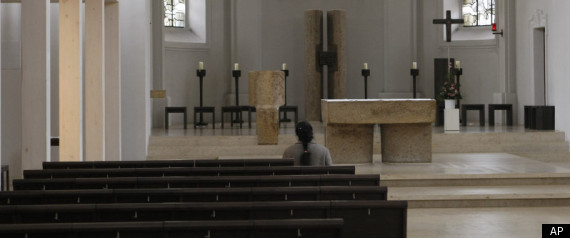
Catholics are leaving the church for the evangelical cult that is putting politicians in office, especially from the red states down in the South who are bitter about losing the Civil War – and their slaves! I would guess Catholic leaders want to be seen as haters of big government, too, and jumped on the I Hate Obama bandwagon to get some attention – and their flock back!
The Republican candidates are giving more then religious signals to their evangelical sheep, and Santorum, the Catholic, is surging. He may run against Obama. The Morons have gotten gobs of attention.
What does any of this have to do with having a personal relationship with Jesus – if there is such a thing? This compitition for votes and flocks is destroying this Democracy. This is why Christians want secular issues to take a back seat – and real secular history! Jesus is a mere slave to this evil system, chained to their auction block, for sale to the highest bidder.
I have come to free Jesus. I will role back the stone to his tomb and reveal the riddle about his resurrection. Then, there will be no Christian church, just the original church made up of Nazarites called ‘The Church of God’.
Take the Vow of the Nazarite. Repent, and help prepare the way!
Jon the Nazarite
Jon Presco
More Hispanics Leaving Catholicism for Evangelical Protestantism
SANTA MARIA (By Stan Oklobdzija, Santa Maria Times) February 20, 2006 — In immigrant communities across the United States, a battle is being waged for the souls of Hispanics – and a distinctly American style of worship is beginning to take hold.
According to a landmark study, as many as 600,000 Hispanics in this country leave the Catholic Church every year in favor of Protestant evangelical churches.
Furthermore, of the approximately 30 percent of Hispanics nationwide who identify themselves as non-Catholic, the vast majority are affiliated with an evangelical or “born-again” church.
Catholicism remains by far the largest religious denomination for U.S. Hispanics, but because Hispanics are the fastest-growing ethnic group in the United States, any shift in the way they worship promises to make a huge impact on America’s religious landscape. Examples of this trend can be seen in the Santa Maria Valley as small storefront churches pop up in shopping centers and some Catholic priests report the loss of some members of their flocks.
Gaston Espinosa directed one of the most comprehensive studies of evangelical Latino churches published to date.
“Hispanic Churches in American Public Life,” published in 2003, surveyed about 2,000 Hispanics living in the United States and Puerto Rico about their religious preferences, activities and beliefs. The three-year study, funded by the Pew Charitable Trusts, focused on the impact of religion on the civic and political activity of Hispanics living in the United States.
I was a Protestant for twenty years before I became a Catholic. I led many people out of the Catholic Church. My formula for getting Catholics to leave the Church usually consisted of three steps.
Step 1: Get Catholics to have a conversion experience in a Protestant setting. Most Fundamentalist, Evangelical, and charismatic Protestant churches have dynamic youth programs, vibrant Wednesday and Sunday evening services, and friendly small-group bible studies. In addition, they host special crusades, seminars and concerts. At the invitation of a Protestant friend, a Catholic may begin attending one or more of these events while still going to Sunday Mass at his local parish.
Most Protestant services proclaim a simple gospel: repent from sin and follow Christ in faith. They stress the importance of a personal relationship with Jesus and the reward of eternal life. Most of the Catholics who attend these services are not accustomed to hearing such direct challenges to abandon sin and follow Christ. As a result, many Catholics experience a genuine conversion.
Protestants should be commended for their zeal in promoting conversions. Catholic leaders need to multiply the opportunities for their people to have such conversions in Catholic settings. The reason is simple. About five out of ten people adopt the beliefs of the denomination where they have their conversion. This percentage is even higher for those who had profound conversions or charismatic experiences that were provided by Protestants. (Believe me, I know; I was a graduate of an Assembly of God college and a youth minister in two charismatic churches.)
Protestant pastors, evangelists, youth leaders, and lay ministers are acutely aware that conversion experiences in Protestant settings often lead to a Protestant faith and church membership. Why do so many Catholic leaders fail to see this? Why are they so nonchalant about a process that has pulled hundreds of thousands of Catholics out of the Church?
Step 2: Give their conversion a Protestant interpretation.
A genuine conversion is one of life’s most precious experiences, comparable to marriage or the birth of a child. Conversion awakens a deep hunger for God. Effective Protestant ministries train workers to follow up on this spiritual longing.
Before a stadium crusade, I would give follow-up workers a six-week training course. I showed them how to present a Protestant interpretation of the conversion experience with a selective use of bible verses. The scripture of choice was of course John 3:3, the “born-again” verse: “Jesus declared, ‘I tell you the truth, no one can see the kingdom of God unless he is born again.’
I used the “touch and go” scripture technique, similar to that used by pilots training for landings and takeoffs. We would briefly touch down on John 3:3 to show that being born again was necessary for eternal life. Then I would describe conversion in terms of being born again. We would make a hasty takeoff before reading John 3:5 which stresses the necessity of being “born of water and spirit.” I never mentioned that for 20 centuries the Orthodox and Catholic Churches, echoing the unanimous teaching of the Church fathers, understood this passage as referring to the Sacrament of Baptism! And I certainly never brought up Titus 3:5 (“He saved us through the washing of rebirth and renewal by the Holy Spirit”) as a parallel reference to John 3:5.
In my experience as a Protestant, all the Catholics who had a conversion in a Protestant setting lacked a firm grasp of their Catholic faith.
In twenty years of Protestant ministry, I never met a Catholic who knew that John 3:3-8 describes the sacrament of Baptism. It wasn’t hard to convince them to disregard the sacraments along with the Church that emphasized the sacraments.
Proverbs says: “He who states his case first seems right, until the other comes and examines him” (18:17). Catholics without a scriptural foundation for their Catholic beliefs never hear “the rest of the story.” My selective use of scripture made the Protestant perspective seem so absolutely sure. Over time, this one-sided approach to scripture caused Catholics to reject their Catholic faith.
Step 3: Accuse the Catholic church of denying salvation by grace.
Catholics often consider Protestants who proselytize to be bigoted, narrow-minded, or prejudiced. This is unfair and inaccurate; a profound charity energizes their misguided zeal.
There was only one reason I led Catholics out of the Church: I thought they were on their way to hell. I mistakenly thought the Catholic Church denied that salvation was by grace; I knew that anyone who believed this wasn’t going to heaven. Out of love for their immortal souls, I worked tirelessly to convert them.
I used Ephesians 2:8-9 to convince Catholics that it was imperative for them to leave the Church:
For it is by grace you have been saved, through faith — and this not from yourselves, it is the gift of God — not by works, so that no one can boast.
First I would say, “The Bible says that salvation is by grace and not by works. Right?” Their answer was always yes. Then I would say, “The Catholic Church teaches that salvation is by works. Right?” (I never met a Catholic who did not say yes. Every Catholic I met during my twenty years of ministry confirmed my misconception that Catholicism taught salvation is by works instead of grace.) Finally, I would declare, “The Catholic Church is leading people to hell by denying salvation is by grace. You’d better join a church that teaches the true way to heaven.”
Because I would also do a “touch and go” in Ephesians, I rarely quoted verse 10 which says, “For we are God’s workmanship, created in Christ Jesus to do good works, which God prepared in advance for us to do.” Listen carefully to stadium evangelists, televangelists, and radio preachers. Nine times out of ten they will quote Ephesians 2:8-9 with great emphasis and never mention verse 10.
We are not slaves futilely trying to earn salvation by doing “works of the law” (Eph. 2:8-9). Yet as sons of God we are inspired and energized by the Holy Spirit to do “good works” as we cooperate with our heavenly father in extending the Kingdom of God (Eph. 2:10). Catholicism believes and teaches the full message of Ephesians 2:8-10, without equivocating or abbreviating the truth.
For twenty centuries the Catholic Church has faithfully taught that salvation is by grace. Peter the first pope said, “We believe it is through the grace of our Lord Jesus that we are saved” (Acts 15:11). The Catechism of the Catholic Church, fully endorsed by Pope John Paul II, says, “Our justification comes from the grace of God” (section 1996).
Protestantism started when Martin Luther declared that we are justified (made righteous) by faith alone. At the time I was leading Catholics out of the Church, I wasn’t aware that Martin Luther had added the word alone to his translation of Romans 3:28 in order to prove his doctrine. (The word alone is not found in any contemporary Protestant English translation of Romans 3:28.) I didn’t realize that the only place the bible mentions “faith alone” in the context of salvation is in James 2:24, where the idea of faith alone is explicitly refuted: “You see that a person is justified by what he does and not by faith alone.” This verse was troubling, but I either ignored it, or twisted it to mean something other that what the verse and its context clearly taught.
The number of people who have left the Catholic church is huge.
We all have heard stories about why people leave. Parents share stories about their children. Academics talk about their students. Everyone has a friend who has left.
An Interesting Phenomenon
While we have large numbers of Catholics leaving the Catholic church to join a more ‘spiritually alive church’, a more ‘bible based church’, we have in the past 20 years a growing number of Protestant ministers being led by the Spirit to convert to Catholicism. We also have a number of lay evangelicals joining the Catholic church and a number of people who were raised in the Catholic church, join an evangelical church for years and now are returning home to the Catholic church.
This phenomenon is amazing to me when I consider the following factors:
Nearly all of the Protestant ministers now converting to Catholicism were raised in an anti-Catholic atmosphere.
They were very well educated in their own religious beliefs. So it wasn’t as if they didn’t truly know what their particular church believed.
Joining the Catholic church meant losing their jobs. Nearly all of these converts were Pastors in their church’s. When they joined the Catholic church they wanted to continue in Christian ministry. Some were able to do this, others were not.
Often these men left vibrant faith communities to join a parish that may not have been very spiritually alive.
They joined the Catholic church during a time when the media highlighted all sex scandals and the cover-up of these by our bishops. Who needs to join such a church?
So why were these Ministers led to the Catholic Church?
Briefly, they were led to the Catholic church as a result of extensive study especially into the roots of Christianity. All of these former ministers now believe that the Catholic church is the one true church founded by Jesus Christ.
BERLIN (RNS) The number of Germans leaving the Roman Catholic Church rose dramatically in 2010 as Pope Benedict XVI’s homeland wrestled with reports of systematic sexual abuse of minors and attempted cover-ups, according to a study by a German newspaper.
About 180,000 Catholics officially ended their church affiliation in 2010, a rise of 50,000 (or 40 percent) from 2009, according to the weekly Die Zeit newspaper.
The data was collected from surveys answered by most of Germany’s major dioceses. Official church-collected data is not expected until the summer.
The release of 2009 defections almost a year ago had already signaled a growing wave of departures even before the scandal fully erupted last year as several officials at church-run schools were accused of abusing children.
“The increase of church departures in 2010 represents a loss of trust that fell especially hard on the church because of the abuse cases,” said Dominik Schwaderlappe, the general vicar of Cologne. “This is painful for us, because it clearly shows that people are using church departures as their personal form of protest and as a way to show their disgust with the scandal.”
Leaving the church not only means a drop in attendance but also a formal severing of relations; people who formally leave a church are no longer required to have part of their income diverted to the church as church tax.
If the figures are validated, it would represent the first time since World War II that more Catholics than Protestants left their church in a single year.
 Rosamond Press
Leave a comment