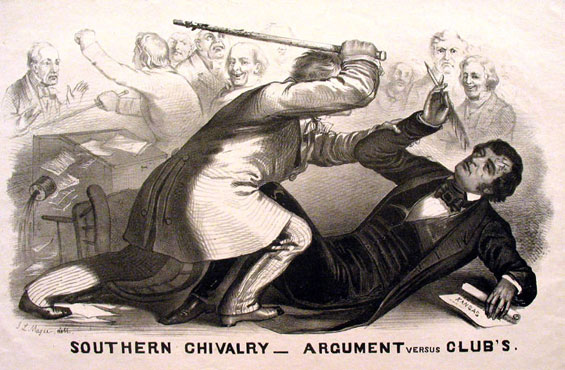
There is a renewed idea that Christian brothers should stick together and take on non-Christians. For slave owners in the South, any Christian who wanted to make laws that took away your God-given slave, was not a Christian, but your enemy, and the enemy of the Christian church.
Above is the image of a Southern Lawmaker assaulting a fellow Lawmaker in the Senate, because he was an Abolitionist. Both men were no doubt Christians, because that was the norm – unless you were one of the Radical Republicans, one of the Socialist Forty-Eighters that founded the Republican Party so all Americans can speak their mind – and vote – and that is exactly who the man holding the quill is. Charles Sumner was a Radical Republican and no doubt good friend of my kindred, John and Jessie Fremont.
Let’s get this clear, Christians who are attacking our President are claiming they want to be left alone to worship as they please. But, this has never been the case! The Great Commission tells them to spread the Good News all over the world, and not just in America. There is no edict or law requiring Americans to spread anything all over the world. Talk about being a trouble maker! Don’t put these LIARS in the White House and in control of Military!
Christians give the impression if we were all Christians, then what a wonderful place America will be. Excuse me! Everyone in Europe were Christians for fifteen hundred years – and no one has yet counted how many people were killed, or murdered fighting religious battles, because a Christian brother prefered two sacraments, over just the one!
I’m not buying it! I don’t have to! Go………….fish!
My kindred fought and died in the Revolutionary War, and the Civil War – for Freedom. How many sons of Catholic priests haved died in any war?
None!
Time to make a list of the holy battles the Popes bid folks to fight – in the name of Son of Peace! My guess is over twenty thousand. How many slave got freed in those holy wars? How many women got the right to vote?
NONE!
Looks to me that Religion and Freedom – never went hand in hand!
Jon Presco
Southern writers led the antebellum shift toward an uncompromising defense of slave holding. After 1831 southerners drove dissenters on the issue of the morality of slaveholding out of the region. Southerners might continue to disagree among themselves about the exact future of slavery, the region’s politics, and the characteristics that made the South distinctively wonderful, but public dissent on the superiority of the South was rare and violently punished.
Representative Preston Brooks, Butler’s nephew, was infuriated, intended to challenge Sumner to a duel, and consulted with fellow South Carolina Representative Laurence M. Keitt on dueling etiquette. Keitt told him that dueling was for gentlemen of equal social standing, and that Sumner was no better than a drunkard, due to the supposedly coarse language he had used during his speech. Brooks concluded in turn that since Sumner was no gentlemen, it would be more appropriate to beat him with his cane.[
RELIGIOUS DEFENSES OF SLAVERY
Religious publications sold more copies than any other form of proslavery writing. The three major protestant evangelical denominationsâBaptists, Methodists, and Presbyteriansâaccounted for more than 90 percent of southern churchgoers. Their ministers ran southern educational institutions, included a higher percentage of slaveholders than any other profession, and controlled an impressive religious press. The Methodist Christian Advocate had the highest circulation of any newspaper in the world in 1830.
Ministers, including the Baptist Richard Furman (1755â1825), who was instrumental in founding George Washington, Furman, and Mercer Universities, led the first wave of antebellum proslavery writing in the wake of the Denmark Vesey slave-revolt conspiracy in Charleston in 1822. Furman’s “Exposition of the Views of the Baptists, Relative to the Coloured Population of the United States” (1823) trumpeted the numerous scriptural passages taken to favor slaveholders that would be repeated ad nauseam after 1831. The abolitionist movement launched that year sprang from radical northern churches. Southern ministers thus felt well positioned to answer the abolitionists’ religiously based charges that slaveholding was a sin. Southern writers sought divine sanction for slaveholding by quoting select scriptural passagesâa development that encouraged a culture of simple biblical literalism in the region. The refrain of the regional war of words had other dramatic and long-lasting historical effects. The Presbyterian (1837, 1857, 1861), Methodist (1844), and Baptist (1845) denominations split into northern and southern wings over the issue of southern demands that slaveholders receive moral vindication and that abolitionists be purged as biblical heretics and dangerous social subversives. Southern ministers then controlled new independent regional denominations, newspapers, and periodicals that they used to promote their proslavery biblical argument.
Of course, long-standing biblical arguments in defense of slavery were well known or available. Antebellum ministers North and South, like the earliest American proslavery publicists in the Puritan New England of the 1600s, were familiar with racist and biblical justifications for slaveholding common in Western culture. Racist religious ideologies based on scripture were used to justify enslavement of Africans before slavery was instituted in America. No society in history, however, produced nearly the volume of religious proslavery writings that the antebellum South did.
The Virginia Baptist minister Thornton String-fellow (1788â1869) wrote the best-selling proslavery tract of the era and was probably the most widely distributed antebellum southern writer of any kind. In his Brief Examination of Scripture Testimony on the Institution of Slavery (1841) Stringfellow gave the authoritative catalog of scriptural proslavery references that would be emphasized by antebellum southern evangelicals throughout the Civil War. Other proslavery ministers constantly pointed out that the God of the Old Testament had sanctioned slaveholding. After all, his prophets, patriarchs, and chosen people held slaves: God chose Abraham and blessed him while he held slaves, two of the Ten Commandments affirmed the master-slave relationship, and Leviticus 25 gave license to the holding of foreigners in perpetual bondage. Like all subsequent biblical proslavery writers, Stringfellow gave greatest emphasis to Paul’s letters (the slaves for this reason labeled the period of their enslavement “Paul’s Time”). Paul’s letters acknowledged that slavery was consistent with Christianity (Ephesians 6), thus creating a New Testament link to the innumerable Old Testament passages. Proslavery ministers reasoned that although he preached in a slaveholding society, Jesus never condemned slavery. In Luke 7, after curing the Centurion’s servant, Jesus commended the Centurion, who, southern ministers pointed out, was a slave-holder. In the economic boom and spread of evangelical profession in the antebellum South, ministers thought they again saw the Savior commending and blessing righteous men who held slaves.
The South saw massive territorial and economic growth starting with the invention of the cotton gin in 1793; similarly, the relatively unchurched South witnessed a wave of conversions, starting with the Great Revival of 1801, which turned the region into the Bible belt. Southerners believed the tremendous economic boom and the spread of evangelical profession in the region were linked. In line with the Protestant work ethic, God had rewarded his righteous followers. When Paul spoke of “believing masters” in Timothy 4, Bible belt masters saw a reflection of themselves in scripture. The most popular biblical passage among antebellum southerners was also from Paul’s Letters. In his letter to Philemon, Paul sent a runaway slave, Onesimus, back to his master. Southern proslavery ministers saw biblical justification not only for the morality of slavery but also for the southern position on the Fugitive Slave Law and the Constitution in this endlessly cited passage.
Like political lessons found in the Bible, biblical myths not in the literal word of scripture also played an important role in southern views of race and territorial expansion. The most infamous of such myths were those surrounding Genesis 9, in which Noah curses his son Ham for mocking Noah’s drunkenness. The curse falls on Ham’s son Canaan, who will be the “lowest of slaves” to Ham’s brothers, Shem and Japheth. Noah prophesies that Japheth will prosper, and white southerners, indeed all antebellum white Americans, especially appropriated Noah’s prophecy that God would “make space for Japheth, and let him live in the tents of Shem; and let Canaan be his slave.” Southerners (and northerners) saw Genesis 9 as foreshadowing a sacred history of the United States: antebellum white Americans (Japheth) had enslaved Africans (Ham) and made space for themselves by occupying the tents of Native Americans (Shem). Southern novelists like William Gilmore Simms (1806â1870) employed this racist myth and routinely referred to blacks as “Children of Ham,” as did northern authors such as Harriet Beecher Stowe (1811â1896).
Charles Sumner (January 6, 1811 – March 11, 1874) was an American politician and senator from Massachusetts. An academic lawyer and a powerful orator, Sumner was the leader of the antislavery forces in Massachusetts and a leader of the Radical Republicans in the United States Senate during the American Civil War and Reconstruction, working to punish the ex-Confederates and guarantee equal rights to the Freedmen.
Sumner changed his political party several times, gaining fame as a Republican. One of the most learned statesmen of the era, he specialized in foreign affairs, working closely with Abraham Lincoln to keep the British and the French from intervening on the side of the Confederacy during the Civil War. He devoted his enormous energies to the destruction of what he considered the Slave Power, that is the efforts of slave owners to take control of the federal government and ensure the survival and expansion of slavery.
In 1856, South Carolina Representative Preston Brooks nearly killed Sumner on the Senate floor for ridiculing slaveowners as pimps in his vitriolic denunciation of the “Crime against Kansas.” After three years of medical treatment Sumner returned to the Senate as the war began. He became the chief Senate spokesman on foreign affairs, and a leader of the Radical Republicans who sought to destroy slavery and radically transform the South. As the chief Radical leader in the Senate during Reconstruction, 1865–1871, Sumner fought hard to provide equal civil and voting rights for the freedmen on the grounds that “consent of the governed” was a basic principle of American republicanism, and to block ex-Confederates from power so they would not reverse the North’s victory in the Civil War. Sumner, teaming with House leader Thaddeus Stevens, defeated Andrew Johnson’s reconstruction plans and imposed Radical views on the South. In 1871, however, he broke with President Ulysses Grant. Grant’s Senate supporters then took away Sumner’s power base, his committee chairmanship. Sumner concluded that Grant’s corrupt despotism and the success of Reconstruction policies called for new national leadership. He opposed Grant’s reelection by supporting the Liberal Republican candidate Horace Greeley in 1872 and lost his power inside the Republican party.
[edit] Early life, education, and law career
Birthplace, Irving Street, Beacon Hill, BostonSumner was born on Irving Street in Boston on January 6, 1811. He was the son of Charles Pinckney Sumner, a progressive Harvard-educated lawyer, abolitionist, and early proponent of racially integrated schools, who shocked 19th century Boston by opposing anti-miscegenation laws.[1] His father had been born in poverty[2] and his mother shared a similar background and worked as a seamstress prior to her marriage.[2] Sumner’s parents were described as exceedingly formal and undemonstrative.[2] His father’s legal practice was a failure, and throughout Sumner’s childhood his family teetered on the edge of the middle class.[2] The family attended Trinity Church, but after 1825 the family occupied a pew in King’s Chapel.[3]
Sumner’s father hated slavery and told Sumner that freeing the slaves would “do us no good” unless they were treated equally by society.[4] Sumner was a close associate of William Ellery Channing, an influential Unitarian minister in Boston. Channing believed that human beings had an infinite potential to improve themselves. Expanding on this argument, Sumner concluded that environment had “an important, if not controlling influence” in shaping individuals.[5] By creating a society where “knowledge, virtue and religion” took precedence, “the most forlorn shall grow into forms of unimagined strength and beauty.”[6] Moral law, he believed, was as important for governments as it was for individuals, and legal institutions that inhibited ones ability to grow—like slavery or segregation—were evil. While Sumner often viewed contemporary society critically, his faith in reform was unshakable. When accused of utopianism, he replied “The Utopias of one age have been the realities of the next.”[7]
Sumner attended the Boston Latin School, where he counted Robert Charles Winthrop, James Freeman Clarke, Samuel Francis Smith, and Wendell Phillips, among his closest friends.[1] He graduated in 1830 from Harvard College, where he lived in Hollis Hall, and in 1834 from Harvard Law School where he became a protege of Joseph Story. At Harvard, he was a member of the Porcellian Club.
In 1834, Sumner was admitted to the bar and entered private practice in Boston in partnership with George Stillman Hillard. A visit to Washington decided him against a political career, and he returned to Boston resolved to practice law. He contributed to the quarterly American Jurist and edited Story’s court decisions as well as some law texts. From 1836 to 1837, Sumner lectured at Harvard Law School.
[edit] Travels in EuropeSumner traveled to Europe in 1837. He landed at Le Havre and found the cathedral at Rouen striking: “the great lion of the north of France…transcending all that my imagination had pictured.[8] He reached Paris in December, began to study French, and visited the Louvre “with a throb,” describing how his ignorance of art made him feel “cabined cribbed, confined” until repeat visits allowed works by Raphael and Leonardo to change his understanding: “They touched my mind, untutored as it is, like a rich strain of music.”[9] He mastered French in six months and attended lectures at the Sorbonne on subjects ranging from geology to Greek history to criminal law.[10] In his journal for January 20, 1838, he noted that one lecturer “had quite a large audience among whom I noticed two or three blacks, or rather mulattos–two-thirds black perhaps–dressed quite à la mode and having the easy, jaunty air of young men of fashion….” who were “well received” by the other students after the lecture. He continued:[11]
They were standing in the midst of a knot of young men and their color seemed to be no objection to them. I was glad to see this, though with American impressions, it seemed very strange. It must be then that the distance between free blacks and whites among us is derived from education, and does not exist in the nature of things.
He joined other Americans who were studying medicine on morning rounds at the city’s great hospitals.[12] In the course of three more years he became fluent in Spanish, German, and Italian, and he met with many of the leading statesmen in Europe.[citation needed] In 1838, Sumner visited Britain, where Lord Brougham declared that he “had never met with any man of Sumner’s age of such extensive legal knowledge and natural legal intellect.”[13] He returned to the U.S. in 1840.[citation needed]
[edit] Early political career
An 1842 bust of Charles Sumner by Thomas Crawford
Sumner ca. 1850In 1840, at the age of 29, Sumner returned to Boston to practice law but devoted more time to lecturing at Harvard Law, editing court reports, and contributing to law journals, especially on historical and biographical themes.
Sumner developed friendships with several prominent Bostonians, particularly Henry Wadsworth Longfellow, whose house he visited regularly in the 1840s. Longfellow’s daughters found his stateliness amusing. Sumner would ceremoniously open doors for the children while saying “In presequas” in a sonorous tone.[14]
In 1845, he delivered an Independence Day oration on “The True Grandeur of Nations” in Boston. He spoke against the Mexican-American War and made an impassioned appeal for freedom and peace.
He became a sought-after orator for formal occasions. His lofty themes and stately eloquence made a profound impression. His platform presence was imposing. He stood six feet and four inches tall, with a massive frame. His voice was clear and of great power. His gestures were unconventional and individual, but vigorous and impressive. His literary style was florid, with much detail, allusion, and quotation, often from the Bible as well as the Greeks and Romans. Henry Wadsworth Longfellow wrote that he delivered speeches “like a cannoneer ramming down cartridges,” while Sumner himself said that “you might as well look for a joke in the Book of Revelation.”[citation needed]
Following the annexation of Texas as a new slave-holding state in 1845, Sumner took an active role in the anti-slavery movement. That same year, Sumner represented the plaintiffs in Roberts v. Boston, a case which challenged the legality of segregation. Arguing before the Massachusetts Supreme Court, Sumner noted that schools for blacks were physically inferior and that segregation bred harmful psychological and sociological effects—arguments that would be made in Brown v. Board of Education over a century later.[15] Sumner lost the case, but the Massachusetts legislature abolished school segregation in 1855.
Sumner worked with Horace Mann to improve the system of public education in Massachusetts. He advocated prison reform. In opposing the Mexican-American War, he considered it a war of aggression, but was primarily concerned that captured territories would expand slavery westward. In 1847, Sumner denounced a Boston Representative’s vote for the declaration of war against Mexico with such vigor that he became a leader of the Conscience Whigs faction of the Massachusetts Whig Party. He declined to accept their nomination for U.S Representative in 1848.
Instead, Sumner helped organize the Free Soil Party, which opposed both the Democrats and the Whigs, who had nominated Zachary Taylor, a slave-owning Southerner, for President. Sumner ran for U.S. Representative as a Free Soil candidate and lost.
In 1851, Democrats gained control of the Massachusetts state legislature in coalition with the Free Soilers. The Free Soilers named Sumner their choice for U.S. Senator. The Democrats initially opposed him and called for a less radical candidate. The impasse was broken after three months and Sumner was elected by a one-vote majority on April 24, 1851. His election marked a sharp break in Massachusetts politics, as his abolitionist politics contrasted sharply those of the senator whose seat he occupied, Daniel Webster, one of the foremost supporters of the Compromise of 1850 and its Fugitive Slave Act.[16]
[edit] Senate service[edit] Antebellum careerSumner took his Senate seat in late 1851 as a Democrat. For the first few sessions, Sumner did not promote any of his controversial causes. On August 26, 1852, Sumner, despite strenuous efforts to dissuade him, delivered his first major speech, titled with a popular abolitionist motto: “Freedom National; Slavery Sectional”. He attacked the 1850 Fugitive Slave Act.[17] After his speech, a Senator from Alabama urged that there be no reply: “The ravings of a maniac may sometimes be dangerous, but the barking of a puppy never did any harm.” Sumner’s outspoken opposition to slavery made him few friends in the Senate.[18]
Though the conventions of both major parties had just affirmed the finality of every provision of the Compromise of 1850, including the Fugitive Slave Act, Sumner called for the Act’s repeal. For more than three hours he denounced it as a violation of the Constitution, an affront to the public conscience, and an offense against divine law. The speech provoked a storm of anger in the South, but it made Sumner’s reputation in the North.[citation needed]
[edit] “Crime against Kansas” and attack by Brooks
Lithograph of Preston Brooks’ 1856 attack on Sumner Wikisource has original text related to this article:
The Crime against Kansas
Though the “Crime against Kansas” speech is very long, “it really is very simply arranged. Sumner is arguing in it for the immediate admission of Kansas into the Union as a free state (his fears of Missouri slave-holders crossing into KS, wreaking havoc with the population, cowing them into submission and imposing a proslavery government there were amply justified). But he is not content in the speech merely to argue placidly for KS’s immediate admission to the Union. Rather, he turns his speech into an expose of the designs of what he calls the “Slave Power”–the unified and relentless machinations of the South gradually to enslave the free-states as they had enbondaged their Black slaves. The three major points he discusses are these: (1) The true crime against Kansas, in its origin and extent; (2) The apologies (i.e., the defenses offered up) for the crime; and (3) The true remedy for the crime.” [19] In 1856, during the “Bleeding Kansas” crisis, Sumner denounced the Kansas-Nebraska Act. In his speech on May 19 and May 20, Sumner attacked the Act. Its motivation, he said, was to rape a virgin:
“Not in any common lust for power did this uncommon tragedy have its origin. It is the rape of a virgin Territory, compelling it to the hateful embrace of slavery; and it may be clearly traced to a depraved desire for a new Slave State, hideous offspring of such a crime, in the hope of adding to the power of slavery in the National Government.”[20]
Sumner then attacked authors of the Act, Senators Stephen A. Douglas of Illinois and Andrew Butler of South Carolina. He said that Butler had taken “a mistress who, though ugly to others, is always lovely to him; though polluted in the sight of the world, is chaste in his sight—I mean, the harlot, Slavery.” According to Hoffer (2010), “It is also important to note the sexual imagery that recurred throughout the oration, which was neither accidental nor without precedent. Abolitionists routinely accused slaveholders of maintaining slavery so that they could engage in forcible sexual relations with their slaves.”[21] Sumner also attacked the honor of South Carolina having alluded in his speech that the history of the state be “blotted out of existence…”[22] Sumner’s three-hour oration also mocked the 59-year-old Butler’s manner of speech and physical mannerisms, which were impaired by a stroke. Douglas said to a colleague during the speech that “this damn fool Sumner is going to get himself shot by some other damn fool.”[23]
Representative Preston Brooks, Butler’s nephew, was infuriated, intended to challenge Sumner to a duel, and consulted with fellow South Carolina Representative Laurence M. Keitt on dueling etiquette. Keitt told him that dueling was for gentlemen of equal social standing, and that Sumner was no better than a drunkard, due to the supposedly coarse language he had used during his speech. Brooks concluded in turn that since Sumner was no gentlemen, it would be more appropriate to beat him with his cane.[citation needed]
Two days later, on the afternoon of May 22, Brooks confronted Sumner as he sat writing at his desk in the almost empty Senate chamber: “Mr. Sumner, I have read your speech twice over carefully. It is a libel on South Carolina, and Mr. Butler, who is a relative of mine.” As Sumner began to stand up, Brooks beat Sumner severely on the head before he could reach his feet, using a thick gutta-percha cane with a gold head. Sumner was knocked down and trapped under the heavy desk (which was bolted to the floor), but Brooks continued to strike Sumner until Sumner ripped the desk from the floor. By this time, Sumner was blinded by his own blood, and he staggered up the aisle and collapsed, lapsing into unconsciousness. Brooks continued to beat the motionless Sumner until his cane broke at which point he left the chamber. Several other Senators attempted to help Sumner, but were blocked by Keitt who brandished a pistol and shouted, “Let them be!” Keitt was censured for his actions.[citation needed]
Brooks was later fined $300 for his actions.[24]
The attack revealed the increasing polarization of the United States at that time, as Sumner became a martyr in the North and Brooks a hero in the South. Northerners were outraged. The editor of the New York Evening Post, William Cullen Bryant, wrote:
The South cannot tolerate free speech anywhere, and would stifle it in Washington with the bludgeon and the bowie-knife, as they are now trying to stifle it in Kansas by massacre, rapine, and murder. Has it come to this, that we must speak with bated breath in the presence of our Southern masters? … Are we to be chastised as they chastise their slaves? Are we too, slaves, slaves for life, a target for their brutal blows, when we do not comport ourselves to please them?
[citation needed]
The outrage in the North was loud and strong. Thousands attended rallies in support of Sumner in Boston, Albany, Cleveland, Detroit, New Haven, New York, and Providence. More than a million copies of Sumner’s speech were distributed. Two weeks after the caning, Ralph Waldo Emerson described the divide the incident represented: “I do not see how a barbarous community and a civilized community can constitute one state. I think we must get rid of slavery, or we must get rid of freedom.”[25] Conversely, Brooks was praised by Southern newspapers. The Richmond Enquirer editorialized that Sumner should be caned “every morning,” praising the attack as “good in conception, better in execution, and best of all in consequences” and denounced “these vulgar abolitionists in the Senate” who “have been suffered to run too long without collars. They must be lashed into submission.” Many Southerners sent Brooks new canes, in endorsement of his assault.[citation needed] Historian William Gienapp has concluded that Brooks’ “assault was of critical importance in transforming the struggling Republican party into a major political force.”[26]
Theological and legal scholar Dr. William R. Long praised the speech as “a most rebarbative and vituperative speech on the Senate floor”, which “flows with Latin quotations and references to English and Roman history.” In his eyes the speech was a “was a gauntlet thrown down, a challenge to the “Slave Power” to admit once and for all that it were encircling the free states with their tentacular grip and gradually siphoning off the breath of democracy-loving citizens.”[19]
[edit] Absence from the Senate
1860 steel-engraved portrait of SumnerIn addition to the head trauma, Sumner suffered from nightmares, severe headaches, and what is now understood to be post-traumatic stress disorder[27] or “psychic wounds.”[28] When he spent months convalescing, his political enemies ridiculed him and accused him of cowardice for not resuming his duties. The Massachusetts General Court reelected him in November 1856, believing that his vacant chair in the Senate chamber served as a powerful symbol of free speech and resistance to slavery.[29]
When he returned to the Senate in 1857, he was unable to last a day. His doctors advised a sea voyage and “a complete separation from the cares and responsibilities that must beset him at home.” He sailed for Europe and immediately found relief.[30] During two months in Paris in the spring of 1857, he renewed friendships, especially with Thomas Gold Appleton, dined out frequently, and attended the opera several nights in a row. His contacts there included Alexis de Tocqueville, poet Alphonse de Lamartine, former French Prime Minister François Guizot, Ivan Turgenev, and Harriet Beecher Stowe.[31] Sumner then toured several countries, including Germany and Scotland, before returning to Washington where he spent only a few days in the Senate in December. Both then and during several later attempts to return to work, he found himself exhausted just listening to Senate business. He sailed once more for Europe on May 22, 1858, the second anniversary of Brooks’ attack.[32]
In Paris, prominent physician Charles-Édouard Brown-Séquard diagnosed Sumner’s condition as spinal cord damage that he could treat by burning the skin along the spinal cord. Sumner chose to refuse anesthesia, which was thought to reduce the effectiveness of the procedure. Observers both at the time and since doubt Brown-Séquard’s efforts were of value.[33] After spending weeks recovering from these treatments, Sumner resumed his touring, this time traveling as far east as Dresden and Prague and south to Italy twice. In France he visited Brittany and Normandy, as well as Montpellier. He wrote his brother: “If anyone cares to know how I am doing, you can say better and better.”[34]
[edit] Returned to SenateSumner returned to the Senate in 1859. When fellow Republicans advised taking a less strident tone than he had years earlier, he answered: “When crime and criminals are thrust before us they are to be met by all the energies that God has given us by argument, scorn, sarcasm and denunciation.” He delivered his first speech following his return on June 4, 1860, during the 1860 presidential election. In “The Barbarism of Slavery”, he attacked attempts to depict slavery as a benevolent institution, said it had stifled economic development in the South and that it left slaveholders reliant on “the bludgeon, the revolver, and the bowie-knife.” He addressed an anticipated objection on the part of one of his colleagues: “Say, sir, in your madness, that you own the sun, the stars, the moon; but do not say that you own a man, endowed with a soul that shall live immortal, when sun and moon and stars have passed away.” Even allies found his language too strong, one calling it “harsh, vindictive, and slightly brutal.”[35] He spent the summer rallying the anti-slavery forces and opposing talk of compromise.[36]
[edit] Civil War[edit] RadicalsSen. Sumner was a member of a faction of the Republican Party known as the Radicals.[37] In March 1861, after the withdrawal of Southern Senators, Sumner became chairman of the Committee on Foreign Relations. The Radicals primarily advocated the immediate abolition of slavery and the destruction of the Southern planter class. Senate Radicals included Sumner, Sen. Zachariah Chandler, and Sen. Benjamin Wade.[37] During the American Civil War, after the fall of Fort Sumter, in April 1861, Sumner, Chandler and Wade repeatedly visited President Abraham Lincoln at the White House speaking on slavery and the rebellion.[37] Although like-minded on slavery, the Radicals were loosely organized and disagreed with one another on other issues such as the tariff and currency issues.[38]
[edit] Slave emancipation
Sen. Sumner and friend Longfellow, 1863Although the Radical Senators desired the immediate emancipation of slaves, President Lincoln, in 1861, was initially resistant to freeing the slaves, since the Union slaves states Delaware, Maryland, Kentucky, and Missouri would be encouraged to join the Confederacy.[37] Sen. Sumner, however, knew that the pressure of the Civil War would eventually cause President Lincoln to free the slaves. As a compromise, the Radicals and President Lincoln passed two Confiscation Acts in 1861 and 1862 that allowed the Union military to free confiscated slaves who were carrying weapons, among other tasks, for the Confederate army. Sen. Sumner and other Radicals had persistently advocated that President Lincoln emancipate the slaves.[37] Lincoln, however, had adopted a moderated plan of gradual emancipation of slaves and compensation to the slave owners. Sen. Sumner believed that emancipating the slaves would keep Britain from entering the Civil War and the millions of slaves freed from bondage would give America higher moral standing. Lincoln described Sumner as “my idea of a bishop”, and consulted him as an embodiment of the conscience of the American people.[39] On January 1, 1863 President Lincoln, out of military necessity, issued the Emancipation Proclamation.[37]
[edit] Castigated Union Brig. Gen. StoneOn December 9, 1861 the Senate Radicals established the Joint Committee on the Conduct of the War, whose purpose was to investigate battle defeats and determine the loyalty of generals fighting for the Union War effort.[40] The committee was formed at the instigation of Radical Sen. Chandler after the Union defeat at the Battle of Ball’s Bluff, under the command of Union Brig. General Charles P. Stone.[40] At the Ball’s Bluff battle on October 21, 1861, Union Senator and Colonel Edward D. Baker, who was a close friend of President Lincoln’s, was killed and Brig. Gen. Stone was blamed for the defeat by the Union press. Sen. Sumner, upset at having learned Brig. Gen. Stone had ordered two runaway slaves to be denied asylum in the Union Army, castigated Brig. Gen. Stone in a Senate speech.[40] Brig. Gen. Stone wrote Sen. Sumner a terse letter and demanded satisfaction from Sen. Sumner. On January 31, 1862 Brig. Gen. Stone defended himself in front of the Senate Committee under Radical chairman Sen. Wade.[40] Indicted under suspicion of treason, without any trial, Brig. Gen. Stone was arrested on February 8, 1862 and federally imprisoned for 189 days.[40]
[edit] Martial law, emancipation, speech controversyOn the onset of the American Civil War in 1861, President Lincoln’s administration made a great effort to ensure the war would not be a revolution waged against slavery.[41] Sen. Sumner had counseled President Lincoln in May to make the end of slavery the primary objective. Sen. Sumner believed President Lincoln’s policy to save the Union, rather than abolish slavery, was a mistake.[41] In October 1861, at the Massachusetts state Republican Convention in Worcester, Sen. Sumner took an unprecedented step and spoke openly in a speech that the Civil War’s sole cause was slavery and the primary objective of the Union government was to destroy slavery. Sen. Sumner stated that the Union government had the power to invoke martial law and emancipate the slaves.[41] The speech caused controversy among the conservative Boston press. Sen. Sumner’s speech was denounced as incendiary and Sumner was viewed as mentally ill and a “candidate for the insane asylum”.[41] The Free Soil faction of the Republican Party fully endorsed Sen. Sumner’s speech. Sumner continued to make public speeches that the goal of the Civil War was to end slavery by emancipation.[41]
 Rosamond Press
Leave a comment