You already read the Catholic women of Nebraska did not want women to have the right to vote because there were Feminists and Socialists in the Suffrage Movement that was partially backed by the newly formed Republican Party, because they wanted to free the slaves right off the top, and feared they would not win seats and the White House – if they were TOO Radical! Fremont ran as the first Republican candidate for President, and promised FREE LAND, an idea I might revise.
Jon Presco
However, there was a political campaign smear rumor current in 1856 that Fremont was a Catholic (the purpose of which was to prevent Fremont from gaining support from those who were suspicious of Catholics).
And a minister from Ponca, Nebraska quoted scripture and said that God simply forgot to list one more commandment — women shall not vote.
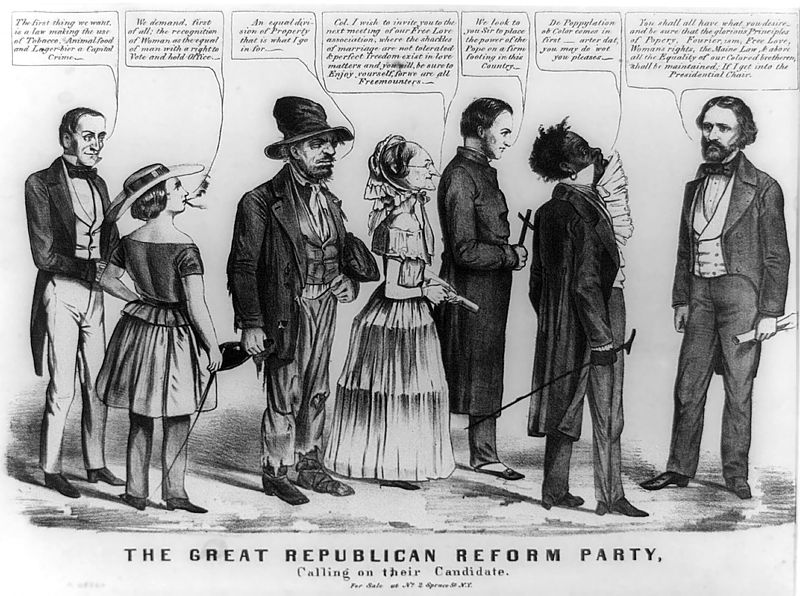
The Great Republican Reform Party Calling on their Candidate”, an 1856 print which is a political cartoon about John C. Frémont, the first Republican party candidate for president of the United States. In the 1840’s and 1850’s, radical social reform movements (such as slavery abolitionism, alcohol prohibitionism, pacifism, socialism, and after 1848, feminism) and/or what were considered eccentric currents of thought (such as Transcendentalism, Mormonism, Oneida, “spirit-rappers” or Spiritualism, etc.) were sometimes stigmatized by being lumped together as “the Isms”. Southerners often prided themselves on the American South being free from all of the pernicious Isms (except for alcohol temperance campaigning, which was fully compatible with traditional Protestant fundamentalism). For example, on Sept. 5th and 9th 1856, the Richmond, Virginia Examiner ran editorials on “Our Enemies, the Isms and their Purposes”, while in 1858 “Parson” Brownlow” called for a “Missionary Society of the South, for the Conversion of the Freedom Shriekers, Spiritualists, Free-lovers, Fourierites, and Infidel Reformers of the North” (reference: The Freedom-of-thought Struggle in the Old South by Clement Eaton). And George Fitzhugh wrote “Why have you Bloomers and Women’s Right’s men, and strong-minded women, and Mormons, and anti-renters, and ‘vote myself a farm’ men, Millerites, and Spiritual Rappers, and Shakers, and Widow Wakemanites, and Agrarians, and Grahamites, and a thousand other superstitious and infidel Isms at the North? Why is there faith in nothing, speculation about everything?”[1]
This cartoon seeks to stigmatize the Fremont campaign and the Republican party (which was the first broadly-successful political party in United States history to firmly and unyieldingly oppose all attempts at the geographical expansion of slavery) by associating them with the “Isms”, most of which were politically very controversial (and some of which were considered to be offensively immoral by many) at the time. The advocates of the Isms are shown making demands on Fremont:
Advanced Fourierist/Transcendentalist thinker
“The first thing we want is a law making the use of Tobacco, Animal food [i.e. meat], and Lager-bier a Capital Crime –”
Woman wearing an extremely masculinized version of the Bloomer costume (with straight pants instead of harem pants, and extremely short skirts over them), and also smoking (which was considered a masculine prerogative at the time)
“We demand, first of all, the recognition of Woman as the equal of man, with a right to Vote and hold Office. –”
Roughly-dressed character, holding liquor bottle
“An equal division of property, that is what I go in for –”
Ugly woman (from Oneida?) wearing a dress with poorly-constructed narrow hoops (at a time when fashionable belles wore very broad hoops, while women who declared their relative independence from ephemeral fashion trends didn’t wear hoops at all)
“Col., I wish to invite you to the next meeting of our Free Love association, where the shackles of marriage are not tolerated, & perfect Freedom exists in love matters, and you will be sure to enjoy yourself, for we are all Freemounters. –” [this last word a double entendre]
Catholic prelate
“We look to you, Sir, to place the power of the Pope on a firm footing in this Country–”
Black man in exaggerated faux-dandy attire (representing abolitionism)
“De Poppylation ob Color comes in first — arter dat [after that], you may do wot you pleases–”
Fremont
“You shall all have what you desire — and be sure that the Glorious Principles of Popery, Fourierism, Free Love, Woman’s Rights, the Maine law [alcohol prohibition], & above all the Equality of our Colored Brethren shall be maintained if I get into the Presidential Chair”.
The cartoonist was motivated by political expedience in grouping Catholicism together with the more commonly-recognized “Isms” (which leads to a certain degree of internal inconsistency in the cartoon); it was the Democratic party which was more often accused of relying on the support of Catholic immigrants, whose presence some considered dangerous to the American political system. However, there was a political campaign smear rumor current in 1856 that Fremont was a Catholic (the purpose of which was to prevent Fremont from gaining support from those who were suspicious of Catholics).
Lest Catholic Men Be Misled
To see this pamphlet as it originally appeared, click here.
Literature was distributed Sunday at the doors of the Catholic churches in Omaha, quoting a few Catholic priests, who, as citizens, had declared themselves in favor of suffrage.
Because the Catholic church has not declared herself on this point, politics being outside of her sphere, this great effort has been made to influence the Catholic voter. Although I am strenuously opposed to mixing politics and religion, as a Catholic woman I must protest against our Catholic men voting for the enfranchisement of women in Nebraska. I do not believe that any Catholic men or women would favor “Votes for Women” if they realized certain facts.
First, There are a million socialists in this country, and all are unanimous for woman suffrage. Because they hope by the women’s vote to help themselves politically. All socialists are opposed to anything Christian, but they bitterly hate and attack Catholics. Why should Catholics join themselves with such a body?
Second, The great cry of the suffrage body is for individual liberty. They demand the vote because they object to their husbands, fathers and brothers voting for them. I heard Dr. Shaw say the other evening, when she spoke at the Brandeis, “No one these days respects authority on any question.” She said, “Who believes the pulpit knows more than the pew?” She spoke of St. Paul as though he were a school boy friend, but did not mention how a certain suffrage leader scored him for enslaving women by his famous text in regard to marriage. It strikes me that a catholic should hesitate to support a movement whose leader expresses such sentiments against authority, when the fundamental point of our belief is the divine authority which Christ gave to His church.
Third. The feminist doctrine, I grant, has not made itself felt here in Nebraska as it has in the east, but nevertheless its followers are an arm of the suffrage body. Does the Catholic woman wish to be in the class which has feminists within its body. We, with the Virgin Mary for our standard of ideal womanhood, must have a care that our ideal is not shattered.
Fourth. I fear that women in politics, judging from the present campaign, will injure the Catholic virtue of charity.
I call attention to Dr. Shaw’s interview in yesterday’s Bee when she called respectable women, such as Mrs. George, “liars,” and spoke of driving the antis back to their “kennels.” I contrasted the dignified address and clear argument of Mrs. George with Dr. Shaw’s clever political speech when she flippantly dodged the real issue, and confined herself principally to abusing the antis.
I hope that Catholic men in this community will vote “No” to woman suffrage.
There were also religious figures who joined the fight to keep women out of the voting booths. After all, some of them argued, women did not belong in the political arena because their place was the “realm of sentiment and love, [they posses] gentler, kinder and holier attributes, that make the name of wife, mother, and sister next to the name of God himself.”
The Roman Catholic Church was the religious group that most consistently opposed women’s suffrage. In 1906 more than 29 percent of all Nebraskans claimed affiliation with the Catholic Church, by far the largest single denomination in the state. German Catholics were the most conservative and opposed most of the progressive era reforms; especially any attempts to provide women access to the ballot box or prohibit the sale of alcoholic beverages.
Yet, there were some Catholic voices in favor of suffrage. In 1914, the national president of the pro-suffrage organization, Dr. Anna Howard Shaw, was in Omaha. Her speeches prompted a few Catholic priests to express their personal support for suffrage. That act prompted the Nebraska chairwoman of the anti-suffragists, Mrs. Mary Nash Crofoot, to distribute a pamphlet called “Lest Catholic Men Be Misled” to churches around the city. The pamphlet was actually authored by her husband but distributed under her name. They argued that feminists were opposed to the standard that the Virgin Mother set for “ideal womanhood.” And she argued that socialists in this country supported suffrage and opposed Catholics. “All socialists are opposed to anything Christian, but they bitterly hate and attack Catholics. Why should Catholics join themselves with such a body?”
You can read the pamphlet here.
Adolf Hult, an early 20th century Lutheran pastor claimed that “Suffragism [is] Gripped by Feminism.” He said that the suffrage movement had been taken over by “lust and immorality.” He feared that the fall of women would lead to the fall of the world. “Must men put on the iron glove?” he asked.
The Reverend John Williams of St. Barnabas Episcopal Church made a distinction between the mainstream suffragists and the radical fringe. Nonetheless, he argued that the more moderate element of the movement failed to limit the excesses of the radicals who were undermining Christian morality, marriage, and home life. The Victorian ideal that a woman’s place was in the home as preordained by God. “God meant for women to reign over home, and most good women reject politics because woman suffrage will destroy society.”
And a minister from Ponca, Nebraska quoted scripture and said that God simply forgot to list one more commandment — women shall not vote.
 Rosamond Press
Leave a comment