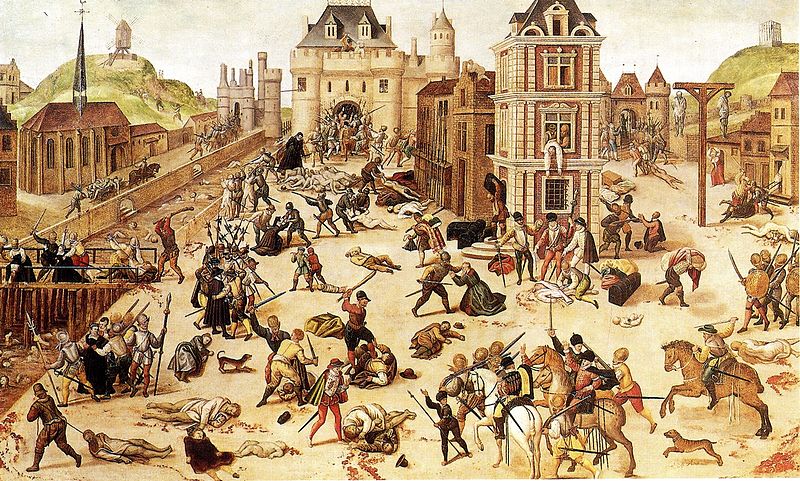
The Pope in Rome does not subscribe to Religious Freedom: Not yesterday! Not today! And not tomorrow. The Catholic church is a giant parasite that has attached itself to our Democracy, and only pretends to be a gentle lamb of God, when they are born of the revenous wolves of Rome. A vast number of Catholics use birth control in a covert manner, because they don’t get to vote on this matter. They disobey the Pope in a underground manner, in secret, in my Democracy my kinsfolk fought to establish – out in the open, on a real battleground!
Down with the sneak attack launched from Rome! What is going on in the streets of Syria, is what went on in the streets of France!
FREEDOM!
Jon Presco
“Don’t Eat the Fish:” This might have been the headline of The Paris Times in the autumn of 1572, if such a newspaper had existed.
On Aug. 24, 1572 – St. Bartholomew’s Day – and several days thereafter, Frenchmen slaughtered 100,000 of their Huguenot countrymen throughout France – 10,000 in Paris alone. The favorite disposal site, the Seine, the Rhone, and the rivers of France were stained red by the oozing corpses left rotting.
Another 6,000 slain downriver in Rouen would have injected the Seine with a fetid ribbon of crimson as it meandered towards the Atlantic. The Loire River valley, so strewn with corpses, brought normally shy and unseen packs of wolves streaming down from their cover in the hills to feed on the freshly killed. The fish from the rivers of France would be unsafe to eat for months.
This incident, known as the St. Bartholomew’s Day Massacre, would be the bloodiest week in the history of the Huguenots – French Protestants – and the blackest day in French history. Their story is marked by unrelenting episodes of harassments, property seizures, tortures, executions, and slaughters.
While spurned in feudal France, their ideas borne from their Calvinistic Christianity would eventually triumph in the formation of America. Their steadfast faith in the face of death is an everlasting testimony to the church in all ages.
Around 1520, Jacob Lefevre translated the first French-language Bible. A literate group of emerging entrepreneurs devoured its early printings, meeting secretly in homes to study. Near the Franco-Flemish border where the Dutch were interspersed with the French, they referred to themselves as “Huis genooten,” which in Dutch is translated as “House oath fellow” and eventually, Huguenot.
The Huguenots were different in three ways. First, they were literate when only the clergy and nobility could read. Second, they were economically independent from the old agrarian feudal systems of land-owning nobles and land-working serfs – most were artisans and business owners. And third, they wanted a participatory Christianity where they could read the scriptures themselves and meditate upon their meaning.
It was a “bottom up” system of Christianity. By contrast, the medieval Catholic Church, with the mass and priests at the head, spoon-fed parishioners what they wanted them to know in a “top down” system.
One law, one king, one faith – this was the essence of the feudal establishment. To break church law was to break the law of the king. The king ruled by “divine rule.” If church law said it was heretical and punishable by being burnt at the stake to own a French-language Bible, the throne was obligated to carry out the punishment.
The Huguenots trusted the Apostles’ Creed and the writings of Augustine. They attributed these to an earlier, purer time in the church. By going back to the source, the Bible, they believed they could rediscover a true faith that could prove a reliable guide for their salvation and personal conduct. They also questioned the concept of divine rule which they could not find reason for in their Bibles.
A few notables pressed the Huguenot cause leading up to the massacre in 1572. Among them was the visionary Admiral Gaspard de Coligny, who persuaded the throne to establish a North American colony in present day Jacksonville, Fla. Five hundred people were transported there in 1564 to set up the first European settlement in North America. Called Fort Caroline, it would quickly suffer the same fate of many professing Huguenot families in France.
——————————————————————————–
Related ChurchWatch Blog: The Masacre of the Huguenot Christians in America
——————————————————————————–
The Spanish fleet of King Philip II moved 2,700 troops into what is now nearby St. Augustine, Florida, with orders to remove the French and Protestant presence in the New World. In 1564, in what would become known as the Matanzas Massacre, Ft. Caroline was wiped out by the Spanish and with it the hopes of a permanent Huguenot colony.
It is believed that only 15 to 20 French survived this carnage, among them the remarkable artist, Jacques Le Moyne de Morgues. The fort would have established a French colony on North American soil several decades before the first permanent English settlement, Jamestown, was founded in 1607 on the James River in Virginia. Its leader was Reverend Robert Hunt who dedicated this continent to the Lordship of Jesus Christ at nearby Cape Henry.
English historian A.L. Rowse attributed the idea of American colonization by England from Huguenot influence.
By 1541, John Calvin, wrote the “Institutes of the Christian Religion” in Geneva, Switzerland. Within a few years, the French Reformed Church of the Huguenots would adopt Calvin’s work to define their theology, fundamental beliefs and church structure, which featured a representative form of church government. Laymen could cast votes for the members of its board of elders in each church. Local churches were grouped into classes and nationally, a synod met for the most important matters. This “bottom up” church government made the Huguenots a people where every man had a vote. It began to fuel the dreams of a new kind of democratic government.
Within thirty years they had progressed from a ragtag network of secret home churches, to a competing expression of the Christian faith. In Calvin’s “Institutes of the Christian Religion,” he expressed the most logical and well conceived Protestant theology ever written. The Huguenots were now a direct threat to the established church.
France was called the eldest daughter of the Roman Catholic Church and Europe’s most populous country. Popes had resided in Avignon, France, and the city was still owned by the Church. The Catholic Church stiffly resisted the Huguenots in their efforts to establish a competing form of Christianity.
The Huguenot’s “heresy” lay in their sincere belief they were not founding something new but were purifying or reforming the Church and restoring it to its pristine early years, rejecting both scholastic and papal errors. The feudal establishment of kings, bishops, and popes held the assertion that their institutions needed no reform and would for decades to come, derisively refer to the Huguenots as the “so called Reformed Church.”
Leading up to the St. Bartholomew’s Day Massacre in 1572, Huguenots had been severely persecuted. Most had faced their oppressors – be it priest or governmental official – with dignity and without protest. Typically a local spy would turn them in and they would have to answer charges. They were asked to recant their Calvinist faith or suffer the consequences. Few recanted, and whole families had their property confiscated, and were executed, usually by being burnt at the stake.
“Ratting out” their Huguenot neighbor became a thriving business in France. The typical Huguenot family, due to their business and artisan skills, had a higher per-capita wealth than the average French household. And the informer received one-third of the confiscated wealth of the Huguenots in question and two-thirds was split between the churches and nobles. This may partly explain why the Roman Catholic Church owned over 40 percent of France at this time.
This 50-year persecution culminated in the gruesome St. Bartholomew’s Day massacre that made it unsafe to eat the fish in France’s rivers. It started with the assassination of Adm. Coligny. The order to kill him, and incite the Parisian mobs to “kill all the heretics,” was a joint agreement betweens Catherine of Medici, regent to young King Charles the IX, and the Guise brothers of Lorraine. The mob terror spread rapidly throughout France.
Within a week, up to 100,000 Huguenots were slain.
The murder of Coligny and other prominent Huguenots nobles is probably all Catherine intentioned. But once the bloodletting started, the Catholic mobs, (already stirred up by the priests under the Guise and Papal direction) set upon every Huguenot household and nobleman they could find.
Parisian bookbinder Niquet became a typical victim of the carnage. He, his wife, and seven children, were roasted to death by a fire made of his own books. Scenes like these were repeated throughout France for several days. In many towns, the Huguenots would be herded into the jails by officials for “protection.” They would then be executed, like cattle in a slaughterhouse. This happened in Lyons, Meaux, Rouen, Troyes, Tours and Toulouse.
Estimates of the magnitude of the slaughter vary from 60,000 to 100,000. The latter figure was given by the Catholic Archbishop of Paris, Hardouin Beaumont, and by John Foxe’s “Book of Martyrs.”
The Huguenots hungered for self-expression and freedom in their worship, business pursuits and government. For this they were a persecuted vanguard in a medieval world not ready for their ideas.
Their strivings, along with those of their fellow Calvinists; English Puritans, Scots Presbyterians, and Dutch Reformers, brought to America a talented and highly energetic group of nation-builders. It was the Huguenots, through Adm. Coligny, where the English idea of a North American settlement first arose. Rights taken for granted, from freedom of religion to the right to bear arms, were all influenced by the Huguenot experience.
As American Christians we should pay homage to their steadfast faith. As the saying goes, “the blood of the martyrs is the seed of the church.” The blood shed into Frances’ rivers in 1572 might well have been the floating seed of our American faith and government.
he Huguenot Society of America was founded in 1883 through the initiative of Alfred V. Wittmeyer, Rector of the French Church in New York City, and a group of Huguenot descendants. Its first president was John Jay, grandson and namesake of the first Chief Justice of the United States. The members organized to perpetuate the memory of the Huguenot settlers in America, to commemorate the principal events in the history of the Huguenots, and to promote the cause of religious freedom. To this end, the Society collects and preserves documents relating to Huguenot history and genealogy; hosts luncheons and receptions; publishes books; presents lectures; and maintains a library of books, monographs, manuscripts, and materials on the Huguenot experience. In addition, the Society offers scholarships to college students of Huguenot ancestry and awards grants to scholars and relevant organizations when practicable.
Huguenot History
The Huguenots were French Protestants. The tide of the Reformation reached France early in the sixteenth century and was part of the religious and political fomentation of the times. It was quickly embraced by members of the nobility, by the intellectual elite, and by professionals in trades, medicine, and crafts. It was a respectable movement involving the most responsible and accomplished people of France. It signified their desire for greater freedom religiously and politically. The names of Huguenot leaders at that time included the royal houses of Navarre, Valois, and Condé; Admiral Coligny, and hundreds of other officers in the military. Marguerite d’Angoulême (pictured right), whom scholars have called “the first modern woman,” was an early supporter of reform in the Catholic Church. She influenced her brother, Francis I, to be lenient with the Huguenots.
The Huguenot Church grew rapidly. At its first synod in 1559, fifteen churches were represented. Over two thousand churches sent representatives to the synod in 1561. In the beginning, the Huguenots were greatly favored by Francis I because of their stature and their abilities as well as their economic contribution to the country’s finances. However, ninety percent of France was Roman Catholic, and the Catholic Church was determined to remain the controlling power. The Huguenots alternated between high favor and outrageous persecution. Inevitably, there were clashes between Roman Catholics and Huguenots, many erupting into the shedding of blood. During the 1560s, the clashes worsened. Finally, Catherine de’ Medici and the Guise factions, together representing the Crown and the Church, organized a deadly act (pictured left). Thousands of Huguenots were in Paris celebrating the marriage of Henry of Navarre to Marguerite de Valois on Saint Bartholomew’s Day, August 24, 1572. On that day, soldiers and organized mobs fell upon the Huguenots, and thousands of them were slaughtered. Gaspard de Coligny was among the first to fall at the hands of a servant of the Duke de Guise and was chopped to pieces. Pope Gregory XIII had a medal struck off in honor of the event and sent to Catherine and all Catholic prelates.
Civil wars followed. On March 4, 1590, Prince Henry of Navarre led Huguenot forces against the Catholic League at the Battle of Ivry (pictured right) in Normandy, resulting in a decisive victory. Then, on April 13, 1598, as the newly crowned Henry IV, he issued the Edict of Nantes, which granted to the Huguenots toleration and liberty to worship in their own way. For a time, at least, there was more freedom for the Huguenots. However, about one hundred years later, on October 18, 1685, Louis XIV revoked the Edict of Nantes. Practice of the “heretical” religion was forbidden. Huguenots were ordered to renounce their faith and join the Catholic Church. They were denied exit from France under pain of death. And, Louis XIV hired 300,000 troops to hunt the heretics down and confiscate their property. This revocation caused France to lose half a million of its best citizens. It was not until November 28, 1787, after the United States of America had gained its independence from England, that the Marquis de Lafayette, who was impressed by the fact that so many of the American leaders were of Huguenot descent, persuaded Louis XVI and the French Council to adopt an Edict of Toleration guaranteeing religious freedom to all in France.
During the entire period between the early part of the sixteenth century to 1787, thousands of Huguenots left their homes in France for other countries because of recurring waves of persecution. As Esther Forbes, wrote in Paul Revere and the World He Lived In (Boston: Houghton Mifflin Company, 1942):
France had opened her own veins and spilt her best blood when she drained herself of her Huguenots, and everywhere, in every country that would receive them, this amazing strain acted as a yeast.
Huguenot settlers immigrated to the American colonies directly from France and indirectly from the Protestant countries of Europe, including the Netherlands, England, Germany, and Switzerland (the Huguenot haven of Geneva is pictured below). Although the Huguenots settled along almost the entire eastern coast of North America, they showed a preference for what are now the states of Massachusetts, New York, Pennsylvania, Virginia, and South Carolina. Just as France suffered a notable loss though the emigration of these intelligent, capable people, so the American colonies gained. The colonists became farmers, laborers, ministers, soldiers, sailors, and people who engaged in government. The Huguenots supplied the colonies with excellent physicians and expert artisans and craftsmen. For example, Irénée du Pont brought his expertise for making gunpowder learned from the eminent Lavoisier; and Apollo Rivoire, a goldsmith, was the father of Paul Revere, master silversmith and renowned patriot. George Washington, himself, was the grandson of a Huguenot on his mother’s side. The Huguenots adapted themselves readily to the New World. Their descendants increased rapidly and spread quickly. Today, people of Huguenot origin are found in all parts of our country.
Spanish treasure fleets sailed along the Florida coast on their way to Spain and Fort Caroline provided a perfect base for French attacks. Worst of all to the devoutly Catholic Philip, the settlers were Huguenots (French Protestants). Despite Philip’s protests, Jean Ribault sailed from France in May 1565 with more than 600 soldiers and settlers to resupply Fort Caroline.
General Pedro Menéndez de Aviles, charged with removing the French, also sailed in May, arriving at the Saint Johns River in August with some 800 people, shortly after Ribault. The Spanish came ashore on September 8 and established and named their new village “St. Augustine” because land had first been sighted on the Feast Day of St. Augustine, August 28.
Jean Ribault sailed on September 10 to attack and wipe out the Spanish at St. Augustine, but a hurricane carried his ships far to the south, wrecking them on the Florida coast.
At the same time, Menéndez led a force to attack Fort Caroline. Since most of the soldiers were absent, Menéndez was easily able to capture the French settlement, killing most of the men in the battle. He then learned from Timucuan Indians that a group of white men were on the beach a few miles south of St. Augustine. He marched with 70 soldiers to where an inlet had blocked 127 of the shipwrecked Frenchmen trying to get back to Fort Caroline.
With a captured Frenchman as translator, Menéndez described how Fort Caroline had been captured and urged the French to surrender. Rumors to the contrary, he made no promises as to sparing them. Having lost most of their food and weapons in the shipwreck, they did surrender. However, when Menéndez then demanded that they give up their Protestant faith and accept Catholicism, they refused. 111 Frenchmen were killed. Only sixteen were spared – a few who professed being Catholic, some impressed Breton sailors, and four artisans needed at St. Augustine.
Two weeks later the sequence of events was repeated. More French survivors appeared at the inlet, including Jean Ribault. On October 12 Ribault and his men surrendered and met their fate, again refusing to give up their faith. This time 134 were killed. From that time, the inlet was called Matanzas — meaning “slaughters” in Spanish.
The Capitol Hill Prayer newsletter recently featured a story on the anniversary of the French Huguenot massacre.
“Although they died as martyrs 444 years ago, the sacrifice of the French Huguenots in Florida still stands in eternity, and the price has been paid in the heavens for our freedom on this land, here on earth. Praise God. . . . they loved not their lives unto death.” (Rev. 12:11)
The newsletter explains that a mural in the United States Capitol reveals this part of Florida’s history and provides a map depicting the three oldest cities in our nation:
“An often overlooked site of interest in the U.S. Capitol is a historical map that is shown in the ceiling of the Cox Corridor in the House wing of the Capitol Building. Titled ‘Fort St. Augustine,’ this mural is in the ceiling of the corridor, and shows the dates of the founding of the first three cities in our land: St. Augustine (1565), Jamestown (1607), and Plymouth (1620).”
“The Spanish conquistadors founded St. Augustine, Florida on September 8, 1565 while they carried out the command of King Philip II of Spain, to ‘do away with’ the ‘French problem’ on land that Spain had claimed.”
“Later, the Spanish built the Castillo de San Marcos — a fearsome-looking fortress, designed to serve as a signal to all others that this land belonged to Spain! The Castillo de San Marcos, which took 30 years to build, is also shown on this map.”
“St. Augustine, Florida, is the oldest city in America today, having been founded by Europeans who have resided there ever since.”
These are significant and beautiful historic sites and, in combination with Fort Caroline in Jacksonville, and Fort Matanzas, just south of St. Augustine on the Atlantic Coast, are worth a visit.
 Rosamond Press
Leave a comment