
Jon
http://www.huffingtonpost.com/2012/01/24/keystone-xl-protest-activists_n_1227386.html#s635231
Keystone XL Rally Ups the Political Ante for Obama
By Bob Deans
November 8, 2011 | (2) Comments
Share | |
Sunday’s anti-pipeline rally, the largest White House protest since the invasion of Iraq, added a populist dimension to the debate over the proposed Keystone XL pipeline, solidifying the issue as a symbol of President Obama’s commitment to reducing the nation’s reliance on fossil fuels.
All of that sharply raises the political stakes in the matter for a president struggling to bolster his flagging popularity, especially with young voters and progressives, a year out from Election Day.
The issue is further complicated by allegations that the State Department may have botched its review of TransCanada’s request for permission to build the 1,700-mile pipeline. It would originate in Alberta, cross the U.S. border at Montana and stretch to refineries and ports along the Gulf of Mexico, making it an international project subject to State Department review.
In response to congressional requests for an inquiry, State Department Inspector General Harold Geisel initiated a “special review” on Monday to determine whether the department’s officials have complied with federal laws and regulations in processing TransCanada’s application and assessing the project’s environmental impact.
There’s much to review. To help prepare the environmental impact statement published in August, the State Department used a consulting outfit — Cardno ENTRIX — with close ties to TransCanada. Emails suggest some State Department employees might have coached TransCanada in the process, rather than serve as impartial reviewers. And State reportedly ignored requests from other federal agencies that the review include consideration of alternate pipeline routes that might have, for example, avoided the groundwater aquifer that provides about 80 percent of the drinking and irrigation water in Nebraska.
However that inquiry turns out, Obama made clear last week that he would have the final say in whether to grant the permit, and he stressed that he would not put U.S. ranchers, farmers’ waters, and lands at risk.
“The president recognizes that there are a number of critical issues involved in this decision, including climate change, impacts on public health and natural resources, as well as the economy and jobs, energy independence,” White House spokesman Jay Carney told reporters on Monday.
He’ll need no input from Congress: Obama alone has the authority to determine whether the project serves the national interest.
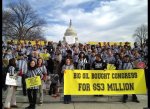
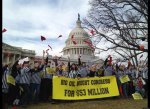
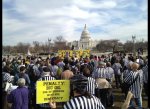
If Obama had imagined the pipeline question might be decided in the shadows of public opinion, those hopes were dashed on Sunday, when as many as 15,000 protesters peaceably encircled the White House in a line several people deep.
Most White House protests are led by a president’s opponents, but supporters led this one. Participants described their ring around the White House as a kind of political hug for Obama, less an effort to chastise him than to buck up his spirits and embolden him in the face of pressure from Big Oil and its politically powerful allies.
“What I’m hoping we’re doing is giving him the political cover to do the right thing,” explained Maryland General Assembly member Heather Mizeur. A member of the executive committee of the Democratic National Committee, Mizeur has joined a dozen other DNC members in a resolution calling on Obama to reject the pipeline.
“We are your base. We are the Democrats who elected you,” Mizeur said in an address to protesters in Lafayette Park, across the street from the White House. “We trust that you are going to listen to us. We trust that you are going to do the right thing. Reject the Keystone XL pipeline.”
For months, environmentalists have urged Obama to red light the proposed Keystone XL pipeline, which would take up to 35 million gallons a day of low-grade crude oil from the tar sands of Alberta to the refineries and ports of east Texas.
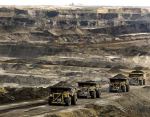
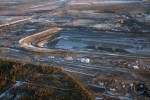
The pipeline, its environmental critics contend, would support ongoing destruction of Canada’s boreal forest, where tar sands production has already created an industrial wasteland the size of Chicago. It would further the development of tar sands crude, which generates four-and-a-half times more carbon than producing domestic U.S. crude oil. And it would put Great Plains ranchers, farmers, croplands, and waters at risk of the kinds of pipeline blowouts that have wrought disaster over the past two years to the Yellowstone River in Montana and the Kalamazoo River in Michigan.
For environmentalists, the Keystone XL has become emblematic of a suite of fossil fuel production ills that threaten the Gulf of Mexico and the Arctic ocean, site of high risk offshore oil drilling; the Appalachian mountains, where ridges are being blown apart for coal; the growing use of hydraulic fracturing to get at natural gas imbedded in shale; and, of course, Canadian tar sands.
A Populist Complexion
Oil companies command outsized influence in Washington: the industry has spent $431 million lobbying D.C. politicians in just the past three years. Speakers at Sunday’s rally alluded to the uphill battle pipeline opponents face. In the Occupy Wall Street era, though, that message appeared to add resonance to the broader appeal.
Labor leader Roger Toussaint assailed TransCanada’s claims that the pipeline would help put Americans back to work, a widely discredited contention. “We want jobs, but not jobs as gravediggers of the planet,” said Toussaint, an official with the Transport Workers Union of America, which represents subway, airline and rail employees, among others, in New York, Philadelphia, Chicago, and elsewhere.
Having secured right-of-way agreements with thousands of landowners, TransCanada has threatened to invoke eminent domain — a kind of legal power to commandeer land against an owner’s will — as a way to steamroll remaining holdouts. That has infuriated heartland Americans, many of whom can trace family tracts to the days of prairie schooners and homesteaders.
“We owe TransCanada absolutely nothing,” Nebraska rancher Bruce Boettcher told pipeline protesters at Sunday’s rally. “We the American people do not have to sacrifice our land and water to meet TransCanada’s bottom line.”
Nebraska’s state legislature is in its second week of a special session meant to address concerns that the Keystone XL, as currently routed, would cut across 300 miles of the Ogallala Aquifer, upon which the state depends for about 80 percent of its drinking and irrigation water.
“We’re not just the lone thorn in the side of TransCanada,” said Ben Gotschall, a fourth generation rancher who plans to testify against the pipeline before committee hearings in Lincoln this week. “We’re kind of the battlefield area for a nationwide fight.”
The Political Calculus
Could approving the Keystone XL leave young, progressive voters disenchanted enough with Obama to perhaps deflate the faithful he needs to win next November?
“You win elections not (just) because your hard core supporters turn out, but because they get excited and bring all their friends with them. You need some of that fire and fervor in order to get elected,” said rally organizer Bill McKibben, an OnEarth contributing editor and founder of 350.org and TarSandsAction. “If on these really big gut-check questions the president can’t bring himself to stand up to big oil, it’s going to be an awfully lot to ask.”
Maura Cowley agrees. She’s co-director of Energy Action Coalition, which includes 50 organizations representing 350,000 young Americans. If Obama green lights the pipeline, she said, opponents would “organize around every single mile” of the route in an effort to block construction.
“The president doesn’t need us spending our next year in fields in Nebraska trying to block this pipeline,” said McKibben, one of more than 1,200 activists who were arrested during anti-pipeline protests in Washington last August. “It’s hard to knock on doors for the president when your hands are cuffed behind your back.”
 Rosamond Press
Leave a comment