

Jon Presco
In the mean time Congress has postpone its decision on giving permission to Transcanada to run pipelines through several states today they agreed not to run pipelines with through the Ogallala Acaufer. While this made for a great deal of argument, according to environmenalist their remains a potential danger to the environment. Keystone XL which was proposed in 2008 has faced much critism. TransCanada argument is that Enbridge and Kinder Morgan are moving forward with their pipelines. Enbridge have plans to connect two pipelines to connect the Alberta’s oil sands to refineries in the Gulf Coast. Enbridge like Transcanada is a Canadian based company, but unlike TransCanada they already have a right of way and a section crossing the border in which make them optomistic they won’t have a problems with running their pipelines because they say they wouldn’t be subject to the State Department review. According to some though in-spite what Enbridge may think about them not having a problem with their expansions. Some would disagreed and said that if TransCanada isn’t allowed to continue expansion the Enbridge and Kinder Morgan expansion will be effected as well. Kinder Morgan are still in the early stage and will run pipe lines to Vancouver and Washington State. According to the Canadian government if Transcanada does not get the deal they are using Enbridge and Kinder Morgan for backup.
Kinder Morgan has bought out its partner in a $430 million Houston Ship Channel terminal project, the company has announced.
TransMontaigne Partners held 50 percent interest in the Battleground Oil Specialty Terminal Company, or BOSTCO, joint venture, which is slated to build 52 oil storage tanks with a total capacity of 6.6 million barrels on the Houston Ship Channel.
Kinder Morgan Energy Partners now owns 98 percent of the project, with an unnamed BOSTCO customer controlling the remaining 2 percent.
Construction began Dec. 14 on the terminal, which will handle low-grade petroleum products and residual fuel used by ship engines and industrial plants. It will begin limited operation in the third quarter of 2013. The terminal is scheduled to be fully operational in early 2014.
“The project will include one of the deepest vessel drafts in the Houston Ship Channel and position Kinder Morgan extremely well for the growing trend of exporting petroleum related products overseas,” said Kinder Morgan Terminals President Jeff Armstrong in a written statement.
HOUSTON, Jun 11, 2002 (BUSINESS WIRE) — Transocean Inc. (NYSE:RIG) today announced that Richard D. Kinder has submitted his resignation as a member of the Company’s Board of Directors to devote more attention to his duties at Kinder Morgan, Inc. and Kinder Morgan Energy Partners, L.P. Mr. Kinder’s resignation is effective immediately.
“During his seven-year tenure on the Transocean Board, Rich Kinder provided strong leadership and counsel through a period of rapid growth at our Company,” said J. Michael Talbert, Chief Executive Officer of Transocean Inc. “His exceptional business sense and knowledge of global energy markets will be missed. We wish him well in every endeavor.”
Mr. Kinder is Chairman of the Board and Chief Executive Officer of both Kinder Morgan, Inc. and Kinder Morgan Energy Partners, L.P., which own and operate diversified energy assets. He served as a Transocean Inc. director since November 1994. Transocean Inc. does not intend to fill the vacancy created by Mr. Kinder’s resignation and will operate with an 11-member Board of Directors.
Transocean Inc. is the world’s largest offshore drilling contractor with more than 150 fully or partially owned or operated mobile offshore drilling units, inland drilling barges and other assets utilized in the support of offshore drilling activities worldwide. The company’s mobile offshore drilling fleet is considered one of the most modern and versatile in the world with 31 high-specification semisubmersibles and drillships, 28 other semisubmersibles and one drillship and 54 jackup drilling rigs. Transocean Inc. specializes in technically demanding segments of the offshore drilling business, including industry-leading positions in deepwater and harsh environment drilling services. With a current equity market capitalization in excess of $10 billion, the company’s ordinary shares are traded on the New York Stock Exchange under the symbol “RIG.”
CONTACT: Transocean Inc
Keystone Pipeline
From Wikipedia, the free encyclopedia
Jump to: navigation, search
Keystone Pipeline
(Finished Phase 1)[1]
Location
Country
Canada
United States
From
Hardisty, Alberta
Passes through
Regina, Saskatchewan
Steele City, Nebraska
To
Wood River, Illinois
Patoka, Illinois (end)
General information
Type
Crude oil
Owner
TransCanada
Construction started
2008
Commissioned
June 2010
Technical information
Length
3,456 km (2,147 mi)
Maximum discharge
0.59 Mbbl/d (~2.9×10^7 t/a)
Diameter
30 in (762 mm)
Number of pumping stations
39
Cushing Extension
(Finished Phase 2)[1]
Location
Country
United States
From
Steele City, Nebraska
To
Cushing, Oklahoma
General information
Type
Crude oil
Commissioned
February 2011
Technical information
Length
480 km (300 mi)
Diameter
36 in (914 mm)
Number of pumping stations
4
Gulf Coast Expansion (XL)
(Proposed Phase 3) [1]
Location
Country
United States
From
Cushing, Oklahoma
To
Port Arthur, Texas
Houston, Texas
General information
Type
Crude oil
Expected
Unknown
Technical information
Length
700 km (430 mi)
Diameter
36 in (914 mm)
Steele City Expansion (XL)
(Proposed Phase 4)[1]
Location
Country
Canada
United States
From
Hardisty, Alberta
Passes through
Baker, Montana
To
Steele City, Nebraska
General information
Type
Crude oil
Expected
Unknown
Technical information
Length
526 km (327 mi)
Diameter
36 in (914 mm)
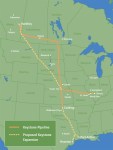
The Keystone Pipeline System is a pipeline system to transport synthetic crude oil and diluted bitumen (“dilbit”) from the Athabasca Oil Sands in northeastern Alberta, Canada to multiple destinations in the United States, which include refineries in Illinois, Cushing oil distribution hub in Oklahoma, and proposed connections to refineries along the Gulf Coast of Texas. It consists of the operational “Keystone Pipeline” (Phase 1) and “Keystone-Cushing Extension” (Phase 2), and two proposed Keystone XL pipeline expansion segments. After the Keystone XL pipeline segments are completed, American crude oil would enter the XL pipelines at Baker, Montana and Cushing, Oklahoma.[1]
The Keystone XL has faced lawsuits from oil refineries and criticism from environmentalists and some members of the United States Congress. The U.S. Department of State in 2010 extended the deadline for federal agencies to decide if the pipeline is in the national interest, and in November, 2011, President Obama postponed the decision until 2013. On November 30, Senate Republicans introduced legislation aimed at forcing the Obama administration to approve the Keystone XL pipeline within 60 days, unless the president declares the project is not in the national interest.[2]
Contents
[hide]
1 History
1.1 Keystone Pipeline
1.2 Keystone XL
2 Route
2.1 Phase 1
2.2 Phase 2
2.3 Phase 3
2.4 Phase 4
3 Description
4 Partnership
5 Lawsuits
6 Keystone XL controversies
6.1 Environmental issues
6.2 Political issues
6.3 Geopolitical issues
6.4 Economic issues
6.5 2011 protests and postponement
7 References
8 External links
[edit] History
[edit] Keystone Pipeline
TransCanada Corporation proposed the project on February 9, 2005. In October 2007, the Communications, Energy and Paperworkers Union of Canada asked the Canadian federal government to block regulatory approvals for the pipeline, with union president Dave Coles stating that ‘the Keystone pipeline will exclusively serve US markets, create permanent employment for very few Canadians, reduce our energy security, and hinder investment and job creation in the Canadian energy sector’.[3] However, the National Energy Board of Canada approved the construction of the Canadian section of the pipeline, including converting a portion of TransCanada’s Canadian Mainline gas pipeline to crude oil pipeline, on September 21, 2007.[4] On March 17, 2008, the U.S. Department of State issued a Presidential Permit authorizing the construction, maintenance and operation of facilities at the United States and Canada border.[5]
On January 22, 2008, ConocoPhillips acquired a 50% stake in the project.[6] However, on June 17, 2009, TransCanada agreed that they would buy out ConocoPhillips’ share in the project and revert to being the sole owner.[7] It took TransCanada more than two years to acquire all the necessary state and federal permits for the pipeline. Construction took another two years.[8] The pipeline became operational in June 2010.[9]
[edit] Keystone XL
The Keystone XL extension was proposed in 2008.[10] The application was filed in the beginning of 2009 and the National Energy Board of Canada started hearings in September 2009.[11] It was approved by the National Energy Board on March 11, 2010.[12] The South Dakota Public Utilities Commission granted a permit on February 19, 2010.[13]
The pipeline, however, has faced strong opposition from the environmental community. In its March 2010 report, the Natural Resources Defense Council stated that “the Keystone XL Pipeline undermines the U.S. commitment to a clean energy economy,” instead delivering dirty fuel from oil sands at high costs.[14] On June 23, 2010, 50 Democrats in Congress spoke out against the Keystone XL pipeline. In their letter to Secretary of State Hillary Clinton, they warned that “building this pipeline has the potential to undermine America’s clean energy future and international leadership on climate change.”[15][16] On June 30, 2010, TransCanada replied by saying that development of oil sands will expand regardless of whether the crude oil is exported to the United States or alternatively to Asian markets through the Enbridge Northern Gateway Pipelines or the Kinder Morgan’s Trans-Mountain line.[17]
On July 6, 2010, House Energy and Commerce Committee chairman Henry Waxman urged the State Department to block Keystone XL, saying in a letter to the department that ‘this pipeline is a multi-billion dollar investment to expand our reliance on the dirtiest source of transportation fuel currently available’.[18][19] On July 21, 2010, the Environmental Protection Agency said the draft environmental impact study for Keystone XL was inadequate and should be revised, indicating that the State Department’s original report was “unduly narrow” because it didn’t fully look at oil spill response plans, safety issues and greenhouse gas concerns.[20][21][22] The final environmental impact report was released on August 26, 2011. It stated that the pipeline would pose “no significant impacts” to most resources if environmental protection measures are followed, but it would present “significant adverse effects to certain cultural resources.”[23] However, summer/fall, 2011, protests brought the challenge to the White House, leading ultimately to the President’s November, 2011 postponement of the decision until 2013.
On November 10, 2011, TransCanada stated they have spoken with the U.S. Department of State and will have conversations to discuss next steps. TransCanada pointed out fourteen different routes for Keystone XL were being studied, eight that impacted Nebraska. They included one potential alternative route in Nebraska that would have avoided the entire Sandhills region and Ogallala aquifer and six alternatives that would have reduced pipeline mileage crossing the Sandhills or the aquifer.[24][25] On November 22, 2011, the governor of Nebraska signed two bills that enacted a compromise agreed upon with the pipeline builder to move the route, and approved up to US$2 million in state funding for an environmental study.[26] On November 30, 2011, a group of leading Republican senators introduced legislation aimed at forcing the Obama administration to make a decision on the Keystone XL pipeline within 60 days.[2] On December 13, 2011, the Republicans attached this provision on a bill that also would extend the payroll tax cut set to expire at the end of the year, despite Obama threatening to veto it.[27]
In December 2011, Congress voted to give the Obama Administration a 60-day deadline to make a decision on TransCanada’s application for the construction of the Keystone XL Pipeline.[28] On January 18, 2012, President Obama rejected the application, stating that the deadline for the decision had “prevented a full assessment of the pipeline’s impact.”[29] Legislation proposed by congressman Lee Terry would place the Federal Energy Regulatory Commission in authority over the pipeline and require the commission to approve a permit for construction within 30 days of receiving a new application if the project is deemed safe. Following the rejection by Obama, a hearing by the House Energy and Commerce Committee’s energy and power subcommittee was planned for January 25, to consider that bill.[30][31]
 Rosamond Press
Leave a comment