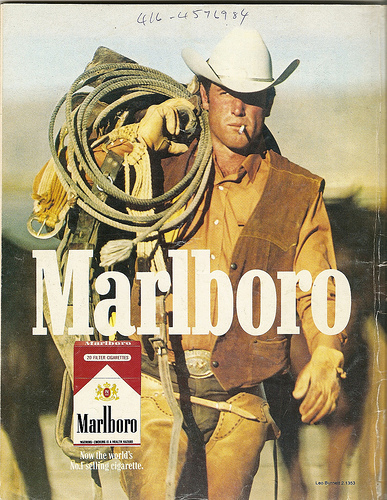
Sidewinder, Karl Rove, only pretends to like the American Cowboy. Keep this drug dealer away from your kids! Like a parasite, he gets our children addicted to nicotine, then sucks out their health and money while turning them into heavy duty tax payers. Millions of hooked Americans are paying high taxes on tobacco they would not normally pay, just for the right to smoke themsleves to death!
Jon
“Twenty-six thousand Texans will die this year from smoking-related illnesses. That’s a fact that seems lost on Governor George W. Bush, whose presidential bid is being greatly assisted by money and manpower intimately associated with the tobacco industry. And if Bush’s record in Texas is any indication, should he make it to the White House the industry can feel certain that it will have a friend in the Oval Office.
Some of Bush’s closest aides are allies of Philip Morris, including Karl Rove, the leading Republican Party campaign strategist in Texas. A close friend of Bush’s since the early seventies and Bush’s chief political adviser since the late eighties, Rove–who’s been called “the governor’s Svengali” by National Review–was formally on the payroll of Philip Morris from 1991 to 1996 as a paid political intelligence operative.
“”I was, frankly, offended by it.
I’m a huge fan of Clint Eastwood, I thought it was an extremely well-done ad, but it is a sign of what happens when you have Chicago-style politics, and the President of the United States and his political minions are, in essence, using our tax dollars to buy corporate advertising and the best-wishes of the management which is benefited by getting a bunch of our money that they’ll never pay back.”
The Nation Institute’s Investigative Fund provided research support.
.About the Author
Robert Dreyfuss
Robert Dreyfuss, a Nation contributing editor, is an investigative journalist in Alexandria, Virginia, specializing in…
Also by the Author
The United States Should Stay Out of Syria (War and Peace, World)
Backing one side in a Syrian civil war? Not a good idea.
Robert Dreyfuss The Futility of the Afghan War
Lots of killing, but no progress.
Robert Dreyfuss Related Topics
Bill Clinton Company Location Employment Change George W. Bush Governor Jack Dillard James Francis Jr. Karl Rove Karl Rove & Company National Smokers Alliance Person Career Person Communication Person Relation Philip Morris Political Relationship Republican Party Texas chief lobbyist spokesman Money, in the form of campaign contributions to Bush’s $60 million war chest, is part of the story, beginning with the $1,000 check given to Bush in June by Geoffrey Bible, president and CEO of Philip Morris. Even more important, the tobacco industry is poised once again to provide the Republican Party with millions of dollars in unregulated “soft” money, offering a significant boost to the Bush 2000 drive. But Bush’s tobacco ties reach far deeper than money; they go to the very heart of his campaign organization–a story that so far has been largely ignored in the national media’s bubbly coverage of W.’s campaign.
Some of Bush’s closest aides are allies of Philip Morris, including Karl Rove, the leading Republican Party campaign strategist in Texas. A close friend of Bush’s since the early seventies and Bush’s chief political adviser since the late eighties, Rove–who’s been called “the governor’s Svengali” by National Review–was formally on the payroll of Philip Morris from 1991 to 1996 as a paid political intelligence operative. Another close friend and adviser is James Francis Jr., whose brother has been a key figure behind several Philip Morris-backed front groups and who himself has flirted with the National Smokers Alliance, an industry-funded smokers’ rights group. And then there is former Republican National Committee chairman Haley Barbour, one of the party’s most wily and influential kingmakers, who is both an important player in Bush 2000 and arguably the number-one lobbyist for Philip Morris and the tobacco industry in Washington.
Just how much influence these men have had on Bush is impossible to measure. But Bush’s record on tobacco certainly doesn’t displease the industry: opposition to the federal lawsuit against Big Tobacco and to increased taxes on cigarettes, plus vigorous support for tort reform that limits consumers’ rights to sue makers of dangerous products–like tobacco. In Texas, Bush refused to support a lawsuit against Big Tobacco that eventually won $17 billion for the state’s treasury. Taken together, Bush’s friendships and his stance on tobacco-related issues are causing cigarette makers to salivate over the possibility of a Bush victory next year. “The prospect of Bill Clinton gone and a George Bush presidency makes the industry almost giddy,” said Martin Feldman, a tobacco industry analyst at Salomon Smith Barney, in September.
Start with Rove. Deposed in a lawsuit in Texas, Rove frankly admitted to having been a paid political consultant for Philip Morris, reporting to Jack Dillard, the tobacco giant’s ubiquitous Austin lobbyist. Beginning in 1991, Rove was paid up to $3,000 per month by Philip Morris, gathering political intelligence and gossip for the company and regularly reporting on federal, state and local political races. For five years, Rove said, he was “retained by Philip Morris in an ongoing capacity to basically advise them on elections, to give them my best feelings about what was going to happen in elections, what was shaping up in terms of candidates, political gossip [about] who was likely to get elected.” For example, he said, he would “compile a list of political or community leaders in selective legislative districts…and provide an analysis of which of those districts would be in play in the nineties.”
During this whole period, Rove–a disciple of the late Lee Atwater, a GOP strategist and former chairman of the Republican National Committee–was Bush’s political guru, operating out of his offices at Karl Rove & Company, which was also the Texas Republican Party’s chief fundraising and direct-mail firm. While Rove worked for Philip Morris, he was also assembling W.’s 1994 campaign for governor. Then, until separating himself from the cigarette maker in 1996, Rove spent two years simultaneously advising the sitting Governor on politics and policy and serving Philip Morris. One of the issues that Rove helped shape for Bush was tort reform, which was a central part of Bush’s ’94 campaign and then a major, and successful, legislative priority in 1995. Tort reform just happened to have been one of the tobacco industry’s highest priorities since the start of the wave of class-action lawsuits, individual suits and state-backed litigation against the industry.
Dillard, Rove’s paymaster, was a moving force in the Texas tort reform movement, serving on the board of directors of the Texas Civil Justice League (TCJL) and the Texas Association of Business and Chambers of Commerce (TABCC), two of the state’s three organizations devoted to pushing tort reform. (The third group, Texans for Lawsuit Reform, has its own Philip Morris connections, as we shall see.) Dillard, though mostly staying behind the scenes, was closely involved in the details of the tort reform effort and the business community’s response to antitobacco lawsuits; for instance, in a handwritten memo to the head of the TCJL–obtained by a group opposed to tort reform and released to the media–Dillard prods the tort reform group to soften a proposed response to Democratic Attorney General Dan Morales’s lawsuit against the industry, noting that the draft is “way too strong and personal in its approach,” adding, “it would have to be toned down. Therefore I am sending you the revised version…which is much less highly charged.”
 Rosamond Press
Leave a comment